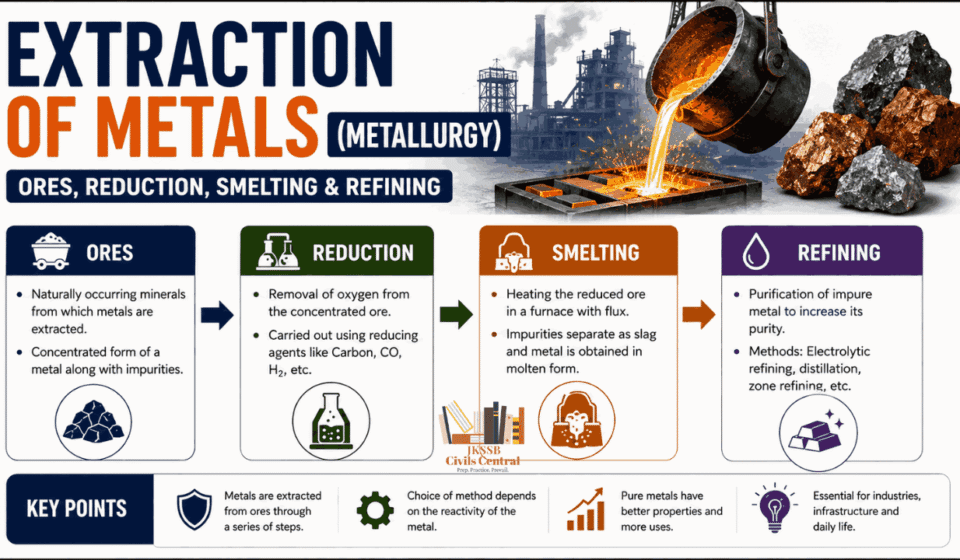
Extraction of Metals (Metallurgy) | Ores, Reduction, Smelting & Refining

Understand the principles of metallurgy, occurrence of metals, minerals and ores, concentration of ores, extraction techniques, roasting, calcination, reduction, smelting, refining, thermite process, and environmental aspects of metal extraction for JKSSB, JKPSC, SSC, UPSC & State PSC examinations.
Learning Dashboard
| Chapter Information | Details |
|---|---|
| Subject | General Science – Chemistry |
| Series | Metals and Non-Metals |
| Lesson Number | Lesson 8 |
| Previous Lesson | Alloys and Their Uses | Types, Composition, Properties & Applications |
| Current Lesson & Final Chapter | Extraction of Metals (Metallurgy) | Ores, Reduction, Smelting & Refining |
| Core Theme | Metals are generally found in nature as compounds. Metallurgy is the science of extracting these metals from their ores and refining them into pure forms for industrial and commercial use. |
| Major Topics Covered | Metallurgy, Minerals, Ores, Difference between Minerals and Ores, Concentration of Ores, Calcination, Roasting, Reduction, Smelting, Flux, Slag, Extraction Based on Reactivity Series, Electrolytic Reduction, Refining of Metals, Electrolytic Refining, Thermite Process, Environmental Impact |
| Important Metals Studied | Iron, Aluminium, Copper, Zinc, Lead, Silver, Gold, Sodium, Potassium |
| Key Concepts | Metallurgy, Ore, Mineral, Gangue, Flux, Slag, Roasting, Calcination, Reduction, Electrolysis, Refining |
| Real-Life Applications | Steel Industry, Aluminium Industry, Mining, Electrical Industries, Construction, Transportation, Manufacturing, Jewellery |
| Exam Focus | Frequently Asked in JKSSB FAA, JKPSC, JKAS, SSC, CDS, UPSC & State PSC Examinations |
Chapter Overview
In the previous lessons, we studied the physical and chemical properties of metals, the reactivity series, corrosion, and alloys. We learned that metals are indispensable in modern life because of their strength, durability, conductivity, and versatility. However, an important question still remains: Where do these metals come from, and how are they obtained?
Most metals are not found in nature in their pure metallic form. Instead, they occur naturally as compounds combined with oxygen, sulphur, carbonates, chlorides, or other elements. These naturally occurring compounds must undergo a series of scientific and industrial processes before pure metals can be obtained.
The branch of science and engineering that deals with the extraction of metals from their ores and their purification is known as metallurgy. Metallurgy plays a vital role in modern civilization because almost every industry—including construction, transportation, power generation, electronics, aerospace, medicine, and manufacturing—depends on the continuous production of pure metals.
The extraction of metals is not the same for every element. Highly reactive metals such as sodium, potassium, and aluminium require extraction by electrolysis, whereas moderately reactive metals like iron and zinc are extracted by chemical reduction using carbon or carbon monoxide. Less reactive metals such as silver and gold are comparatively easier to obtain because they may occur in the native state or require simpler extraction methods.
Throughout this lesson, we will study minerals and ores, understand the steps involved in metallurgy, learn the processes of concentration, calcination, roasting, reduction, smelting, and refining, and explore important industrial techniques such as electrolytic refining and the thermite process. We will also discuss the environmental challenges associated with metal extraction and the need for sustainable mining and recycling.
Since metallurgy is one of the most important and frequently tested topics in JKSSB FAA, JKPSC, JKAS, SSC, CDS, UPSC, and other State PSC examinations, mastering this lesson will provide a comprehensive understanding of how metals are produced and why different extraction methods are used for different metals.
What is Metallurgy?
From ancient civilizations to the modern technological world, metals have played a vital role in human development. Buildings, bridges, vehicles, machinery, electrical appliances, medical instruments, and countless everyday objects are made from metals. However, these metals are rarely found in nature in their pure form. Instead, they usually occur combined with other elements as naturally occurring compounds. Therefore, before metals can be used, they must be extracted and purified through carefully controlled scientific processes.
The branch of science that deals with these processes is known as metallurgy. Metallurgy combines the principles of chemistry, physics, geology, and engineering to convert naturally occurring mineral resources into useful metallic products.
Definition of Metallurgy
Metallurgy is the science and technology of extracting metals from their ores, purifying them, and preparing them for practical use.
It includes every stage involved in converting an ore into a pure metal, from mining and concentration to extraction, refining, and processing.
Why is Metallurgy Necessary?
Most metals occur in nature as compounds such as:
- Oxides
- Sulphides
- Carbonates
- Chlorides
These compounds cannot be used directly because they do not possess the properties of pure metals.
Metallurgy is therefore necessary to:
- Extract metals from their ores.
- Remove unwanted impurities.
- Produce pure metals suitable for industrial use.
- Improve the quality of metals for manufacturing.
- Supply metals required for modern technology and infrastructure.
Without metallurgy, industries would not have access to the metals needed for construction, transportation, communication, medicine, and engineering.
Objectives of Metallurgy
The primary objectives of metallurgy are:
- To extract metals economically from their ores.
- To obtain metals with high purity.
- To reduce the loss of valuable metals during extraction.
- To improve the efficiency of extraction processes.
- To produce metals suitable for different industrial applications.
- To minimize environmental pollution during metal extraction.
Modern metallurgy also emphasizes sustainable mining and the recycling of metals to conserve natural resources.
Major Stages of Metallurgy
The extraction of metals generally involves several successive stages. These include:
- Mining – Obtaining the ore from the earth.
- Crushing and Grinding – Breaking the ore into smaller particles.
- Concentration (Beneficiation) of Ore – Removing unwanted impurities.
- Extraction of Metal – Obtaining crude metal from the concentrated ore.
- Refining (Purification) – Producing pure metal suitable for industrial use.
Each stage plays an important role in ensuring efficient and economical metal production.
Importance of Metallurgy
Metallurgy is one of the most important branches of applied science because it supports almost every sector of the economy. Its importance includes:
- Production of construction materials.
- Manufacture of machines and vehicles.
- Development of electrical and electronic industries.
- Production of medical and surgical equipment.
- Growth of aerospace and defence industries.
- Supply of metals for renewable energy technologies.
- Conservation of natural resources through recycling.
Thus, metallurgy forms the foundation of modern industrial development.
Examples of Metals Produced by Metallurgy
Many important metals are obtained through metallurgical processes. Examples include:
- Iron
- Aluminium
- Copper
- Zinc
- Lead
- Nickel
- Tin
- Silver
- Gold
Each metal requires a different extraction method depending on its chemical reactivity and the nature of its ore.
Metallurgy and the Reactivity Series
The method used to extract a metal depends largely on its position in the reactivity series.
- Highly reactive metals such as sodium, potassium, calcium, magnesium, and aluminium are extracted mainly by electrolysis.
- Moderately reactive metals such as zinc, iron, lead, and copper are generally extracted by chemical reduction using carbon or carbon monoxide.
- Less reactive metals such as silver, gold, and platinum may occur in the native state or require comparatively simple extraction methods.
Therefore, understanding the reactivity series is essential for understanding metallurgy.
Everyday Importance of Metallurgy
Everyday life depends heavily on metallurgy. It provides the metals used in:
- Buildings and bridges.
- Railway tracks.
- Automobiles and aircraft.
- Mobile phones and computers.
- Electric wires and transmission lines.
- Kitchen utensils.
- Agricultural machinery.
- Coins and jewellery.
Virtually every manufactured product contains metals that have been produced through metallurgical processes.
Exam Tip
Remember these high-scoring facts:
- Metallurgy is the science of extracting metals from their ores and refining them.
- Most metals occur in nature as compounds rather than in the free state.
- The major stages of metallurgy are mining, concentration, extraction, and refining.
- The extraction method depends on the position of the metal in the reactivity series.
- Highly reactive metals are extracted by electrolysis.
- Moderately reactive metals are extracted by chemical reduction.
- Less reactive metals are comparatively easier to obtain.
Understanding the concept of metallurgy provides the foundation for studying minerals and ores, where we will learn the difference between these two terms and why only certain naturally occurring minerals are suitable for the economical extraction of metals.
Minerals and Ores
Before a metal can be extracted, it must first be located within the Earth’s crust. However, nature does not store metals in neatly separated blocks ready for human use. Over millions of years, geological processes have caused metals to combine with oxygen, sulphur, carbon dioxide, silica, chlorine, and many other elements. As a result, most metals exist as naturally occurring compounds rather than in their pure metallic state.
This naturally raises an important question: If metals are present in the Earth’s crust, why can’t they be used directly after mining?
The answer lies in their chemical form. The substances obtained during mining usually contain the desired metal mixed with large quantities of rock, sand, clay, and other unwanted materials. Moreover, the metal itself is generally present in the form of stable compounds such as oxides, sulphides, carbonates, or chlorides. These compounds must undergo a series of metallurgical processes before pure metal can be obtained.
To understand this extraction process, it is essential to distinguish between two fundamental terms in metallurgy—minerals and ores. Although these terms are often used interchangeably in everyday language, they have distinct scientific meanings.
What are Minerals?
A mineral is a naturally occurring inorganic substance found in the Earth’s crust that contains one or more metals or other valuable elements in the form of chemical compounds. Minerals are formed through natural geological processes over millions of years. They constitute the Earth’s natural storehouse of metals and are found in rocks, mountains, riverbeds, and underground deposits. Some minerals contain high concentrations of metals, while others contain only small amounts.
For example, iron occurs in minerals such as haematite, magnetite, limonite, and siderite. Similarly, aluminium is found in minerals like bauxite, cryolite, and feldspar. Although all these substances are minerals, they are not equally suitable for the commercial extraction of metals.
What are Ores?
An ore is a mineral from which a metal can be extracted economically and conveniently using available metallurgical processes. In other words, every ore contains a useful quantity of metal, making its extraction commercially profitable. The selection of an ore depends not only on the percentage of metal it contains but also on factors such as mining costs, availability of extraction technology, energy requirements, transportation, and environmental considerations.
Thus, the concept of an ore is based on economic feasibility as well as scientific possibility.
Relationship Between Minerals and Ores
One of the most important principles in metallurgy is the relationship between minerals and ores. Every ore is a mineral because it occurs naturally and contains a metal. However, every mineral is not an ore because many minerals either contain too little metal or require extraction methods that are too expensive to be commercially viable.
This distinction explains why only a limited number of naturally occurring minerals are exploited on an industrial scale.
Examples of Minerals and Ores
The difference between minerals and ores becomes clearer through examples. Iron is found in several minerals, including haematite (Fe₂O₃), magnetite (Fe₃O₄), limonite (Fe₂O₃·xH₂O), and siderite (FeCO₃). Among these, haematite and magnetite are the principal ores of iron because they contain a high percentage of iron and can be processed economically.
Similarly, aluminium occurs in several minerals, but bauxite (Al₂O₃·2H₂O) is regarded as its chief ore because it contains a high concentration of aluminium oxide and is comparatively easy to process. Copper is extracted mainly from copper pyrites (CuFeS₂), while zinc is commonly obtained from zinc blende (ZnS) and calamine (ZnCO₃).
These examples illustrate that although many minerals contain the same metal, only a few qualify as commercially important ores.
Characteristics of a Good Ore
Not every mineral deposit is suitable for mining. A good ore should possess certain desirable characteristics. A good ore:
- Contains a high percentage of the desired metal.
- Is available in large quantities.
- Can be mined economically.
- Allows easy extraction of the metal.
- Requires minimum expenditure on processing.
- Produces limited environmental damage during extraction.
These characteristics determine whether a mineral deposit can be developed into a profitable mining project.
Importance of Minerals and Ores
Minerals and ores form the foundation of the mining and metallurgical industries. They provide the raw materials required for producing metals used in:
- Construction and infrastructure.
- Transportation and automobiles.
- Electrical and electronic industries.
- Aerospace and defence.
- Medical equipment.
- Household appliances.
- Machinery and manufacturing.
Without economically viable ores, the large-scale production of metals would not be possible.
Common Ores of Important Metals
| Metal | Chief Ore | Chemical Formula |
|---|---|---|
| Aluminium | Bauxite | Al₂O₃·2H₂O |
| Iron | Haematite | Fe₂O₃ |
| Iron | Magnetite | Fe₃O₄ |
| Copper | Copper Pyrites | CuFeS₂ |
| Zinc | Zinc Blende | ZnS |
| Zinc | Calamine | ZnCO₃ |
| Lead | Galena | PbS |
| Mercury | Cinnabar | HgS |
Exam Tip
Students often confuse minerals and ores, but remembering one simple rule eliminates this confusion:
Every ore is a mineral, but every mineral is not an ore. Also remember these important facts:
- Minerals are naturally occurring compounds containing metals.
- Ores are minerals from which metals can be extracted economically.
- The choice of an ore depends on metal content, ease of extraction, cost, and commercial feasibility.
- Bauxite is the chief ore of aluminium.
- Haematite is the chief ore of iron.
- Copper pyrites is an important ore of copper.
- Galena is the chief ore of lead.
- Cinnabar is the chief ore of mercury.
Understanding minerals and ores provides the starting point for metallurgy because every extraction process begins with selecting the appropriate ore. Once a suitable ore has been identified and mined, the next challenge is to remove the unwanted impurities present in it. This leads us to the next important stage of metallurgy—Concentration (Beneficiation) of Ores.
Concentration (Beneficiation) of Ores
After an ore has been identified and extracted from the Earth through mining, it is still not ready for the extraction of the metal. A freshly mined ore contains not only the desired metal compound but also a large quantity of unwanted materials such as sand, clay, rock fragments, silica, and other earthy impurities. If these impurities are not removed before extraction, they increase the cost of processing, consume more fuel, reduce the efficiency of extraction, and lower the purity of the metal obtained.
This naturally raises another important question: Why is the metal not extracted directly from the mined ore?
The answer lies in the composition of the ore itself. In most cases, the percentage of the desired metal present in the raw ore is comparatively low. Processing such an ore directly would be both technically difficult and economically wasteful. Therefore, before the actual extraction begins, the ore is first purified by removing as much of the unwanted material as possible. This preliminary purification is known as concentration of ore or beneficiation of ore.
Concentration is one of the most important stages in metallurgy because it increases the percentage of the desired metal in the ore and makes the subsequent extraction process faster, cheaper, and more efficient.
What is Concentration of Ore?
Concentration of ore is the process of removing unwanted impurities (gangue) from the ore to increase the percentage of the desired metal before extraction. The process improves the quality of the ore by separating the valuable mineral particles from the worthless materials associated with them.
The concentrated ore obtained after this process is called the concentrate, which is then sent for further metallurgical treatment.
What is Gangue?
The unwanted earthy and rocky materials associated with an ore are collectively known as gangue or matrix. Gangue may consist of substances such as:
- Sand
- Clay
- Silica
- Limestone
- Soil
- Other rocky materials
These impurities have no commercial value in the extraction of the metal and therefore must be removed before further processing.
Why is Concentration Necessary?
The concentration of ore is not merely a cleaning process; it is an essential industrial operation that determines the efficiency of the entire metallurgical process. Removing gangue offers several important advantages.
Firstly, it increases the percentage of the desired metal in the ore, making extraction more economical.
Secondly, it reduces the amount of material that must be heated during extraction, thereby saving fuel and energy.
Thirdly, the removal of impurities improves the efficiency of chemical reactions occurring during roasting, calcination, reduction, and smelting.
Finally, concentrated ores produce metals of higher purity and reduce the cost of refining. Thus, concentration improves both the technical efficiency and the economic viability of metallurgy.
Methods of Concentration of Ores
The method used for concentration depends upon the physical and chemical properties of the ore and the gangue. Since different ores possess different characteristics, no single method is suitable for all ores. The most commonly used methods are:
- Hydraulic Washing (Gravity Separation)
- Magnetic Separation
- Froth Flotation
- Leaching
Each method is based on a different scientific principle and is suitable for specific types of ores.
Hydraulic Washing (Gravity Separation)
Hydraulic washing is one of the simplest methods used for concentrating heavy ores. It is based on the difference in the densities of the ore particles and the gangue. The crushed ore is washed with a stream of water flowing over a sloping surface. Since the ore particles are heavier, they settle down, while the lighter impurities are carried away by the flowing water. This method is mainly used for oxide ores and native ores having a much higher density than their impurities.
Magnetic Separation
Magnetic separation is used when either the ore or the gangue possesses magnetic properties. The crushed ore is passed over a moving conveyor belt beneath a powerful magnet. Magnetic particles are attracted by the magnet, whereas non-magnetic particles fall away separately. This method is particularly useful for separating magnetic iron ores from non-magnetic impurities.
Froth Flotation Process
Froth flotation is the most important method used for concentrating sulphide ores. In this process, the powdered ore is mixed with water to form a slurry. Small quantities of pine oil or other frothing agents are added, and air is blown through the mixture.
The sulphide ore particles become attached to the air bubbles and rise to the surface as froth, while the gangue remains in the water. The froth is then collected, dried, and used for further extraction. This method is widely employed in the concentration of ores of copper, lead, and zinc.
Leaching
Leaching is a chemical method of concentration. In this process, the powdered ore is treated with a suitable chemical reagent that dissolves the desired metal compound without affecting the impurities. The dissolved metal compound is then recovered from the solution by suitable chemical reactions. Leaching is commonly used for the extraction of metals such as aluminium from bauxite and gold from low-grade ores.
Choosing the Appropriate Method
The selection of a concentration method depends upon several factors, including:
- The nature of the ore.
- The physical properties of the ore and gangue.
- The chemical behaviour of the ore.
- Economic considerations.
- Industrial feasibility.
Therefore, metallurgists carefully analyse the characteristics of an ore before selecting the most suitable concentration technique.
Importance of Ore Concentration
The concentration of ore is one of the most critical operations in metallurgy because it:
- Increases the metal content of the ore.
- Removes gangue efficiently.
- Reduces fuel consumption.
- Improves extraction efficiency.
- Produces purer metals.
- Reduces the overall cost of metal production.
Without concentration, large-scale extraction of metals would be uneconomical and inefficient.
Exam Tip
For competitive examinations, students should remember the following high-yield facts:
- Concentration (Beneficiation) of ore is the removal of gangue before extraction.
- Gangue refers to unwanted impurities such as sand, clay, and silica.
- Hydraulic washing is based on the difference in density.
- Magnetic separation is based on the difference in magnetic properties.
- Froth flotation is mainly used for sulphide ores.
- Leaching is based on the selective dissolution of the ore in a suitable reagent.
- The main purpose of concentration is to increase the percentage of metal and improve the efficiency of extraction.
The concentration of ore prepares the raw material for the next stage of metallurgy. Once the unwanted impurities have been removed, the concentrated ore undergoes thermal treatment to convert it into a form suitable for reduction. Depending on the nature of the ore, this treatment is carried out by either calcination or roasting, which are the next important processes in the extraction of metals.
Calcination
After the ore has been concentrated, the next challenge is to prepare it for the actual extraction of the metal. At this stage, the concentrated ore still exists as a stable chemical compound, and extracting the metal directly from it is often difficult. Metallurgists therefore subject the ore to a preliminary heat treatment that alters its chemical composition and makes the subsequent reduction process much easier.
The nature of this heat treatment depends on the type of ore being processed. Carbonate ores and hydrated ores are generally treated by a process known as calcination, while sulphide ores are usually treated by roasting. Understanding why these two different methods are required is one of the key concepts in metallurgy.
Calcination is not merely a heating process. It is a carefully controlled chemical operation designed to remove volatile substances such as moisture and carbon dioxide, convert the ore into a metal oxide, and improve the efficiency of the extraction process that follows.
What is Calcination?
Calcination is the process of heating a concentrated carbonate or hydrated ore strongly in the absence or limited supply of air below its melting point to remove volatile impurities and convert it into the corresponding metal oxide.
During calcination, the ore does not melt. Instead, heat causes the decomposition of the ore, releasing gases such as carbon dioxide (CO₂) and water vapour (H₂O) while leaving behind a porous metal oxide. This metal oxide is much easier to reduce to the pure metal in the subsequent stages of metallurgy.
Why is Calcination Necessary?
The need for calcination arises because many naturally occurring ores contain substances that interfere with the extraction of metals. Carbonate ores contain carbon dioxide, while hydrated ores contain chemically combined water. These substances increase the weight of the ore without contributing to the production of the metal.
By removing these volatile components before reduction, calcination simplifies the extraction process and improves its efficiency. The process also converts chemically stable carbonate ores into metal oxides, which are much easier to reduce using carbon or other reducing agents.
Another important advantage is that calcination makes the ore porous. The porous structure allows reducing agents to penetrate the ore more easily, resulting in faster and more complete reduction during later stages.
Chemical Changes During Calcination
The principal chemical change during calcination is the decomposition of the ore due to strong heating. For example, when calamine (zinc carbonate) is heated, it decomposes to form zinc oxide and carbon dioxide.
ZnCO₃ → ZnO + CO₂
Similarly, when limestone (calcium carbonate) is heated, it decomposes into calcium oxide and carbon dioxide.
CaCO₃ → CaO + CO₂
Hydrated ores behave in a similar manner. On heating, they lose their chemically combined water and are converted into the corresponding metal oxide. Thus, the primary purpose of calcination is to transform carbonate and hydrated ores into oxides that can be reduced more easily.
Characteristics of Calcination
Several characteristic changes occur during calcination. The ore loses moisture and volatile substances. Carbon dioxide is expelled from carbonate ores. Hydrated ores lose their water of crystallization or chemically combined water. The ore becomes lighter, more porous, and chemically more suitable for reduction. These changes significantly improve the efficiency of the subsequent metallurgical operations.
Ores Suitable for Calcination
Calcination is mainly employed for:
- Carbonate ores.
- Hydrated oxide ores.
It is not suitable for sulphide ores, as these are treated by roasting in the presence of excess air. The choice between calcination and roasting therefore depends entirely on the chemical nature of the ore.
Industrial Importance of Calcination
Calcination is an essential step in many metallurgical industries because it prepares ores for efficient reduction. Without calcination, carbonate ores would require much more energy during reduction, and the presence of carbon dioxide or moisture would reduce the overall efficiency of metal extraction.
By converting ores into porous oxides, calcination reduces fuel consumption, improves the yield of metals, and lowers production costs. This process is therefore widely used in the extraction of metals such as zinc, lead, and several other metals obtained from carbonate or hydrated ores.
Difference Between Calcination and Roasting
Students often confuse calcination with roasting because both involve heating ores. However, their objectives and conditions are quite different.
| Calcination | Roasting |
|---|---|
| Carried out in the absence or limited supply of air | Carried out in the presence of excess air |
| Used mainly for carbonate and hydrated ores | Used mainly for sulphide ores |
| Removes moisture and carbon dioxide | Removes sulphur by converting it into sulphur dioxide |
| Produces metal oxides | Also produces metal oxides but through oxidation |
Remembering these differences is important because they are frequently tested in competitive examinations.
Exam Tip
For examination purposes, remember these key facts:
- Calcination is the strong heating of carbonate or hydrated ores in the absence or limited supply of air.
- Its main purpose is to remove moisture and carbon dioxide and convert the ore into a metal oxide.
- Carbonate ores undergo calcination.
- The ore becomes porous, making reduction easier.
- Calcination is not used for sulphide ores.
- Roasting is carried out for sulphide ores in the presence of excess air.
Calcination prepares the concentrated ore for the next major stage of metallurgy. However, not all ores are carbonates or hydrated compounds. Many important metals such as copper, zinc, and lead occur naturally as sulphide ores, which require a different type of heat treatment. This process is known as roasting, and it forms the next important step in the extraction of metals.
Roasting
Not all ores respond to heat in the same manner. While carbonate and hydrated ores can be converted into metal oxides simply by removing carbon dioxide or water, sulphide ores present an entirely different challenge. Many economically important metals, including copper, zinc, lead, and mercury, occur naturally as sulphides, where the metal is firmly bonded with sulphur. These compounds are chemically stable and cannot be reduced efficiently without first removing the sulphur present in them.
The presence of sulphur creates two major difficulties. Firstly, sulphide ores are more resistant to direct reduction than metal oxides, making the extraction process energy-intensive. Secondly, if sulphur remains in the ore during extraction, it lowers the quality of the metal obtained and interferes with subsequent metallurgical operations. Before the metal can be extracted, the sulphide ore must therefore be converted into a metal oxide, which is much easier to reduce.
To accomplish this transformation, metallurgists employ an important thermal process known as roasting. It is one of the most widely used operations in extractive metallurgy because it not only prepares the ore for reduction but also removes sulphur and several other volatile impurities. By converting sulphide ores into oxides, roasting makes the extraction of metals faster, more efficient, and economically viable.
What is Roasting?
Roasting is the process of strongly heating a concentrated sulphide ore in the presence of excess air or oxygen below its melting point so that it is converted into the corresponding metal oxide while sulphur is removed as sulphur dioxide (SO₂).
Unlike calcination, which is carried out in the absence or limited supply of air, roasting requires a continuous supply of oxygen because the process is essentially an oxidation reaction. Oxygen reacts with the sulphur present in the ore, converting it into sulphur dioxide gas, while the metal combines with oxygen to form its oxide.
The metal oxide produced during roasting serves as the intermediate compound from which the pure metal is finally obtained through reduction.
Why is Roasting Necessary?
The importance of roasting lies in its ability to transform chemically stable sulphide ores into compounds that are much easier to process. Direct reduction of sulphide ores is generally difficult because sulphides are stable and do not readily give up the metal. By converting them into metal oxides, roasting simplifies the subsequent reduction process and improves the overall efficiency of metal extraction.
Roasting also performs an important purification function. During heating, impurities such as sulphur, arsenic, phosphorus, and other volatile substances are oxidized and removed from the ore. This improves the quality of the ore before it enters the reduction stage and ultimately results in the production of purer metals.
Thus, roasting is both a chemical conversion process and a preliminary purification process, making it an indispensable step in the extraction of many important metals.
Chemical Changes During Roasting
The principal chemical change occurring during roasting is oxidation. When the sulphide ore is heated in the presence of oxygen, the sulphur combines readily with oxygen to form sulphur dioxide gas, while the metal is converted into its oxide. For example, the roasting of zinc blende (ZnS) takes place according to the following reaction:
2ZnS + 3O₂ → 2ZnO + 2SO₂
Similarly, galena (PbS) is converted into lead oxide during roasting, while cinnabar (HgS) produces mercury oxide before the final extraction of mercury. Complex sulphide ores such as copper pyrites (CuFeS₂) undergo a series of oxidation reactions that ultimately convert the sulphides into their corresponding oxides.
Although the reactions differ from one ore to another, the underlying principle remains the same—the sulphide is transformed into an oxide by oxidation.
Changes that Occur During Roasting
Several important physical and chemical changes take place simultaneously during roasting. The sulphide ore is converted into a metal oxide, making it suitable for reduction. Sulphur is removed in the form of sulphur dioxide gas, while several volatile impurities such as arsenic and phosphorus are also oxidized and eliminated. These transformations improve both the purity of the ore and the efficiency of the extraction process that follows.
As a result, the roasted ore becomes much more suitable for obtaining the pure metal.
Ores that Undergo Roasting
Roasting is specifically used for sulphide ores because these ores require oxidation before reduction can be carried out effectively. Some of the most important sulphide ores treated by roasting include:
- Zinc Blende (ZnS) – Ore of Zinc
- Copper Pyrites (CuFeS₂) – Ore of Copper
- Galena (PbS) – Ore of Lead
- Cinnabar (HgS) – Ore of Mercury
These ores are first roasted to convert them into oxides before the actual extraction of the metal begins.
Industrial Importance of Roasting
Roasting occupies a central position in modern metallurgy because many commercially important metals are extracted from sulphide ores. Without converting these ores into oxides, large-scale metal extraction would become inefficient and economically expensive.
Another important feature of roasting is that the sulphur dioxide produced during the process is not always treated as waste. In modern metallurgical industries, this gas is collected and converted into sulphuric acid, one of the most extensively manufactured industrial chemicals in the world. This not only reduces environmental pollution but also adds economic value to the extraction process by producing another commercially important product.
Difference Between Calcination and Roasting
Although both calcination and roasting involve the strong heating of ores, they differ in their purpose, the type of ore treated, and the conditions under which heating is carried out.
| Calcination | Roasting |
|---|---|
| Used mainly for carbonate and hydrated ores | Used mainly for sulphide ores |
| Performed in the absence or limited supply of air | Performed in the presence of excess air |
| Removes moisture and carbon dioxide | Removes sulphur as sulphur dioxide |
| Converts carbonates into metal oxides | Converts sulphides into metal oxides through oxidation |
A clear understanding of these differences is essential because comparison-based questions are frequently asked in competitive examinations.
Environmental Impact of Roasting
Like many industrial processes, roasting has important environmental implications. The sulphur dioxide released during roasting is a major atmospheric pollutant. If allowed to escape unchecked, it reacts with moisture in the atmosphere to form acidic compounds, contributing to acid rain. Acid rain damages forests, crops, lakes, rivers, buildings, and historical monuments while also affecting soil quality and aquatic life.
To minimize these harmful effects, modern metallurgical industries install pollution-control systems that capture sulphur dioxide before it is released into the atmosphere. The captured gas is then used in the manufacture of sulphuric acid, converting a potential pollutant into a valuable industrial resource. This approach not only protects the environment but also improves the overall efficiency and sustainability of metallurgical operations.
Exam Tip
For competitive examinations, remember these important facts:
- Roasting is the strong heating of sulphide ores in the presence of excess air or oxygen.
- Its primary purpose is to convert sulphide ores into metal oxides.
- Sulphur is removed as sulphur dioxide (SO₂).
- Roasting is mainly used for zinc blende, copper pyrites, galena, and cinnabar.
- Calcination is carried out in limited air, whereas roasting requires excess air.
- Sulphur dioxide produced during roasting is used in the manufacture of sulphuric acid.
The metal oxide obtained after roasting is now in a form from which the metal can be extracted much more easily. The next major stage in metallurgy is reduction, where oxygen is removed from the metal oxide using suitable reducing agents or electricity to produce the pure metal.
Reduction of Metal Oxides
The ultimate objective of every metallurgical process is to obtain the pure metal from its naturally occurring compounds. By the time an ore reaches this stage, it has already undergone concentration and, wherever necessary, thermal treatment through calcination or roasting. These processes remove unwanted impurities and convert the ore into a metal oxide. Yet, the metal is still chemically bonded to oxygen and cannot be used in this form.
This raises the most important question in metallurgy: How is the oxygen removed from the metal oxide to obtain the free metal?
The answer lies in the process of reduction. Reduction is the heart of extractive metallurgy because it transforms the metal from its combined state into its elemental form. The method adopted for reduction depends largely on the reactivity of the metal. Highly reactive metals require electrical energy for extraction, whereas moderately reactive metals can be obtained by using chemical reducing agents such as carbon or carbon monoxide.
Understanding reduction is therefore essential because it explains why different metals require different extraction techniques despite undergoing similar preliminary treatments.
What is Reduction?
Reduction is the process of removing oxygen from a metal oxide to obtain the free metal. In metallurgy, reduction is carried out by supplying a substance that has a greater affinity for oxygen than the metal itself. This substance combines with the oxygen present in the metal oxide, leaving behind the pure metal.
The substance responsible for removing oxygen is called a reducing agent.
Why is Reduction Necessary?
Most metals occur in nature as stable compounds because they readily combine with oxygen. During roasting or calcination, these compounds are generally converted into metal oxides, but the oxygen still remains chemically attached to the metal. Since metals in the oxide form cannot be used directly for manufacturing or industrial purposes, oxygen must be removed. Reduction accomplishes this by breaking the bond between the metal and oxygen, thereby producing the free metal required for practical applications.
Without reduction, metallurgy would stop at the oxide stage, and no usable metal could be obtained.
Reducing Agents Used in Metallurgy
The choice of reducing agent depends upon the position of the metal in the reactivity series. For many moderately reactive metals such as iron, zinc, and lead, the most common reducing agents are carbon and carbon monoxide. These substances readily combine with oxygen to form carbon dioxide, leaving the metal behind.
For example, the extraction of iron from iron(III) oxide takes place according to the following reaction:
Fe₂O₃ + 3CO → 2Fe + 3CO₂
Similarly, zinc oxide can be reduced using carbon:
ZnO + C → Zn + CO
In both reactions, carbon or carbon monoxide removes oxygen from the metal oxide and is therefore described as the reducing agent.
Reduction Based on the Reactivity Series
Not all metal oxides can be reduced using carbon. The extraction method depends on how strongly a metal is bonded to oxygen.
Highly Reactive Metals
Metals such as potassium, sodium, calcium, magnesium, and aluminium have a very high affinity for oxygen. Their oxides are extremely stable and cannot be reduced by carbon. These metals are extracted by electrolytic reduction, in which electric current breaks down the molten compound and releases the metal.
Moderately Reactive Metals
Metals such as zinc, iron, lead, and copper have a lower affinity for oxygen than carbon.
Their oxides can therefore be reduced chemically using:
- Carbon
- Carbon monoxide
This is one of the most economical methods of extracting metals on an industrial scale.
Less Reactive Metals
Metals such as silver, gold, and platinum occur either in the native state or as compounds that can be reduced relatively easily. Their extraction requires comparatively simpler methods because these metals have a much weaker tendency to combine with oxygen.
Importance of Carbon in Reduction
Carbon occupies a special position in metallurgy because it is inexpensive, readily available, and possesses a strong affinity for oxygen. At high temperatures, carbon removes oxygen from many metal oxides by forming carbon monoxide or carbon dioxide. This property makes carbon one of the most widely used reducing agents in industries involved in the extraction of iron, zinc, lead, and several other metals. The widespread availability of coal and coke has also made carbon-based reduction economically attractive for large-scale production.
Factors Affecting Reduction
The success of reduction depends on several factors. The most important among them are:
- The position of the metal in the reactivity series.
- The stability of the metal oxide.
- The nature of the reducing agent.
- The temperature at which reduction is carried out.
- The purity of the ore.
Metallurgists carefully control these factors to maximize the yield and purity of the extracted metal.
Industrial Importance of Reduction
Reduction is the stage at which the actual metal is obtained. Every major metallurgical industry—including the production of iron, zinc, copper, and lead—depends upon efficient reduction processes.
The quality of the reducing agent, temperature control, and purity of the ore directly influence the quantity and quality of the metal produced. Consequently, improvements in reduction technology have played a major role in the growth of modern industries.
Reduction vs Oxidation
Students often confuse oxidation and reduction because both occur together in many metallurgical reactions.
| Reduction | Oxidation |
|---|---|
| Removal of oxygen | Addition of oxygen |
| Gain of electrons | Loss of electrons |
| Produces free metal from metal oxide | Forms metal oxides |
| Occurs during extraction of metals | Occurs during roasting and corrosion |
Remember that in metallurgy, the principal objective is reduction, because it produces the usable metal.
Exam Tip
For competitive examinations, remember these high-yield facts:
- Reduction is the removal of oxygen from a metal oxide.
- The substance that removes oxygen is called the reducing agent.
- Carbon and carbon monoxide are the most common reducing agents.
- Highly reactive metals are extracted by electrolysis because their oxides cannot be reduced by carbon.
- Moderately reactive metals such as iron and zinc are extracted by chemical reduction.
- Reduction is the most important stage of metallurgy because it produces the free metal.
Once the metal has been produced through reduction, it is often obtained in an impure form known as crude metal. The removal of these remaining impurities is carried out through refining, the final stage of metallurgy that produces metals of high purity suitable for industrial, commercial, and scientific applications.
Smelting
The conversion of a metal oxide into its metallic form through reduction does not immediately produce a pure and usable metal. In most metallurgical operations, the reduced metal is still mixed with various impurities, including remnants of the ore, ash from the fuel, and substances that were originally present as gangue. Separating the metal from this complex mixture is another major challenge in metallurgy, and this is accomplished through an important process known as smelting.
Smelting is one of the oldest metallurgical techniques known to humanity. Archaeological evidence suggests that ancient civilizations used primitive furnaces to extract metals such as copper and iron thousands of years ago. Although modern industries employ highly advanced blast furnaces and electric furnaces, the basic principle of smelting has remained unchanged—heating the ore at very high temperatures so that the metal separates from its impurities.
The process is particularly important for metals such as iron, copper, lead, and tin, where chemical reduction alone is insufficient to obtain the metal in a usable form.
What is Smelting?
Smelting is the process of heating the concentrated and reduced ore strongly in a furnace, along with a suitable reducing agent and flux, to separate the molten metal from its impurities. Unlike roasting or calcination, which merely prepare the ore for extraction, smelting is the stage at which the metal is actually collected in its molten state.
The intense heat inside the furnace causes the metal to melt and settle at the bottom, while the impurities combine with the added flux to form a lighter substance called slag, which floats above the molten metal. This difference in density allows the metal and slag to be separated easily.
Why is Smelting Necessary?
Even after reduction, the extracted metal is rarely free from impurities. Small quantities of silica, clay, alumina, ash, and other non-metallic substances remain mixed with it. If these impurities are allowed to remain, they reduce the quality, strength, and commercial value of the metal. Smelting removes these unwanted materials by converting them into slag, which can be separated from the molten metal with ease.
Thus, smelting performs two important functions simultaneously. It completes the extraction of the metal and removes the remaining impurities, producing a crude metal that is ready for refining.
How Does Smelting Work?
The concentrated ore, after roasting or calcination, is mixed with a reducing agent such as coke and heated inside a furnace at a very high temperature. A suitable flux is also added to the furnace. The function of the flux is to react chemically with the gangue present in the ore.
As the temperature rises, several reactions occur simultaneously. The reducing agent converts the metal oxide into the free metal, while the flux combines with the gangue to produce molten slag. Since slag is lighter than the molten metal, it floats on the surface and can be removed easily. The heavier molten metal collects at the bottom of the furnace, from where it is tapped out for further purification.
This simple principle of density difference makes smelting one of the most effective methods of separating metals from impurities.
Blast Furnace – The Heart of Iron Smelting
One of the best-known examples of smelting is the extraction of iron in a blast furnace. Inside the blast furnace, iron ore, coke, and limestone are introduced continuously from the top, while a blast of hot air is forced through the lower part of the furnace. The coke burns to produce heat and carbon monoxide. Carbon monoxide then reduces iron oxide to molten iron.
At the same time, limestone decomposes to form calcium oxide, which acts as a flux and combines with silica impurities to produce slag. As the process continues, molten iron collects at the bottom of the furnace, while the lighter slag floats above it. The molten iron is periodically tapped from the furnace and sent for further refining.
Importance of Flux During Smelting
The success of smelting depends greatly on the proper selection of flux. A flux is a substance added to the furnace to react with gangue and convert it into an easily removable molten mass known as slag. Without flux, many impurities would remain mixed with the metal, reducing its quality and making refining more difficult.
The choice of flux depends on the chemical nature of the gangue. If the gangue is acidic, such as silica (SiO₂), a basic flux like limestone (CaCO₃) is used. If the gangue is basic, an acidic flux such as silica is added. This chemical compatibility ensures efficient removal of impurities during smelting.
Formation of Slag
One of the most important chemical reactions occurring during smelting is the formation of slag. Slag is a molten mixture formed when the flux reacts chemically with gangue. For example, in the extraction of iron:
- Gangue: Silica (SiO₂)
- Flux: Limestone (CaCO₃)
On heating, limestone decomposes into calcium oxide (CaO), which reacts with silica: CaO + SiO₂ → CaSiO₃
The product, calcium silicate (CaSiO₃), is the slag formed during iron extraction. Since slag is lighter than molten iron, it floats on the surface and can be removed easily.
Importance of Smelting in Industry
Smelting is one of the most important industrial processes because it enables the large-scale production of metals required by modern society. The process is widely used in the extraction of:
- Iron
- Copper
- Lead
- Tin
- Nickel
Without smelting, the mass production of construction materials, automobiles, machinery, railway tracks, electrical equipment, and countless industrial products would not be possible.
Environmental Concerns
Smelting is an energy-intensive process that consumes large quantities of fuel and generates gaseous emissions. The burning of coke releases carbon dioxide, contributing to greenhouse gas emissions. Depending on the type of ore, gases such as sulphur dioxide may also be produced.
Modern smelting plants therefore incorporate advanced pollution-control technologies, waste heat recovery systems, and cleaner fuel sources to reduce their environmental impact while improving energy efficiency.
Exam Tip
For competitive examinations, remember these high-yield facts:
- Smelting is the extraction of metal by strong heating in a furnace.
- The metal is obtained in the molten state during smelting.
- Flux reacts with gangue to form slag.
- Slag is lighter than molten metal and floats on its surface.
- Limestone is the common flux used in the extraction of iron.
- Calcium silicate (CaSiO₃) is the slag formed during iron smelting.
- The blast furnace is used for the smelting of iron.
Although smelting removes most of the impurities present in the ore, the metal obtained is still not completely pure. Industrial applications often require metals with extremely high purity, especially in electrical, electronic, and scientific fields. Achieving this level of purity requires the final stage of metallurgy, known as refining or purification of metals.
Flux and Slag
The extraction of metals is not simply a matter of separating the metal from its ore. Even after concentration, roasting, calcination, and reduction, the ore still contains certain unwanted substances that cannot be removed easily by heating alone. These impurities, collectively known as gangue, interfere with the extraction process and reduce the quality of the metal obtained. If they are allowed to remain, they not only lower the purity of the metal but also make the operation less efficient and more expensive.
Metallurgists solve this problem by introducing another substance into the furnace during smelting. This substance is carefully chosen so that it reacts chemically with the gangue rather than with the metal. The product of this reaction is a separate molten material that can be removed easily from the furnace. This simple yet ingenious technique has become one of the most important principles of modern metallurgy.
The substances involved in this process are known as flux and slag. Understanding their role is essential because they determine how efficiently impurities are removed during the extraction of metals.
What is Flux?
A flux is a substance added during the smelting process to react chemically with the gangue and convert it into an easily removable molten mass called slag. Flux itself does not participate in the extraction of the metal. Its primary function is to remove impurities that would otherwise remain mixed with the molten metal. Without flux, many ores could not be purified efficiently, and the quality of the extracted metal would be greatly reduced.
Why is Flux Added?
Gangue consists of substances such as silica, clay, alumina, and other earthy materials that remain mixed with the ore even after concentration. These impurities are chemically stable and cannot always be separated by physical means. If they remain inside the furnace during smelting, they contaminate the molten metal and reduce its purity.
The addition of flux solves this problem by converting the gangue into another compound that is chemically different from the metal and can therefore be separated easily. Thus, flux improves both the efficiency of extraction and the quality of the metal obtained.
What is Slag?
Slag is the molten substance formed when the flux reacts chemically with the gangue during smelting. Since slag is generally lighter than the molten metal, it floats on the surface of the furnace. This difference in density makes separation very easy. The slag is removed from the top of the furnace, while the heavier molten metal settles at the bottom and is collected separately.
Thus, slag serves as a convenient medium through which unwanted impurities are removed from the extraction process.
Types of Flux
The type of flux used depends entirely on the chemical nature of the gangue. If the gangue is acidic, a basic flux is added. If the gangue is basic, an acidic flux is used. This follows a simple chemical principle: acidic substances react with basic substances to form stable compounds.
For example, if the gangue consists mainly of silica (SiO₂), which is acidic in nature, limestone (CaCO₃) is commonly used as a basic flux. On heating, limestone decomposes to form calcium oxide (CaO).
The calcium oxide then reacts with silica according to the following reaction: CaO + SiO₂ → CaSiO₃
The product, calcium silicate (CaSiO₃), is the slag formed during the extraction of iron. Conversely, when the gangue is basic in nature, an acidic substance such as silica is added as the flux so that a stable slag can be formed.
Characteristics of Slag
Slag possesses several properties that make it suitable for the removal of impurities. It is lighter than molten metal, allowing it to float on the surface. It remains in the molten state at furnace temperatures, making its removal easy. It contains the impurities originally present in the ore and therefore separates them from the metal. In addition, slag acts as a protective layer over the molten metal, reducing its direct contact with atmospheric oxygen and thereby minimizing oxidation during extraction.
Importance of Flux and Slag in Metallurgy
The concepts of flux and slag are fundamental to modern metallurgy because they enable efficient purification during smelting. Their importance extends beyond merely removing impurities. The use of an appropriate flux improves the recovery of metal, reduces fuel consumption, protects the furnace lining, and increases the overall efficiency of the extraction process.
Similarly, the formation of slag prevents valuable metal from being lost along with the impurities and contributes to the production of cleaner, higher-quality metals. Without the controlled formation of slag, large-scale extraction of metals such as iron, copper, and lead would become far more difficult and uneconomical.
Industrial Applications of Slag
Although slag is produced as a by-product of metallurgy, it is far from being useless. Modern industries utilize slag in several valuable applications. It is widely used in the manufacture of:
- Cement.
- Road construction materials.
- Railway ballast.
- Building aggregates.
- Mineral wool used for thermal insulation.
The utilization of slag not only reduces industrial waste but also contributes to sustainable resource management.
Flux vs Slag
Students frequently confuse flux and slag because both are associated with the smelting process. However, they differ completely in their nature and function.
| Flux | Slag |
|---|---|
| Added to the furnace before or during smelting | Formed inside the furnace during smelting |
| Reacts with gangue | Product formed from the reaction of flux and gangue |
| Helps remove impurities | Contains the removed impurities |
| A reagent used in extraction | A by-product of extraction |
Remember that flux is added, whereas slag is formed.
Exam Tip
For competitive examinations, remember these important facts:
- Flux is added to remove gangue during smelting.
- Slag is formed by the reaction between flux and gangue.
- Slag is lighter than molten metal and therefore floats on its surface.
- Limestone (CaCO₃) is the most common basic flux used in iron extraction.
- Calcium silicate (CaSiO₃) is the slag formed during the extraction of iron.
- Acidic gangue requires a basic flux, while basic gangue requires an acidic flux.
- Flux improves the purity and recovery of metals during extraction.
The formation of slag completes one of the most important purification steps in metallurgy. Once the metal has been separated from its impurities through smelting, attention shifts to the method used for extracting different metals according to their chemical reactivity. This leads to the next major topic—Extraction of Metals Based on the Reactivity Series, where the choice of extraction technique depends on how strongly a metal is bonded to oxygen and other elements. memcite
Extraction of Metals Based on the Reactivity Series
One of the most remarkable features of metallurgy is that there is no single method for extracting all metals. Although every metal ultimately has to be separated from its ore, the technique used for extraction depends entirely on the chemical nature of the metal itself. A method that works efficiently for one metal may prove completely ineffective for another.
The reason for this difference lies in the reactivity of metals. Some metals have a very strong tendency to combine with oxygen and other non-metals, forming highly stable compounds that are difficult to break down. Others are comparatively less reactive and can be separated from their compounds with much greater ease. This variation in chemical behaviour makes the reactivity series the guiding principle of metallurgy.
The position of a metal in the reactivity series determines how firmly it is bonded to oxygen and, consequently, the amount of energy required to extract it. Highly reactive metals demand powerful methods such as electrolysis, whereas moderately reactive metals can often be extracted by chemical reduction. The least reactive metals may even occur in nature in their free metallic state.
Understanding this relationship between reactivity and extraction is one of the most important concepts in chemistry because it explains why industries employ different technologies for different metals.
Highly Reactive Metals
Metals such as potassium, sodium, calcium, magnesium, and aluminium occupy the upper part of the reactivity series. These metals possess an exceptionally strong affinity for oxygen and therefore form highly stable oxides. Once combined with oxygen, these oxides cannot be reduced by ordinary reducing agents such as carbon because the attraction between the metal and oxygen is much stronger than the attraction between carbon and oxygen.
For this reason, the extraction of highly reactive metals is carried out by electrolysis.
In this method, the molten compound of the metal is subjected to the passage of electric current. The electrical energy breaks the chemical bonds within the compound, causing the metal ions to gain electrons and separate as pure metal.
Aluminium provides one of the best examples of this process. It is extracted from purified bauxite by the electrolysis of molten alumina. Similarly, sodium is produced by the electrolysis of molten sodium chloride.
Although electrolysis requires large amounts of electrical energy and is therefore expensive, it remains the only practical method for extracting highly reactive metals.
Moderately Reactive Metals
Metals such as zinc, iron, lead, and copper occupy the middle portion of the reactivity series. Their oxides are comparatively less stable than those of highly reactive metals and can therefore be reduced chemically. After the ore has been converted into a metal oxide through roasting or calcination, it is heated with reducing agents such as carbon or carbon monoxide.
These reducing agents have a greater affinity for oxygen than the metal and remove oxygen from the metal oxide, producing the free metal. For example, iron is extracted by reducing iron oxide with carbon monoxide inside a blast furnace.
Fe₂O₃ + 3CO → 2Fe + 3CO₂
Similarly, zinc oxide is reduced using carbon to obtain metallic zinc. Because carbon is inexpensive and readily available, chemical reduction is one of the most economical methods of extracting moderately reactive metals on an industrial scale.
Less Reactive Metals
Metals such as silver, gold, and platinum occupy the lower end of the reactivity series. These metals have only a weak tendency to combine with oxygen and other elements. As a result, they are often found in nature in the native state, meaning they occur as free metals rather than as compounds.
When these metals do occur as compounds, they can usually be reduced by relatively simple methods because their oxides are not very stable. The occurrence of these metals in the native state explains why gold and platinum are often found in river sands and mineral deposits without being chemically combined with other elements.
This low reactivity also accounts for their excellent resistance to corrosion and tarnishing.
Role of the Reactivity Series in Metallurgy
The reactivity series is much more than a simple arrangement of metals. It serves as a practical guide for selecting the appropriate extraction method. A metallurgist examining an ore first identifies the metal present and then determines its position in the reactivity series. This immediately indicates whether the metal should be extracted by electrolysis, chemical reduction, or simpler methods.
Without the reactivity series, the extraction of metals would involve costly experimentation and inefficient industrial processes. Thus, the reactivity series forms the scientific foundation upon which modern metallurgy is built.
Summary of Extraction Methods
The relationship between metal reactivity and extraction can be summarized as follows:
| Position in Reactivity Series | Examples | Method of Extraction |
|---|---|---|
| Highly Reactive Metals | Potassium, Sodium, Calcium, Magnesium, Aluminium | Electrolysis of molten compounds |
| Moderately Reactive Metals | Zinc, Iron, Lead, Copper | Reduction of metal oxides using carbon or carbon monoxide |
| Least Reactive Metals | Silver, Gold, Platinum | Found in native state or extracted by simple reduction methods |
This classification provides a simple and effective way of remembering the extraction methods of different metals.
Industrial Significance
Selecting the correct extraction method is essential for efficient industrial production. Electrolysis enables the production of metals that cannot be obtained chemically, while carbon reduction provides an economical means of extracting millions of tonnes of iron, zinc, and lead every year. Simpler methods are sufficient for precious metals because of their low chemical reactivity.
The choice of extraction method therefore influences not only the cost of production but also the energy consumed, the environmental impact, and the commercial viability of the entire metallurgical process.
Exam Tip
For competitive examinations, remember these important facts:
- The extraction method depends on the position of the metal in the reactivity series.
- Highly reactive metals are extracted by electrolysis.
- Moderately reactive metals are extracted by reduction using carbon or carbon monoxide.
- Least reactive metals often occur in the native state.
- Aluminium is extracted by electrolysis of alumina.
- Iron is extracted by reducing iron oxide in a blast furnace.
- Gold and platinum are often found in the free state because of their very low reactivity.
The extraction methods discussed above produce metals that are still not perfectly pure. Depending on the ore and the extraction process, the metal may contain traces of other metals and impurities. Removing these remaining impurities is the objective of the final stage of metallurgy, known as Refining (Purification) of Metals, where crude metals are converted into highly pure metals suitable for industrial and scientific applications.
Refining (Purification) of Metals
The extraction of a metal from its ore marks a significant achievement in metallurgy, but it does not represent the end of the process. The metal obtained immediately after reduction or smelting is seldom pure. It usually contains small amounts of other metals, remnants of the reducing agent, traces of flux, dissolved gases, and various impurities that entered during extraction. Such a metal is known as crude metal or impure metal.
For many applications, these impurities may appear insignificant, yet even a small quantity can drastically alter the properties of a metal. Electrical wires made from impure copper conduct electricity less efficiently, impure aluminium loses its corrosion resistance, and precious metals containing impurities fail to meet the standards required for jewellery or scientific instruments. Consequently, the crude metal must undergo one final stage of treatment before it becomes suitable for industrial use.
This final stage is known as refining or purification of metals. It is one of the most important operations in metallurgy because it determines the quality, reliability, and commercial value of the finished metal.
What is Refining?
Refining is the process of removing the remaining impurities from crude metal to obtain metal of very high purity. The metal produced after refining is known as refined metal. Depending on its intended application, the purity may exceed 99.9%, particularly for metals used in electrical, electronic, medical, and scientific industries.
The method of refining depends upon the nature of the metal, the type of impurities present, and the degree of purity required.
Why is Refining Necessary?
The need for refining arises because crude metals rarely possess the properties required for practical applications. Impurities reduce electrical conductivity, lower thermal conductivity, weaken mechanical strength, decrease corrosion resistance, and adversely affect the appearance of the metal. In certain industries, even minute quantities of impurities can make a metal unsuitable for use.
For example, electrical transmission cables require copper of extremely high purity because impurities increase electrical resistance and result in energy losses. Similarly, aluminium used in aircraft manufacturing must possess a high degree of purity to ensure maximum strength and corrosion resistance.
Refining therefore transforms an industrial metal into a material capable of meeting stringent engineering and commercial standards.
Common Methods of Refining
Over the years, metallurgists have developed several refining techniques. Each method is based on a particular physical or chemical property of the metal being purified. The most important methods include:
- Electrolytic Refining
- Distillation
- Liquation
- Poling
- Zone Refining
Among these, electrolytic refining is by far the most important and is widely used for obtaining highly pure metals.
Choosing the Appropriate Refining Method
No single refining method is suitable for every metal. Metallurgists carefully select the refining technique after considering factors such as:
- The chemical properties of the metal.
- The nature of the impurities.
- The melting and boiling points of the metal.
- The level of purity required.
- The economic cost of the process.
This careful selection ensures that purification is both efficient and commercially viable.
Importance of Refining
Refining plays a vital role in modern metallurgy because it produces metals that meet the quality standards required by different industries. Highly refined metals are essential for:
- Electrical transmission.
- Electronic devices.
- Aerospace engineering.
- Medical instruments.
- Scientific equipment.
- Jewellery manufacturing.
- Chemical industries.
Without refining, many advanced technologies that depend on ultra-pure metals would not be possible.
Industrial Significance
The demand for high-purity metals has increased enormously with the growth of modern technology. Semiconductor devices require metals with exceptionally low impurity levels. Electrical industries depend on highly refined copper and aluminium for efficient transmission of electricity. Precious metals such as gold and silver must be refined before they can be used in jewellery, electronics, or investment products.
Thus, refining not only improves the quality of metals but also expands their range of industrial applications.
Exam Tip
For competitive examinations, remember these important facts:
- Refining is the process of removing impurities from crude metal.
- The metal obtained after extraction is called crude or impure metal.
- The purified metal is known as refined metal.
- Different metals require different refining methods.
- Electrolytic refining is the most important and widely used purification method.
- Highly pure metals are essential for electrical, electronic, medical, and scientific applications.
Refining represents the final stage of metallurgy, but the methods used to achieve purification vary considerably from one metal to another. Among them, electrolytic refining occupies a special place because it can produce metals of exceptionally high purity and is extensively used for metals such as copper, silver, gold, nickel, and zinc. It is therefore studied separately as one of the most important refining techniques in metallurgy.
Electrolytic Refining
The extraction of a metal from its ore produces what is known as crude metal. Although this metal has already been separated from most of its impurities, it is rarely pure enough for modern industrial applications. Tiny amounts of unwanted elements may still remain mixed with the metal, and even these small impurities can significantly affect its properties. Electrical conductivity decreases, corrosion resistance may be reduced, and the strength or appearance of the metal may deteriorate.
For many industries, such impurities are unacceptable. Electrical cables require copper of exceptionally high purity to minimize the loss of electrical energy. Similarly, metals used in electronics, scientific instruments, and precision engineering must meet extremely high standards of purity. Achieving such purity requires a refining technique that is both efficient and highly accurate.
Among all the methods of purification, electrolytic refining is regarded as the most important and widely used. It is capable of producing metals with purity exceeding 99.9%, making it indispensable in modern metallurgy.
What is Electrolytic Refining?
Electrolytic refining is the process of purifying a metal by using electric current, in which the impure metal acts as the anode, a thin sheet of pure metal acts as the cathode, and a solution of a suitable metal salt serves as the electrolyte.
The process is based on the principle of electrolysis, where electric current causes chemical changes within an electrolyte. During electrolysis, atoms of the impure metal dissolve from the anode into the electrolyte as positively charged ions. These ions then move towards the cathode, where they gain electrons and are deposited as pure metal.
As this process continues, the cathode gradually becomes thicker with pure metal, while the anode slowly dissolves.
Principle of Electrolytic Refining
Electrolytic refining works because different substances respond differently to the passage of electric current. When electricity flows through the electrolyte, only the ions of the desired metal are deposited on the cathode. Most impurities either remain dissolved in the electrolyte or settle at the bottom of the electrolytic cell.
As a result, the metal deposited on the cathode is extremely pure, while the impurities are separated naturally during the process. This selective deposition is what makes electrolytic refining one of the most effective purification techniques in metallurgy.
Components of an Electrolytic Cell
An electrolytic refining setup consists of three essential components.
The anode is made of the impure metal that is to be purified.
The cathode is a thin sheet of pure metal of the same type.
The electrolyte is an aqueous solution containing a soluble salt of that metal.
For example, in the electrolytic refining of copper:
- The anode is a thick slab of impure copper.
- The cathode is a thin sheet of pure copper.
- The electrolyte is a solution of copper sulphate acidified with dilute sulphuric acid.
This arrangement ensures the continuous transfer of pure copper from the anode to the cathode.
How Electrolytic Refining Works
When electric current is passed through the electrolytic cell, the impure metal at the anode begins to dissolve into the electrolyte. These metal ions travel through the solution towards the cathode. At the cathode, the metal ions gain electrons and are deposited as a thin layer of pure metal.
As the process continues, the anode gradually becomes smaller, while the cathode becomes thicker because of the continuous deposition of pure metal. The impurities present in the anode do not behave in the same way. Some impurities dissolve in the electrolyte and remain there, while others, particularly valuable metals such as gold, silver, and platinum, do not dissolve. Instead, they settle below the anode as a residue known as anode mud or anode sludge.
Interestingly, this anode mud often contains precious metals that can later be recovered economically, making electrolytic refining both efficient and commercially valuable.
Advantages of Electrolytic Refining
Electrolytic refining offers several important advantages over other purification methods. It produces metals of exceptionally high purity, often exceeding 99.9%. The process allows valuable metals present as impurities to be recovered from anode mud, reducing economic losses.
Since the purification takes place under controlled conditions, the quality of the refined metal remains uniform. Furthermore, the process is suitable for large-scale industrial production, making it one of the most widely adopted refining techniques in the world.
Metals Purified by Electrolytic Refining
Electrolytic refining is commonly used for metals that require a very high degree of purity. Some important examples include:
- Copper
- Silver
- Gold
- Nickel
- Zinc
- Lead
Among these, copper is the most common example discussed in textbooks and competitive examinations.
Industrial Importance of Electrolytic Refining
The development of electrolytic refining revolutionized the metal industry by making it possible to produce ultra-pure metals on a commercial scale. Refined copper obtained through this process is extensively used in electrical wiring, transformers, generators, motors, and electronic devices because even small impurities reduce electrical conductivity.
Similarly, refined gold and silver are used in jewellery, electronic circuits, and scientific instruments, while highly pure nickel and zinc find applications in batteries, electroplating, and specialized engineering industries. Thus, electrolytic refining plays a crucial role in meeting the quality standards demanded by modern technology.
Exam Tip
For competitive examinations, remember these high-scoring facts:
- Electrolytic refining is the purification of metals using electric current.
- The impure metal acts as the anode.
- A thin sheet of pure metal acts as the cathode.
- The electrolyte is a solution of a soluble salt of the same metal.
- Pure metal is deposited on the cathode.
- The anode gradually dissolves during the process.
- Impurities settle as anode mud or remain dissolved in the electrolyte.
- Copper is the most common metal purified by electrolytic refining.
- Anode mud may contain valuable metals such as gold, silver, and platinum.
Although electrolytic refining is the most widely used purification method, it is not the only one. Certain metals possess unique physical properties that make other refining techniques more suitable. Processes such as distillation, zone refining, and poling are employed for specific metals where electrolytic refining is either unnecessary or less efficient. These specialized methods complete the range of purification techniques used in modern metallurgy.
Other Methods of Refining Metals
Although electrolytic refining is the most widely used method for obtaining highly pure metals, it is not suitable for every metal. Different metals possess different physical and chemical properties, and these differences often determine the most effective method of purification. For example, some metals have very low boiling points, while others contain impurities that can be removed simply by controlled heating. Certain metals required for the electronics industry demand an exceptionally high level of purity that cannot always be achieved by ordinary refining techniques.
To meet these diverse industrial requirements, metallurgists have developed several specialized methods of refining. Each method is based on a particular property of the metal, such as its melting point, boiling point, or behaviour under specific conditions. Although these techniques are not used as extensively as electrolytic refining, they play a crucial role in the purification of several important metals.
Among these methods, distillation, poling, and zone refining are particularly significant and are frequently discussed in competitive examinations.
Distillation
Distillation is used for metals that possess low boiling points. The principle of this method is based on the fact that certain metals vaporize much more readily than their impurities. When the impure metal is heated, the metal itself changes into vapour, while the non-volatile impurities remain behind.
The metal vapour is then cooled and condensed to obtain pure metal. Since the impurities do not evaporate under the same conditions, they remain in the original container and are separated automatically. This method is particularly suitable for metals such as zinc and mercury, both of which have comparatively low boiling points.
Distillation is simple, economical, and highly effective whenever there is a large difference between the boiling points of the metal and its impurities.
Poling
Some metals are obtained after reduction in an oxidized state because traces of metal oxides remain dissolved in the molten metal. These oxides adversely affect the quality of the metal and must be removed before it can be used. The purification of such metals is carried out by poling.
In this method, the molten metal is stirred with freshly cut green wooden logs. The high temperature causes the wood to release gases such as carbon monoxide and hydrogen, which act as reducing agents. These gases reduce the remaining metal oxides back into the pure metal, thereby improving its quality.
Poling is commonly employed for the purification of copper and tin. Although relatively simple, this method is highly effective for removing oxide impurities from certain molten metals.
Zone Refining
The rapid development of electronics, computers, communication systems, and semiconductor technology created a demand for metals of extraordinary purity. Even extremely small quantities of impurities can alter the electrical properties of semiconductor materials and render them unsuitable for electronic devices. To obtain metals of such exceptional purity, metallurgists use zone refining, one of the most advanced purification techniques.
The process is based on a simple scientific principle: impurities are more soluble in the molten metal than in the solid metal. A narrow region of a metal rod is heated until it melts, while the remainder of the rod remains solid. This molten zone is then moved slowly from one end of the rod to the other.
As the molten zone travels, impurities dissolve preferentially in the liquid portion and move along with it. Eventually, almost all the impurities accumulate at one end of the rod. The impure end is then cut off, leaving behind an extremely pure metal. Zone refining is widely used for purifying silicon, germanium, and other semiconductor materials required in the manufacture of computer chips, transistors, solar cells, and integrated circuits.
Comparison of Different Refining Methods
Each refining technique has been developed to suit a particular category of metals.
| Method | Principle | Metals Purified |
|---|---|---|
| Electrolytic Refining | Purification by electrolysis | Copper, Silver, Gold, Nickel, Zinc |
| Distillation | Difference in boiling points | Zinc, Mercury |
| Poling | Reduction of oxide impurities | Copper, Tin |
| Zone Refining | Difference in solubility of impurities in molten and solid metal | Silicon, Germanium |
The selection of the appropriate method depends on the physical and chemical properties of the metal, the nature of the impurities, and the purity required for its intended application.
Importance of Specialized Refining Methods
Modern industries demand metals with different levels of purity depending on their applications. Metals used in construction can tolerate small amounts of impurities, whereas those used in electrical transmission require much higher purity. Semiconductor industries demand metals of almost absolute purity because even traces of impurities can alter their electrical behaviour.
Specialized refining methods therefore ensure that every industry receives metals with the precise quality required for efficient and reliable performance. These techniques have played a crucial role in the development of modern electronics, telecommunications, aerospace engineering, renewable energy technologies, and precision scientific instruments.
Exam Tip
For competitive examinations, remember these important facts:
- Distillation is used for metals with low boiling points such as zinc and mercury.
- Poling removes oxide impurities from molten copper and tin.
- Zone refining is based on the greater solubility of impurities in molten metal than in solid metal.
- Zone refining is used for ultra-pure silicon and germanium used in semiconductor industries.
- Electrolytic refining remains the most widely used method for obtaining highly pure metals, whereas distillation, poling, and zone refining are specialized techniques used for specific metals and industrial requirements.
The extraction and purification of metals complete the technical aspects of metallurgy. However, modern metallurgical activities also have significant environmental consequences, including land degradation, air pollution, water contamination, and the depletion of natural resources. Understanding these impacts is essential for developing sustainable mining and extraction practices, which forms the next important topic in this chapter—Environmental Impact of Metallurgy.
Environmental Impact of Metallurgy
The extraction of metals has played a decisive role in the progress of human civilization. From the Iron Age to the present era of advanced technology, metallurgy has provided the raw materials required for buildings, transportation, communication systems, medical equipment, and industrial machinery. Modern life, as we know it, would be impossible without the continuous production of metals.
However, every technological advancement comes with certain environmental responsibilities. The extraction of metals is an energy-intensive process that begins with mining and continues through concentration, roasting, smelting, refining, and waste disposal. Each of these stages affects the natural environment in one way or another. Large quantities of earth are excavated during mining, fossil fuels are consumed in furnaces, harmful gases are released into the atmosphere, and enormous volumes of industrial waste are generated.
These environmental challenges have made sustainable metallurgy one of the most important concerns of modern science and industry. Today, the objective is not merely to extract metals efficiently but also to ensure that extraction takes place with the least possible damage to the environment.
Land Degradation Due to Mining
The first environmental impact of metallurgy begins even before the extraction of the metal. Mining requires the removal of large quantities of soil, rocks, and vegetation to reach mineral deposits buried beneath the Earth’s surface. Open-pit mining, which is widely used for extracting many ores, often leaves behind enormous pits and permanently alters the natural landscape.
The removal of forests for mining operations leads to deforestation, resulting in the destruction of wildlife habitats and a decline in biodiversity. The loss of vegetation also accelerates soil erosion, reducing the fertility of the land and making ecological restoration more difficult.
In many mining regions, abandoned mines remain as degraded landscapes long after mineral extraction has ceased, posing long-term environmental challenges.
Air Pollution
Several metallurgical processes release gases that contribute to air pollution. During roasting, sulphide ores produce sulphur dioxide (SO₂), a major atmospheric pollutant. If released without treatment, sulphur dioxide reacts with moisture in the atmosphere to form acids that return to the Earth’s surface as acid rain.
Acid rain damages forests, agricultural crops, lakes, rivers, buildings, and historical monuments. It also affects soil chemistry, reducing agricultural productivity and disturbing aquatic ecosystems. Similarly, smelting and other high-temperature processes consume large quantities of fossil fuels such as coal and coke. The combustion of these fuels releases carbon dioxide (CO₂), one of the principal greenhouse gases responsible for global warming and climate change.
Thus, metallurgical industries contribute both to local air pollution and to global environmental problems.
Water Pollution
Mining and metallurgical industries also have significant effects on water resources. Rainwater passing through mines often dissolves harmful substances from exposed rocks and carries them into nearby rivers, lakes, and groundwater. Industrial wastewater generated during ore concentration and refining may contain suspended solids, acids, alkalis, and traces of heavy metals.
If these untreated effluents are discharged directly into water bodies, they contaminate drinking water, damage aquatic ecosystems, and pose serious health risks to both humans and animals. Protecting water resources has therefore become a major priority in modern metallurgical industries.
Generation of Solid Waste
The extraction of metals generates enormous quantities of solid waste. Most of the material excavated during mining consists of gangue and other rocks that have no commercial value. After concentration and smelting, additional waste products such as slag are produced.
Although a considerable portion of slag is now utilized in cement manufacture, road construction, and building materials, large volumes of mining waste still require careful disposal to prevent environmental contamination. Improper dumping of these wastes occupies valuable land and may lead to soil and water pollution.
Depletion of Natural Resources
Metals are obtained from mineral deposits that have formed over millions of years through geological processes. Unlike forests or agricultural crops, these mineral resources cannot be replenished within a human lifetime. Continuous extraction without proper conservation gradually depletes high-grade ores, forcing industries to mine lower-grade deposits that require more energy and generate greater amounts of waste.
The rapid industrialization of the modern world has therefore increased concerns about the long-term availability of important metals. This highlights the importance of sustainable resource management and efficient utilization of existing mineral reserves.
Noise and Dust Pollution
Mining operations involve drilling, blasting, crushing, and the movement of heavy machinery. These activities generate significant levels of noise and dust, affecting both workers and nearby communities. Continuous exposure to excessive noise can lead to hearing problems, while fine dust particles may cause respiratory diseases and reduce air quality. Modern mining operations employ dust suppression systems, protective equipment, and noise-control measures to minimize these impacts.
Sustainable Metallurgy
Recognizing these environmental challenges, industries across the world are increasingly adopting the principles of sustainable metallurgy. The objective is to extract metals efficiently while minimizing environmental damage and conserving natural resources for future generations. Several measures contribute to sustainable metallurgical practices.
Mining companies now undertake afforestation and land reclamation programmes after mining operations are completed. Advanced pollution-control equipment is installed to capture harmful gases such as sulphur dioxide before they are released into the atmosphere. Industrial wastewater is treated before discharge to prevent contamination of rivers and groundwater.
Energy-efficient furnaces and cleaner technologies are replacing older, more polluting systems. Perhaps the most important step is the increasing emphasis on recycling metals, which reduces the need for fresh mining and conserves valuable natural resources.
Importance of Recycling
Recycling has become one of the most effective methods of reducing the environmental impact of metallurgy. Metals such as aluminium, copper, iron, and steel can be recycled repeatedly without losing their essential properties. Compared with extracting metals from ores, recycling requires much less energy, generates less pollution, and reduces the demand for mining.
For example, recycling aluminium consumes only a fraction of the energy required to extract aluminium from bauxite. Consequently, recycling not only conserves natural resources but also contributes significantly to sustainable industrial development.
Exam Tip
For competitive examinations, remember these important facts:
- Mining causes land degradation, deforestation, and habitat destruction.
- Roasting releases sulphur dioxide (SO₂), which contributes to acid rain.
- Smelting produces carbon dioxide (CO₂), a major greenhouse gas.
- Mining and refining may cause water pollution if industrial effluents are not treated.
- Slag and mining waste require proper disposal or recycling.
- Mineral resources are non-renewable and must be used judiciously.
- Recycling metals conserves resources, saves energy, and reduces environmental pollution.
- Sustainable metallurgy aims to balance industrial development with environmental protection.
The study of metallurgy demonstrates that the extraction of metals is not merely a chemical process but also an environmental and economic responsibility. Modern industries must therefore combine efficient extraction techniques with pollution control, resource conservation, and recycling to ensure that the growing demand for metals can be met without compromising the health of the planet.
JKSSB CivilsCentral Insight
Metallurgy is much more than the extraction of metals from ores—it is the foundation of modern civilization. Every bridge, railway track, aircraft, power plant, mobile phone, surgical instrument, and automobile owes its existence to the science of metallurgy. From ancient blacksmiths producing simple iron tools to modern industries manufacturing ultra-pure semiconductor materials, the progress of human civilization has always been closely linked with advances in metal extraction and purification.
One of the most important ideas to understand is that nature rarely provides metals in a ready-to-use form. Most metals occur as stable compounds because they readily combine with oxygen, sulphur, carbon dioxide, and other elements present in the Earth’s crust. Metallurgy is the scientific process that reverses these natural chemical combinations, allowing humans to recover pure metals from their ores.
The success of metallurgy depends on selecting the correct extraction method for each metal. This is where the reactivity series becomes the guiding principle. Highly reactive metals such as sodium and aluminium cannot be extracted using ordinary reducing agents because their compounds are extremely stable. They require electrolysis, an energy-intensive process driven by electricity. Moderately reactive metals such as iron and zinc can be obtained economically through chemical reduction using carbon or carbon monoxide, while less reactive metals such as gold and silver require comparatively simpler extraction methods.
Another concept that deserves special attention is the distinction between minerals and ores. Although every ore is a mineral, only those minerals from which metals can be extracted economically are considered ores. This distinction explains why mining companies invest enormous resources in geological surveys before opening a mine. A mineral deposit may contain a metal, but unless it is economically viable to extract it, it has little industrial significance.
The sequence of metallurgical operations also follows a logical scientific order. Concentration removes gangue and enriches the ore. Calcination or roasting converts the ore into a suitable oxide. Reduction removes oxygen to produce the metal. Smelting separates the molten metal from impurities through the formation of slag. Finally, refining removes the remaining impurities to produce metals of exceptional purity. Each stage prepares the material for the next, illustrating that metallurgy is a carefully coordinated process rather than a collection of independent operations.
Modern metallurgy is equally concerned with environmental sustainability. Mining disturbs ecosystems, roasting releases sulphur dioxide, smelting consumes large quantities of energy, and industrial waste must be managed responsibly. Consequently, contemporary metallurgical industries increasingly rely on pollution-control technologies, energy-efficient furnaces, waste recycling, and the recovery of valuable by-products. The growing emphasis on metal recycling has become particularly important because it conserves mineral resources, reduces energy consumption, and minimizes environmental pollution.
For competitive examinations, students should not memorize metallurgical processes in isolation. Instead, they should understand why each process is performed, when it is used, and how it relates to the reactivity of the metal. Once these relationships become clear, seemingly difficult topics such as calcination, roasting, reduction, smelting, flux, slag, electrolysis, and refining become easy to understand and remember. This conceptual approach not only improves examination performance but also provides a deeper appreciation of one of the most important industrial sciences that supports the modern world.
Quick Revision
The extraction of metals from their ores involves a series of carefully planned scientific processes, each designed to prepare the ore for the next stage. Understanding these processes as a connected sequence, rather than as isolated topics, makes metallurgy much easier to remember. The entire process begins with naturally occurring minerals and ends with highly purified metals that are ready for industrial use.
Metals are generally found in nature as compounds in the form of ores. Since these ores contain large amounts of unwanted impurities called gangue, they are first concentrated to increase the proportion of the desired metal. Depending on the nature of the ore, it is then subjected to calcination or roasting, converting it into a metal oxide that is easier to reduce.
The metal oxide is subsequently reduced to the free metal by using suitable reducing agents or electricity, depending upon the metal’s position in the reactivity series. The crude metal obtained is separated from impurities through smelting, where flux reacts with gangue to produce slag. Finally, the metal undergoes refining, producing highly pure metal suitable for industrial, commercial, and scientific applications.
Remembering this logical sequence provides a complete picture of metallurgy and helps in answering both conceptual and objective questions in competitive examinations.
Important Definitions
Students should remember the following basic definitions because they form the foundation of metallurgy.
- Metallurgy is the science of extracting metals from their ores and refining them into pure metals.
- A mineral is a naturally occurring inorganic substance containing one or more metals or other valuable elements.
- An ore is a mineral from which a metal can be extracted economically and conveniently.
- Gangue refers to the unwanted earthy impurities associated with an ore.
- Flux is a substance added during smelting to react with gangue and form slag.
- Slag is the molten mass formed by the reaction between flux and gangue.
Order of Metallurgical Processes
The entire process of metallurgy can be remembered in the following sequence:
Mining → Concentration → Calcination/Roasting → Reduction → Smelting → Refining
Each process prepares the material for the next stage, ultimately producing a highly purified metal.
Important Processes at a Glance
- Concentration (Beneficiation): Removes gangue from the ore.
- Calcination: Heating carbonate or hydrated ores in the absence or limited supply of air.
- Roasting: Heating sulphide ores in the presence of excess air.
- Reduction: Removal of oxygen from metal oxides to obtain the free metal.
- Smelting: Strong heating of the ore with flux to separate molten metal from impurities.
- Refining: Removal of remaining impurities to obtain pure metal.
Reactivity Series and Extraction Methods
The extraction method depends entirely on the position of the metal in the reactivity series.
- Highly reactive metals such as potassium, sodium, calcium, magnesium, and aluminium are extracted by electrolysis.
- Moderately reactive metals such as zinc, iron, lead, and copper are extracted by chemical reduction using carbon or carbon monoxide.
- Less reactive metals such as silver, gold, and platinum often occur in the native state or require comparatively simple extraction methods.
Important Ores to Remember
| Metal | Chief Ore |
|---|---|
| Aluminium | Bauxite |
| Iron | Haematite |
| Copper | Copper Pyrites |
| Zinc | Zinc Blende |
| Lead | Galena |
| Mercury | Cinnabar |
High-Yield Facts
The following facts are repeatedly asked in competitive examinations:
- Every ore is a mineral, but every mineral is not an ore.
- Gangue consists of unwanted impurities associated with the ore.
- Hydraulic washing is based on the difference in density.
- Magnetic separation is based on magnetic properties.
- Froth flotation is mainly used for sulphide ores.
- Leaching is based on selective dissolution.
- Calcination is used for carbonate and hydrated ores.
- Roasting is used for sulphide ores.
- Carbon and carbon monoxide are common reducing agents.
- Limestone acts as a basic flux during iron extraction.
- Calcium silicate is the slag formed during iron smelting.
- Electrolytic refining is the most common method of obtaining highly pure metals.
- Copper is the most common example of electrolytic refining.
- Anode mud may contain gold, silver, and platinum.
- Distillation is used for zinc and mercury.
- Poling is used for copper and tin.
- Zone refining is used for silicon and germanium.
- Recycling metals conserves energy and natural resources while reducing environmental pollution.
Frequently Asked Questions (FAQs)
The following frequently asked questions cover the most important concepts related to Extraction of Metals (Metallurgy). These questions are designed to reinforce conceptual understanding and are highly useful for JKSSB, JKPSC, JKAS, SSC, CDS, UPSC, and other State PSC examinations.
1. What is metallurgy?
Metallurgy is the branch of science and technology that deals with the extraction of metals from their ores, their purification, and their preparation for practical use. It includes every stage of metal production, beginning with mining and ending with the refining of pure metals.
2. Why are most metals not found in their pure state?
Most metals are chemically reactive. During the formation of the Earth’s crust, they combined with oxygen, sulphur, carbon dioxide, chlorine, and other elements to form stable compounds. As a result, metals generally occur as oxides, sulphides, carbonates, or chlorides rather than as free elements. Only very unreactive metals such as gold, silver, and platinum are commonly found in the native state.
3. What is the difference between a mineral and an ore?
A mineral is any naturally occurring inorganic substance that contains a metal or other valuable element. An ore is a mineral from which the metal can be extracted economically and conveniently.
Therefore: Every ore is a mineral, but every mineral is not an ore.
4. What is gangue?
Gangue refers to the unwanted impurities present along with an ore. These impurities may include sand, clay, silica, limestone, and other rocky materials. Gangue has no commercial value during metal extraction and must be removed before further processing.
5. Why is concentration of ore necessary?
Freshly mined ore contains a large amount of gangue, which increases the cost of extraction and reduces efficiency. The concentration of ore removes these impurities, increases the percentage of the desired metal, reduces fuel consumption, and improves the efficiency of subsequent metallurgical processes.
6. What is calcination?
Calcination is the process of heating carbonate or hydrated ores strongly in the absence or limited supply of air. Its main purpose is to remove moisture and carbon dioxide and convert the ore into a metal oxide suitable for reduction.
7. What is roasting?
Roasting is the process of heating sulphide ores strongly in the presence of excess air. During roasting, sulphur is removed as sulphur dioxide (SO₂), and the sulphide ore is converted into a metal oxide.
8. What is the difference between calcination and roasting?
Although both processes involve heating ores, they differ in their purpose and conditions. Calcination is carried out for carbonate and hydrated ores in the absence or limited supply of air, whereas roasting is used for sulphide ores in the presence of excess air. Calcination removes moisture and carbon dioxide, while roasting removes sulphur as sulphur dioxide.
9. What is reduction in metallurgy?
Reduction is the process of removing oxygen from a metal oxide to obtain the free metal. Carbon and carbon monoxide are the most common reducing agents used for moderately reactive metals.
10. Why are highly reactive metals extracted by electrolysis?
Highly reactive metals such as sodium, potassium, calcium, magnesium, and aluminium form extremely stable compounds. These compounds cannot be reduced by carbon or carbon monoxide. Therefore, they are extracted by electrolysis, in which electric current separates the metal from its compound.
11. What is smelting?
Smelting is the process of heating the ore strongly in a furnace along with a reducing agent and flux to obtain the metal in the molten state. During smelting, impurities combine with flux to form slag, which can be separated easily from the molten metal.
12. What is flux?
Flux is a substance added during smelting to react with gangue and convert it into slag. It helps remove impurities and improves the quality of the extracted metal.
13. What is slag?
Slag is the molten substance formed when flux reacts with gangue during smelting. Since slag is lighter than molten metal, it floats on the surface and is removed easily.
14. How does the reactivity series influence the extraction of metals?
The position of a metal in the reactivity series determines the method used for its extraction. Highly reactive metals are extracted by electrolysis. Moderately reactive metals are extracted by chemical reduction using carbon or carbon monoxide. Less reactive metals are often found in the native state or require comparatively simple extraction methods.
15. What is refining?
Refining is the final stage of metallurgy in which impurities are removed from crude metal to obtain highly pure metal suitable for industrial use.
16. What is electrolytic refining?
Electrolytic refining is the purification of a metal by electrolysis. In this process:
- The impure metal acts as the anode.
- A thin sheet of pure metal acts as the cathode.
- A solution of a soluble salt of the same metal serves as the electrolyte.
Pure metal is deposited on the cathode, while impurities either remain in solution or settle as anode mud.
17. What is anode mud?
Anode mud is the insoluble residue that collects below the anode during electrolytic refining. It often contains valuable metals such as gold, silver, and platinum, which can be recovered separately.
18. What are the other methods of refining?
Apart from electrolytic refining, important refining methods include:
- Distillation – Used for metals with low boiling points such as zinc and mercury.
- Poling – Used to remove oxide impurities from molten copper and tin.
- Zone Refining – Used for obtaining ultra-pure silicon and germanium required in semiconductor industries.
19. Why is recycling of metals important?
Recycling conserves natural resources because metals can be reused repeatedly without significant loss of their properties. It also saves energy, reduces mining activities, lowers environmental pollution, and decreases the amount of industrial waste generated.
20. Why is the study of metallurgy important for competitive examinations?
Metallurgy is one of the most frequently tested topics in General Science for JKSSB, JKPSC, SSC, UPSC, CDS, and State PSC examinations. Questions are commonly asked on:
- Minerals and ores.
- Concentration methods.
- Calcination and roasting.
- Reduction.
- Smelting.
- Flux and slag.
- Extraction methods based on the reactivity series.
- Electrolytic refining.
- Environmental impact of metallurgy.
A clear understanding of these concepts helps candidates solve both objective and descriptive questions with confidence.
21. What is the most effective way to remember metallurgy?
Instead of memorizing individual definitions, remember the logical sequence of the entire process:
Mineral → Ore → Concentration → Calcination/Roasting → Reduction → Smelting → Refining → Pure Metal
Once this sequence is understood, every stage of metallurgy becomes interconnected and much easier to remember. Students can then relate each process to its purpose, the type of ore involved, and the changes occurring at each stage, making both learning and revision significantly more effective.
Mind Maps
Mind Map 1: Complete Metallurgy Process
                   METALLURGY
                        │
                        ▼
                 Mining of Ore
                        │
                        ▼
            Concentration of Ore
         (Removal of Gangue)
                        │
        ┌───────────────┴───────────────┐
        │                               │
        ▼                               ▼

  Calcination                    Roasting

(Carbonate Ores)              (Sulphide Ores)

        │                               │
        └───────────────┬───────────────┘
                        ▼
               Metal Oxide Formation
                        │
                        ▼
                  Reduction
                        │
                        ▼
                  Smelting
                        │
                        ▼
                   Refining
                        │
                        ▼
                  Pure Metal
Mind Map 2: Minerals and Ores
               MINERALS & ORES
                     │
         ┌───────────┴───────────┐
         │                       │
         ▼                       ▼

      Mineral                 Ore

Naturally Occurring     Mineral from which

Compound                Metal can be extracted

                        Economically

         │
         ▼

Gangue

↓

Sand

Clay

Silica

Rock

↓

Removed by

Concentration
Mind Map 3: Extraction According to Reactivity Series
           REACTIVITY SERIES
                  │
 ┌────────────────┼────────────────┐
 │                │                │
 ▼                ▼                ▼

Highly        Moderately        Least

Reactive      Reactive         Reactive

 │                │                │

K              Zn              Ag

Na             Fe              Au

Ca             Pb              Pt

Mg             Cu

Al

 │                │                │

Electrolysis   Carbon/CO      Native State

               Reduction      Simple Reduction
Mind Map 4: Important Metallurgical Processes
         METALLURGICAL PROCESSES
                  │
 ┌────────┬────────┬────────┬────────┐
 │        │        │        │
 ▼        ▼        ▼        ▼

Calcination  Roasting  Reduction  Smelting

 │            │           │           │

Limited Air  Excess Air Remove O₂ Molten Metal

Carbonates   Sulphides  Carbon    Flux + Gangue

Hydrated                 CO       ↓

Ores                               Slag

────────────────────────────────────────

Final Step

↓

Refining

↓

Pure Metal
Mind Map 5: Refining and Environmental Impact
          REFINING & ENVIRONMENT
                   │
      ┌────────────┴────────────┐
      │                         │
      ▼                         ▼

Refining                 Environment

 │                         │

Electrolytic          Mining

Distillation          Air Pollution

Poling                Water Pollution

Zone Refining         Solid Waste

                      Resource Depletion

                      │
                      ▼

                 Sustainable

                 Metallurgy

                      │

      Recycling • Pollution Control

      Afforestation • Energy Efficiency
About The Author