Skip to content
-
Subscribe to our newsletter & never miss our best posts. Subscribe Now!
JKSSB-CivilsCentral JKSSB-CivilsCentral

Prep.Practice.Prevail.

JKSSB-CivilsCentral JKSSB-CivilsCentral

Prep.Practice.Prevail.

  • Home
  • Premium J&K History Series
    • Prehistoric & Early J&K
    • Ancient J&K
    • Early Medieval J&K
    • Medieval J&K
    • Mughal, Afghan & Sikh J&K
    • Dogra State & Princely J&K
    • 1947, Accession & Constitutional History
    • Political Awakening & Modern J&K
    • Post-1947 J&K
  • JKSSB
    • JE Civil
  • Contact Us
  • About us
  • Home
  • Premium J&K History Series
    • Prehistoric & Early J&K
    • Ancient J&K
    • Early Medieval J&K
    • Medieval J&K
    • Mughal, Afghan & Sikh J&K
    • Dogra State & Princely J&K
    • 1947, Accession & Constitutional History
    • Political Awakening & Modern J&K
    • Post-1947 J&K
  • JKSSB
    • JE Civil
  • Contact Us
  • About us
  • https://www.facebook.com/
  • https://twitter.com/
  • https://t.me/
  • https://www.instagram.com/
  • https://youtube.com/
JKSSB-CivilsCentral JKSSB-CivilsCentral

Prep.Practice.Prevail.

JKSSB-CivilsCentral JKSSB-CivilsCentral

Prep.Practice.Prevail.

  • Home
  • Premium J&K History Series
    • Prehistoric & Early J&K
    • Ancient J&K
    • Early Medieval J&K
    • Medieval J&K
    • Mughal, Afghan & Sikh J&K
    • Dogra State & Princely J&K
    • 1947, Accession & Constitutional History
    • Political Awakening & Modern J&K
    • Post-1947 J&K
  • JKSSB
    • JE Civil
  • Contact Us
  • About us
  • Home
  • Premium J&K History Series
    • Prehistoric & Early J&K
    • Ancient J&K
    • Early Medieval J&K
    • Medieval J&K
    • Mughal, Afghan & Sikh J&K
    • Dogra State & Princely J&K
    • 1947, Accession & Constitutional History
    • Political Awakening & Modern J&K
    • Post-1947 J&K
  • JKSSB
    • JE Civil
  • Contact Us
  • About us
  • https://www.facebook.com/
  • https://twitter.com/
  • https://t.me/
  • https://www.instagram.com/
  • https://youtube.com/
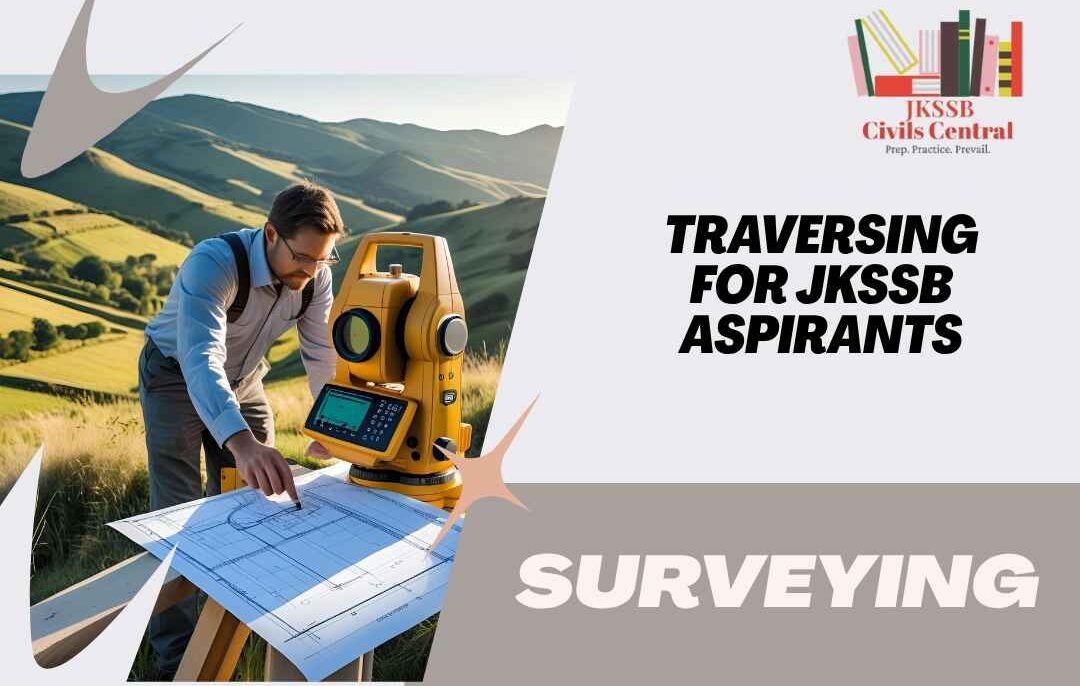
Traversing in surveying showing connected survey lines and stations
JE CivilSurveying

Traversing in Surveying – A Complete Guide for JKSSB Aspirants

By Sahil Digra
0

🔍 Introduction

Traversing is one of the most fundamental techniques in the field of surveying. It involves a series of straight lines connected together to form a framework of survey lines. Each line in a traverse is called a traverse leg, and its length and direction are carefully measured.

Understanding traversing is essential for JKSSB aspirants, especially those appearing for Junior Engineer (JE) and Surveyor exams. This topic is frequently tested in the exam through objective and practical-type questions.


📌 Definition of Traversing

Traversing is defined as:

“A method of surveying in which a number of connected survey lines form a framework, and both linear and angular measurements are made to determine the relative positions of survey stations.”

It is particularly useful when obstacles like buildings, forests, or rivers prevent the use of simple chaining methods.


🧭 Objectives of Traversing

  • To locate physical features such as boundaries, roads, and rivers
  • To provide control points for detailed surveys
  • To determine the relative positions of points in inaccessible terrain
  • To establish base lines for construction projects

🗂️ Types of Traverses

1. Open Traverse

  • Does not return to the starting point
  • Cannot be used for checking errors
  • Suitable for long linear projects like:
    • Roads
    • Railways
    • Pipelines

Example: A survey for a new highway alignment where the endpoint is not the same as the start point.

2. Closed Traverse

  • The traverse returns to the starting point or connects with a known point
  • Forms a closed polygon
  • Enables checking and correction of angular and linear errors
  • Used in:
    • Plot boundary surveys
    • Reservoir layout
    • Construction site surveys

Example: Surveying the boundary of a square land parcel.


📐 Methods of Traversing

1. Chain Traversing

  • Only linear measurements taken
  • No angle measurements
  • Directions are judged using features (not precise)
  • Suitable for small area surveys

Not used where accuracy is required.


2. Compass Traversing

  • Uses prismatic compass to measure magnetic bearings
  • Distances measured using chain/tape
  • Affected by local attraction
  • Suitable for moderate accuracy surveys

Formula:
Included Angle = F.B. of Forward Line – B.B. of Previous Line


3. Theodolite Traversing

  • Uses a theodolite to measure horizontal and vertical angles
  • Distances measured with chain, tape, or EDM
  • Highly accurate
  • Ideal for engineering works and precise surveys

Example: Used in dam construction, tunnels, and bridges.


4. Plane Table Traversing

  • Combines plotting and measurement on the field
  • Saves time but less accurate
  • Suitable for rapid surveys
  • Useful in preliminary and reconnaissance surveys

5. Total Station Traversing

  • A modern method using a digital total station
  • Combines EDM (Electronic Distance Measurement) and angle reading
  • Stores data digitally
  • Produces highly accurate results with least human error

🛠️ Instruments Used in Traversing

InstrumentPurpose
Chain / TapeLinear measurement
Prismatic CompassBearing measurement
TheodoliteAngle measurement
Plane TableOn-field plotting
Total StationDigital measurement + recording
Ranging RodsMarking points
ArrowsIntermediate points in chaining

🧮 Traverse Computations

🔄 Latitude and Departure

  • Used in closed traverse to compute area and adjust errors.

Latitude (ΔY) = L×cos⁡θL \times \cos \thetaL×cosθ

Departure (ΔX) = L×sin⁡θL \times \sin \thetaL×sinθ

Where:

  • LLL = Length of traverse line
  • θ\thetaθ = Reduced Bearing of line

📏 Closing Error

In a closed traverse, the closing error is calculated as: Closing Error=(ΣL)2+(ΣD)2\text{Closing Error} = \sqrt{(\Sigma L)^2 + (\Sigma D)^2}Closing Error=(ΣL)2+(ΣD)2​

Where:

  • ΣL\Sigma LΣL = Sum of Latitudes
  • ΣD\Sigma DΣD = Sum of Departures

🧮 Error Adjustment – Bowditch’s Rule

Used to distribute error proportionally in a closed traverse. Correction to Latitude=Total Error in Latitude×Length of LineTotal Perimeter\text{Correction to Latitude} = \frac{\text{Total Error in Latitude} \times \text{Length of Line}}{\text{Total Perimeter}}Correction to Latitude=Total PerimeterTotal Error in Latitude×Length of Line​ Correction to Departure=Total Error in Departure×Length of LineTotal Perimeter\text{Correction to Departure} = \frac{\text{Total Error in Departure} \times \text{Length of Line}}{\text{Total Perimeter}}Correction to Departure=Total PerimeterTotal Error in Departure×Length of Line​


✅ Advantages of Traversing

  • Suitable for all types of terrain
  • Closed traverse allows error detection and correction
  • Can be done with high precision using modern instruments
  • More flexible than triangulation in obstructed areas

❌ Limitations

  • Open traverse has no internal check for errors
  • Compass surveys are affected by magnetic disturbances
  • Manual methods are time-consuming and less accurate than digital tools

📘 JKSSB Exam Specific Notes

  • Repeated questions include:
    • Types of traverse
    • Instruments used
    • Bowditch’s Rule
    • Bearings (Whole Circle vs Quadrantal)
  • Always revise:
    • Numerical problems on traverse adjustments
    • Bearings conversion: True vs Magnetic
    • Included angle calculations

Previous Question Example (JKSSB JE 2022):
“Which of the following is used to adjust the closing error in a closed traverse?”
Answer: Bowditch’s Rule


📝 Conclusion

Traversing is a core concept in surveying and an essential part of the JKSSB civil engineering syllabus. Whether you’re preparing for JKSSB JE, Surveyor, or any other technical post, mastering the types, instruments, and error adjustment techniques in traversing will give you a strong edge.

About The Author

Sahil Digra

See author's posts

Tags:

Bowditch RuleCivil Engineering BlogCompass TraversingJKSSB Civil EngineeringJKSSB JE SyllabusMethods of TraversingOpen and Closed TraverseSurveying for JKSSB JESurveying InstrumentsSurveying MCQs JKSSBSurveying TechniquesTheodolite TraversingTotal Station SurveyingTraverse ComputationTraversing for JKSSBTraversing in SurveyingTypes of Traversing
Author

Sahil Digra

Follow Me
Other Articles
Illustration showing the importance of surveying in civil engineering projects and JKSSB exam preparation
Previous

Importance of Surveying – A Complete Guide for JKSSB Aspirants

Basic surveying instruments used in plane and geodetic surveying – JKSSB Civil Engineering
Next

Principles and Classifications | Complete Guide for JKSSB Civil Engineering Aspirants

No Comment! Be the first one.

    Leave a Reply Cancel reply

    Your email address will not be published. Required fields are marked *

    Recent Posts

    • Sultanate Administration and Economy in Medieval Kashmir
    • Shah Mir Dynasty: Foundation, Major Sultans and Political Consolidation
    • Rinchen, Kota Rani and the Political Transition to Muslim Rule in Kashmir
    • Islam in Medieval Kashmir: Early Contacts, Migration, Settlement and Islamization
    • Lohara Dynasty in Kashmir: Rulers, Political Developments and Decline
    jkssb.Civilscentral.com
    • Sultanate Administration and Economy in Medieval Kashmir
    • Shah Mir Dynasty: Foundation, Major Sultans and Political Consolidation
    • Rinchen, Kota Rani and the Political Transition to Muslim Rule in Kashmir
    • Islam in Medieval Kashmir: Early Contacts, Migration, Settlement and Islamization
    • Lohara Dynasty in Kashmir: Rulers, Political Developments and Decline

    You May Have Missed

    Sultanate Administration and Economy in Medieval Kashmir
    Medieval J&K Premium J&K History Series

    Sultanate Administration and Economy in Medieval Kashmir

    Rohit Thapa
    By Rohit Thapa
    September 24, 2026
    Shah Mir Dynasty Foundation, Major Sultans and Political Consolidation
    Medieval J&K Premium J&K History Series

    Shah Mir Dynasty: Foundation, Major Sultans and Political Consolidation

    Rohit Thapa
    By Rohit Thapa
    September 22, 2026
    Rinchen, Kota Rani and the Political Transition to Muslim Rule in Kashmir
    Medieval J&K Premium J&K History Series

    Rinchen, Kota Rani and the Political Transition to Muslim Rule in Kashmir

    Rohit Thapa
    By Rohit Thapa
    September 22, 2026
    Islam in Medieval Kashmir Early Contacts, Migration, Settlement and Islamization
    Early Medieval J&K Premium J&K History Series

    Islam in Medieval Kashmir: Early Contacts, Migration, Settlement and Islamization

    Rohit Thapa
    By Rohit Thapa
    September 22, 2026
    Lohara Dynasty in Kashmir Rulers, Political Developments and Decline
    Early Medieval J&K Premium J&K History Series

    Lohara Dynasty in Kashmir: Rulers, Political Developments and Decline

    Rohit Thapa
    By Rohit Thapa
    September 22, 2026
    Queen Didda and the Lohara Dynasty Power, Politics and the Transition to Lohara Rule
    Early Medieval J&K Premium J&K History Series

    Queen Didda and the Lohara Dynasty: Power, Politics and the Transition to Lohara Rule

    Rohit Thapa
    By Rohit Thapa
    September 22, 2026
    Post-Utpala Kashmir Political Fragmentation, Yashaskara, Parvagupta and Kshemagupta
    Early Medieval J&K Premium J&K History Series

    Post-Utpala Kashmir: Political Fragmentation, Yashaskara, Parvagupta and Kshemagupta

    Rohit Thapa
    By Rohit Thapa
    September 22, 2026
    Shankaravarman and the Later Utpala Period Expansion, Fiscal Pressure and Political Instability
    Early Medieval J&K Premium J&K History Series

    Shankaravarman and the Later Utpala Period: Expansion, Fiscal Pressure and Political Instability

    Rohit Thapa
    By Rohit Thapa
    September 19, 2026
    Utpala Dynasty in Kashmir Avantivarman, Suyya and the Agrarian-Hydraulic Transformation
    Early Medieval J&K Premium J&K History Series

    Utpala Dynasty in Kashmir: Avantivarman, Suyya and the Agrarian-Hydraulic Transformation

    Rohit Thapa
    By Rohit Thapa
    September 18, 2026
    • Sultanate Administration and Economy in Medieval Kashmir
    • Shah Mir Dynasty: Foundation, Major Sultans and Political Consolidation
    • Rinchen, Kota Rani and the Political Transition to Muslim Rule in Kashmir
    • Islam in Medieval Kashmir: Early Contacts, Migration, Settlement and Islamization
    • Lohara Dynasty in Kashmir: Rulers, Political Developments and Decline
    • About us
    • Candidate Dashboard
    • Contact Us
    • Disclaimer
    • Privacy Policy
    • Terms and Conditions
    • Typing Practice
    Copyright 2026 — JKSSB-CivilsCentral. All rights reserved.