Principal Stress and Strain in Strength of Materials – Civil Engineering 📘 | JKSSB JE Civil

🔹 Introduction
In Strength of Materials (SOM), most structural members are subjected to combined stresses rather than a single direct stress. For example, in beams, slabs, columns, bridges, and machine parts, stresses act in different directions simultaneously due to loads, supports, and geometry. These combined stresses may include direct stresses (tensile or compressive), bending stresses, torsional stresses, and shear stresses acting together, making it essential to determine equivalent or resultant stresses for safe design.
To analyze such cases, we calculate:
- Principal Stresses (σ₁, σ₂, σ₃) → Maximum & minimum normal stresses that occur on mutually perpendicular planes where shear stress is zero. These represent the critical stresses used in design.
- σ₁ = Major principal stress (maximum normal stress)
- σ₂ = Intermediate principal stress
- σ₃ = Minor principal stress (minimum normal stress)
The principal stresses provide a clear picture of the state of stress at a point, allowing engineers to apply failure theories such as Maximum Normal Stress theory, Maximum Shear Stress theory, and Distortion Energy theory for safe design.
- Principal Strains (ε₁, ε₂, ε₃) → Maximum & minimum normal strains that occur on planes where shear strain is zero. These are directly related to principal stresses through Hooke’s law in 3D.
- ε₁ = Major principal strain (maximum extension)
- ε₂ = Intermediate principal strain
- ε₃ = Minor principal strain (maximum compression)
Principal strains are important because failure theories such as Maximum Strain theory (Saint-Venant’s theory) and Total Strain Energy theory make use of them in evaluating material safety.
👉 Why Important?
- Helps in failure analysis of structures.
- Basis for design theories like Maximum Shear Stress Theory (Tresca) and Distortion Energy Theory (von Mises).
- Frequently asked in JKSSB JE Civil, SSC JE, RRB JE, and GATE exams.
🔹 General State of Stress
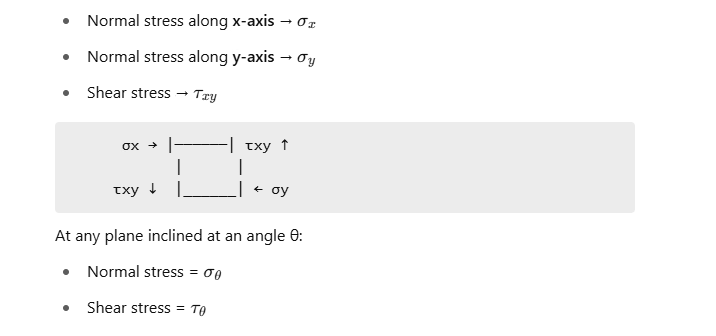
Consider a small element subjected to:
🔹 Stress Transformation Equations
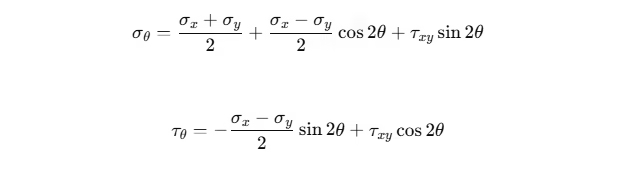
👉 These are called stress transformation equations.
🔹 Principal Stresses (σ₁ and σ₂)
Where,
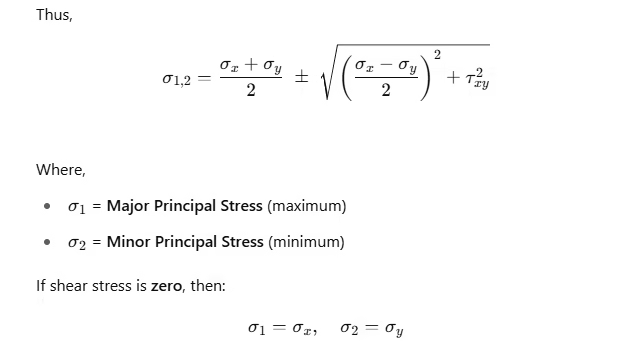
🔹 Angle of Principal Planes

👉 Remember: The angle is measured from x-axis in the anticlockwise direction.
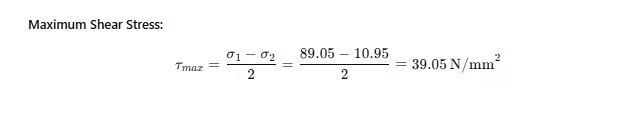
🔹 Maximum Shear Stress
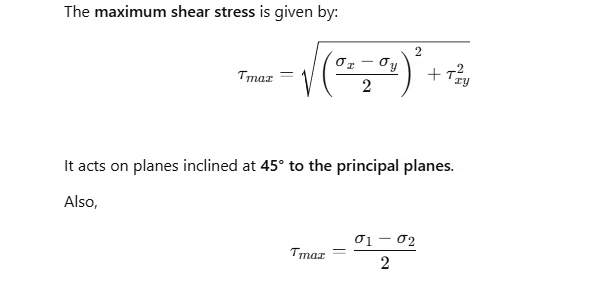
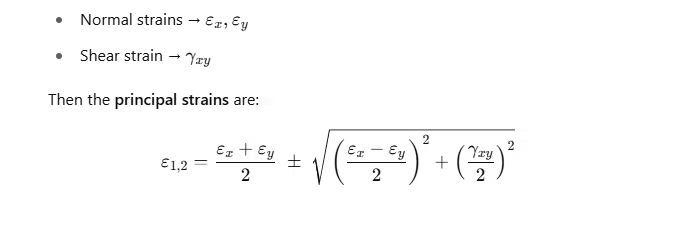
🔹 Principal Strains
If the element is subjected to:
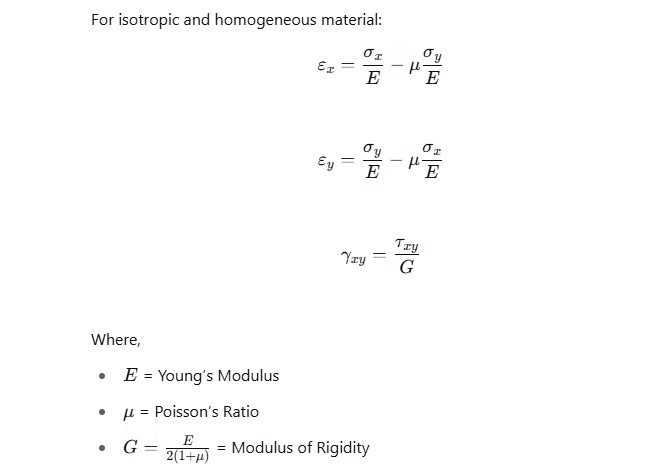
🔹 Relation Between Stress & Strain (Hooke’s Law – 2D)
🔹 Mohr’s Circle (Graphical Method)
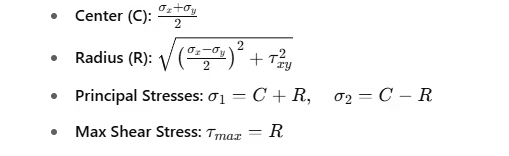
Mohr’s Circle provides a graphical solution to find principal stresses, strains, and maximum shear stress.
👉 In JKSSB exams, Mohr’s circle questions are very common.
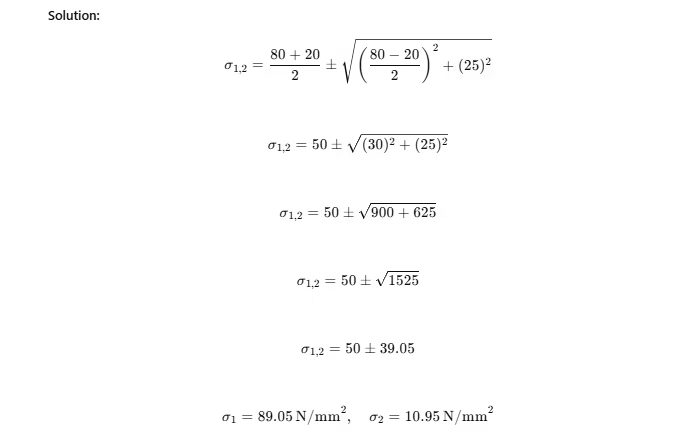
🔹 Example Problem (JKSSB Pattern)
A material is subjected to:
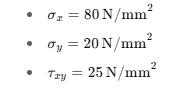
Find principal stresses and maximum shear stress.
🔹 Key Takeaways
- Principal stresses = max & min normal stresses.
- Principal planes = shear stress = 0.
- Max shear stress = half the difference of principal stresses.
- Mohr’s Circle is a powerful tool for quick determination.
- Very important topic for JKSSB JE Civil exam.
✅ Exam Tip for JKSSB: Always check units (N/mm², MPa) in calculations. Mistakes in unit conversion are common in competitive exams.
Conclusion
The concept of Principal Stress and Principal Strain is one of the most fundamental and powerful tools in Strength of Materials. By transforming a complex system of stresses into simple principal stresses and strains, engineers can:
- Identify the maximum and minimum stresses acting on a structure.
- Determine the planes of failure where shear stress vanishes.
- Apply failure theories to ensure structures are designed within safe limits.
From an academic point of view, this topic is a frequently asked area in competitive exams like JKSSB, SSC JE, and GATE because it tests both conceptual clarity and numerical solving ability. Practicing numerical problems based on principal stress equations, Mohr’s circle, and strain transformations helps aspirants build confidence.
From a practical perspective, civil engineers use this knowledge in designing safe, economical, and durable structures such as high-rise buildings, bridges, dams, pavements, and retaining walls. By analyzing stresses in terms of their principal values, engineers can predict possible failure conditions well before actual construction, saving both cost and time.
👉 In conclusion: Principal stress and strain analysis is not only a theoretical concept but also a practical necessity in civil engineering. Mastery of this topic ensures both academic success and professional competency.
FAQs on Principal Stress and Strain
Q1. What is meant by principal stress?
👉 Principal stress is the maximum or minimum normal stress acting on a plane where shear stress is zero.
Q2. What is the difference between principal stress and principal strain?
👉 Principal stress refers to normal stresses on planes of zero shear, while principal strain refers to the normal strains on those same planes.
Q3. Why are principal stresses important in civil engineering design?
👉 Because structural failure depends on maximum stresses/strains, principal stresses simplify the complex stress system into values directly usable for failure theories and IS code checks.
Q4. What is the formula for principal stresses in 2D?
👉 σ₁,₂ = ( (σₓ + σᵧ) / 2 ) ± √[ ((σₓ − σᵧ)/2)² + (τₓᵧ)² ]
Q5. What is the orientation of principal planes?
👉 The angle of principal planes is given by:
tan(2θₚ) = (2τₓᵧ) / (σₓ − σᵧ)
Q6. What is the maximum shear stress in 2D stress system?
👉 τmax = √[ ((σₓ − σᵧ)/2)² + (τₓᵧ)² ]
Q7. Which method is used to graphically determine principal stresses?
👉 Mohr’s Circle Method.
Q8. Are principal stresses always tensile?
👉 No, they can be tensile (positive) or compressive (negative) depending on loading.
Q9. Can principal stresses exist without shear stress?
👉 Yes, in uniaxial loading, the applied direct stress itself is the principal stress.
Q10. Is this topic important for JKSSB JE Civil exams?
👉 Yes ✅, almost every exam like JKSSB JE, SSC JE, and GATE asks numerical problems or conceptual MCQs from principal stresses and strains.
📝 PYQs on Principal Stress & Strain
Q1. The planes carrying no shear stress are known as:
(a) Shear planes
(b) Neutral planes
(c) Principal planes ✔️
(d) Stress-free planes
Q2. If σₓ = 100 MPa, σᵧ = 50 MPa, and τₓᵧ = 25 MPa, the maximum shear stress is:
(a) 25 MPa
(b) 50 MPa
(c) 40.31 MPa ✔️
(d) 75 MPa
Solution:
τmax = √[ ((σₓ − σᵧ)/2)² + τₓᵧ² ]
= √[ (25)² + (25)² ] = √1250 = 35.36 MPa (approx).
Q3. The sum of principal stresses in a two-dimensional stress system is equal to:
(a) σₓ + σᵧ ✔️
(b) σₓ − σᵧ
(c) 2τ
(d) Zero
Q4. The maximum shear stress in a biaxial stress system is equal to:
(a) (σ₁ + σ₂)/2
(b) (σ₁ − σ₂)/2 ✔️
(c) √(σ₁² + σ₂²)
(d) None of these
Q5. Which of the following is true for Mohr’s Circle?
(a) It is drawn for shear stresses only
(b) It gives principal stresses and maximum shear stress ✔️
(c) It represents stress-strain curve
(d) It is used only for tensile stresses
Q6. In a 2D stress system, principal stresses are at how many planes?
(a) 1
(b) 2 ✔️
(c) 3
(d) Infinite
Q7. If σₓ = 80 MPa, σᵧ = 20 MPa, and τₓᵧ = 0, the maximum principal stress is:
(a) 20 MPa
(b) 80 MPa ✔️
(c) 100 MPa
(d) 40 MPa
Q8. The angle of principal plane (θₚ) is obtained from:
(a) tanθₚ = τₓᵧ / σₓ
(b) tan(2θₚ) = 2τₓᵧ / (σₓ − σᵧ) ✔️
(c) tanθₚ = σₓ / σᵧ
(d) None of these
Q9. In case of pure shear stress, the two principal stresses are:
(a) Equal and tensile
(b) Equal and compressive
(c) Equal in magnitude but opposite in nature ✔️
(d) Zero
Q10. Which failure theory is based on principal stresses?
(a) Maximum Shear Stress Theory
(b) Maximum Principal Stress Theory ✔️
(c) Distortion Energy Theory
(d) Total Strain Energy Theory
✅ These are most asked types of questions in JKSSB/SSC and will help aspirants revise quickly.
📌 Join our Telegram Channel JKSSB CivilsCentral for regular updates, quizzes, PDF notes, and practice sets curated specifically for JKSSB aspirants.
About The Author