Skip to content
-
Subscribe to our newsletter & never miss our best posts. Subscribe Now!
JKSSB-CivilsCentral JKSSB-CivilsCentral

Prep.Practice.Prevail.

JKSSB-CivilsCentral JKSSB-CivilsCentral

Prep.Practice.Prevail.

  • Home
  • Premium J&K History Series
    • Prehistoric & Early J&K
    • Ancient J&K
    • Early Medieval J&K
    • Medieval J&K
    • Mughal, Afghan & Sikh J&K
    • Dogra State & Princely J&K
    • 1947, Accession & Constitutional History
    • Political Awakening & Modern J&K
    • Post-1947 J&K
  • JKSSB
    • JE Civil
  • Contact Us
  • About us
  • Home
  • Premium J&K History Series
    • Prehistoric & Early J&K
    • Ancient J&K
    • Early Medieval J&K
    • Medieval J&K
    • Mughal, Afghan & Sikh J&K
    • Dogra State & Princely J&K
    • 1947, Accession & Constitutional History
    • Political Awakening & Modern J&K
    • Post-1947 J&K
  • JKSSB
    • JE Civil
  • Contact Us
  • About us
  • https://www.facebook.com/
  • https://twitter.com/
  • https://t.me/
  • https://www.instagram.com/
  • https://youtube.com/
JKSSB-CivilsCentral JKSSB-CivilsCentral

Prep.Practice.Prevail.

JKSSB-CivilsCentral JKSSB-CivilsCentral

Prep.Practice.Prevail.

  • Home
  • Premium J&K History Series
    • Prehistoric & Early J&K
    • Ancient J&K
    • Early Medieval J&K
    • Medieval J&K
    • Mughal, Afghan & Sikh J&K
    • Dogra State & Princely J&K
    • 1947, Accession & Constitutional History
    • Political Awakening & Modern J&K
    • Post-1947 J&K
  • JKSSB
    • JE Civil
  • Contact Us
  • About us
  • Home
  • Premium J&K History Series
    • Prehistoric & Early J&K
    • Ancient J&K
    • Early Medieval J&K
    • Medieval J&K
    • Mughal, Afghan & Sikh J&K
    • Dogra State & Princely J&K
    • 1947, Accession & Constitutional History
    • Political Awakening & Modern J&K
    • Post-1947 J&K
  • JKSSB
    • JE Civil
  • Contact Us
  • About us
  • https://www.facebook.com/
  • https://twitter.com/
  • https://t.me/
  • https://www.instagram.com/
  • https://youtube.com/
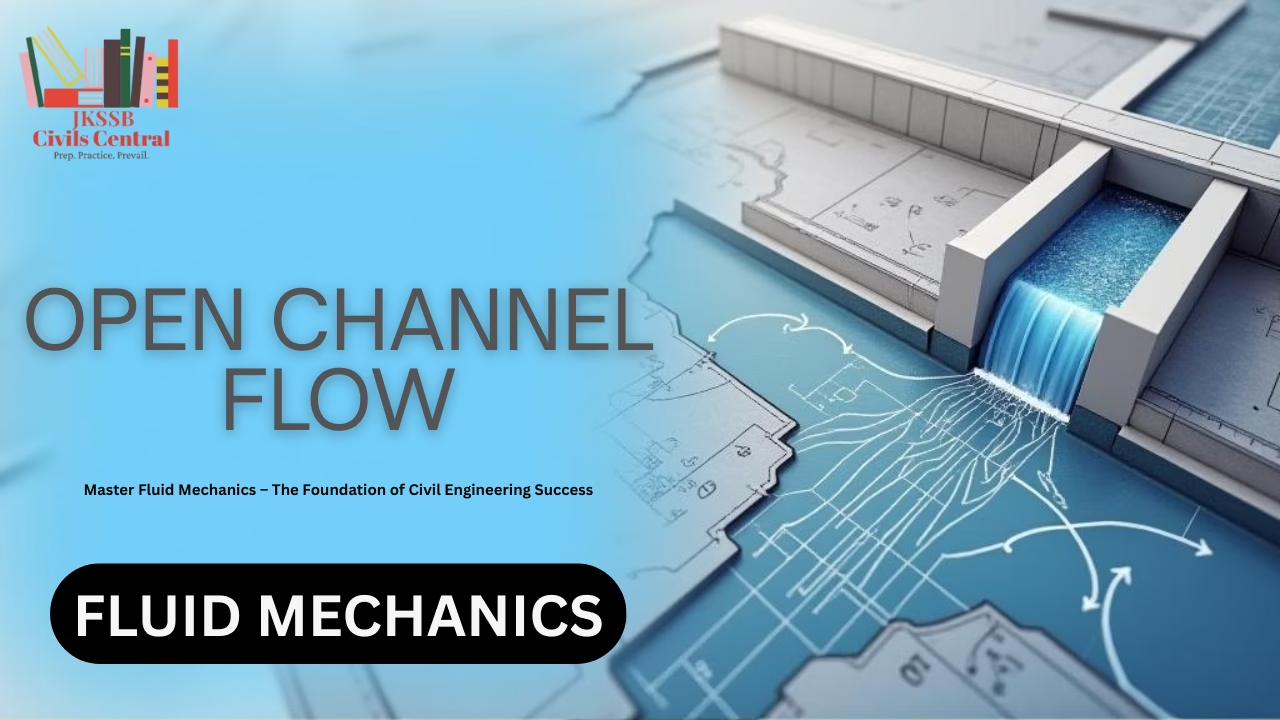
Open Channel Flow diagram with flow types, equations, and hydraulic parameters in civil engineering
FLUID MECHANICSJE Civil

Open Channel Flow in Fluid Mechanics | Civil Engineering JKSSB Guide

By Sahil Digra
0

📅 Updated on: July 31, 2025
👷‍♂️ Useful for: JKSSB JE Civil, SSC JE, RRB JE, AE Exams
📚 Subject: Fluid Mechanics – Civil Engineering


📌 Introduction to Open Channel Flow

Open Channel Flow refers to the movement of fluid, typically water, in a conduit or channel with a free surface exposed to atmospheric pressure. This free surface allows for the direct interaction of the fluid with atmospheric conditions, which significantly influences the behavior of the flow. Unlike pipe flow where pressure differences primarily drive the movement, open channel flow is governed mainly by gravity and the slope of the channel bed. The velocity and depth of flow can vary significantly depending on the channel’s shape, roughness, slope, and boundary conditions.

The analysis of open channel flow is crucial in civil engineering due to its extensive presence in natural and engineered environments. It plays a vital role in flood forecasting, river hydraulics, stormwater management, and the design of irrigation and drainage systems.

Examples of open channel flow include:

  • Natural streams, creeks, and rivers with varying widths and slopes
  • Man-made canals and lined irrigation ditches with uniform geometry
  • Sewer lines that are only partially filled
  • Urban stormwater drainage systems and open gutters
  • Hydraulic structures such as culverts, spillways, and flumes

Understanding the principles of open channel flow aids engineers in predicting water levels, designing channel sections for efficient flow, and ensuring safe and sustainable water management practices.

  • Natural streams and rivers
  • Man-made canals and irrigation ditches
  • Sewer lines (partially full)
  • Stormwater drains
  • Culverts and spillways

Understanding open channel flow is crucial for civil engineers involved in hydraulic engineering, irrigation, drainage systems, and flood control.


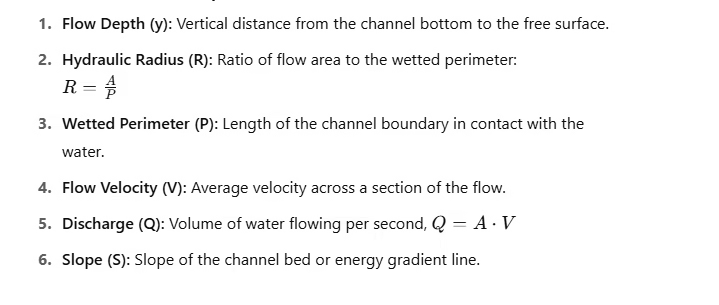
🧠 Basic Terms in Open Channel Flow

🌐 Classification of Open Channel Flow

Open channel flow can be classified in several ways:

🔸 1. Based on Time Variation:

  • Steady Flow: Flow parameters (velocity, depth, discharge) do not change with time at any section.
  • Unsteady Flow: Flow parameters change with time.

🔸 2. Based on Space Variation:

  • Uniform Flow: Depth and velocity remain constant along the channel length.
  • Non-uniform Flow: Depth and velocity vary along the channel.

🔸 3. Based on Depth Variation:

  • Gradually Varied Flow (GVF): Flow depth changes slowly and smoothly along the length.
  • Rapidly Varied Flow (RVF): Abrupt changes in depth, e.g., hydraulic jump.

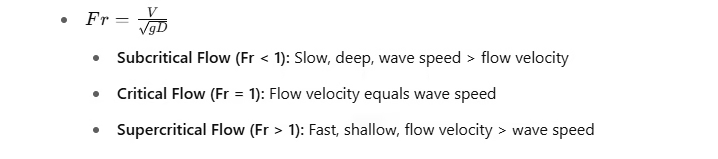
🔸 4. Based on Froude Number (Fr):

    🔍 Flow Regimes and Their Importance

    Understanding the flow regime (subcritical, critical, supercritical) helps in designing stable channels. For instance:

    • Subcritical flows require attention to downstream conditions because disturbances or changes in the downstream water surface elevation can propagate upstream and influence the flow conditions. In this regime, the gravitational forces dominate over inertial forces, causing the flow to be stable but sensitive to changes downstream. For example, if a gate is closed or a dam structure is introduced at the downstream end, it can significantly affect the upstream water levels. Therefore, in designing open channels operating under subcritical conditions, it is essential to analyze the downstream boundary conditions to ensure smooth and efficient flow.
    • Supercritical flows are governed by upstream changes because in this regime, the inertial forces dominate over gravitational forces. This means that the flow is fast-moving and relatively shallow, and any disturbance or change introduced upstream affects the downstream flow characteristics, but not vice versa. For example, if the slope or roughness of the channel changes at an upstream location, it can significantly influence the velocity and depth of flow downstream. These flows are less stable, more prone to erosion, and require careful energy dissipation measures downstream. Therefore, in designing channels expected to carry supercritical flow, engineers must focus on upstream hydraulic conditions and ensure proper control structures to manage flow transitions.
    • Hydraulic jumps occur when supercritical flow transitions to subcritical flow, resulting in a sudden increase in flow depth and a significant loss of kinetic energy. This transition typically happens in open channels when a high-velocity, low-depth flow (supercritical) encounters a zone of lower velocity and higher depth (subcritical), causing turbulence, surface rollers, and energy dissipation. Hydraulic jumps are commonly observed downstream of spillways, sluice gates, and weirs. They are used in engineering applications to reduce the erosive power of flowing water and to stabilize downstream flow. The energy lost during a hydraulic jump is transformed into turbulence and heat, which helps protect channel beds and structures from damage.

    🧮 Important Equations in Open Channel Flow

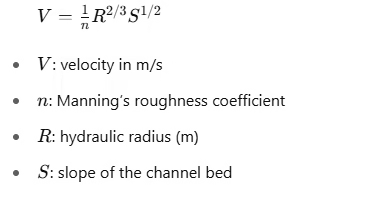
    1. Manning’s Formula:
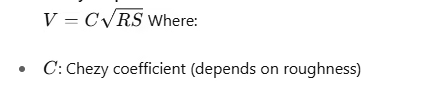
    1. Chezy’s Equation:

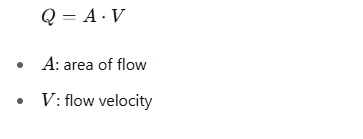
    1. Continuity Equation:

    📐 Cross Sections of Channels

    1. Rectangular: Simple shape used in labs and some concrete channels
    2. Trapezoidal: Common in irrigation canals
    3. Circular: Common in sewer systems
    4. Parabolic: Sometimes used in urban drainage for self-cleaning properties

    🏞️ Real-World Applications

    • Irrigation Design: Properly sized channels ensure efficient water delivery.
    • Urban Drainage: Manage stormwater during peak rains.
    • River Engineering: Study of flow profiles and flood forecasting.
    • Energy Dissipation: Use of hydraulic jumps to reduce energy in spillways.

    🧪 Example Problem for JKSSB Exam

    Q: A trapezoidal channel has a bottom width of 4 m, side slope 1:1, and flow depth of 2 m. Calculate the cross-sectional area.


    📚 Tips to Master Open Channel Flow for JKSSB JE

    • Revise formulas regularly (especially Manning’s & Froude number)
    • Understand types of flows through visuals or videos
    • Practice problems from GATE, SSC JE, and previous JKSSB exams
    • Prepare short notes with classification tables and diagrams

    📌 Conclusion

    Open channel flow is a foundational aspect of civil engineering, vital for the design and operation of hydraulic structures and water conveyance systems. It has broad applications in fields such as irrigation planning, stormwater drainage, urban hydrology, river engineering, and environmental management. Professionals in these fields must understand how water behaves under various open flow conditions to ensure system efficiency, safety, and sustainability.

    For JKSSB aspirants and other competitive exam candidates, open channel flow forms a significant part of the fluid mechanics syllabus. Mastering this topic ensures comprehensive preparedness not only for theory-based questions but also for practical numericals and case-based scenarios often asked in exams. Essential concepts such as Froude number, Manning’s equation, hydraulic radius, and classifications of flow must be internalized thoroughly. A solid understanding allows candidates to tackle questions with confidence, especially those related to flow regimes, hydraulic jumps, and energy losses.

    📌 Join our Telegram Channel JKSSB CivilsCentral for regular updates, quizzes, PDF notes, and practice sets curated specifically for JKSSB aspirants.


    About The Author

    Sahil Digra

    See author's posts

    Tags:

    Canal DesignChannel DesignCivil EngineeringEnergy DissipationFlow ClassificationFluid MechanicsFroude NumberGradually Varied FlowHydraulic JumpHydraulic StructuresIrrigation EngineeringJKSSB JEManning EquationOpen Channel FlowOpen Channel Flow ExamplesRapidly Varied FlowUniform Flow
    Author

    Sahil Digra

    Follow Me
    Other Articles
    Schematic diagram of a hydraulic turbine used in fluid mechanics and civil engineering
    Previous

    Hydraulic Machines in Fluid Mechanics | Civil Engineering for JKSSB

    Next

    Workability of Concrete in Concrete Technology – JKSSB Civil Engineering Notes

    No Comment! Be the first one.

      Leave a Reply Cancel reply

      Your email address will not be published. Required fields are marked *

      Recent Posts

      • Sultanate Administration and Economy in Medieval Kashmir
      • Shah Mir Dynasty: Foundation, Major Sultans and Political Consolidation
      • Rinchen, Kota Rani and the Political Transition to Muslim Rule in Kashmir
      • Islam in Medieval Kashmir: Early Contacts, Migration, Settlement and Islamization
      • Lohara Dynasty in Kashmir: Rulers, Political Developments and Decline
      jkssb.Civilscentral.com
      • Sultanate Administration and Economy in Medieval Kashmir
      • Shah Mir Dynasty: Foundation, Major Sultans and Political Consolidation
      • Rinchen, Kota Rani and the Political Transition to Muslim Rule in Kashmir
      • Islam in Medieval Kashmir: Early Contacts, Migration, Settlement and Islamization
      • Lohara Dynasty in Kashmir: Rulers, Political Developments and Decline

      You May Have Missed

      Sultanate Administration and Economy in Medieval Kashmir
      Medieval J&K Premium J&K History Series

      Sultanate Administration and Economy in Medieval Kashmir

      Rohit Thapa
      By Rohit Thapa
      September 24, 2026
      Shah Mir Dynasty Foundation, Major Sultans and Political Consolidation
      Medieval J&K Premium J&K History Series

      Shah Mir Dynasty: Foundation, Major Sultans and Political Consolidation

      Rohit Thapa
      By Rohit Thapa
      September 22, 2026
      Rinchen, Kota Rani and the Political Transition to Muslim Rule in Kashmir
      Medieval J&K Premium J&K History Series

      Rinchen, Kota Rani and the Political Transition to Muslim Rule in Kashmir

      Rohit Thapa
      By Rohit Thapa
      September 22, 2026
      Islam in Medieval Kashmir Early Contacts, Migration, Settlement and Islamization
      Early Medieval J&K Premium J&K History Series

      Islam in Medieval Kashmir: Early Contacts, Migration, Settlement and Islamization

      Rohit Thapa
      By Rohit Thapa
      September 22, 2026
      Lohara Dynasty in Kashmir Rulers, Political Developments and Decline
      Early Medieval J&K Premium J&K History Series

      Lohara Dynasty in Kashmir: Rulers, Political Developments and Decline

      Rohit Thapa
      By Rohit Thapa
      September 22, 2026
      Queen Didda and the Lohara Dynasty Power, Politics and the Transition to Lohara Rule
      Early Medieval J&K Premium J&K History Series

      Queen Didda and the Lohara Dynasty: Power, Politics and the Transition to Lohara Rule

      Rohit Thapa
      By Rohit Thapa
      September 22, 2026
      Post-Utpala Kashmir Political Fragmentation, Yashaskara, Parvagupta and Kshemagupta
      Early Medieval J&K Premium J&K History Series

      Post-Utpala Kashmir: Political Fragmentation, Yashaskara, Parvagupta and Kshemagupta

      Rohit Thapa
      By Rohit Thapa
      September 22, 2026
      Shankaravarman and the Later Utpala Period Expansion, Fiscal Pressure and Political Instability
      Early Medieval J&K Premium J&K History Series

      Shankaravarman and the Later Utpala Period: Expansion, Fiscal Pressure and Political Instability

      Rohit Thapa
      By Rohit Thapa
      September 19, 2026
      Utpala Dynasty in Kashmir Avantivarman, Suyya and the Agrarian-Hydraulic Transformation
      Early Medieval J&K Premium J&K History Series

      Utpala Dynasty in Kashmir: Avantivarman, Suyya and the Agrarian-Hydraulic Transformation

      Rohit Thapa
      By Rohit Thapa
      September 18, 2026
      • Sultanate Administration and Economy in Medieval Kashmir
      • Shah Mir Dynasty: Foundation, Major Sultans and Political Consolidation
      • Rinchen, Kota Rani and the Political Transition to Muslim Rule in Kashmir
      • Islam in Medieval Kashmir: Early Contacts, Migration, Settlement and Islamization
      • Lohara Dynasty in Kashmir: Rulers, Political Developments and Decline
      • About us
      • Candidate Dashboard
      • Contact Us
      • Disclaimer
      • Privacy Policy
      • Terms and Conditions
      • Typing Practice
      Copyright 2026 — JKSSB-CivilsCentral. All rights reserved.