
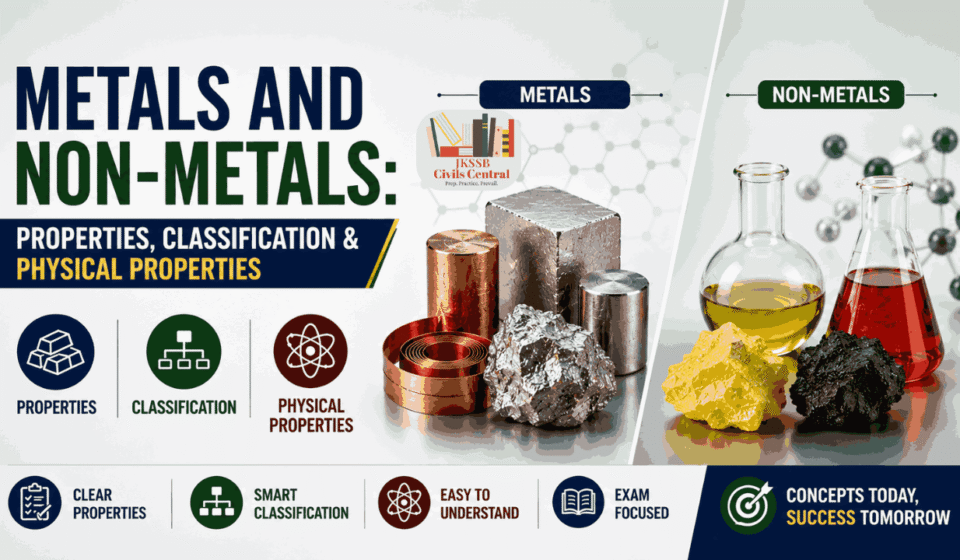
Metals and Non-Metals: Properties, Classification & Physical Properties

Metals and Non-Metals: Properties, Classification & Physical Properties:
Learning Dashboard
| Chapter Information | Details |
|---|---|
| Subject | General Science – Chemistry |
| Series | Metals and Non-Metals |
| Lesson Number | Lesson 1 |
| Current Lesson | Metals and Non-Metals: Properties, Classification & Physical Properties |
| Next Lesson | Chemical Properties of Metals: Reaction with Oxygen |
| Core Theme | Understanding the classification of elements into metals, non-metals, and metalloids, along with their physical properties, differences, and everyday applications. This lesson builds the conceptual foundation for studying the chemical properties of metals in the subsequent lessons. |
| Major Topics Covered | Elements, Classification of Elements, Metals, Non-Metals, Metalloids, Physical Properties of Metals, Physical Properties of Non-Metals, Comparison Between Metals and Non-Metals, Everyday Applications |
| Important Elements Studied | Iron (Fe), Copper (Cu), Aluminium (Al), Gold (Au), Silver (Ag), Oxygen (O), Nitrogen (N), Carbon (C), Sulphur (S), Chlorine (Cl), Silicon (Si), Germanium (Ge) |
| Key Concepts | Elements, Metals, Non-Metals, Metalloids, Metallic Bonding, Free Electrons, Electropositive Nature, Electronegative Nature, Malleability, Ductility, Conductivity, Semiconductors |
| Real-Life Applications | Electrical Wiring, Construction Materials, Aircraft, Jewellery, Cooking Utensils, Water Purification, Fertilizers, Batteries, Solar Cells, Computer Chips |
| Exam Focus | Frequently Asked in JKSSB FAA, JKSSB, JKPSC, JKAS, SSC, CDS, UPSC & State PSC Examinations |
Introduction
Look around you for a moment. The chair you sit on, the mobile phone in your hand, the electrical wires in your room, the water bottle on your table, the pencil you write with, and even the oxygen you breathe are all made up of different elements. Although these substances appear vastly different in appearance and function, they are composed of a limited number of naturally occurring elements found in the Earth’s crust and atmosphere. Understanding these elements is one of the fundamental objectives of chemistry. Among all the elements discovered so far, the majority can be broadly classified into two major groups—metals and non-metals. This classification is not arbitrary; rather, it is based on the similarities and differences in their physical and chemical properties. Metals generally possess properties such as lustre, high electrical conductivity, malleability, and ductility, whereas non-metals exhibit characteristics like brittleness, poor conductivity, and comparatively lower melting points. These distinctive properties determine how each element is used in our daily lives and in various industries.
The importance of studying metals and non-metals extends far beyond the classroom. Every modern civilization depends heavily on metals for construction, transportation, communication, healthcare, manufacturing, and energy production. Buildings are constructed using steel, electrical transmission relies on copper and aluminium, automobiles use numerous metallic alloys, and medical instruments are manufactured from corrosion-resistant metals such as stainless steel. At the same time, non-metals are equally indispensable. Oxygen sustains life, nitrogen improves soil fertility through fertilizers, carbon forms the basis of all organic compounds, and chlorine helps purify drinking water. Thus, both metals and non-metals are essential for human existence and technological advancement.
From a scientific perspective, understanding the properties of metals and non-metals also explains why different materials behave differently. Why does copper conduct electricity while rubber does not? Why can aluminium be rolled into thin sheets whereas glass breaks when struck? Why is gold suitable for jewellery while iron is preferred for constructing bridges? The answers to these questions lie in the intrinsic properties of metals and non-metals, which arise from their atomic structure and chemical behaviour.
For students preparing for competitive examinations such as JKSSB Finance Accounts Assistant (FAA), JKPSC, JKAS, SSC, CDS, and other State PSC examinations, this chapter is particularly important because it forms the foundation for several advanced topics in chemistry. Questions are frequently asked about the physical properties of metals and non-metals, their exceptions, their chemical reactions, the reactivity series, corrosion, alloys, and their practical applications. A clear conceptual understanding of this chapter not only helps in answering direct factual questions but also enables students to solve application-based and analytical questions with confidence.
In this lesson, we shall begin by understanding what elements are, how they are classified into metals, non-metals, and metalloids, and why this classification is necessary. We shall then study the physical properties of metals and non-metals, explore the scientific reasons behind these properties, examine important exceptions that are commonly asked in examinations, and compare both groups in a systematic manner.
What are Elements?
Before understanding metals and non-metals, it is essential to understand the concept of an element, because metals and non-metals are themselves categories of elements. Just as a building is constructed from bricks, all matter in the universe is ultimately made up of a limited number of basic substances known as elements. Without understanding what an element is, it becomes difficult to appreciate why some substances behave as metals while others exhibit the properties of non-metals.
Every object around us is made of matter. The water we drink, the air we breathe, the soil beneath our feet, the food we eat, and the stars shining in the night sky are all forms of matter. Scientists discovered that despite the enormous variety of substances found in nature, all matter is composed of a relatively small number of fundamental building blocks called elements. These elements combine in different ways to form millions of compounds and materials that we encounter in everyday life.
What is an Element?
An element is the simplest pure substance that consists of only one kind of atom and cannot be broken down into simpler substances by ordinary physical or chemical methods. In simpler words, an element is a substance in which all the atoms are identical. Since every atom of an element has the same number of protons in its nucleus, the chemical properties of all atoms of that element remain the same.
For example, every atom of iron contains 26 protons, every atom of oxygen contains 8 protons, and every atom of gold contains 79 protons. This fixed number of protons, known as the atomic number, uniquely identifies an element and distinguishes it from all other elements.
Unlike compounds, elements cannot be separated into simpler substances through ordinary chemical reactions. Water, for instance, can be decomposed into hydrogen and oxygen by electrolysis because it is a compound. However, oxygen itself cannot be further decomposed into another substance because it is an element.
Thus, an element represents the most fundamental chemical identity of matter.
Characteristics of Elements
Every element possesses certain unique characteristics that distinguish it from other substances.
- An element consists of only one type of atom.
- All atoms of an element have the same atomic number.
- It is a pure substance with a fixed composition.
- It cannot be broken down into simpler substances by ordinary chemical methods.
- Each element has its own characteristic physical and chemical properties.
- Every element is represented by a unique chemical symbol, such as Fe for iron, Cu for copper, O for oxygen, and Au for gold.
These characteristics enable scientists to identify and classify different elements accurately.
Elements Around Us
Although we encounter countless materials in daily life, only a limited number of elements are responsible for their composition.
Some familiar examples include:
| Element | Symbol | Everyday Importance |
| Iron | Fe | Buildings, bridges, machinery, vehicles |
| Aluminium | Al | Aircraft, utensils, electrical cables, packaging |
| Copper | Cu | Electrical wiring, motors, plumbing |
| Gold | Au | Jewellery, electronics |
| Silver | Ag | Jewellery, electronic contacts |
| Oxygen | O | Respiration and combustion |
| Nitrogen | N | Fertilizers and atmosphere |
| Carbon | C | Fuels, living organisms, graphite, diamond |
| Sulphur | S | Fertilizers, medicines, industries |
| Chlorine | Cl | Water purification and disinfectants |
These examples demonstrate that elements form the foundation of modern civilization. Some provide structural strength, others sustain life, while many are indispensable in medicine, agriculture, electronics, and manufacturing.
How Many Elements Are Known?
Scientists have identified 118 chemical elements, all of which are systematically arranged in the Modern Periodic Table.
These elements are broadly divided into:
- Naturally occurring elements, which are found in nature.
- Artificial or synthetic elements, which are produced in laboratories through nuclear reactions.
Most of the elements used in everyday life, such as iron, aluminium, copper, oxygen, nitrogen, carbon, and sulphur, occur naturally. Some heavier elements, like americium, californium, and oganesson, are produced artificially and have specialized scientific applications.
The discovery of new elements has greatly expanded our understanding of atomic structure and chemical behaviour.
Why Are Elements Classified?
If there are 118 different elements, why don’t we study each one separately?
The answer lies in the remarkable observation that many elements exhibit similar physical and chemical properties. Scientists found that grouping similar elements together makes their study much easier and helps predict their behaviour.
For example:
- Iron, copper, aluminium, and gold all possess metallic characteristics such as lustre and electrical conductivity.
- Oxygen, nitrogen, sulphur, and chlorine exhibit properties that are distinctly different from metals.
To simplify the study of chemistry, scientists classified elements into three broad groups:
- Metals
- Non-metals
- Metalloids
This classification allows us to understand the behaviour of many elements by studying the common properties shared within each group.
The Modern Periodic Table and Classification of Elements
The Modern Periodic Table is a systematic arrangement of all known elements according to their atomic number. It not only organizes elements but also reveals relationships between their properties. Most of the elements are located on the left and the centre of the periodic table and are classified as metals. They constitute nearly 80% of all known elements.
The right-hand side of the periodic table is occupied mainly by non-metals, which are comparatively fewer in number but play an equally important role in nature. Between these two groups lies a narrow zigzag region containing elements that possess properties intermediate between metals and non-metals. These are known as metalloids or semi-metals.
This arrangement helps scientists predict an element’s properties, reactivity, and possible applications simply by knowing its position in the periodic table.
JKSSB CivilsCentral Insight
For competitive examinations, remember the following high-yield facts:
- An element is the simplest pure substance made up of only one type of atom.
- Elements cannot be broken down into simpler substances by ordinary chemical methods.
- The atomic number uniquely identifies an element.
- There are currently 118 known chemical elements.
- Elements are broadly classified into metals, non-metals, and metalloids.
- The Modern Periodic Table arranges elements in increasing order of atomic number.
Classification of Elements
After understanding what an element is, the next logical question is: Are all elements alike? The answer is No. Although every element is made up of only one type of atom, different elements exhibit remarkably different physical and chemical properties. Some are hard and shiny, while others are soft or brittle. Some conduct electricity efficiently, whereas others act as insulators. Certain elements react vigorously with water and oxygen, while others remain almost chemically inert.
If scientists had attempted to study all 118 known elements individually, chemistry would have become extremely complicated. Fortunately, careful observation revealed that many elements share common characteristics. Elements with similar properties could therefore be grouped together, making their study much simpler and more systematic.
This scientific grouping of elements based on their similar physical and chemical properties is known as the classification of elements. It is one of the most important concepts in chemistry because it helps us understand the behaviour of a large number of elements by studying only a few representative members.
Why is Classification of Elements Necessary?
Imagine visiting a library where thousands of books are placed randomly without any arrangement. Finding a particular book would be extremely difficult. However, if the books are organized according to subjects such as science, history, literature, and mathematics, locating the required book becomes much easier.
The same principle applies to chemistry. Since numerous elements exist, scientists classify them into groups so that they can be studied efficiently.
The classification of elements helps us:
- Study similar elements together.
- Understand common physical and chemical properties.
- Predict the behaviour of newly discovered elements.
- Compare different groups of elements easily.
- Understand the arrangement of elements in the Modern Periodic Table.
Thus, classification is not merely a method of organizing information; it is a scientific tool that allows chemists to identify patterns and relationships among elements.
Basis of Classification
The classification of elements is based primarily on the physical and chemical properties exhibited by their atoms.
Scientists observed that elements showing similar characteristics generally possess similar electronic arrangements in their outermost shell. Since the outermost electrons largely determine how an element behaves during chemical reactions, elements with similar electron configurations often display similar properties.
For example:
- Iron, copper, aluminium, and zinc are all good conductors of heat and electricity. They possess metallic lustre and can be shaped into sheets or wires. Therefore, they are classified as metals.
- Oxygen, sulphur, nitrogen, and chlorine are poor conductors of electricity and do not exhibit metallic characteristics. These are classified as non-metals.
- Silicon and germanium possess properties intermediate between metals and non-metals. Such elements form a separate group known as metalloids.
Thus, similarities in atomic structure give rise to similarities in physical and chemical behaviour.
Three Main Categories of Elements
On the basis of their properties, elements are broadly classified into three groups:
- Metals
- Non-Metals
- Metalloids (Semi-metals)
Each of these groups possesses its own characteristic features and plays an important role in nature as well as in human civilization.
Let us briefly understand each category before studying them in detail.
Metals
Metals constitute the largest group of elements in the periodic table. Nearly 80% of all known elements are metals.
These elements are generally characterized by properties such as:
- Metallic lustre
- High electrical conductivity
- Good thermal conductivity
- Malleability
- Ductility
- Sonority
- High density
- High melting and boiling points
Because of these properties, metals are widely used in construction, transportation, electrical engineering, manufacturing, medicine, and numerous other industries.
Common examples include:
- Iron (Fe)
- Copper (Cu)
- Aluminium (Al)
- Gold (Au)
- Silver (Ag)
- Zinc (Zn)
Non-Metals
Non-metals form a comparatively smaller group but are equally important for life and industry.
Unlike metals, non-metals generally possess properties such as:
- Dull appearance
- Brittleness
- Poor electrical conductivity
- Poor thermal conductivity
- Low density
- Lower melting and boiling points
Despite lacking metallic characteristics, non-metals perform several indispensable functions. Oxygen supports respiration, nitrogen contributes to plant nutrition, carbon forms the basis of all living organisms, and chlorine is extensively used for water purification.
Common examples include:
- Oxygen (O)
- Nitrogen (N)
- Carbon (C)
- Sulphur (S)
- Phosphorus (P)
- Chlorine (Cl)
The physical and chemical behaviour of non-metals differs considerably from that of metals, making them an important separate class of elements.
Metalloids (Semi-metals)
Not all elements can be classified strictly as metals or non-metals. A small group of elements exhibits properties that are intermediate between the two. These elements are known as metalloids or semi-metals.
Metalloids often appear metallic in appearance but behave like non-metals in certain chemical reactions. Their unique combination of properties makes them extremely useful in modern technology, particularly in the electronics industry.
Some important metalloids include:
- Boron (B)
- Silicon (Si)
- Germanium (Ge)
- Arsenic (As)
- Antimony (Sb)
- Tellurium (Te)
Among these, silicon is the most widely used metalloid because it serves as the primary material for manufacturing computer chips, mobile phones, solar cells, and integrated electronic circuits.
The dual nature of metalloids makes them highly valuable in semiconductor technology.
Distribution of Elements in the Modern Periodic Table
The Modern Periodic Table visually reflects the classification of elements.
- Metals occupy the left side and the central portion of the periodic table.
- Non-metals are mainly located on the upper right side.
- Metalloids are found along a zigzag boundary separating metals and non-metals.
This arrangement is not accidental. It reflects gradual changes in the physical and chemical properties of elements across the periodic table. As one moves from left to right across a period, metallic character gradually decreases, while non-metallic character increases.
Understanding this arrangement helps students quickly identify the general nature of an element simply by observing its position in the periodic table.
JKSSB CivilsCentral Insight
Remember the following important points for examinations:
- Elements are broadly classified into metals, non-metals, and metalloids.
- The classification is based on similarities in physical and chemical properties.
- Nearly 80% of all known elements are metals.
- Metalloids exhibit properties intermediate between metals and non-metals.
- Silicon is the most important metalloid because of its use in semiconductor technology.
- In the Modern Periodic Table, metals are mainly on the left, non-metals on the right, and metalloids lie along the zigzag boundary.
Now that we understand how elements are classified, the next will focus on the first major group—Metals. We shall explore what metals are, their defining characteristics, where they are found, and why they have become indispensable for the development of human civilization.
What are Metals?
After understanding how elements are classified into metals, non-metals, and metalloids, let us now study the largest and most important group—metals. From the earliest civilizations to the modern technological era, metals have played a central role in shaping human progress. The discovery of metals transformed the way people lived, enabling the construction of stronger buildings, better tools, efficient transportation, advanced communication systems, and sophisticated medical equipment. Even today, it is difficult to imagine modern life without metals.
Every day, we interact with metals in countless ways. The steel used in bridges and skyscrapers, the aluminium in aircraft, the copper in electrical wires, the iron in machinery, the gold and silver in jewellery, and the stainless steel in kitchen utensils are all examples of how metals have become indispensable to society. Their widespread use is not accidental; it is a direct consequence of their unique physical and chemical properties.
To understand why metals are so valuable, we must first understand what metals are and what distinguishes them from other groups of elements.
What is a Metal?
A metal is an element that readily loses electrons to form positive ions (cations) and generally possesses properties such as lustre, malleability, ductility, sonority, and good conductivity of heat and electricity.
In simpler words, metals are those elements that are usually hard, strong, shiny, and efficient conductors of heat and electricity. Because of these characteristics, they are widely used in engineering, manufacturing, construction, transportation, electronics, and countless other industries.
Although every metal possesses its own unique characteristics, most metals exhibit a common set of physical and chemical properties that distinguish them from non-metals.
Why Are Metals Called Electropositive Elements?
One of the most important characteristics of metals is their tendency to lose electrons during chemical reactions. Since electrons carry a negative charge, the loss of electrons leaves the metal atom with more positive charges than negative charges. As a result, the atom becomes a positively charged ion, known as a cation.
For example:
- Sodium (Na) loses one electron to form Na⁺.
- Magnesium (Mg) loses two electrons to form Mg²⁺.
- Aluminium (Al) loses three electrons to form Al³⁺.
This tendency to lose electrons is known as electropositive character. It is one of the defining chemical properties of metals and explains why metals readily react with oxygen, water, and acids. The concept of electropositive nature will become even more important when we study the chemical properties of metals in the later lessons of this series.
Where Are Metals Found?
Metals are among the most abundant elements on Earth. They are found in the Earth’s crust, the interior of the Earth, seawater, and even in living organisms in small quantities.
However, most metals do not occur in their pure or free state because they are chemically reactive. Instead, they are usually found combined with other elements in the form of minerals and ores.
For example:
- Iron is commonly obtained from haematite and magnetite.
- Aluminium is extracted from bauxite.
- Zinc is obtained from zinc blende.
- Copper occurs in ores such as copper pyrites.
A few metals with very low chemical reactivity, such as gold, silver, and platinum, may occur in nature in their free or native state because they do not react easily with air or moisture.
Position of Metals in the Modern Periodic Table
The position of an element in the Modern Periodic Table provides valuable information about its nature. Most metals are located on the left side and in the central region of the periodic table. Together, they account for nearly 80% of all known elements, making metals the largest group of elements.
The metallic character is strongest on the left side of the periodic table and gradually decreases as we move from left to right across a period. This trend occurs because the tendency of atoms to lose electrons decreases across a period.
Understanding the position of metals in the periodic table helps scientists predict their properties, chemical behaviour, and possible reactions with other substances.
Common Examples of Metals
Several metals are commonly encountered in daily life. Each possesses unique properties that make it suitable for specific applications.
| Metal | Symbol | Common Uses |
| Iron | Fe | Buildings, bridges, machinery, railway tracks |
| Aluminium | Al | Aircraft, utensils, electrical cables, packaging |
| Copper | Cu | Electrical wiring, motors, plumbing |
| Gold | Au | Jewellery, electronics, coins |
| Silver | Ag | Jewellery, electrical contacts, mirrors |
| Zinc | Zn | Galvanization, dry cells, alloys |
| Magnesium | Mg | Fireworks, aircraft alloys, medicines |
| Lead | Pb | Batteries, radiation shielding |
| Tin | Sn | Food cans, solder, coatings |
These examples illustrate how the unique properties of each metal determine its practical applications.
Why Are Metals So Useful?
The usefulness of metals arises from the combination of their physical and chemical properties. Most metals are strong enough to bear heavy loads, making them suitable for constructing buildings, bridges, and vehicles. Their excellent electrical conductivity allows them to transmit electricity efficiently, while their high thermal conductivity makes them useful in cooking utensils and heat exchangers.
Many metals can be hammered into thin sheets or drawn into long wires without breaking, allowing them to be shaped into countless products. Their high melting points enable them to withstand extreme temperatures, and their ability to form alloys further enhances their usefulness in engineering and manufacturing.
Because of these combined properties, metals have become indispensable in almost every branch of science, technology, medicine, agriculture, and industry.
Metals and Human Civilization
The history of human civilization is closely linked with the discovery and use of metals. In fact, several periods of human history have been named after the dominant metal used during that era.
- The Copper Age marked the beginning of metal usage.
- The Bronze Age witnessed the development of bronze tools and weapons.
- The Iron Age revolutionized agriculture, warfare, and construction through stronger and more durable iron implements.
Even today, modern civilization continues to depend heavily on metals. From satellites orbiting the Earth to high-speed trains, renewable energy systems, smartphones, and medical implants, metals remain the backbone of technological progress.
JKSSB CivilsCentral Insight
For examination purposes, remember these key facts:
- Metals are elements that readily lose electrons to form positive ions (cations).
- Most metals are found on the left and centre of the Modern Periodic Table.
- Nearly 80% of all known elements are metals.
- Most metals occur in nature as ores because of their high reactivity.
- Gold, silver, and platinum are among the few metals found in the native (free) state.
- The usefulness of metals is primarily due to their strength, conductivity, malleability, ductility, and durability.
What are Metalloids?
While classifying elements, scientists realized that not every element could be placed neatly into the category of metals or non-metals. Certain elements displayed a fascinating combination of characteristics—they behaved like metals under some conditions and like non-metals under others. Because of this intermediate behaviour, these elements were placed in a separate group known as metalloids.
Although metalloids constitute only a small fraction of the elements in the periodic table, they have an enormous impact on modern science and technology. Every smartphone, computer, television, solar panel, calculator, and electronic device depends on the unique properties of metalloids. Without them, the digital revolution would not have been possible.
What are Metalloids?
Metalloids are elements that exhibit properties intermediate between metals and non-metals. Because they possess characteristics of both groups, they are also known as semi-metals.
In simple terms, metalloids are neither completely metallic nor completely non-metallic. They may resemble metals in appearance but behave like non-metals in certain chemical reactions. Similarly, they may conduct electricity under specific conditions but not as efficiently as metals.
This dual nature makes metalloids unique and highly valuable for industrial and technological applications.
Why are Metalloids Called Semi-Metals?
The term semi-metal reflects the fact that metalloids lie between metals and non-metals in terms of their physical and chemical behaviour.
For example:
- Many metalloids possess a metallic lustre like metals.
- However, unlike most metals, they are brittle and cannot be hammered into sheets.
- They conduct electricity better than non-metals but less efficiently than metals.
- Their chemical behaviour often resembles that of non-metals.
Thus, metalloids combine selected properties of both groups, making them a bridge between metals and non-metals.
Position of Metalloids in the Modern Periodic Table
In the Modern Periodic Table, metalloids occupy a narrow zigzag or staircase-shaped region that separates metals from non-metals.
This zigzag boundary represents the gradual transition from metallic to non-metallic character as we move across the periodic table.
- Elements on the left of the zigzag are predominantly metals.
- Elements on the right are predominantly non-metals.
- Elements located along the zigzag line are metalloids.
This arrangement reflects the gradual change in the properties of elements rather than an abrupt division.
Important Metalloids
The commonly accepted metalloids include:
| Metalloid | Symbol | Important Uses |
| Boron | B | Glass, detergents, fiberglass |
| Silicon | Si | Computer chips, solar cells, electronic devices |
| Germanium | Ge | Semiconductors, fibre-optic communication |
| Arsenic | As | Semiconductor industry, alloys (limited use due to toxicity) |
| Antimony | Sb | Batteries, flame retardants, alloys |
| Tellurium | Te | Solar panels, thermoelectric devices |
Among these, silicon is by far the most important because it forms the foundation of the modern electronics industry.
Physical Properties of Metalloids
Metalloids possess physical properties that are intermediate between those of metals and non-metals.
Metallic Appearance
Most metalloids have a metallic lustre, giving them a shiny appearance similar to metals.
However, unlike true metals, they are not soft or easily shaped.
Brittle Nature
Although they appear metallic, metalloids are generally brittle.
When struck with a hammer, they tend to break rather than bend. Therefore, they are neither malleable nor ductile like metals.
Moderate Electrical Conductivity
One of the most remarkable properties of metalloids is their intermediate electrical conductivity.
- Metals are excellent conductors.
- Non-metals are poor conductors.
- Metalloids fall between the two.
This property allows them to conduct electricity under controlled conditions, making them ideal semiconductors.
Moderate Thermal Conductivity
Metalloids conduct heat better than most non-metals but not as efficiently as metals. This intermediate behaviour further distinguishes them from both groups.
Chemical Properties of Metalloids
Chemically, metalloids generally behave more like non-metals than metals. They usually form covalent compounds rather than ionic compounds and often produce acidic or amphoteric oxides.
However, their exact behaviour depends on the element involved and the reaction conditions. Because of this variable nature, metalloids cannot be classified exclusively as either metals or non-metals.
What are Semiconductors?
The most important application of metalloids arises from their ability to act as semiconductors. A semiconductor is a material whose electrical conductivity lies between that of a conductor and an insulator.
Unlike metals, whose conductivity remains consistently high, the conductivity of semiconductors can be controlled by changing:
- Temperature
- Light
- Pressure
- Addition of small amounts of impurities (a process called doping)
This ability to regulate electrical conductivity makes semiconductors indispensable in modern electronics.
Silicon – The Most Important Metalloid
Among all metalloids, silicon (Si) deserves special attention.
Silicon is the second most abundant element in the Earth’s crust after oxygen. Although it is found naturally in the form of compounds such as silica and silicates, purified silicon is one of the most important materials used in the electronics industry.
Silicon is used in the manufacture of:
- Computer processors
- Mobile phones
- Laptops
- Integrated circuits (ICs)
- Microchips
- Solar cells
- Calculators
- Digital watches
- LEDs
Its controlled electrical conductivity allows electronic devices to process, store, and transmit information efficiently.
For this reason, silicon is often referred to as the foundation of the digital age.
Germanium and Other Metalloids
Before silicon became widely available, germanium was extensively used as a semiconductor in electronic devices. Even today, it finds applications in:
- Fibre-optic communication
- Infrared optics
- High-speed electronic devices
Similarly:
- Boron is used in heat-resistant glass and detergents.
- Antimony is used in batteries and flame-retardant materials.
- Tellurium is used in solar panels and thermoelectric devices.
Although less common than metals or non-metals, metalloids contribute significantly to modern technology.
Importance of Metalloids in Everyday Life
Modern civilization depends heavily on metalloids.
Every time you use a smartphone, browse the internet, watch television, use a computer, charge a solar-powered device, or operate electronic equipment, you are benefiting from the remarkable properties of metalloids.
Their unique combination of metallic and non-metallic characteristics has enabled the development of:
- Computers
- Smartphones
- Artificial intelligence hardware
- Communication satellites
- Solar energy systems
- Medical electronics
- Digital communication networks
Thus, metalloids form the backbone of the modern electronics and information technology industries.
JKSSB CivilsCentral Insight
Remember these important facts for competitive examinations:
- Metalloids exhibit properties intermediate between metals and non-metals.
- They are also known as semi-metals.
- Metalloids are located along the zigzag boundary of the Modern Periodic Table.
- Silicon is the most important metalloid because it is widely used in semiconductors and computer chips.
- Germanium is another important semiconductor material.
- Metalloids are generally shiny but brittle.
- They conduct electricity better than non-metals but less efficiently than metals.
- Semiconductors are materials whose electrical conductivity lies between conductors and insulators.
Physical Properties of Metals
Having understood what metals are and why they occupy such an important place among the elements, the next step is to examine the characteristics that make them so useful in everyday life. When we hold an iron rod, bend a copper wire, strike a steel bell, or cook food in an aluminium utensil, we are observing the physical properties of metals in action.
Physical properties are those characteristics of a substance that can be observed or measured without changing its chemical composition. In other words, when we examine the colour, hardness, conductivity, or melting point of a metal, the metal itself remains chemically unchanged. These properties are responsible for determining where and how a particular metal is used.
Although different metals have their own unique characteristics, most metals exhibit a common set of physical properties because of the way their atoms are arranged and bonded. In metallic substances, positively charged metal ions are arranged in a regular crystal lattice and are surrounded by a “sea” of freely moving electrons. This special type of bonding, known as metallic bonding, is responsible for most of the characteristic properties of metals.
Let us study each physical property in detail.
1. Metals Possess Metallic Lustre
One of the most easily recognizable properties of metals is their lustre or shiny appearance.
Freshly cut metals generally have a bright, polished surface that reflects light efficiently. This shiny appearance arises because the free electrons present on the surface of a metal absorb incoming light and quickly re-emit it, producing a characteristic metallic shine.
The degree of lustre varies from one metal to another. Precious metals such as gold, silver, and platinum exhibit an exceptionally brilliant lustre, making them ideal for jewellery and decorative objects. Metals like copper and aluminium also possess a bright appearance, although they may gradually lose their shine when exposed to air due to the formation of oxide layers.
The lustrous nature of metals is one of the primary reasons they are used in ornaments, coins, decorative articles, mirrors, and architectural structures.
Everyday Examples
- Gold jewellery shines even after many years because gold reacts very slowly with air.
- Silver ornaments have a brilliant white lustre but may become black over time due to the formation of silver sulphide.
- Aluminium utensils appear shiny when new but gradually become dull because of a thin protective oxide coating.
Important Exception
Not every metal appears shiny under all conditions.
For example:
- Lead has a comparatively dull appearance.
- Fresh sodium and potassium are shiny but quickly lose their lustre because they react rapidly with oxygen and moisture present in the air.
Thus, the absence of shine does not necessarily mean that a substance is not a metal.
2. Metals are Good Conductors of Heat
Another important characteristic of metals is their excellent ability to conduct heat. When one end of a metal rod is heated, the other end soon becomes hot. This happens because the free electrons present inside the metal move rapidly and transfer thermal energy from the hotter region to the cooler region.
Among all common metals, silver is the best conductor of heat, followed closely by copper and aluminium. However, because silver is expensive, copper and aluminium are more commonly used for practical purposes.
The high thermal conductivity of metals explains why cooking utensils are made of aluminium, copper, or stainless steel. These metals transfer heat quickly and uniformly, allowing food to cook efficiently.
Everyday Examples
- Aluminium cooking vessels heat up rapidly.
- Copper-bottom utensils distribute heat evenly.
- Iron pans retain heat for a longer period and are preferred for certain types of cooking.
Applications
Good thermal conductivity makes metals suitable for:
- Cooking utensils
- Heat exchangers
- Automobile radiators
- Boilers
- Industrial machinery
Important Exception
Mercury, although a metal, is a comparatively poor conductor of heat compared with most solid metals.
3. Metals are Good Conductors of Electricity
One of the most important properties of metals is their ability to conduct electricity efficiently. Electric current is simply the movement of electrons. Since metals contain a large number of freely moving electrons, electric current passes through them with very little resistance.
This property makes metals indispensable in modern electrical and electronic systems.
Among all metals, silver is the best electrical conductor. However, because of its high cost, copper and aluminium are used extensively in electrical wiring and power transmission.
Everyday Examples
- Copper wires in household electrical circuits.
- Aluminium cables used in high-voltage transmission lines.
- Gold used in electronic connectors because it resists corrosion.
Applications
Electrical conductivity makes metals useful in:
- Electrical wiring
- Motors
- Generators
- Transformers
- Electronic circuits
- Communication systems
Important Exception
Although metals are generally good conductors, lead and mercury conduct electricity less efficiently than metals like copper or silver.
4. Metals are Malleable
Malleability is the property by which a metal can be hammered or rolled into thin sheets without breaking. This property arises because the layers of metal atoms can slide over one another while the metallic bonds remain intact. As a result, the metal changes shape instead of breaking.
Gold is the most malleable metal known. A single gram of gold can be beaten into an extremely thin sheet covering a surprisingly large area.
Everyday Examples
- Aluminium foil used in kitchens.
- Gold leaf used for decorative purposes.
- Metal sheets used in roofing and automobile manufacturing.
Applications
Malleability enables metals to be used in:
- Roofing sheets
- Packaging foils
- Vehicle bodies
- Aircraft construction
- Decorative metalwork
Important Exception
Some metals, such as zinc, become brittle at ordinary temperatures and are therefore less malleable than most metals.
5. Metals are Ductile
Ductility is the ability of a metal to be drawn into thin wires without breaking. Like malleability, ductility results from the flexible nature of metallic bonding, which allows atoms to slide past one another without fracturing the structure.
Among all metals, gold is considered highly ductile, while copper and aluminium are widely used for manufacturing electrical wires.
Everyday Examples
- Copper wires in homes.
- Aluminium transmission cables.
- Steel wires used in bridges and construction.
Applications
Ductility is essential for:
- Electrical wiring
- Telecommunication cables
- Suspension bridges
- Industrial machinery
Important Exception
Not every metal is highly ductile. Metals such as bismuth and antimony are relatively brittle and cannot be drawn easily into wires.
6. Metals are Sonorous
Metals produce a clear ringing sound when struck with a hard object. This property is known as sonority. The sound is produced because metallic atoms are closely packed, allowing vibrations to travel efficiently through the material.
Everyday Examples
- School bells.
- Temple bells.
- Musical instruments such as cymbals and gongs.
Applications
The sonorous nature of metals makes them suitable for:
- Bells
- Musical instruments
- Alarm devices
Important Exception
Not every metal exhibits strong sonority. Soft metals such as lead produce a dull sound when struck.
7. Metals are Generally Hard and Strong
Most metals possess considerable hardness and mechanical strength. Their atoms are held together by strong metallic bonds, enabling them to withstand heavy loads without breaking.
Because of their strength, metals are widely used in:
- Buildings
- Bridges
- Railway tracks
- Machinery
- Vehicles
Important Exception
Several metals are relatively soft.
- Sodium can be cut with a knife.
- Potassium is even softer than sodium.
- Lithium is also comparatively soft.
These metals belong to the alkali metal family and are stored under kerosene because of their high chemical reactivity.
8. Metals Generally Have High Density
Most metals contain closely packed atoms, resulting in a high mass per unit volume, or high density. High density contributes to their strength and durability.
Everyday Examples
- Iron sinks in water because of its high density.
- Lead is used for radiation shielding due to its high density.
Important Exception
Not all metals are dense.
- Lithium, sodium, and potassium have low densities.
- Sodium and potassium are so light that they float on water despite being metals.
9. Metals Generally Have High Melting and Boiling Points
Most metals require a large amount of heat to change from solid to liquid because strong metallic bonds hold their atoms together.
For example:
- Iron melts at about 1538°C.
- Copper melts at about 1085°C.
- Tungsten has one of the highest melting points among all metals, making it suitable for applications requiring extreme temperatures.
This property makes metals useful in engines, furnaces, industrial machinery, and cookware.
Important Exceptions
- Mercury is the only common metal that remains liquid at room temperature.
- Gallium melts at about 30°C and can melt in the palm of your hand due to body heat.
- Cesium also has a very low melting point.
JKSSB CivilsCentral Insight
Remember these high-yield facts for competitive examinations:
- Lustre is due to the reflection of light by free electrons.
- Silver is the best conductor of both heat and electricity.
- Gold is the most malleable and one of the most ductile metals.
- Copper and aluminium are widely used for electrical wiring because they combine good conductivity with lower cost.
- Mercury is the only common metal that is liquid at room temperature.
- Sodium and potassium are soft metals that can be cut with a knife and have low densities.
- Tungsten has an exceptionally high melting point, making it suitable for high-temperature applications.
What are Non-Metals?
After studying metals and their remarkable physical properties, it is natural to wonder whether all elements possess similar characteristics. The answer is no. A large group of elements exhibits properties that are almost opposite to those of metals. These elements are known as non-metals.
Although non-metals are fewer in number than metals, their importance is no less significant. In fact, life on Earth would be impossible without them. The oxygen we breathe, the carbon that forms the backbone of all living organisms, the nitrogen that makes up nearly 78% of the atmosphere, and the phosphorus required for DNA and bones are all non-metals. In addition, many non-metals play indispensable roles in agriculture, medicine, electronics, water purification, and various industrial processes.
Unlike metals, which are generally hard, shiny, and good conductors of heat and electricity, non-metals are usually dull, brittle, and poor conductors. These differences arise because of their atomic structure and the way their atoms interact with one another. Understanding these differences helps explain why metals are used for electrical wiring while materials such as sulphur, phosphorus, and rubber-like non-metallic substances are not.
In this section, we shall understand what non-metals are, where they are found, why they behave differently from metals, and why they are essential for both nature and human civilization.
What is a Non-Metal?
A non-metal is an element that generally gains electrons during chemical reactions to form negatively charged ions (anions) and lacks the characteristic physical properties of metals, such as lustre, malleability, ductility, and high electrical conductivity.
In simple words, non-metals are elements that are usually dull, brittle (when solid), lightweight, and poor conductors of heat and electricity.
While metals tend to lose electrons because they have relatively few electrons in their outermost shell, non-metals usually have nearly filled outer shells. Instead of losing electrons, they tend to gain one or more electrons to achieve a stable electronic configuration. This tendency to gain electrons is one of the fundamental reasons why their chemical behaviour differs from that of metals.
Why Are Non-Metals Called Electronegative Elements?
One of the defining characteristics of non-metals is their tendency to gain electrons. During a chemical reaction, a non-metal atom attracts electrons from another atom. When it gains electrons, it acquires a negative charge and forms a negative ion, known as an anion.
For example:
- Chlorine gains one electron to form Cl⁻.
- Oxygen gains two electrons to form O²⁻.
- Sulphur gains two electrons to form S²⁻.
This tendency to attract electrons is known as electronegativity, and because of this behaviour, non-metals are often referred to as electronegative elements.
This property also explains why metals and non-metals readily combine to form compounds such as sodium chloride (common salt), where sodium loses an electron and chlorine gains it.
Where Are Non-Metals Found?
Non-metals occur abundantly in nature and are present in the atmosphere, Earth’s crust, oceans, and living organisms. Unlike many metals, several non-metals occur naturally in their free state because they are comparatively less likely to react under ordinary conditions.
Examples include:
- Oxygen in the atmosphere.
- Nitrogen in the atmosphere.
- Carbon in the form of graphite and diamond.
- Sulphur near volcanic regions.
- Noble gases such as helium, neon, and argon.
Some non-metals also occur in the combined state as components of minerals and compounds.
For example:
- Hydrogen is present in water.
- Carbon occurs in carbon dioxide and organic compounds.
- Phosphorus occurs in phosphate minerals.
Thus, non-metals are widely distributed throughout nature and play an essential role in maintaining ecological balance.
Position of Non-Metals in the Modern Periodic Table
In the Modern Periodic Table, most non-metals are located on the upper right-hand side, except hydrogen, which is placed separately at the top of Group 1 because of its unique properties.
As we move from left to right across a period, the metallic character of elements decreases while the non-metallic character increases. Therefore, the right side of the periodic table contains elements that are more likely to gain electrons and exhibit non-metallic behaviour.
Between metals and non-metals lies a zigzag line containing the metalloids, which possess intermediate properties. Understanding the position of non-metals in the periodic table helps predict their behaviour and chemical reactivity.
Common Examples of Non-Metals
Several non-metals are familiar because of their importance in everyday life.
| Non-Metal | Symbol | Common Uses |
| Oxygen | O | Respiration, hospitals, combustion |
| Nitrogen | N | Fertilizers, food packaging, atmosphere |
| Carbon | C | Fuels, graphite, diamond, living organisms |
| Sulphur | S | Fertilizers, medicines, vulcanization of rubber |
| Phosphorus | P | Fertilizers, safety matches |
| Chlorine | Cl | Water purification, disinfectants |
| Hydrogen | H | Fuel, manufacture of ammonia |
| Iodine | I | Antiseptics, iodized salt |
These examples demonstrate that non-metals are indispensable in agriculture, healthcare, industry, and environmental management.
Importance of Non-Metals in Daily Life
Although non-metals are not generally used for constructing buildings or manufacturing machines, they are essential for sustaining life and supporting numerous industrial processes.
Oxygen enables respiration and combustion, making it vital for both living organisms and industrial operations. Nitrogen is required for the production of fertilizers that increase agricultural productivity. Carbon forms the structural framework of all organic compounds, including carbohydrates, proteins, fats, and nucleic acids. Chlorine ensures the safety of drinking water by destroying harmful microorganisms, while phosphorus contributes to healthy bones, teeth, and plant growth.
Many modern technologies also depend on non-metals. Carbon is used in batteries and electrodes, graphite serves as a lubricant, and certain non-metals are used in semiconductor manufacturing and chemical industries. Thus, while metals drive infrastructure and engineering, non-metals sustain life and support essential biological and chemical processes.
JKSSB CivilsCentral Insight
For examination purposes, remember these key facts:
- Non-metals generally gain electrons to form negatively charged ions (anions).
- They are called electronegative elements because they attract electrons during chemical reactions.
- Most non-metals are located on the upper right side of the Modern Periodic Table.
- Hydrogen is a unique non-metal placed at the top of Group 1.
- Oxygen, nitrogen, carbon, sulphur, phosphorus, and chlorine are among the most important non-metals.
- Non-metals are essential for life, agriculture, medicine, and environmental protection.
Physical Properties of Non-Metals
Having studied the physical properties of metals, we now turn our attention to non-metals. At first glance, the differences between metals and non-metals appear quite obvious. Metals are generally shiny, strong, and good conductors of heat and electricity, whereas non-metals are often dull, brittle, and poor conductors. However, these differences are not merely superficial—they arise from the fundamental differences in their atomic structure and chemical bonding.
Unlike metals, non-metals do not possess freely moving electrons. Their atoms hold their electrons more tightly, which affects how they interact with light, heat, electricity, and mechanical force. As a result, non-metals exhibit a unique set of physical properties that distinguish them from metals and determine their applications in daily life.
It is important to remember that the properties discussed below represent the general characteristics of non-metals. As with metals, there are notable exceptions, and understanding these exceptions is particularly important for competitive examinations.
Let us now examine each physical property in detail.
1. Non-Metals are Generally Dull
One of the most noticeable properties of non-metals is the absence of metallic lustre. Unlike metals, non-metals do not have a shiny surface because they lack the freely moving electrons that efficiently reflect light. Consequently, most non-metals appear dull or non-lustrous.
Examples such as sulphur, phosphorus, and coal (carbon) have a matte appearance rather than the bright shine characteristic of metals. Since appearance alone is not sufficient to identify a substance, this property should always be considered along with other physical characteristics.
Everyday Examples
- Coal has a dull black appearance.
- Sulphur appears as a dull yellow solid.
- Red phosphorus has a non-shiny surface.
Applications
The dull appearance of most non-metals makes them unsuitable for decorative purposes, unlike gold or silver. However, many non-metals are valued for their chemical properties rather than their appearance.
Important Exception
Iodine is a non-metal but possesses a shiny, metallic-like lustre. This is one of the most frequently asked exceptions in competitive examinations.
2. Non-Metals are Poor Conductors of Heat
Most non-metals do not conduct heat efficiently. This is because their electrons are tightly bound to individual atoms and cannot move freely to transfer thermal energy. As a result, heat travels slowly through non-metals.
This property makes many non-metals useful as thermal insulators, helping to reduce heat loss or prevent burns.
Everyday Examples
- Wooden handles of cooking utensils remain comparatively cool.
- Plastic and rubber coverings reduce heat transfer.
- Air, a mixture of non-metallic gases, is a poor conductor of heat.
Applications
Poor thermal conductivity makes non-metals useful in:
- Insulating materials
- Handles of cooking utensils
- Thermal insulation in buildings
- Protective gloves
Important Exception
Graphite, an allotrope of carbon, conducts heat much better than most other non-metals because of its unique layered structure.
3. Non-Metals are Poor Conductors of Electricity
Most non-metals do not allow electric current to pass through them. Since they lack freely moving electrons, electrical current cannot flow easily through them. Therefore, non-metals are commonly used as electrical insulators.
Everyday Examples
- Plastic covering on electrical wires.
- Rubber gloves worn by electricians.
- Dry wood used as an insulating material.
Applications
Electrical insulation makes non-metals useful in:
- Electrical wire insulation
- Electrical switches
- Protective equipment
- Electronic casings
Important Exception
Graphite is the most important exception. Although graphite is a non-metal, it conducts electricity because each carbon atom has one electron that is free to move within its layered structure.
Because of this property, graphite is used in:
- Dry cell batteries
- Electrodes
- Electric furnaces
Exam Tip: Remember that graphite is the only common non-metal that conducts electricity.
4. Non-Metals are Brittle
Unlike metals, non-metals cannot be hammered into sheets or drawn into wires. When force is applied to a solid non-metal, it usually breaks into smaller pieces rather than changing its shape. This property is known as brittleness.
Brittleness occurs because the atoms in non-metals are held together by directional covalent bonds that do not allow layers of atoms to slide over one another.
Everyday Examples
- A piece of sulphur breaks easily when struck.
- Phosphorus cracks instead of bending.
- Coal shatters under heavy impact.
Applications
Because of their brittleness, non-metals are generally not used for making:
- Wires
- Sheets
- Structural components
Instead, they are used where hardness or flexibility is not required.
5. Non-Metals are Neither Malleable nor Ductile
Since non-metals are brittle, they cannot be hammered into thin sheets (malleability) or drawn into wires (ductility). If an attempt is made to shape a solid non-metal by hammering or stretching, it simply fractures. This property explains why electrical cables are made from copper or aluminium rather than sulphur or phosphorus.
Everyday Observation
- Sulphur powder cannot be rolled into sheets.
- Carbon in the form of coal cannot be drawn into wires.
This is one of the easiest ways to distinguish metals from non-metals.
6. Non-Metals are Non-Sonorous
When struck with a hard object, most non-metals do not produce a clear ringing sound. Instead, they produce a dull or muffled sound because vibrations are not transmitted as efficiently as in metals.
Everyday Examples
- A lump of sulphur produces a dull sound when struck.
- Coal does not ring like an iron rod.
Applications
Because of this property, non-metals are not used for manufacturing bells or musical instruments.
7. Non-Metals Generally Have Low Density
Compared to metals, most non-metals have lower densities because their atoms are not packed as closely together. This makes many non-metals relatively lightweight.
Everyday Examples
- Coal is lighter than iron.
- Plastic objects are much lighter than metallic objects of similar size.
Important Note
Although this is generally true, density varies among different non-metals depending on their structure.
8. Non-Metals Generally Have Low Melting and Boiling Points
Most non-metals melt and boil at relatively low temperatures because the forces holding their atoms or molecules together are weaker than the metallic bonds found in metals. As a result, many non-metals exist as gases or liquids at room temperature.
Examples include:
- Oxygen – Gas
- Nitrogen – Gas
- Chlorine – Gas
- Bromine – Liquid
Only a few non-metals exist as solids under ordinary conditions.
Important Exceptions
Some non-metals possess extremely high melting points due to their strong covalent bonding.
Examples include:
- Diamond (an allotrope of carbon)
- Graphite
These forms of carbon have exceptionally strong atomic structures, making them much harder and more heat-resistant than most other non-metals.
9. Non-Metals Exist in All Three Physical States
Unlike metals, which are generally solids at room temperature (except mercury), non-metals are found in all three physical states under ordinary conditions.
Solid Non-Metals
- Carbon
- Sulphur
- Phosphorus
- Iodine
Liquid Non-Metal
- Bromine
Gaseous Non-Metals
- Oxygen
- Nitrogen
- Hydrogen
- Chlorine
- Helium
- Neon
- Argon
This diversity of physical states is one of the distinguishing features of non-metals.
JKSSB CivilsCentral Insight
Remember these high-yield facts for examinations:
- Most non-metals are dull, brittle, and poor conductors of heat and electricity.
- Iodine is a lustrous non-metal.
- Graphite is the only common non-metal that conducts electricity.
- Graphite also conducts heat better than most non-metals.
- Bromine is the only non-metal that exists as a liquid at room temperature.
- Diamond is the hardest naturally occurring substance despite being a non-metal (an allotrope of carbon).
- Non-metals are generally neither malleable nor ductile and are non-sonorous.
Comparison Between Metals and Non-Metals
The following comparison summarizes the major differences between metals and non-metals.
Comparison Between Metals and Non-Metals
| Property | Metals | Non-Metals |
| Appearance | Generally lustrous (shiny) | Generally dull (except iodine) |
| State at Room Temperature | Mostly solids (except mercury) | Found as solids, liquids, and gases (bromine is liquid) |
| Hardness | Usually hard and strong | Usually soft or brittle |
| Malleability | Can be hammered into thin sheets | Cannot be hammered into sheets |
| Ductility | Can be drawn into wires | Cannot be drawn into wires |
| Sonority | Produce a ringing sound when struck | Do not produce a ringing sound |
| Electrical Conductivity | Good conductors of electricity | Poor conductors (except graphite) |
| Thermal Conductivity | Good conductors of heat | Poor conductors of heat |
| Density | Generally high | Generally low |
| Melting & Boiling Points | Usually high | Usually low |
| Chemical Behaviour | Lose electrons to form positive ions (cations) | Gain electrons to form negative ions (anions) |
| Nature of Oxides | Generally form basic or amphoteric oxides | Generally form acidic or neutral oxides |
| Position in Periodic Table | Left and centre | Upper right side |
| Examples | Iron, Copper, Aluminium, Gold | Oxygen, Nitrogen, Carbon, Sulphur |
Understanding the Differences
Let us understand the scientific reasons behind these differences.
Lustre
Metals appear shiny because their free electrons reflect incident light efficiently. Non-metals lack these free electrons and therefore generally have a dull appearance.
Exception: Iodine is a non-metal but has a metallic lustre.
Conductivity
Metals contain mobile electrons that can move freely throughout the crystal structure. These electrons carry both electrical current and heat, making metals excellent conductors.
In non-metals, electrons are tightly bound to individual atoms, preventing the free movement of charge and heat.
Exception: Graphite conducts electricity because one electron from each carbon atom is free to move within its layered structure.
Malleability and Ductility
Metal atoms are held together by metallic bonds, allowing layers of atoms to slide over one another without breaking the structure. This gives metals their malleability and ductility.
In non-metals, atoms are connected by rigid covalent bonds. When force is applied, these bonds break instead of allowing the layers to slide. As a result, non-metals are brittle.
Strength and Hardness
Most metals possess strong metallic bonding, making them hard and capable of bearing heavy loads. This is why iron and steel are widely used in construction.
Most non-metals are comparatively weaker and brittle, making them unsuitable for structural applications.
Exceptions: Diamond, an allotrope of carbon, is the hardest naturally occurring substance, while sodium and potassium are soft metals.
Melting and Boiling Points
The strong metallic bonds in metals require a large amount of energy to break, resulting in high melting and boiling points. Most non-metals have weaker intermolecular forces, so they melt or boil at comparatively lower temperatures.
Exceptions: Diamond and graphite have very high melting points because of their strong covalent network structures.
Chemical Behaviour
The most fundamental difference between metals and non-metals lies in their electron behaviour.
- Metals lose electrons and form positive ions (cations).
- Non-metals gain electrons and form negative ions (anions).
This difference explains why metals and non-metals readily combine to form ionic compounds such as sodium chloride (NaCl).
Why Are Metals and Non-Metals Both Important?
Although metals and non-metals differ significantly, both are indispensable for human life and technological development.
Metals provide strength, durability, conductivity, and structural support. They are essential for buildings, vehicles, electrical systems, machinery, and industrial equipment.
Non-metals, on the other hand, sustain life and support numerous biological and chemical processes. Oxygen enables respiration, nitrogen contributes to agriculture, carbon forms the basis of all organic compounds, and chlorine ensures safe drinking water.
Modern civilization depends on the combined contribution of both groups. While metals build the infrastructure of society, non-metals maintain the processes that support life and industry.
JKSSB CivilsCentral Insight
The following exceptions are among the most frequently asked in competitive examinations:
- Mercury is the only common metal that is liquid at room temperature.
- Bromine is the only non-metal that is liquid at room temperature.
- Iodine is a lustrous non-metal.
- Graphite is the only common non-metal that conducts electricity.
- Diamond is the hardest naturally occurring substance, yet it is a non-metal.
- Sodium and potassium are soft metals that can be cut with a knife.
- Gold is the most malleable metal.
- Silver is the best conductor of heat and electricity.
Everyday Applications of Metals and Non-Metals
By now, we have developed a clear understanding of the physical properties of metals and non-metals and the scientific reasons behind them. However, studying these properties becomes truly meaningful only when we connect them with their practical applications. In science, the usefulness of a material is determined not by its name but by its properties. Every object we use in our daily lives is made from a material whose properties are best suited for its intended purpose.
For example, electrical wires are made of copper because it is an excellent conductor of electricity and can be drawn into thin wires. Cooking utensils are often made of aluminium because it conducts heat efficiently and is lightweight. Similarly, oxygen is essential for respiration, carbon forms the basis of life, and chlorine is used to purify drinking water because of their unique chemical properties.
Thus, the applications of metals and non-metals are a direct consequence of their physical and chemical characteristics.
Applications of Metals
Metals have become indispensable for modern civilization because they combine strength, durability, conductivity, and ease of shaping. These properties make them suitable for a wide variety of uses.
1. Construction and Infrastructure
The construction industry is one of the largest consumers of metals.
Iron and steel are widely used for constructing:
- Buildings
- Bridges
- Railway tracks
- Flyovers
- Dams
- Industrial structures
Their high strength, hardness, and durability enable them to withstand heavy loads and harsh environmental conditions.
Example: Reinforced steel bars (rebars) provide strength to concrete buildings, making them resistant to earthquakes and heavy loads.
2. Electrical Industry
Electricity has transformed modern life, and metals play a central role in its generation and transmission.
Copper is extensively used in:
- Electrical wiring
- Electric motors
- Transformers
- Household appliances
Aluminium is preferred for:
- Overhead transmission lines
- Power cables
These applications are possible because metals possess excellent electrical conductivity and ductility.
3. Cooking Utensils
Cooking vessels are commonly made of:
- Aluminium
- Copper
- Stainless steel
These metals are selected because they:
- Conduct heat efficiently.
- Distribute heat uniformly.
- Withstand high temperatures.
- Resist corrosion.
This ensures faster and more efficient cooking.
4. Transportation
Modern transportation would not be possible without metals. Automobiles, trains, ships, aircraft, and bicycles all rely on metallic materials.
Different metals serve different purposes:
- Steel provides structural strength.
- Aluminium reduces weight.
- Titanium offers high strength with low weight in aircraft.
- Copper is used in electrical systems of vehicles.
5. Machinery and Industrial Equipment
Factories depend heavily on metals for manufacturing machines and equipment.
Examples include:
- Machine tools
- Agricultural equipment
- Industrial robots
- Heavy construction machinery
- Power plants
The hardness and durability of metals make them suitable for continuous operation under heavy loads.
6. Medical Applications
Several metals are used in medicine because they are strong, corrosion-resistant, and compatible with the human body.
Examples include:
- Stainless steel surgical instruments.
- Titanium bone implants.
- Dental fillings containing metallic alloys.
- Medical equipment and hospital machinery.
7. Jewellery and Decorative Articles
Gold, silver, and platinum are highly valued for their:
- Lustre
- Resistance to corrosion
- Malleability
- Rarity
These properties make them ideal for:
- Jewellery
- Coins
- Decorative items
- Luxury watches
8. Packaging
Aluminium is widely used in:
- Food containers
- Beverage cans
- Aluminium foil
- Medicine blister packs
Its lightweight nature, corrosion resistance, and non-toxic properties make it an excellent packaging material.
Applications of Non-Metals
Although non-metals lack the strength and conductivity of metals, they are equally essential because they support life, agriculture, medicine, and industry.
1. Oxygen – The Gas of Life
Oxygen is perhaps the most important non-metal for living organisms.
It is required for:
- Respiration
- Combustion
- Medical oxygen therapy
- Steel manufacturing
- Welding operations
Without oxygen, most forms of life on Earth would cease to exist.
2. Nitrogen – Supporting Agriculture
Nitrogen constitutes about 78% of Earth’s atmosphere.
Its major uses include:
- Manufacture of fertilizers
- Food preservation
- Production of ammonia
- Chemical industries
Nitrogen-based fertilizers significantly increase agricultural productivity.
3. Carbon – The Basis of Life
Carbon occupies a unique position among non-metals.
It forms:
- Carbohydrates
- Proteins
- Fats
- DNA
- Plastics
- Fuels
Its allotropes also have important applications.
- Graphite is used in pencils, batteries, and lubricants.
- Diamond is used in jewellery and cutting tools.
4. Chlorine – Water Purification
Chlorine is widely used because of its strong disinfecting properties.
Applications include:
- Purification of drinking water.
- Swimming pool sanitation.
- Manufacture of bleaching powder.
- Production of disinfectants.
Its ability to kill harmful microorganisms helps prevent water-borne diseases.
5. Sulphur
Sulphur is an important industrial non-metal.
It is used in:
- Manufacture of sulphuric acid.
- Fertilizers.
- Medicines.
- Vulcanization of rubber.
- Fireworks.
6. Phosphorus
Phosphorus is essential for both plants and animals.
Applications include:
- Fertilizers.
- Safety matches.
- Manufacture of chemicals.
- DNA and bone formation in living organisms.
7. Hydrogen
Hydrogen is the lightest known element.
It is used in:
- Manufacture of ammonia.
- Clean fuel technology.
- Fuel cells.
- Petroleum refining.
Hydrogen is increasingly viewed as an environmentally friendly fuel for the future.
Metals and Non-Metals Working Together
Many useful substances are formed when metals and non-metals combine chemically.
Some common examples include:
| Compound | Metal | Non-Metal | Everyday Use |
| Sodium Chloride (NaCl) | Sodium | Chlorine | Common salt |
| Calcium Carbonate (CaCO₃) | Calcium | Carbon | Cement, marble, chalk |
| Iron Oxide (Fe₂O₃) | Iron | Oxygen | Rust |
| Aluminium Oxide (Al₂O₃) | Aluminium | Oxygen | Abrasives, ceramics |
| Magnesium Oxide (MgO) | Magnesium | Oxygen | Refractory material |
These compounds demonstrate that metals and non-metals complement each other and together contribute to countless products used in everyday life.
JKSSB CivilsCentral Insight
Remember these high-yield applications for examinations:
- Copper → Electrical wiring because of excellent electrical conductivity and ductility.
- Aluminium → Aircraft and utensils because it is lightweight, corrosion-resistant, and a good conductor of heat.
- Iron and Steel → Buildings, bridges, and machinery because of their strength.
- Gold and Silver → Jewellery because of lustre and resistance to corrosion.
- Oxygen → Respiration and medical use.
- Nitrogen → Fertilizers and food preservation.
- Carbon (Graphite) → Electrodes, batteries, pencils, and lubricants.
- Diamond → Cutting tools and jewellery because of its exceptional hardness.
- Chlorine → Water purification and disinfectants.
- Sulphur → Sulphuric acid, fertilizers, and rubber industry.
Conclusion
Competitive examinations such as JKSSB Finance Accounts Assistant (FAA), JKPSC, JKAS, SSC, CDS, and State PSCs frequently ask direct as well as conceptual questions from the chapter Metals and Non-Metals. While many questions test factual knowledge, an increasing number assess whether students understand the scientific reasoning behind the properties and applications of different elements. Therefore, instead of memorizing isolated facts, focus on understanding the concepts discussed throughout this lesson.
One of the most fundamental points to remember is that elements are classified into metals, non-metals, and metalloids based on similarities in their physical and chemical properties. Nearly 80% of all known elements are metals, making them the largest group in the Modern Periodic Table. They are generally located on the left and central portions of the table, whereas non-metals occupy the upper right side. Metalloids are positioned along the characteristic zigzag or staircase line separating metals from non-metals and exhibit intermediate properties.
The defining chemical behaviour of these groups is equally important. Metals are electropositive elements, meaning they tend to lose electrons and form positive ions (cations). In contrast, non-metals are electronegative elements, meaning they generally gain electrons to form negative ions (anions). This transfer of electrons explains the formation of many common ionic compounds, such as sodium chloride (NaCl).
Among the physical properties, remember that metals are generally lustrous, malleable, ductile, sonorous, and good conductors of heat and electricity. These properties arise because of metallic bonding and the presence of free or delocalized electrons, which allow heat and electric current to flow easily while also enabling layers of atoms to slide over one another without breaking.
Non-metals, on the other hand, are generally dull, brittle, non-sonorous, and poor conductors of heat and electricity because their electrons are tightly bound and cannot move freely. Consequently, they are commonly used as insulating materials rather than conducting materials.
Competitive examinations often emphasize exceptions, as these distinguish students with conceptual understanding from those relying solely on memorization. The most important exceptions from this chapter are:
| Exception | Significance |
| Mercury (Hg) | Only common metal that is liquid at room temperature |
| Bromine (Br) | Only non-metal that is liquid at room temperature |
| Iodine (I) | Lustrous (shiny) non-metal |
| Graphite | Only common non-metal that conducts electricity |
| Diamond | Hardest naturally occurring substance, despite being a non-metal |
| Gold (Au) | Most malleable metal |
| Silver (Ag) | Best conductor of heat and electricity |
| Sodium (Na) & Potassium (K) | Soft metals that can be cut with a knife and have low densities |
| Silicon (Si) | Most important metalloid and the foundation of semiconductor technology |
Another favourite examination area is the relationship between properties and uses. Instead of asking students to identify a property directly, questions often ask why a particular material is used for a specific purpose. For example:
- Copper is used for electrical wiring because it is an excellent conductor of electricity and is ductile.
- Aluminium is used in aircraft because it is lightweight, strong, and corrosion-resistant.
- Gold and silver are preferred for jewellery because they are lustrous, malleable, and do not corrode easily.
- Graphite is used in electrodes because it conducts electricity despite being a non-metal.
- Diamond is used for cutting tools because of its exceptional hardness.
- Chlorine is added to drinking water because of its disinfecting properties.
- Oxygen is essential for respiration, while nitrogen is extensively used in the manufacture of fertilizers.
Finally, remember that metalloids form the bridge between metals and non-metals. Their intermediate electrical conductivity enables them to function as semiconductors, making silicon and germanium indispensable for computer chips, mobile phones, integrated circuits, and solar cells. This topic is becoming increasingly relevant as questions related to electronics and semiconductor technology are appearing more frequently in competitive examinations.
Key Takeaways
- An element is the simplest pure substance made up of only one type of atom and cannot be broken down into simpler substances by ordinary physical or chemical methods.
- Elements are broadly classified into three categories: Metals, Non-metals, and Metalloids.
- Metals are electropositive elements that generally lose electrons to form positive ions (cations).
- Non-metals are electronegative elements that generally gain electrons to form negative ions (anions).
- Metalloids exhibit properties intermediate between metals and non-metals and are widely used as semiconductors.
- Silicon is the most important metalloid because it is extensively used in computer chips, integrated circuits, and solar cells.
- Metals are generally:
- Lustrous (shiny)
- Malleable
- Ductile
- Sonorous
- Good conductors of heat and electricity
- Hard and strong
- High melting and boiling points
- Non-metals are generally:
- Dull
- Brittle
- Non-sonorous
- Poor conductors of heat and electricity
- Neither malleable nor ductile
- Lower melting and boiling points
- The characteristic properties of metals arise due to metallic bonding and the presence of free (delocalized) electrons.
- Metals are mainly found on the left and centre of the Modern Periodic Table, while non-metals are located on the upper right side. Metalloids occupy the zigzag boundary between them.
Important Exceptions to Remember
| Property | Exception |
| Liquid metal | Mercury (Hg) |
| Liquid non-metal | Bromine (Br) |
| Lustrous non-metal | Iodine (I) |
| Non-metal that conducts electricity | Graphite |
| Hardest naturally occurring substance | Diamond |
| Most malleable metal | Gold (Au) |
| Best conductor of heat and electricity | Silver (Ag) |
| Soft metals | Sodium (Na) and Potassium (K) |
Learn the Property–Application Connection
Remember that the applications of an element depend on its properties.
| Element | Property | Application |
| Copper | Excellent electrical conductor and ductile | Electrical wiring |
| Aluminium | Lightweight, corrosion-resistant, good conductor | Aircraft, utensils, transmission lines |
| Iron & Steel | Strong and hard | Buildings, bridges, machinery |
| Gold | Lustrous, malleable, corrosion-resistant | Jewellery |
| Oxygen | Supports respiration and combustion | Medical use, industries |
| Nitrogen | Chemically less reactive | Fertilizers, food packaging |
| Chlorine | Strong disinfectant | Water purification |
| Graphite | Conducts electricity | Electrodes, batteries |
| Diamond | Extremely hard | Cutting and drilling tools |
| Silicon | Semiconductor | Computer chips, solar cells |
Mind Map: Classification of Elements
                     ELEMENTS
                         │
      ┌──────────────────┼──────────────────┐
      │                  │                  │
      ▼                  ▼                  ▼
   METALS           METALLOIDS        NON-METALS
      │                  │                  │
      │                  │                  │
Electropositive    Intermediate      Electronegative
Lose electrons     Properties        Gain electrons
Form cations       Semi-metals       Form anions
      │                  │                  │
      ▼                  ▼                  ▼
Examples           Examples          Examples
Fe                 Silicon           Oxygen
Copper             Germanium         Nitrogen
Gold               Boron             Carbon
Silver             Arsenic           Sulphur
Aluminium          Antimony          Chlorine
Mind Map: Physical Properties of Metals
                     PHYSICAL PROPERTIES OF METALS
                                 │
      ┌──────────────────────────┼──────────────────────────┐
      │                          │                          │
      ▼                          ▼                          ▼
   APPEARANCE              CONDUCTIVITY          MECHANICAL PROPERTIES
      │                          │                          │
      │                          │                          │
   Lustrous                Heat & Electricity     Malleability
   (Shiny)                 Good Conductors        Ductility
      │                          │                Sonority
      │                          │                    │
      ▼                          ▼                    ▼
 Jewellery               Wires • Utensils     Sheets • Wires • Bells

──────────────────────────────────────────────────────────────────────────

                                 │
                ┌────────────────┴────────────────┐
                │                                 │
                ▼                                 ▼
       OTHER PROPERTIES                 IMPORTANT EXCEPTIONS
                │                                 │
                │                                 │
      • Hard & Strong                 • Mercury → Liquid Metal
      • High Density                  • Gold → Most Malleable
      • High Melting Point            • Silver → Best Conductor
                                      • Sodium & Potassium → Soft Metals

──────────────────────────────────────────────────────────────────────────

                           WHY THESE PROPERTIES?
                                   │
                                   ▼
                     Metallic Bonding + Free Electrons
Mind Map: Physical Properties of Non-Metals
                 PHYSICAL PROPERTIES OF NON-METALS
                              │
      ┌───────────────────────┼───────────────────────┐
      │                       │                       │
      ▼                       ▼                       ▼
   APPEARANCE            CONDUCTIVITY       MECHANICAL PROPERTIES
      │                       │                       │
      │                       │                       │
      Dull             Poor Conductors        Brittle
                       Heat & Electricity     Non-Malleable
                                              Non-Ductile
                                                  │
                                                  ▼
                                          Break on Hammering

──────────────────────────────────────────────────────────────────────────

                              │
             ┌────────────────┴────────────────┐
             │                                 │
             ▼                                 ▼
      OTHER PROPERTIES               IMPORTANT EXCEPTIONS
             │                                 │
             │                                 │
     • Low Density                  • Graphite → Conducts Electricity
     • Low Melting Point            • Iodine → Lustrous Non-metal
     • Non-Sonorous                 • Bromine → Liquid Non-metal
     • Exists as Solid,             • Diamond → Hardest Natural Substance
       Liquid & Gas

──────────────────────────────────────────────────────────────────────────

                           WHY THESE PROPERTIES?
                                   │
                                   ▼
                   Electrons are Tightly Bound to Atoms
Frequently Asked Questions (FAQs)
The following questions address some of the most common doubts that students have while studying Metals and Non-Metals. These explanations reinforce concepts and also cover areas that are frequently tested in competitive examinations such as JKSSB, JKPSC, JKAS, SSC, CDS, and State PSCs.
1. What is an element?
An element is the simplest pure substance made up of only one type of atom. It cannot be broken down into simpler substances by ordinary physical or chemical methods. Each element is identified by its unique atomic number, which represents the number of protons in the nucleus of its atoms.
2. On what basis are elements classified into metals, non-metals, and metalloids?
Elements are classified based on their physical and chemical properties. Elements that exhibit similar characteristics are grouped together to simplify their study and to predict their behaviour.
3. Why do metals conduct electricity while non-metals generally do not?
Metals contain free (delocalized) electrons that move easily throughout the metallic structure, allowing electric current to flow. In contrast, the electrons in non-metals are tightly bound to their atoms and cannot move freely, making them poor conductors of electricity.
4. Why are metals generally good conductors of heat?
The freely moving electrons in metals transfer thermal energy rapidly from one part of the metal to another. This efficient transfer of energy makes metals excellent conductors of heat.
5. Why are metals malleable and ductile?
Metals possess metallic bonding, in which layers of metal atoms can slide over one another without breaking the bonds completely. This allows metals to be hammered into thin sheets (malleability) and drawn into wires (ductility).
6. Why are non-metals brittle?
In non-metals, atoms are held together by strong directional covalent bonds. When force is applied, these bonds break instead of allowing the atoms to slide. As a result, most solid non-metals break easily and are therefore brittle.
7. Why are metals generally shiny?
Metals are shiny because their free electrons reflect most of the light falling on their surface. This reflection produces the characteristic metallic lustre.
8. Why is graphite a conductor of electricity despite being a non-metal?
Graphite has a unique layered structure in which each carbon atom contributes one electron that remains free to move between the layers. These mobile electrons allow graphite to conduct electricity, making it an important exception among non-metals.
9. Why is diamond extremely hard although it is a non-metal?
In diamond, every carbon atom is strongly bonded to four other carbon atoms, forming a rigid three-dimensional network. These strong covalent bonds make diamond the hardest naturally occurring substance.
10. Why is mercury the only common metal that is liquid at room temperature?
Mercury has relatively weak metallic bonding compared to most other metals. Consequently, it melts at about −39°C, allowing it to remain liquid at ordinary room temperature.
11. Why is bromine the only liquid non-metal at room temperature?
Bromine molecules experience intermolecular forces that are strong enough to keep it in the liquid state at room temperature but not strong enough to make it a solid. This makes bromine unique among non-metals.
12. Why is copper used for electrical wiring instead of silver?
Although silver is the best conductor of electricity, it is very expensive. Copper offers excellent electrical conductivity, high ductility, corrosion resistance, and is much more economical, making it the preferred choice for electrical wiring.
13. Why is aluminium used in aircraft manufacturing?
Aluminium is lightweight, strong, corrosion-resistant, and has a high strength-to-weight ratio. These properties reduce the overall weight of aircraft while maintaining structural strength, improving fuel efficiency and performance.
14. What are metalloids?
Metalloids are elements that exhibit properties intermediate between metals and non-metals. They are also known as semi-metals and are widely used in semiconductor technology because of their controlled electrical conductivity.
15. Why is silicon called the backbone of the electronics industry?
Silicon is a semiconductor whose electrical conductivity can be precisely controlled. This property makes it ideal for manufacturing computer processors, integrated circuits, microchips, solar cells, and numerous electronic devices.
16. Why are gold and silver commonly used for making jewellery?
Gold and silver possess several desirable properties, including metallic lustre, malleability, ductility, and resistance to corrosion. These properties make them attractive, durable, and easy to shape into intricate ornaments.
17. Why are most metals found as ores in nature?
Most metals are chemically reactive and readily combine with oxygen, sulphur, carbonates, or other elements. Therefore, they are usually found in nature as ores rather than in their free state. Less reactive metals such as gold and platinum may occur in the native (free) state.
18. Why are metals generally found on the left side of the Modern Periodic Table?
Metals have relatively few electrons in their outermost shell and tend to lose them easily during chemical reactions. As a result, the metallic character is highest on the left side of the Modern Periodic Table and gradually decreases towards the right.
19. Which properties of metals and non-metals are most frequently asked in competitive examinations?
The most frequently tested concepts include:
- Metallic lustre
- Malleability and ductility
- Electrical and thermal conductivity
- Sonority
- Differences between metals and non-metals
- Important exceptions such as mercury, bromine, graphite, iodine, and diamond
- Uses of metals based on their properties
- Position of metals, non-metals, and metalloids in the Modern Periodic Table
20. Why is it important to study metals and non-metals before learning chemical reactions?
The physical properties explain how substances behave under ordinary conditions, while the chemical properties explain how they react with other substances. A strong understanding of the classification and physical properties of metals and non-metals makes it much easier to understand topics such as reaction with oxygen, reaction with water, reactivity series, corrosion, metallurgy, and electrochemistry, which are covered in the subsequent lessons of this series.
About The Author













[…] Metals and Non-Metals: Properties, Classification & Physical Properties […]