
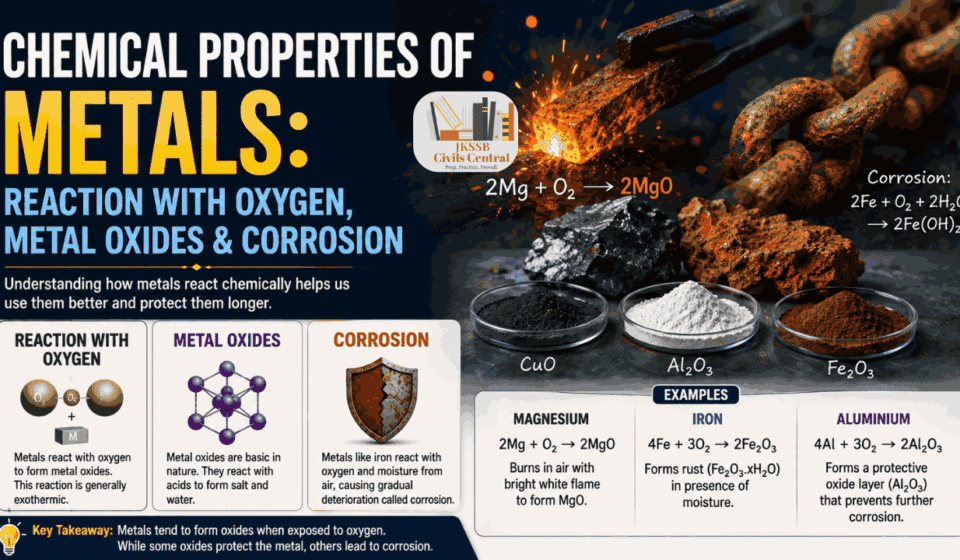
Chemical Properties of Metals: Reaction with Oxygen, Metal Oxides & Corrosion

Chemical Properties of Metals: Reaction with Oxygen, Metal Oxides & Corrosion
Learning Dashboard
| Chapter Information | Details |
|---|---|
| Subject | General Science – Chemistry |
| Series | Metals and Non-Metals |
| Lesson Number | Lesson 2 |
| Previous Lesson | Metals and Non-Metals: Properties, Classification & Physical Properties |
| Current Lesson | Chemical Properties of Metals: Reaction with Oxygen, Metal Oxides & Corrosion |
| Next Lesson | Chemical Properties of Metals: Reaction with Water – Cold Water, Hot Water & Steam Explained |
| Core Theme | Metals readily react with oxygen because of their tendency to lose electrons. This lesson explains the formation of metal oxides, oxidation, protective oxide layers, and the beginning of corrosion, providing the foundation for understanding the chemical behaviour of metals. |
| Major Topics Covered | Chemical Properties of Metals, Electronic Configuration, Electropositive Nature, Reaction with Oxygen, Metal Oxides, Basic Oxides, Amphoteric Oxides, Reactions of Magnesium, Iron, Copper & Aluminium, Protective Oxide Layers, Reactivity Towards Oxygen, Introduction to Corrosion |
| Important Metals Studied | Magnesium (Mg), Iron (Fe), Copper (Cu), Aluminium (Al), Sodium (Na), Potassium (K), Zinc (Zn), Silver (Ag), Gold (Au) |
| Key Concepts | Chemical Properties, Oxidation, Metal Oxides, Basic Oxides, Amphoteric Oxides, Protective Oxide Layer, Corrosion, Electropositive Nature, Reactivity of Metals |
| Real-Life Applications | Rusting of Iron, Aluminium Utensils, Copper Patina, Fireworks (Magnesium), Protective Metal Coatings, Construction Materials, Industrial Metal Oxides |
| Exam Focus | ★★★★★ Very High – Frequently Asked in JKSSB FAA, JKSSB, JKPSC, JKAS, SSC, CDS, UPSC & State PSC Examinations |
Chapter Overview
In the previous lesson, we explored the classification of elements and studied the physical properties of metals, non-metals, and metalloids. We learned why metals are lustrous, malleable, ductile, sonorous, and excellent conductors of heat and electricity, while non-metals possess contrasting physical characteristics. These properties helped us understand how different elements behave under normal conditions and why they are used for specific purposes in our daily lives.
However, the true nature of a metal cannot be understood by studying its physical properties alone. A metal reveals its real behaviour only when it participates in a chemical reaction. Every day, we observe examples of such reactions without even realizing the science behind them. Iron gates develop rust after prolonged exposure to air, copper utensils gradually acquire a green coating, aluminium remains corrosion-resistant despite being highly reactive, and magnesium burns with an intense white flame when heated. Although these phenomena appear different, they all have one common cause—the interaction of metals with oxygen.
This lesson marks the beginning of the study of the chemical properties of metals. Among all chemical reactions involving metals, their reaction with oxygen is the most fundamental because it introduces the concepts of oxidation, metal oxides, basic and amphoteric oxides, protective oxide layers, and corrosion. These concepts not only explain the behaviour of metals in nature but also form the foundation for understanding metallurgy, electrochemistry, corrosion prevention, and several industrial processes.
Throughout this lesson, we will explore why metals react with oxygen, how metal oxides are formed, why different metals react at different rates, and why some metals corrode while others remain protected by thin oxide layers. Each concept will be explained with chemical equations, scientific reasoning, practical examples, and examination-oriented insights to ensure long-term understanding rather than short-term memorization.
Why Do Metals Undergo Chemical Reactions?
Before studying the reaction of metals with oxygen, it is important to understand why metals react in the first place. Every chemical reaction involving metals—whether it is the rusting of iron, the burning of magnesium, or the corrosion of copper—is driven by the natural tendency of metal atoms to achieve a more stable electronic configuration.
Understanding this fundamental principle makes all subsequent chemical reactions easier to understand because every reaction follows the same basic rule: metals tend to lose electrons to become stable.
The Need for Stability
Every atom in nature tries to achieve a stable electronic configuration. An atom becomes chemically stable when its outermost electron shell is completely filled. In most cases, this means having eight electrons in the valence shell, a principle commonly known as the Octet Rule.
Atoms that do not possess a complete outermost shell are chemically unstable. To attain stability, they either lose, gain, or share electrons during chemical reactions.
Most metals contain one, two, or three electrons in their outermost shell. Since losing these few electrons requires much less energy than gaining several additional electrons, metals naturally prefer to lose electrons and attain a stable electronic configuration.
Loss of Electrons by Metals
The most important chemical characteristic of metals is their tendency to lose electrons. When a metal atom loses one or more electrons, it is converted into a positively charged ion, known as a cation. This happens because the atom now contains more protons than electrons.
For example, sodium loses one electron to form a sodium ion.
Na → Na⁺ + e⁻
Similarly, magnesium loses two electrons to form a magnesium ion.
Mg → Mg²⁺ + 2e⁻
Aluminium loses three electrons to form an aluminium ion.
Al → Al³⁺ + 3e⁻
These reactions demonstrate that metals generally participate in chemical reactions by donating electrons rather than accepting them.
Why are Metals Called Electropositive Elements?
Since metals readily lose electrons during chemical reactions, they are known as electropositive elements.
The term electropositive refers to the tendency of an element to donate electrons and form positively charged ions. This property distinguishes metals from non-metals, which generally gain electrons and are therefore called electronegative elements.
The electropositive nature of metals is responsible for almost all their chemical reactions, including their reactions with oxygen, water, acids, and salt solutions.
Formation of Positive Ions (Cations)
Whenever a metal loses electrons, it forms a cation.
Some common examples are:
| Metal | Electrons Lost | Ion Formed |
|---|---|---|
| Sodium | 1 | Na⁺ |
| Magnesium | 2 | Mg²⁺ |
| Aluminium | 3 | Al³⁺ |
| Calcium | 2 | Ca²⁺ |
| Zinc | 2 | Zn²⁺ |
These positively charged ions combine with negatively charged ions such as oxygen, chlorine, or sulphur to form stable ionic compounds.
How Does This Lead to Chemical Reactions?
Most non-metals, especially oxygen, have a strong tendency to gain electrons. When a metal comes into contact with oxygen, electrons move naturally from the metal atom to the oxygen atom. As a result, the metal is oxidized and a metal oxide is formed.
This explains why metals react with oxygen to produce compounds such as:
- Magnesium oxide (MgO)
- Aluminium oxide (Al₂O₃)
- Iron oxide (Fe₂O₃)
- Copper oxide (CuO)
Thus, the tendency of metals to lose electrons forms the basis of their entire chemical behaviour.
Why is This Concept Important?
Understanding why metals undergo chemical reactions is the foundation for all subsequent topics in this chapter. Once you understand that metals naturally lose electrons to become stable, it becomes much easier to explain their reactions with oxygen, water, acids, bases, and salt solutions.
Instead of memorizing individual chemical equations, you will be able to predict the behaviour of metals based on this single fundamental principle.
Reaction of Metals with Oxygen
Having understood why metals undergo chemical reactions, we can now study the most fundamental chemical reaction of metals—their reaction with oxygen. This reaction is not only one of the simplest chemical reactions but also one of the most important because it explains many natural phenomena such as the burning of magnesium, rusting of iron, tarnishing of copper, and the corrosion resistance of aluminium.
Oxygen is one of the most abundant elements on Earth. It constitutes about 21% of the Earth’s atmosphere and is present in water, minerals, and numerous chemical compounds. Since metals are constantly exposed to oxygen in the atmosphere, understanding this reaction is essential for explaining their behaviour in both nature and industrial applications.
Although all metals react with oxygen, they do not react at the same rate. Some metals react so vigorously that they may catch fire when exposed to air, while others react slowly over a period of months or years. A few noble metals hardly react with oxygen under ordinary conditions. These differences arise because each metal has a different tendency to lose electrons.
Why Do Metals React with Oxygen?
The reaction between metals and oxygen is driven by the transfer of electrons. Metals naturally tend to lose electrons to achieve a stable electronic configuration. Oxygen, on the other hand, is a highly electronegative element with a strong tendency to gain electrons. When a metal comes into contact with oxygen, electrons move from the metal atom to the oxygen atom.
As a result:
- The metal is oxidized because it loses electrons.
- Oxygen is reduced because it gains electrons.
- A new compound known as a metal oxide is formed.
Thus, the reaction between metals and oxygen is an example of an oxidation-reduction (redox) reaction, where oxidation and reduction occur simultaneously.
General Chemical Equation
The reaction of a metal with oxygen can be represented by a simple general equation:
Metal + Oxygen → Metal Oxide
In symbolic form,
Metal + O₂ → Metal Oxide
Although the products vary depending on the metal involved, the overall pattern remains the same—oxygen combines with the metal to produce a stable oxide.
Some common examples include:
- Magnesium + Oxygen → Magnesium Oxide
- Iron + Oxygen → Iron Oxide
- Copper + Oxygen → Copper Oxide
- Aluminium + Oxygen → Aluminium Oxide
This simple equation forms the basis for understanding oxidation, corrosion, extraction of metals, and several industrial processes.
What are Metal Oxides?
Whenever a metal combines chemically with oxygen, the product formed is known as a metal oxide. A metal oxide is therefore a compound consisting of a metal and oxygen. During its formation, the metal loses electrons while oxygen gains those electrons, producing a stable ionic compound.
Metal oxides differ from the original metals in both their physical and chemical properties. For example, shiny magnesium metal changes into a white powder called magnesium oxide, while reddish-brown iron gradually transforms into brown iron oxide during rusting.
The formation of metal oxides is one of the most common chemical changes observed in everyday life and plays an important role in metallurgy, manufacturing, construction, and environmental chemistry.
Characteristics of Metal Oxides
Although different metals produce different oxides, most metal oxides share several common characteristics. Most metal oxides are solid compounds at room temperature and generally possess high melting and boiling points because of the strong electrostatic attraction between positively charged metal ions and negatively charged oxide ions.
Another important characteristic is that most metal oxides are basic in nature. When they react with acids, they form salt and water, which is a characteristic property of bases.
Some metal oxides, however, do not behave purely as bases. Oxides of metals such as aluminium and zinc can react with both acids and bases. Such oxides are called amphoteric oxides, and they will be discussed in detail later in this lesson.
Why is the Reaction with Oxygen Important?
The reaction between metals and oxygen is much more than a simple chemical equation. It explains several processes that we observe in everyday life and forms the basis of many industrial applications.
For example, the brilliant white flame produced when magnesium burns is a result of its rapid reaction with oxygen. The rusting of iron bridges and railway tracks occurs because iron slowly reacts with oxygen in the presence of moisture. Aluminium remains resistant to corrosion because it develops a thin protective oxide layer on its surface, while copper utensils gradually acquire a green coating after prolonged exposure to moist air.
Understanding this reaction also helps explain why certain metals require special storage conditions, why some metals corrode rapidly whereas others remain unaffected for decades, and why metal oxides are extensively used in industries such as cement manufacturing, ceramics, metallurgy, and paint production.
Nature of Metal Oxides
We learned that when metals react with oxygen, they form metal oxides. However, not all metal oxides behave in the same manner. Some react only with acids, while others react with both acids and bases. Based on their chemical behaviour, metal oxides are mainly classified into basic oxides and amphoteric oxides.
Understanding this classification is important because it explains the chemical properties of different metals and is one of the most frequently tested topics in competitive examinations.
Basic Metal Oxides
Most metal oxides are basic in nature. A basic oxide is an oxide that reacts with an acid to produce salt and water. This behaviour is similar to that of a base such as sodium hydroxide.
The basic nature of metal oxides is due to the presence of oxide ions (O²⁻), which can neutralize acids. Since most metals are electropositive and readily lose electrons, the oxides formed by them generally exhibit basic properties.
Some common examples of basic metal oxides include:
- Magnesium oxide (MgO)
- Calcium oxide (CaO)
- Sodium oxide (Na₂O)
- Potassium oxide (K₂O)
These oxides are widely used in industries, laboratories, and construction because of their alkaline nature.
Reaction of Basic Oxides with Acids
One of the characteristic properties of basic oxides is that they react with acids to form salt and water. This reaction is known as a neutralization reaction because the acidic and basic properties neutralize each other.
For example, magnesium oxide reacts with hydrochloric acid to produce magnesium chloride and water.
MgO + 2HCl → MgCl₂ + H₂O
Similarly, calcium oxide reacts with hydrochloric acid to form calcium chloride and water.
CaO + 2HCl → CaCl₂ + H₂O
These reactions confirm that magnesium oxide and calcium oxide behave as basic oxides.
Applications of Basic Metal Oxides
The basic nature of metal oxides makes them useful in a variety of industrial and commercial applications.
Calcium oxide (quicklime) is extensively used in the manufacture of cement, glass, and steel. It is also used for neutralizing acidic soils in agriculture.
Magnesium oxide is used in refractory bricks because it can withstand very high temperatures without decomposing. It is also used in medicines as an antacid to reduce excess stomach acid.
Several metal oxides are also employed in water treatment, pollution control, and chemical manufacturing because of their ability to neutralize acidic substances.
Amphoteric Oxides
Although most metal oxides are basic, there are a few important exceptions. Certain metal oxides exhibit both acidic and basic properties. These oxides are known as amphoteric oxides.
An amphoteric oxide reacts with both acids and bases, producing different products depending on the substance with which it reacts.
The two most important amphoteric oxides studied at the school and competitive examination level are:
- Aluminium oxide (Al₂O₃)
- Zinc oxide (ZnO)
These oxides occupy an intermediate position between acidic and basic oxides and therefore show dual chemical behaviour.
Reaction of Amphoteric Oxides with Acids
Like basic oxides, amphoteric oxides react with acids to produce salt and water.
For example, aluminium oxide reacts with hydrochloric acid to form aluminium chloride and water.
Al₂O₃ + 6HCl → 2AlCl₃ + 3H₂O
Similarly, zinc oxide reacts with hydrochloric acid to form zinc chloride and water.
ZnO + 2HCl → ZnCl₂ + H₂O
These reactions demonstrate the basic behaviour of amphoteric oxides.
Reaction of Amphoteric Oxides with Bases
Unlike ordinary basic oxides, amphoteric oxides can also react with strong bases such as sodium hydroxide.
For example, aluminium oxide reacts with sodium hydroxide to form sodium aluminate.
Al₂O₃ + 2NaOH → 2NaAlO₂ + H₂O
Similarly, zinc oxide reacts with sodium hydroxide to produce sodium zincate.
ZnO + 2NaOH → Na₂ZnO₂ + H₂O
This ability to react with both acids and bases is the defining characteristic of amphoteric oxides.
Basic Oxides vs Amphoteric Oxides
The difference between these two categories is summarized below.
| Property | Basic Oxides | Amphoteric Oxides |
|---|---|---|
| Nature | Basic | Both acidic and basic |
| React with Acids | Yes | Yes |
| React with Bases | No | Yes |
| Common Examples | MgO, CaO, Na₂O | Al₂O₃, ZnO |
Why is this Classification Important?
The classification of metal oxides into basic and amphoteric is not merely theoretical. It explains why different metals behave differently during chemical reactions and why they are selected for specific industrial applications.
For instance, the amphoteric nature of aluminium oxide contributes to the remarkable corrosion resistance of aluminium, making it suitable for aircraft, electrical transmission lines, kitchen utensils, and construction materials. Similarly, zinc oxide finds applications in rubber manufacturing, paints, cosmetics, and pharmaceuticals because of its unique chemical properties.
A clear understanding of these concepts also provides the foundation for studying corrosion, metallurgy, extraction of metals, and electrochemistry, where the behaviour of metal oxides plays a central role.
Examples of Reactions of Metals with Oxygen
Having understood why metals react with oxygen and the nature of the metal oxides formed, let us now examine how different metals behave when they come into contact with oxygen. Although all metals combine with oxygen to form metal oxides, the rate of reaction, the products formed, and their behaviour differ from one metal to another.
Some metals react vigorously and produce brilliant flames, while others react slowly over long periods. Certain metals develop protective oxide layers that prevent further oxidation, whereas others continue to corrode gradually. Studying these examples helps us understand the practical applications of metals and forms an important part of competitive examinations.
Magnesium (Mg)
Magnesium is one of the most reactive metals commonly studied in chemistry. When a clean magnesium ribbon is heated in air, it reacts vigorously with oxygen and burns with a dazzling white flame, producing a white powder known as magnesium oxide.
Chemical Equation
2Mg + O₂ → 2MgO
Observation
During the reaction, the following observations can be made:
- The magnesium ribbon burns with an intense bright white flame.
- A large amount of heat and light is released.
- A white ash or powder of magnesium oxide remains after the reaction is complete.
This reaction is highly exothermic, meaning it releases a significant amount of heat energy along with light.
Scientific Explanation
Magnesium contains two electrons in its outermost shell and readily loses them during the reaction. Oxygen gains these electrons, resulting in the formation of magnesium oxide, an ionic compound. Because magnesium has a strong tendency to lose electrons, it reacts rapidly with oxygen once heated. The energy released during the reaction is responsible for the brilliant white flame that is characteristic of burning magnesium.
Applications
The intense white light produced by burning magnesium has several practical applications.
It is used in:
- Fireworks and pyrotechnic displays
- Emergency signal flares
- Distress signals at sea
- Military illumination devices
- Flash photography (historically)
Although modern electronic flash units have largely replaced magnesium flash powder, its ability to produce intense light remains an important industrial property.
Exam Tip
Remember the following points for competitive examinations:
- Magnesium burns with a dazzling white flame.
- It forms magnesium oxide (MgO).
- The reaction is highly exothermic.
- Magnesium oxide is a basic oxide.
Iron (Fe)
Unlike magnesium, iron reacts with oxygen much more slowly under ordinary conditions. A freshly cut iron surface does not immediately undergo rapid oxidation. However, when iron is exposed to both oxygen and moisture for a prolonged period, it gradually forms a reddish-brown substance known as rust.
Chemical Equation
4Fe + 3O₂ → 2Fe₂O₃
In the presence of water, the rust formed is commonly represented as hydrated iron(III) oxide (Fe₂O₃·xH₂O).
Observation
The following changes are observed during rusting:
- The shiny surface of iron gradually becomes dull.
- A reddish-brown coating develops on the surface.
- The metal slowly becomes weak and brittle.
- Rust flakes off, exposing fresh iron underneath.
Unlike the oxide layer formed on aluminium, rust is porous and does not adhere firmly to the surface. Therefore, it fails to protect the underlying metal.
Scientific Explanation
Iron loses electrons and reacts with oxygen to form iron oxide. In the presence of water vapour or moisture, this oxide becomes hydrated, producing rust.
Since rust is porous, oxygen and moisture continue to reach the fresh iron beneath it. As a result, corrosion continues progressively until a large portion of the metal is damaged.
This explains why old iron bridges, gates, pipelines, and machinery require regular maintenance and protective coatings.
Applications and Importance
Iron is one of the most widely used structural metals in the world. Therefore, understanding its reaction with oxygen is of great practical importance.
The study of rusting helps engineers design methods to protect iron structures through:
- Painting
- Galvanization
- Greasing
- Electroplating
- Alloy formation (stainless steel)
Preventing rust significantly increases the lifespan of buildings, bridges, railway tracks, vehicles, and industrial machinery.
Exam Tip
Remember these important facts:
- Iron reacts slowly with oxygen.
- Rusting requires both oxygen and moisture.
- Rust is hydrated iron(III) oxide.
- Rust is porous and does not protect the metal.
- Rusting weakens iron structures over time.
Comparison: Magnesium vs Iron
| Property | Magnesium | Iron |
|---|---|---|
| Rate of Reaction | Very Fast | Slow |
| Observation | Burns with bright white flame | Rusts gradually |
| Product Formed | Magnesium oxide (MgO) | Hydrated iron(III) oxide (Rust) |
| Heat Produced | Large amount | Very little under ordinary conditions |
| Nature of Oxide | Protective and stable | Porous and non-protective |
| Practical Importance | Fireworks, signal flares | Construction, corrosion studies |
Copper (Cu)
Copper is much less reactive than magnesium and iron, and therefore it does not react rapidly with oxygen under ordinary conditions. Freshly polished copper has a reddish-brown, lustrous appearance, but when it remains exposed to moist air for a long period, its surface gradually undergoes a series of slow chemical reactions.
Unlike iron, which develops rust, copper forms a green protective coating known as patina. This green layer is commonly observed on old copper roofs, statues, coins, and historical monuments. One of the best-known examples is the green colour of the Statue of Liberty, which is primarily due to the formation of patina.
Chemical Reactions
When heated strongly in air, copper reacts with oxygen to form black copper(II) oxide.
2Cu + O₂ → 2CuO
However, under ordinary atmospheric conditions, copper reacts slowly with oxygen, moisture, and carbon dioxide present in the air to form a green coating of basic copper carbonate.
2Cu + H₂O + CO₂ + O₂ → CuCO₃·Cu(OH)₂
This green compound is commonly known as patina.
Observation
The following changes can be observed when copper reacts with oxygen:
- Fresh copper has a shiny reddish-brown appearance.
- On prolonged exposure to moist air, the surface gradually turns green.
- A thin protective coating develops over the metal.
- The inner copper remains protected from further corrosion.
Unlike rust on iron, this green coating adheres firmly to the surface and prevents further oxidation.
Scientific Explanation
Copper reacts much more slowly than highly reactive metals because it has a lower tendency to lose electrons. Initially, a thin layer of copper oxide forms on the surface. Over time, this oxide further reacts with moisture and carbon dioxide present in the atmosphere to produce basic copper carbonate, which appears green.
This protective layer acts as a barrier between the metal and the surrounding air. As a result, oxygen and moisture cannot easily reach the underlying copper, preventing continuous corrosion.
This is an excellent example of how certain metal oxides protect the metal instead of damaging it.
Applications
The corrosion-resistant nature of copper makes it suitable for numerous applications.
Copper is widely used in:
- Electrical wiring and cables
- Water pipes and plumbing systems
- Coins
- Decorative articles
- Statues and monuments
- Roofing materials
Many historical monuments made of copper have survived for centuries because the patina protects the underlying metal from further deterioration.
Exam Tip
Remember the following important facts:
- Copper reacts slowly with oxygen.
- On heating, it forms black copper(II) oxide (CuO).
- In moist air, it develops a green patina.
- Patina mainly consists of basic copper carbonate.
- Unlike rust, the patina acts as a protective coating.
Aluminium (Al)
Aluminium presents one of the most interesting examples of the reaction between metals and oxygen. Although aluminium is more reactive than iron, it does not rust like iron. At first glance, this may seem surprising, but the explanation lies in the unique behaviour of the oxide formed on its surface.
The moment aluminium is exposed to air, it reacts rapidly with oxygen and forms an extremely thin, transparent, and hard layer of aluminium oxide. This oxide layer firmly adheres to the surface and completely covers the underlying metal.
Chemical Equation
4Al + 3O₂ → 2Al₂O₃
The product formed is aluminium oxide (Al₂O₃).
Observation
The reaction between aluminium and oxygen is generally not visible because it occurs almost instantly.
However, the following observations explain its behaviour:
- Fresh aluminium quickly develops a thin oxide layer.
- The oxide layer is transparent and difficult to see.
- It adheres firmly to the surface.
- Further reaction with oxygen almost stops.
As a result, aluminium remains bright and corrosion-resistant even after years of use.
Scientific Explanation
Aluminium has a strong tendency to lose electrons and is therefore a highly reactive metal. However, the aluminium oxide formed during the reaction is dense, hard, and non-porous. This oxide layer acts as a protective shield, preventing oxygen, moisture, and other corrosive substances from reaching the metal beneath. Since the underlying aluminium is isolated from the environment, further oxidation is effectively prevented.
This phenomenon is known as passivation, and it explains why aluminium is highly resistant to corrosion despite its high reactivity.
Applications
The protective oxide layer makes aluminium one of the most useful engineering metals.
It is extensively used in:
- Aircraft and spacecraft
- Cooking utensils
- Window and door frames
- Beverage cans
- Electrical transmission lines
- Automobile components
- Building construction
Its lightweight nature, combined with corrosion resistance, makes aluminium indispensable in modern engineering and manufacturing.
Exam Tip
Keep the following points in mind:
- Aluminium is highly reactive.
- It forms aluminium oxide (Al₂O₃).
- Aluminium oxide is a hard, protective, non-porous layer.
- This process is called passivation.
- Aluminium does not rust like iron because its oxide layer prevents further oxidation.
- Aluminium oxide is an amphoteric oxide, reacting with both acids and bases.
Comparison: Copper vs Aluminium
| Property | Copper | Aluminium |
|---|---|---|
| Rate of Reaction with Oxygen | Slow | Rapid (initially) |
| Oxide Formed | Copper Oxide (CuO) | Aluminium Oxide (Al₂O₃) |
| Surface Appearance | Green patina develops over time | Thin transparent oxide layer forms immediately |
| Nature of Oxide Layer | Protective | Highly protective and non-porous |
| Corrosion Resistance | High | Very High |
| Important Property | Patina protects the metal | Passivation prevents further oxidation |
| Major Applications | Electrical wiring, pipes, monuments | Aircraft, utensils, transmission lines, construction |
Reactivity of Metals Towards Oxygen
From the examples discussed so far, it is evident that all metals do not react with oxygen in the same manner. Magnesium burns with a dazzling white flame, iron rusts slowly over time, copper develops a green protective coating, while aluminium forms an invisible oxide layer that prevents further corrosion. These differences raise an important question: Why do some metals react vigorously with oxygen whereas others hardly react at all?
The answer lies in the reactivity of metals. Every metal has a different tendency to lose electrons. Metals that lose electrons easily react rapidly with oxygen, whereas metals that hold their electrons more strongly react slowly or may not react under ordinary conditions. Based on their behaviour, metals can be broadly classified into highly reactive, moderately reactive, and least reactive metals.
Highly Reactive Metals
Highly reactive metals possess a very strong tendency to lose electrons. As a result, they react vigorously with oxygen, often producing large amounts of heat and light. Some of these reactions are so violent that the metals may catch fire when exposed to air.
The most common highly reactive metals include:
- Potassium (K)
- Sodium (Na)
- Calcium (Ca)
These metals react so rapidly with oxygen and moisture present in the atmosphere that they cannot be left exposed to air. To prevent accidental reactions, sodium and potassium are stored under kerosene oil, which isolates them from air and moisture.
For example, sodium reacts rapidly with oxygen to form sodium oxide.
4Na + O₂ → 2Na₂O
Similarly, potassium reacts even more vigorously and may ignite spontaneously when exposed to air.
Characteristics of Highly Reactive Metals
Highly reactive metals exhibit several common characteristics.
They:
- Lose electrons very easily.
- React vigorously with oxygen.
- Produce large amounts of heat during the reaction.
- May catch fire when exposed to air.
- Require special storage methods to prevent accidental oxidation.
Because of their extreme reactivity, these metals are rarely found in the free state in nature. Instead, they occur in the form of compounds such as oxides, chlorides, and carbonates.
Moderately Reactive Metals
Moderately reactive metals react with oxygen less vigorously than sodium or potassium. Most of them require heating before they react rapidly with oxygen, while some react slowly under ordinary atmospheric conditions.
Common moderately reactive metals include:
- Magnesium (Mg)
- Aluminium (Al)
- Zinc (Zn)
- Iron (Fe)
Among these, magnesium burns readily when heated, whereas aluminium immediately forms a protective oxide layer. Iron reacts slowly and eventually forms rust in the presence of moisture.
These metals are widely used in construction, transportation, electrical engineering, and household products because they provide a good balance between strength and chemical stability.
Characteristics of Moderately Reactive Metals
Moderately reactive metals generally:
- Lose electrons less readily than highly reactive metals.
- Often require heating to react rapidly with oxygen.
- May develop protective oxide layers.
- Are commonly used for engineering and industrial applications.
Their moderate reactivity makes them suitable for everyday use because they are neither too reactive nor completely unreactive.
Least Reactive Metals
Least reactive metals have very little tendency to lose electrons. Consequently, they react very slowly with oxygen and often remain unaffected even after prolonged exposure to air.
The most common least reactive metals are:
- Gold (Au)
- Silver (Ag)
- Platinum (Pt)
These metals are often referred to as noble metals because of their exceptional resistance to oxidation and corrosion. Gold, for example, retains its lustre for many years without forming an oxide layer. This is why gold ornaments remain shiny even after decades of use. Similarly, platinum is highly resistant to chemical attack and is therefore used in laboratory equipment, catalysts, and high-quality jewellery.
Characteristics of Least Reactive Metals
Least reactive metals possess the following characteristics:
- Very low tendency to lose electrons.
- Hardly react with oxygen under ordinary conditions.
- Resist corrosion and oxidation.
- Retain their lustre for long periods.
- Often occur in the free (native) state in nature.
Their excellent corrosion resistance makes them valuable despite their high cost.
Factors Affecting the Reactivity of Metals
The reactivity of a metal is primarily determined by how easily it loses its valence electrons. Metals with fewer and more loosely held outer electrons lose them readily and therefore react more vigorously.
Several factors influence this behaviour, including:
- The number of electrons in the outermost shell.
- The distance of the valence electrons from the nucleus.
- The strength with which the nucleus attracts these electrons.
- The amount of energy required to remove the outermost electrons.
As we move down certain groups in the Periodic Table, the outermost electrons are located farther from the nucleus and are held less tightly. Consequently, metals such as potassium are generally more reactive than sodium, and sodium is more reactive than lithium.
Summary of Reactivity Towards Oxygen
The behaviour of different metals towards oxygen can be summarized as follows:
| Category | Metals | Behaviour with Oxygen |
|---|---|---|
| Highly Reactive | Potassium, Sodium, Calcium | React vigorously; may catch fire; stored under kerosene oil |
| Moderately Reactive | Magnesium, Aluminium, Zinc, Iron | React on heating or slowly in air; some form protective oxide layers |
| Least Reactive | Gold, Silver, Platinum | Hardly react with oxygen; resist corrosion and retain lustre |
Why is the Reactivity of Metals Important?
Understanding the reactivity of metals is essential because it explains many practical observations in everyday life. It tells us why sodium cannot be kept in the open, why magnesium burns with an intense flame, why iron rusts, why aluminium is corrosion-resistant, and why gold jewellery remains shiny for years.
Moreover, the concept of reactivity forms the basis for understanding the Reactivity Series of Metals, extraction of metals from ores, displacement reactions, corrosion, and electrochemistry. Therefore, mastering this concept is crucial not only for competitive examinations but also for advanced studies in chemistry.
Protective Oxide Layers and Passivation
We learned that different metals react with oxygen at different rates. However, an interesting observation can be made from these reactions. Some metals continue to corrode even after oxidation begins, while others stop reacting after forming a very thin oxide layer on their surface.
For example, iron continues to rust for years, gradually weakening the metal. In contrast, aluminium reacts rapidly with oxygen initially but then remains protected for decades. Similarly, metals such as zinc and chromium also show remarkable resistance to corrosion.
The reason behind this difference lies in the nature of the oxide layer formed during oxidation. If the oxide layer is compact, hard, and firmly attached to the surface, it acts as a protective shield and prevents further oxidation. Such a layer is called a protective oxide layer.
What is a Protective Oxide Layer?
A protective oxide layer is a thin, hard, and non-porous coating that forms naturally on the surface of certain metals when they react with oxygen.
Unlike ordinary corrosion products, this oxide layer adheres firmly to the metal and prevents oxygen, moisture, and other corrosive substances from reaching the underlying metal. As a result, further chemical reaction almost completely stops.
Although the metal undergoes oxidation initially, the protective layer acts as a barrier, preserving the remaining metal beneath it. This natural protection greatly increases the durability and lifespan of the metal.
What is Passivation?
The formation of a protective oxide layer is known as passivation. Passivation is a natural process in which a highly reactive metal becomes chemically less active because its surface is covered by a stable oxide film. Once this film is formed, the metal no longer comes into direct contact with oxygen or moisture, significantly reducing further corrosion.
It is important to understand that passivation does not mean the metal has become less reactive by nature. Instead, it means that the protective oxide layer prevents further reaction with the surrounding environment.
Passivation is one of the main reasons why several highly reactive metals remain stable and useful under ordinary atmospheric conditions.
Aluminium – A Classic Example of Passivation
Aluminium is one of the best examples of a metal that undergoes passivation.
Although aluminium is chemically more reactive than iron, it does not rust like iron because it forms an extremely thin but very strong layer of aluminium oxide (Al₂O₃) immediately after exposure to air.
This oxide layer possesses several important characteristics:
- It is extremely thin.
- It is hard and compact.
- It is non-porous.
- It adheres firmly to the metal surface.
- It prevents oxygen and moisture from reaching the metal beneath.
Because of these properties, aluminium remains protected even in humid environments. This explains why aluminium is extensively used for making aircraft bodies, kitchen utensils, window frames, beverage cans, and electrical transmission lines.
Zinc – Natural Corrosion Resistance
Zinc also forms a protective oxide layer when exposed to oxygen. Initially, zinc reacts with oxygen to produce zinc oxide (ZnO). On prolonged exposure to air, this oxide reacts further with carbon dioxide and moisture to form a stable protective coating.
This protective layer slows down further oxidation and greatly increases the durability of zinc products. One of the most important applications of zinc is galvanization, a process in which a thin layer of zinc is coated over iron to protect it from rusting.
Even if the zinc coating is slightly damaged, zinc reacts first with oxygen because it is more reactive than iron. In this way, zinc continues to protect the underlying iron from corrosion.
Chromium – The Secret Behind Stainless Steel
Chromium is another metal that exhibits passivation. When exposed to oxygen, chromium forms a thin layer of chromium oxide (Cr₂O₃) on its surface. This oxide layer is highly stable, hard, and resistant to chemical attack.
The corrosion resistance of stainless steel is primarily due to the presence of chromium. Stainless steel contains about 10–12% chromium, which continuously forms a protective oxide layer whenever the surface is exposed to air.
Even if the surface is scratched, a new chromium oxide layer quickly forms, restoring the protection.
This property makes stainless steel ideal for:
- Kitchen utensils
- Surgical instruments
- Food processing equipment
- Water storage tanks
- Industrial machinery
Why Does Iron Continue to Rust?
Unlike aluminium, zinc, and chromium, iron does not form a protective oxide layer. When iron reacts with oxygen in the presence of moisture, it forms rust (hydrated iron(III) oxide). Rust is porous, loose, and flaky. It does not adhere firmly to the surface and therefore cannot protect the underlying metal.
As rust flakes off, fresh iron is exposed to oxygen and moisture, allowing corrosion to continue. This continuous cycle gradually weakens iron structures and eventually leads to significant material loss.
This is the fundamental reason why iron bridges, pipelines, vehicles, and machinery require regular maintenance and protective coatings.
Comparison of Protective and Non-Protective Oxide Layers
The behaviour of different oxide layers can be summarized below.
| Property | Protective Oxide Layer | Non-Protective Oxide Layer |
|---|---|---|
| Structure | Compact and hard | Porous and flaky |
| Adhesion | Firmly attached | Loosely attached |
| Permeability | Prevents oxygen and moisture from entering | Allows oxygen and moisture to reach the metal |
| Effect on Corrosion | Stops or greatly slows further corrosion | Corrosion continues |
| Examples | Aluminium oxide, Zinc oxide, Chromium oxide | Rust (Hydrated Iron Oxide) |
Importance of Protective Oxide Layers
Protective oxide layers play an important role in engineering, construction, transportation, and manufacturing.
Their major advantages include:
- Increasing the lifespan of metal structures.
- Reducing corrosion and maintenance costs.
- Protecting metals from moisture and atmospheric oxygen.
- Improving the durability of household and industrial products.
- Enhancing the safety and reliability of engineering structures.
Without these naturally formed oxide layers, metals such as aluminium and stainless steel would corrode much more rapidly, making them unsuitable for many modern applications.
JKSSB Exam Tip
The following facts are frequently asked in competitive examinations:
- Passivation is the formation of a protective oxide layer on a metal surface.
- Aluminium oxide (Al₂O₃) forms a hard, protective coating.
- Chromium oxide (Cr₂O₃) provides corrosion resistance to stainless steel.
- Zinc protects iron through galvanization.
- Rust is not a protective layer because it is porous and allows corrosion to continue.
- Aluminium is more reactive than iron, yet it resists corrosion due to passivation.
Introduction to Corrosion
In the previous sections, we learned that when metals react with oxygen, they form metal oxides. We also discovered that some metals, such as aluminium and chromium, develop protective oxide layers that prevent further chemical attack. However, not all metals are equally fortunate. Certain metals continue to react slowly with their surroundings, leading to gradual deterioration and loss of strength. This undesirable process is known as corrosion.
Corrosion is one of the most significant challenges in engineering, construction, transportation, and manufacturing. Every year, enormous amounts of money are spent worldwide on repairing or replacing metal structures damaged by corrosion. From rusted bridges and leaking pipelines to damaged vehicles and weakened machinery, corrosion affects almost every sector that depends on metals.
Understanding corrosion is therefore important not only from an examination perspective but also because it explains one of the most common chemical changes observed in our daily lives.
What is Corrosion?
Corrosion is the slow and gradual deterioration of a metal due to its reaction with substances present in the surrounding environment, such as oxygen, moisture, acids, or salts. During corrosion, the original metal is gradually converted into more stable compounds such as oxides, hydroxides, sulphides, or carbonates, depending on the environmental conditions.
Unlike many chemical reactions that occur rapidly, corrosion is generally a slow process. It may take days, months, or even years before visible signs of corrosion appear, but once it begins, it continues unless appropriate preventive measures are taken.
The most familiar example of corrosion is the rusting of iron, where iron slowly reacts with oxygen and moisture to form hydrated iron(III) oxide, commonly known as rust.
Corrosion vs Oxidation
Many students assume that corrosion and oxidation are the same process. Although they are closely related, they are not identical.
Oxidation is a broad chemical process in which a substance combines with oxygen or loses electrons. It may occur rapidly or slowly and does not necessarily result in damage.
Corrosion, on the other hand, is a specific type of oxidation that leads to the gradual destruction or deterioration of metals due to environmental reactions.
For example:
- Burning of magnesium is an example of rapid oxidation, but it is not considered corrosion.
- Formation of aluminium oxide is oxidation, but the oxide layer protects the metal and therefore does not cause destructive corrosion.
- Rusting of iron is both oxidation and corrosion, because the oxide formed is porous and continuously damages the metal.
Thus, every corrosion process involves oxidation, but not every oxidation process results in corrosion.
Conditions Necessary for Corrosion
Corrosion does not occur under all circumstances. Certain environmental conditions are necessary for the process to begin and continue.
The most important conditions include:
- Presence of oxygen
- Presence of moisture or water
- Exposure to salts or acidic substances
- Long-term exposure to the atmosphere
Among these, oxygen and moisture are the most essential for the rusting of iron. This explains why an iron object kept in a dry environment rusts much more slowly than one exposed to humid air or rainwater. Similarly, iron structures located near the sea corrode more rapidly because seawater contains dissolved salts that accelerate the corrosion process.
Everyday Examples of Corrosion
Corrosion is a familiar phenomenon that can be observed in many everyday situations.
Some common examples include:
- Rusting of iron gates, fences, and bridges.
- Corrosion of water pipelines.
- Rust formation on bicycles and automobiles.
- Damage to ship hulls due to seawater.
- Corrosion of underground metal pipelines.
- Deterioration of railway tracks exposed to rain and humidity.
These examples demonstrate that corrosion is not merely a laboratory concept but a major practical problem affecting infrastructure and public safety.
Harmful Effects of Corrosion
Corrosion has serious economic and engineering consequences because it gradually weakens metallic structures and reduces their useful life.
Some of its major harmful effects are:
- Weakening of buildings, bridges, and industrial structures.
- Damage to vehicles, machinery, and equipment.
- Leakage in water, gas, and oil pipelines.
- Increased maintenance and repair costs.
- Reduction in the efficiency of industrial machines.
- Safety hazards due to failure of metallic structures.
Worldwide, billions of dollars are spent every year to repair or replace materials damaged by corrosion, making it one of the costliest chemical processes affecting human society.
Can Corrosion be Prevented?
Fortunately, corrosion is not an unavoidable process. Several methods can significantly reduce or even prevent corrosion by preventing the metal from coming into direct contact with oxygen and moisture.
Some commonly used methods include:
- Painting
- Oiling and greasing
- Galvanization
- Electroplating
- Alloy formation (such as stainless steel)
- Formation of protective oxide layers
Each of these methods works by creating a barrier between the metal and its surrounding environment, thereby reducing the chances of chemical reaction. The detailed study of these methods will be covered in Lesson 6: Corrosion and Prevention of Corrosion.
Why is Corrosion Important in Competitive Examinations?
Questions on corrosion are frequently asked because they combine concepts from oxidation, chemical reactions, metallurgy, and everyday science. Students are often expected to distinguish between oxidation and corrosion, identify the conditions required for rusting, recognize metals that form protective oxide layers, and understand common methods used to prevent corrosion.
A clear conceptual understanding of corrosion also helps in answering application-based questions related to engineering, construction, transportation, and industrial chemistry.
JKSSB CivilsCentral Insight
The reaction of metals with oxygen is one of the most fundamental topics in chemistry because it explains how metals undergo oxidation, why metal oxides are formed, and why different metals exhibit different levels of reactivity. A clear understanding of these concepts not only helps in answering direct examination questions but also builds the foundation for advanced topics such as the reactivity series, corrosion, metallurgy, electrochemistry, and extraction of metals.
One of the most important concepts to remember is that metals react because they tend to lose electrons. Since most metals possess one, two, or three electrons in their outermost shell, they can achieve a more stable electronic configuration by losing these electrons. This property makes metals electropositive elements, and it is the primary reason behind almost every chemical reaction involving metals.
When a metal reacts with oxygen, it loses electrons while oxygen gains them. Consequently, a metal oxide is formed. This process is known as oxidation, and it represents one of the simplest examples of an oxidation-reduction (redox) reaction.
Although the general reaction remains the same, different metals react with oxygen at different rates. Highly reactive metals such as potassium, sodium, and calcium react vigorously with oxygen and may even catch fire when exposed to air. Moderately reactive metals such as magnesium, aluminium, zinc, and iron react less vigorously, while noble metals like gold, silver, and platinum hardly react with oxygen under ordinary conditions.
Another concept frequently tested in competitive examinations is the nature of metal oxides. Most metal oxides are basic in nature and react with acids to produce salt and water. However, aluminium oxide (Al₂O₃) and zinc oxide (ZnO) are important exceptions because they are amphoteric oxides, meaning they react with both acids and bases. Questions based on amphoteric oxides are common in JKSSB, SSC, and State PSC examinations.
Students should also understand the difference between protective and non-protective oxide layers. Metals such as aluminium, zinc, and chromium develop thin, compact, and non-porous oxide layers that prevent further oxidation. This natural phenomenon is known as passivation and explains the excellent corrosion resistance of these metals. In contrast, iron forms rust, which is porous and loosely attached to the surface. Since rust cannot prevent oxygen and moisture from reaching the underlying metal, corrosion continues until the metal is significantly weakened.
Another important distinction is between oxidation and corrosion. Oxidation is a broad chemical process involving the loss of electrons or combination with oxygen, whereas corrosion is the gradual deterioration of a metal due to its reaction with the surrounding environment. Therefore, every corrosion process involves oxidation, but not every oxidation process leads to corrosion.
From an examination perspective, students should remember the following high-yield facts:
- Metal + Oxygen → Metal Oxide
- Metals lose electrons and form positive ions (cations).
- Oxygen gains electrons and acts as an oxidizing agent.
- Most metal oxides are basic.
- Aluminium oxide (Al₂O₃) and zinc oxide (ZnO) are amphoteric oxides.
- Magnesium burns with a dazzling white flame and forms magnesium oxide.
- Iron requires both oxygen and moisture for rusting.
- Copper develops a green protective patina after prolonged exposure to moist air.
- Aluminium forms a protective oxide layer through passivation.
- Sodium and potassium are stored under kerosene oil because they react vigorously with oxygen and moisture.
- Gold and platinum are least reactive and therefore resist oxidation under ordinary conditions.
Rather than memorizing these facts individually, try to connect them with one central idea: the tendency of metals to lose electrons. Once this concept is understood, the behaviour of metals with oxygen, water, acids, bases, and salt solutions becomes logical and much easier to remember.
Quick Revision
Before moving on to the next lesson, it is important to revise the key concepts discussed in this chapter. The following points summarize the entire lesson in a concise manner and are especially useful for last-minute revision before competitive examinations.
- Chemical properties describe the behaviour of metals when they undergo chemical reactions with substances such as oxygen, water, acids, bases, and salt solutions.
- Metals undergo chemical reactions because they tend to lose electrons and attain a stable electronic configuration. This tendency makes them electropositive elements.
- When metals lose electrons, they form positively charged ions (cations), while oxygen gains these electrons during the reaction.
- The general reaction of metals with oxygen is:Metal + Oxygen → Metal Oxide
- The formation of metal oxides is an example of an oxidation-reduction (redox) reaction, where the metal is oxidized and oxygen is reduced.
- Most metal oxides are basic in nature and react with acids to produce salt and water.
- Aluminium oxide (Al₂O₃) and zinc oxide (ZnO) are amphoteric oxides because they react with both acids and bases.
- Magnesium reacts vigorously with oxygen and burns with a dazzling white flame, producing magnesium oxide (MgO).
- Iron reacts slowly with oxygen in the presence of moisture to form rust (hydrated iron(III) oxide). Since rust is porous, it cannot protect the underlying metal.
- Copper reacts slowly with moist air to develop a green protective coating (patina) consisting mainly of basic copper carbonate.
- Aluminium reacts rapidly with oxygen but forms a thin, hard, non-porous layer of aluminium oxide, which protects the metal from further corrosion. This phenomenon is known as passivation.
- Metals such as aluminium, zinc, and chromium form protective oxide layers, whereas iron forms a non-protective oxide layer that allows corrosion to continue.
- Based on their reactivity towards oxygen, metals can be classified into:
- Highly Reactive: Potassium, Sodium, Calcium
- Moderately Reactive: Magnesium, Aluminium, Zinc, Iron
- Least Reactive: Gold, Silver, Platinum
- Sodium and potassium are stored under kerosene oil because they react vigorously with oxygen and moisture present in the air.
- Corrosion is the gradual deterioration of a metal due to its reaction with oxygen, moisture, acids, or other environmental substances.
- Although oxidation and corrosion are related, every corrosion process involves oxidation, but not every oxidation process results in corrosion.
- Corrosion weakens metallic structures, increases maintenance costs, and reduces the lifespan of machinery, bridges, pipelines, and vehicles.
- Protective methods such as painting, galvanization, electroplating, alloy formation, and passivation help in preventing corrosion.
Mind Map 1: Why Do Metals Undergo Chemical Reactions?
                 CHEMICAL PROPERTIES OF METALS
                            │
                            ▼
             WHY DO METALS UNDERGO CHEMICAL REACTIONS?
                            │
      ┌─────────────────────┼─────────────────────┐
      │                     │                     │
      ▼                     ▼                     ▼
 Need Stability       Lose Electrons      Form Cations
      │                     │                     │
      ▼                     ▼                     ▼
 Stable Electronic    Electropositive      Na⁺ Mg²⁺ Al³⁺
 Configuration         Nature

────────────────────────────────────────────────────────────

                     RESULT
                        │
                        ▼
         React with Oxygen, Water, Acids,
          Bases & Salt Solutions
Mind Map 2: Reaction of Metals with Oxygen
                REACTION OF METALS WITH OXYGEN
                           │
                           ▼
          Metal + Oxygen → Metal Oxide
                           │
      ┌────────────────────┼────────────────────┐
      │                    │                    │
      ▼                    ▼                    ▼
 Metal loses          Oxygen gains         Metal Oxide
 Electrons            Electrons            Formed

────────────────────────────────────────────────────────────

                 EXAMPLES

Mg + O₂ → MgO

Fe + O₂ → Fe₂O₃

Cu + O₂ → CuO

Al + O₂ → Al₂O₃
Mind Map 3: Nature of Metal Oxides
                    METAL OXIDES
                         │
          ┌──────────────┴──────────────┐
          │                             │
          ▼                             ▼
    BASIC OXIDES                AMPHOTERIC OXIDES
          │                             │
          │                             │
 React with Acids          React with Acids
                           AND Bases

          │                             │
          ▼                             ▼
 MgO                       Al₂O₃

 CaO                       ZnO

 Na₂O

──────────────────────────────────────────────

Basic Oxides
      │
      ▼
Salt + Water

Amphoteric Oxides
      │
      ▼
React with Both
Acids & Bases
Mind Map 4: Reaction of Important Metals with Oxygen
                METALS + OXYGEN
                       │
 ┌─────────────┬──────────────┬──────────────┬─────────────┐
 │             │              │              │
 ▼             ▼              ▼              ▼

MAGNESIUM      IRON         COPPER      ALUMINIUM

│              │              │              │

Burns with     Rusting      Green        Protective
White Flame    Occurs        Patina       Oxide Layer

│              │              │              │

MgO         Hydrated      Basic Copper     Al₂O₃
            Fe₂O₃         Carbonate

│              │              │              │

Very Fast     Slow         Slow         Passivation
Reaction      Reaction     Reaction
Mind Map 5: Reactivity & Corrosion
                 REACTIVITY OF METALS
                         │
      ┌──────────────────┼──────────────────┐
      │                  │                  │
      ▼                  ▼                  ▼
 Highly              Moderately          Least
 Reactive             Reactive          Reactive

Na                  Mg                Au

K                   Al                Ag

Ca                  Zn                Pt

                    Fe

──────────────────────────────────────────────

                PROTECTIVE LAYERS

Aluminium → Al₂O₃

Zinc → ZnO

Chromium → Cr₂O₃

Iron → Rust (Not Protective)

──────────────────────────────────────────────

              CORROSION

Oxygen + Moisture
        │
        ▼
 Rusting of Iron
        │
        ▼
 Weakens Metal
Frequently Asked Questions (FAQs)
The following frequently asked questions will help strengthen your conceptual understanding of the reaction of metals with oxygen. These questions cover the most common doubts asked by students and are highly relevant for JKSSB FAA, JKPSC, JKAS, SSC, CDS, UPSC, and other State PSC examinations.
1. Why do metals react with oxygen?
Metals react with oxygen because they have a natural tendency to lose electrons and attain a stable electronic configuration. Oxygen, being highly electronegative, readily accepts these electrons. This transfer of electrons results in the formation of metal oxides, making the reaction between metals and oxygen one of the most common chemical reactions in nature.
2. What is the general reaction between metals and oxygen?
The general chemical reaction is: Metal + Oxygen → Metal Oxide
In this reaction, the metal is oxidized by losing electrons, while oxygen is reduced by gaining those electrons. The product formed is known as a metal oxide.
3. What are metal oxides?
Metal oxides are compounds formed when metals chemically combine with oxygen. They are generally ionic compounds consisting of positively charged metal ions and negatively charged oxide ions. Most metal oxides are solid at room temperature and exhibit basic properties.
4. Why are most metal oxides basic in nature?
Most metal oxides are basic because they react with acids to produce salt and water. This behaviour is due to the presence of oxide ions, which neutralize acids. Examples of basic metal oxides include magnesium oxide (MgO) and calcium oxide (CaO).
5. What are amphoteric oxides?
Amphoteric oxides are oxides that exhibit both acidic and basic properties. They react with both acids and bases, unlike ordinary basic oxides.
The two most important amphoteric oxides are:
- Aluminium oxide (Al₂O₃)
- Zinc oxide (ZnO)
These oxides are among the most frequently asked topics in competitive examinations.
6. Why does magnesium burn with a dazzling white flame?
Magnesium is a highly reactive metal. When heated, it reacts vigorously with oxygen, releasing a large amount of heat and light. This produces the characteristic dazzling white flame and forms magnesium oxide (MgO).
7. Why does iron rust instead of forming a protective oxide layer?
Iron forms rust, which is chemically known as hydrated iron(III) oxide. Unlike aluminium oxide, rust is porous and loosely attached to the surface. It allows oxygen and moisture to continue reaching the underlying iron, causing corrosion to progress continuously.
8. Why does aluminium not rust like iron?
Although aluminium is more reactive than iron, it forms a thin, hard, and non-porous layer of aluminium oxide (Al₂O₃) immediately after exposure to air. This protective layer prevents oxygen and moisture from reaching the underlying metal, thereby stopping further corrosion. This phenomenon is known as passivation.
9. What is passivation?
Passivation is the process in which a metal forms a thin, stable, and protective oxide layer on its surface after reacting with oxygen. This oxide layer acts as a barrier and prevents further chemical reactions with the surrounding environment.
Aluminium, zinc, and chromium are common examples of metals that undergo passivation.
10. Why does copper develop a green coating?
Copper reacts slowly with oxygen, moisture, and carbon dioxide present in the atmosphere to form a green coating called patina. This coating mainly consists of basic copper carbonate and acts as a protective layer that prevents further corrosion.
11. Why are sodium and potassium stored under kerosene oil?
Sodium and potassium are highly reactive metals. They react vigorously with oxygen and moisture present in the air and may even catch fire. Storing them under kerosene oil prevents direct contact with air and water, ensuring safe storage.
12. Which metals form protective oxide layers?
Several metals form compact oxide layers that protect them from further corrosion. The most important examples are:
- Aluminium → Aluminium oxide (Al₂O₃)
- Zinc → Zinc oxide (ZnO)
- Chromium → Chromium oxide (Cr₂O₃)
These protective layers significantly increase the durability of the metals.
13. What is the difference between oxidation and corrosion?
Oxidation is a chemical process in which a substance loses electrons or combines with oxygen.
Corrosion is the gradual deterioration of a metal due to its reaction with oxygen, moisture, or other environmental substances.
Thus, every corrosion process involves oxidation, but not every oxidation process results in corrosion.
14. Why do different metals react with oxygen at different rates?
Different metals have different tendencies to lose electrons. Highly reactive metals lose electrons easily and react rapidly with oxygen, whereas less reactive metals hold their electrons more strongly and therefore react slowly or may not react under ordinary conditions.
This difference in electron-losing tendency determines the reactivity of metals.
15. Why are gold and platinum resistant to oxidation?
Gold and platinum are least reactive (noble) metals. They have a very low tendency to lose electrons and therefore hardly react with oxygen under ordinary conditions. This is why gold jewellery retains its shine for many years without corroding.
16. Which metals react most vigorously with oxygen?
Among the commonly studied metals:
- Potassium (K)
- Sodium (Na)
- Calcium (Ca)
are highly reactive and react vigorously with oxygen. Potassium and sodium may even ignite spontaneously when exposed to air.
17. Why is understanding the reaction of metals with oxygen important?
The reaction of metals with oxygen forms the foundation for several important topics in chemistry, including:
- Reactivity Series
- Corrosion and its Prevention
- Metallurgy
- Electrochemistry
- Extraction of Metals
- Redox Reactions
A clear understanding of this topic also helps explain many everyday phenomena, such as rusting, corrosion resistance, and the formation of protective oxide layers.
18. Which facts from this lesson are most frequently asked in competitive examinations?
The following facts should always be remembered:
- Metal + Oxygen → Metal Oxide
- Metals are electropositive and lose electrons.
- Most metal oxides are basic.
- Al₂O₃ and ZnO are amphoteric oxides.
- Magnesium burns with a dazzling white flame.
- Iron rusts only in the presence of oxygen and moisture.
- Copper develops a green patina.
- Aluminium undergoes passivation.
- Sodium and potassium are stored under kerosene oil.
- Gold, silver, and platinum are least reactive metals.
About The Author












[…] Chemical Properties of Metals: Reaction with Oxygen, Metal Oxides & Corrosion […]