
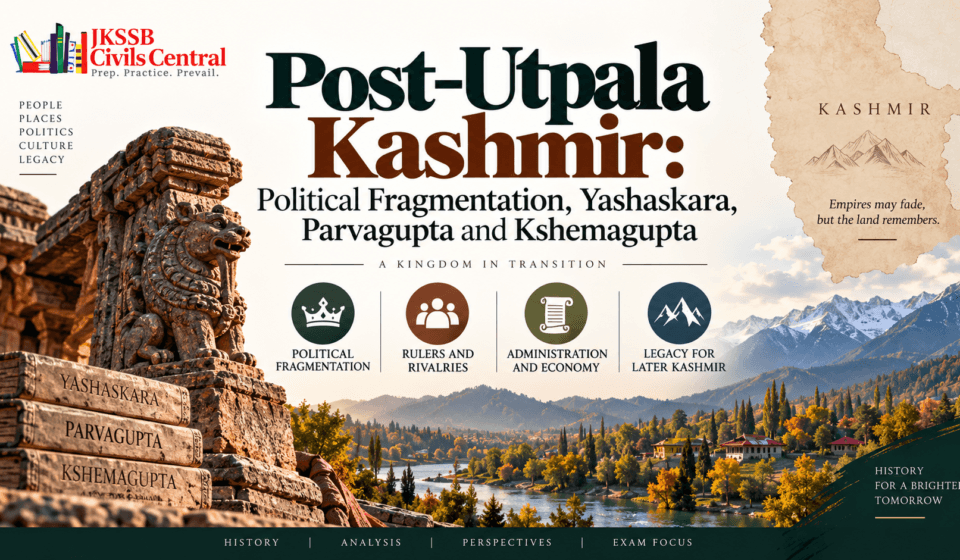
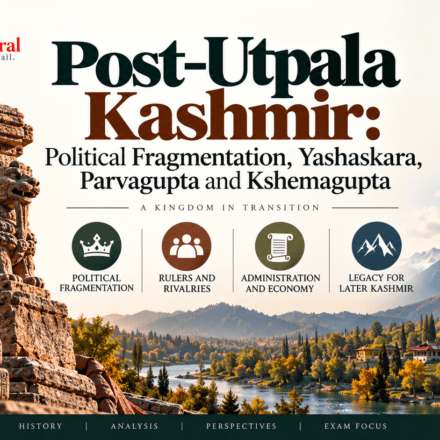
Post-Utpala Kashmir: Political Fragmentation, Yashaskara, Parvagupta and Kshemagupta

J&K History Series Navigation
| Previous Article | Current Article | Next Article |
|---|---|---|
| Article 15 — Shankaravarman and the Later Utpala Period: Expansion, Fiscal Pressure and Political Instability | Article 16 — Post-Utpala Kashmir: Political Fragmentation, Yashaskara, Parvagupta and Kshemagupta | Article 17 — Queen Didda and the Lohara Dynasty: Power, Politics and the Transition to Lohara Rule |
Learning Dashboard
| Category | Key Information |
|---|---|
| Historical Period | 10th century CE |
| Historical Phase | Late Early Medieval Kashmir |
| Political Context | Fragmentation after the decline of effective Utpala rule |
| Major Rulers | Yashaskara, Parvagupta, Kshemagupta |
| Important Transitional Rulers | Shuravarman II, Sangramadeva |
| Key Political Development | Increasing influence of ministers, court factions and competing power groups |
| Yashaskara | c. 939–948 CE |
| Parvagupta | c. 948/949–950 CE |
| Kshemagupta | c. 950–958 CE |
| Important Marriage | Kshemagupta married Didda of the Lohara family |
| Important Region | Kashmir Valley and Lohara country south-west of Kashmir |
| Major Source | Kalhana’s Rajatarangini, especially Book VI |
| Other Evidence | Coins, temple remains and external historical context |
| Core Theme | Political fragmentation → ministerial power → dynastic realignment → Lohara connection |
| JKSSB Importance | Very High |
| Expected Question Types | Chronology, statement-based, ruler-dynasty association, matching, identification and succession questions |
Introduction
The political history of Kashmir after the death of Shankaravarman in 902 CE did not immediately collapse into a single new dynasty. Instead, the kingdom entered a prolonged period of succession struggles, short-lived rulers, court factionalism and growing competition among ministers and military groups. Although the Utpala line continued for several decades after Shankaravarman, its political authority became increasingly unstable, and by 939 CE the old ruling order had effectively given way to a new phase.
The reign of Yashaskara, beginning around 939 CE, temporarily restored a measure of order. His accession is especially important because Kalhana presents him as a ruler selected through the intervention of leading Brahmins after the disorder of the preceding years. His reign, however, was relatively short, and the political system again became vulnerable after his death. The brief succession that followed eventually allowed Parvagupta, a powerful official associated with the office of divira, to transform ministerial influence into direct kingship.
Parvagupta’s short reign was followed by that of his son Kshemagupta, whose marriage to Didda, daughter of the Lohara ruler Simharaja, created a political connection that would become decisive in the subsequent history of Kashmir. Kshemagupta’s reign therefore occupies a crucial position between the weakening of the old Utpala political order and the emergence of the Lohara dynasty under Didda’s nephew after 1003 CE.
CivilsCentral Historical Insight: The significance of the post-Utpala period lies not in the appearance of a single replacement dynasty but in the gradual transfer of political power. Authority moved from an unstable royal line toward ministers, court factions and influential regional families. The marriage of Kshemagupta and Didda then connected Kashmir’s throne with the Lohara political house, creating a bridge between the late Utpala and later Lohara periods.
Part I — The Background: Why Utpala Rule Became Unstable
The Crisis After Shankaravarman
Shankaravarman’s death in 902 CE did not end Utpala rule, but it exposed the weakness of the political system that had developed during the later ninth century. His successor Gopalavarman ruled only briefly, followed by a succession of short reigns and competing political claims. The rapid turnover at the throne made it difficult for any ruler to establish durable authority.
The problem was not simply that individual rulers were weak. The deeper issue was that control over the state was becoming increasingly contested. Ministers, military groups, court factions and regional elites could influence succession and sometimes determine who occupied the throne.
The political sequence after Shankaravarman therefore became increasingly complicated:
Shankaravarman
→ Gopalavarman
→ Sankata
→ Sugandha
→ Partha
→ Nirjitavarman
→ Chakravarman
→ Shuravarman I
→ repeated changes of power
→ Unmattavanti
→ Shuravarman II
→ Yashaskara
This succession should not be memorised merely as a list. Its historical importance lies in the fact that short reigns and repeated changes weakened the continuity of royal authority.
The Rise of Court and Military Power
Kalhana’s narrative increasingly refers to groups such as the Tantrins, Ekangas, Damaras, ministers and other political actors. Their precise institutional character changed over time and should not be projected into a modern bureaucratic framework.
The important structural development was that political authority was no longer concentrated securely in the person of the king. Groups capable of controlling military force, court access or administrative resources could influence succession.
CivilsCentral Historical Insight: Political fragmentation is best understood as a redistribution of power. The weakening of the monarchy did not create a political vacuum; it created competition among other groups capable of exercising power. This distinction explains why Kashmir continued to have rulers while effective royal authority became increasingly unstable.
Part II — The End of the Earlier Utpala Order
Shuravarman II
The final ruler normally placed within the old Utpala sequence is Shuravarman II, whose reign is conventionally dated to around 939 CE. His short rule illustrates the instability that had developed by the end of the ninth and beginning of the tenth centuries. The rapid succession of rulers made dynastic legitimacy increasingly dependent upon the ability of political groups to support a claimant.
When Shuravarman II died, Kashmir entered a new political phase under Yashaskara.
It is useful to distinguish between: Utpala dynasty as a genealogical/political tradition and effective Utpala royal authority.
The old ruling line had already become extremely unstable before 939 CE. Consequently, the accession of Yashaskara should be understood as a major political transition even though later genealogical lists sometimes arrange these rulers differently.
Part III — Yashaskara: Restoration after Disorder
Yashaskara’s Rise
Yashaskara came to the throne around 939 CE. Kalhana presents his accession as the outcome of a political effort by leading Brahmins to restore order after the preceding instability. This is important because it shows that the monarchy could still derive legitimacy from groups outside the royal family. Yashaskara’s accession was therefore not simply a straightforward hereditary succession.
The historical tradition associates his selection with a collective political decision, giving the episode a distinctive place in Kashmir’s medieval history. The precise mechanics of the selection belong primarily to Kalhana’s narrative and should not be treated as evidence for a formal constitutional system in the modern sense.
Restoring Order
Kalhana portrays Yashaskara positively in comparison with several of his predecessors. He is described as restoring earlier regulations, suppressing disorder and addressing the activities of robbers and dishonest officials. These claims should be understood as part of Kalhana’s historical evaluation. They nevertheless suggest an important contemporary memory: Yashaskara was associated with restoration after political disorder.
His reign therefore represents a temporary reversal of the fragmentation that had characterised the preceding decades.
CivilsCentral Historical Insight: Yashaskara’s importance lies less in territorial expansion than in political restoration. His accession shows that when hereditary succession became unstable, elite groups could intervene to reconstruct royal authority around a ruler perceived as capable of restoring order.
Part IV — Yashaskara’s Relationship with the Political Elite
Yashaskara’s relationship with the Brahmanical elite was complex. Kalhana’s narrative suggests that he initially maintained some distance from powerful Brahmins but later became more generous toward them. This should not be converted into a simplistic statement that Yashaskara was either “anti-Brahmin” or “pro-Brahmin.” Medieval political relationships were more fluid than such labels suggest.
Royal authority depended upon relationships with multiple groups, and patronage could change according to political circumstances. The broader significance is that legitimacy and patronage were interconnected. A ruler needed support from influential groups, while elites benefited from royal protection and patronage.
Part V — The Administration and Economic Setting
The post-Utpala period inherited an economy shaped by the agricultural and hydraulic developments of earlier Utpala rule. However, political instability could weaken the state’s ability to maintain consistent administration. When succession became uncertain, officials and regional power holders had greater opportunities to pursue their own interests. The result could be a gap between formal royal authority and actual control over resources.
This does not mean that the economy collapsed during Yashaskara’s reign. Rather, political stability became a major economic resource in itself.
The relationship can be expressed as:
Stable kingship
→ predictable administration
→ stronger revenue collection
→ protection of agriculture and trade
→ greater political capacity
Where stability weakened:
Succession conflict
→ competing officials
→ local extraction
→ uncertain political authority
→ reduced central control.
This structural relationship helps explain why later Kashmir politics became increasingly dominated by court and military groups.
Part VI — Yashaskara and Temple Patronage
Yashaskara is associated with the construction of a Vishnu temple known as Yashaskarasvamin. The temple was not completed during his lifetime and was later completed under Parvagupta. This detail is historically useful because it connects the two rulers through a physical monument and demonstrates that political transition did not necessarily interrupt all forms of religious patronage.
The temple tradition also provides a useful examination association:
Yashaskara → Yashaskarasvamin
Parvagupta → completion of Yashaskarasvamin
This is an example of how monuments can preserve evidence of political continuity across changing rulers.
CivilsCentral Historical Insight: Monumental construction could outlast the political authority of the ruler who began it. The unfinished Yashaskarasvamin temple, completed under Parvagupta, illustrates how cultural projects could bridge political transitions.
Part VII — The End of Yashaskara’s Reign
Yashaskara ruled for approximately nine years and died around 948 CE. His reign was comparatively stable when viewed against the turmoil before 939 CE, but his death again created a succession problem. His successor was Sangramadeva, his son, but the young ruler’s position was vulnerable to the influence of powerful ministers.
A brief transitional ruler, Varnata, also appears in some chronological reconstructions around this period. The exact ordering and duration of the short succession between Yashaskara and Parvagupta is presented somewhat differently in historical lists.
For examination purposes, the secure sequence is:
Yashaskara → brief succession around 948 → Parvagupta → Kshemagupta
The precise short-lived intermediate reigns should not be allowed to obscure the larger political transition.
Part VIII — Sangramadeva and the Rise of Parvagupta
A New Kind of Political Power
After Yashaskara’s death, Sangramadeva became ruler. The young king, however, did not possess the political strength necessary to control the court independently. A powerful official named Parvagupta increasingly dominated political affairs.
Parvagupta had served in the administrative sphere and is associated with the office of divira, generally understood in this context as a high-ranking clerk/writer or administrative official.
This is significant because it demonstrates how political power could move upward through the administrative structure. A person who was not originally a hereditary monarch could use control over administration and court politics to become the dominant political actor.
The Elimination of Rivals
Kalhana’s account presents Parvagupta as gradually eliminating his political rivals and ultimately assuming direct kingship. The narrative is strongly moralised, and individual details should therefore be treated as literary historical evidence rather than as independently documented events.
Nevertheless, the broader development is clear:
Weak king
→ powerful minister
→ control of court
→ elimination of rivals
→ direct kingship
This is one of the clearest examples in the late Utpala period of the transformation of ministerial authority into royal authority.
CivilsCentral Historical Insight: Parvagupta’s rise demonstrates that political fragmentation could create opportunities for officials to become king-makers and eventually kings. The crisis of the monarchy therefore did not simply produce weaker rulers; it altered the pathways through which political power could be acquired.
Part IX — Parvagupta’s Short Reign
From Minister to King
Parvagupta became king around 948/949 CE and ruled for only about two years, until 950 CE. His reign is important less for major territorial or cultural achievements than for what it reveals about the changing structure of power.
He represented a new political pattern: administrative official → political power broker → ruler
This pattern is especially important because the succeeding ruler, Kshemagupta, was Parvagupta’s son. Thus, within a single generation, political authority moved from the established royal line into the hands of a powerful ministerial family.
Political Legitimacy
Parvagupta’s accession also demonstrates that medieval kingship could be acquired through political control rather than only through uninterrupted hereditary descent. Once on the throne, however, a ruler still needed to create legitimacy through royal patronage, alliances, religious institutions and dynastic succession.
Parvagupta’s completion of the Yashaskarasvamin temple can be understood partly within this broader process of royal representation.
Part X — Parvagupta and the Completion of Yashaskarasvamin
The completion of Yashaskarasvamin under Parvagupta is a useful example of political continuity during dynastic instability. Yashaskara had initiated the temple, but Parvagupta completed it after assuming power. The project therefore connected the new ruler to the memory and legitimacy of his predecessor.
Religious patronage could serve several functions simultaneously:
- devotional purposes,
- public royal representation,
- association with established traditions,
- creation of political legitimacy.
It would therefore be too simplistic to interpret temple construction only as a religious act. In early medieval kingship, monumental patronage was also part of the public expression of sovereignty.
Part XI — Kshemagupta: The Beginning of a New Political Connection
Accession
After Parvagupta’s death around 950 CE, his son Kshemagupta became ruler. Kshemagupta ruled until 958 CE. His reign is historically important because it created the political relationship that would later transform the history of Kashmir: his marriage to Didda, a princess of the Lohara ruling family.
The marriage was not merely a personal relationship. It linked the Kashmir court with a powerful family from the mountain region south-west of the valley. This connection became increasingly important because Didda later emerged as the dominant political figure of Kashmir.
Didda’s Background
Didda was the daughter of Simharaja, ruler of Lohara, a region traditionally associated with the mountainous country south-west of Kashmir. She was also connected through her maternal line to the Shahi ruler Bhima. This relationship connected the Kashmir court to both the Lohara political world and the wider north-western ruling network.
The marriage therefore had strategic significance beyond the immediate court.
CivilsCentral Historical Insight: The marriage of Kshemagupta and Didda illustrates how dynastic marriages could function as political bridges. The alliance connected Kashmir to the Lohara region and to the wider Shahi political network, creating relationships that later influenced the succession and formation of the Lohara dynasty.
Part XII — The Lohara Connection
Lohara and Kashmir
The Lohara region lay in the mountainous country south-west of Kashmir and had its own political elite. The Lohara ruling family became increasingly important in Kashmir because of Didda’s marriage to Kshemagupta and her subsequent political career.
The sequence is:
Lohara family
↓
Didda
↓
Marriage to Kshemagupta
↓
Abhimanyu
↓
Didda’s regency
↓
Didda’s direct rule
↓
Sangramaraja
↓
Lohara dynasty in Kashmir
This is one of the most important transition chains in early medieval J&K history.
Part XIII — Kshemagupta’s Administration and Court Politics
Kshemagupta’s reign was comparatively more stable than the turbulent succession of the preceding decades, but the political environment remained factional. Didda’s presence at court was significant, while other powerful figures also competed for influence. The sources mention ministers and court groups whose interests could affect royal decisions.
One important figure was Phalguṇa, associated with the court and later connected to Kshemagupta through marriage. The precise political influence of individual ministers is difficult to reconstruct fully, but the evidence demonstrates that the king’s authority operated within a network of powerful families and officials.
The court was therefore not a simple hierarchy in which the king exercised unlimited authority. Political relationships, family alliances and ministerial power shaped governance.
Part XIV — Kshemagupta and the Shahi Connection
The marriage of Didda and Kshemagupta also strengthened Kashmir’s connection with the Shahi political world. Didda’s maternal grandfather was the Shahi ruler Bhima, according to the historical tradition. Bhima is associated with the construction of the Bhimakesava temple in Kashmir during Kshemagupta’s reign.
This is significant for two reasons.
First, it shows that political relationships extended beyond the immediate Kashmir Valley.
Second, it demonstrates that religious patronage could reflect wider dynastic connections.
The Bhimakesava association should nevertheless be treated within the source tradition rather than as proof of direct Shahi administration over Kashmir.
CivilsCentral Historical Insight: Dynastic marriage created channels through which regional political networks entered Kashmir’s court. The Shahi connection did not mean that Kashmir became a Shahi province; rather, it demonstrates the interconnected nature of the ruling houses of Kashmir, Lohara and the north-west.
Part XV — Coinage and the Kshemagupta–Didda Association
Numismatic evidence provides an interesting supplement to the literary narrative of Kshemagupta’s reign. Coins associated with Kshemagupta have been identified bearing the abbreviated legend “Di Kshema”, interpreted as a connection between Kshemagupta and Didda.
This is valuable because it provides material evidence for the importance of Didda’s position at the royal court. However, coins should not be overinterpreted. A coin legend can demonstrate association, titulature or political representation, but by itself it cannot reconstruct the complete division of power between a king and queen.
The appropriate historical conclusion is:
The coinage supports the importance of the Kshemagupta–Didda association, while the exact constitutional or administrative role of Didda during Kshemagupta’s lifetime remains a matter of historical interpretation.
Part XVI — Kshemagupta and Religious Patronage
Despite the political instability of the broader period, religious and architectural activity continued. The period is associated with several temple foundations, including:
- Yashaskarasvamin, begun under Yashaskara and completed under Parvagupta;
- Phalgunasvamin, associated with the minister Phalguṇa;
- Bhimakesava, associated with the Shahi ruler Bhima;
- other religious foundations recorded in the wider tradition of tenth-century Kashmir.
These monuments are important because they demonstrate that the political instability of the court did not bring cultural activity to a complete halt. Instead, religious patronage became increasingly connected with rulers, ministers, queens and regional dynasties.
This represents a subtle change from the earlier period, when royal architectural patronage was more visibly concentrated around powerful kings such as Lalitaditya and Avantivarman.
Part XVII — The Death of Kshemagupta
Kshemagupta died in 958 CE, after approximately eight years of rule. The source tradition associates his death with illness following a hunting expedition. The precise medical cause cannot be established with certainty. His death created another succession problem because his son Abhimanyu was still a child.
This was the point at which Didda’s political importance increased dramatically. Instead of immediately becoming queen regnant, Didda initially exercised power as the guardian/regent of the young Abhimanyu. This transition belongs to the next stage of the series, but it is essential to understand why Article 16 ends with Kshemagupta rather than simply with his death.
Part XVIII — From Kshemagupta to Didda
The political sequence after 958 CE can be understood as a gradual transfer of effective authority:
Kshemagupta
↓
death in 958 CE
↓
Abhimanyu becomes king
↓
Didda exercises regency
↓
Didda increasingly controls state affairs
↓
Abhimanyu dies in 972 CE
↓
Nandigupta
↓
Tribhuvana
↓
Bhimagupta
↓
Didda assumes direct rule around 980 CE
↓
Lohara transition after 1003 CE
The important point here is that Kshemagupta’s marriage created the dynastic bridge that made this later political transformation possible.
CivilsCentral Historical Insight: The death of Kshemagupta did not merely produce another succession. It placed Didda at the centre of Kashmir’s political system and transformed a marriage alliance into a mechanism of political power. The later Lohara transition cannot be understood without this earlier connection.
Part XIX — Was This Still the Utpala Dynasty?
This question requires careful treatment. Historical lists differ in how they classify the rulers after Shuravarman II. Some continue to place Yashaskara, Parvagupta and Kshemagupta within a broader Utpala succession, while other genealogical traditions separate them into distinct political groupings.
For a modern examination-oriented chronology, the safest approach is to distinguish dynastic continuity from political transformation.
Broad Chronological Model
Utpala dynasty established by Avantivarman
↓
Later Utpala rulers
↓
political fragmentation
↓
Shuravarman II
↓
Yashaskara
↓
Parvagupta
↓
Kshemagupta
↓
Didda’s regency and rule
↓
Lohara transition
Part XX — The Role of Ministers in the Political Transformation
One of the most important developments of this period was the increasing importance of ministerial power. During the earlier Utpala period, ministers were important advisers and administrators. During the post-Utpala crisis, some ministers became king-makers and eventually rulers themselves.
Parvagupta represents the clearest example.
This development should not be interpreted as evidence that ministers simply “replaced” kings. Rather, it indicates that the ability to control the institutions surrounding the throne became as important as hereditary legitimacy.
The political transformation can therefore be represented as:
Royal lineage
Ministerial control
Military support
Elite alliances
↓
Effective political authority
This is one of the most important structural lessons of the period.
Part XXI — Political Fragmentation and the Changing Nature of Kingship
The later Utpala crisis demonstrates that a state can remain territorially recognisable while its internal political structure changes substantially.
Kashmir continued to have:
- a royal court,
- taxation,
- religious patronage,
- military institutions,
- agricultural production,
- regional connections.
But the distribution of power changed.
The king increasingly depended upon:
- ministers,
- military groups,
- court factions,
- regional elites,
- dynastic marriages.
Consequently, the monarchy became more vulnerable to factional competition. This is why the period should be described as political fragmentation, rather than simply as “decline.”
The term “decline” suggests a uniform collapse, whereas the historical evidence reveals reorganisation of political power.
CivilsCentral Historical Insight: Fragmentation does not mean the disappearance of the state. In post-Utpala Kashmir, institutions continued to function, but political authority became distributed among a wider set of actors. This reorganisation of power created both instability and new routes to political influence.
Part XXII — Cultural Continuity Amid Political Change
Political instability did not eliminate Kashmir’s cultural production. The tenth century remained a period of important Sanskrit intellectual and religious activity. Temples continued to be constructed, literary traditions continued, and Kashmir remained connected to wider Himalayan and north-western networks.
The important historical lesson is that political instability and cultural decline do not necessarily occur simultaneously.
A fragmented political system can still sustain:
- religious institutions,
- temple construction,
- intellectual activity,
- artistic production,
- manuscript traditions.
Indeed, competing rulers and ministers could use cultural patronage to strengthen their own legitimacy.
Part XXIII — Historical Sources and Evidence
Kalhana’s Rajatarangini
The principal narrative source remains Kalhana’s Rajatarangini. For this period, its value is especially high because Kalhana provides extensive accounts of:
- succession struggles,
- rulers,
- ministers,
- political factions,
- marriages,
- temples,
- administrative developments,
- social conditions.
However, the chronicle was composed in the twelfth century, long after the tenth-century events. Kalhana also structured his narrative through moral judgments and literary conventions.
Therefore: Kalhana → essential narrative source, but Kalhana ≠ contemporary administrative archive
Coins
Coins provide useful material evidence, particularly for ruler names, legends and royal associations. The Kshemagupta–Didda coinage is particularly useful because it complements the literary tradition concerning their political association.
Temple Evidence
Surviving and documented temple remains help establish the continuation of religious patronage during the period. They can corroborate the existence of royal or ministerial building activity, but attribution of every surviving structure must be made cautiously.
Regional Evidence
The history of the Loharas and Shahis provides the wider political context in which the Kashmir court operated. This regional perspective is essential because Kashmir was not politically isolated from the surrounding Himalayan and north-western world.
CivilsCentral Historical Insight: The post-Utpala period demonstrates why historians must combine sources. Kalhana provides political narrative, coins provide material evidence, temples reveal patronage and regional history explains dynastic connections. The strongest reconstruction emerges from their comparison rather than dependence on a single source.
Part XXIV — Historical Significance
1. End of Stable Utpala Authority
The period after Shankaravarman demonstrates the increasing weakness of the Utpala political system.
2. Rise of Political Factionalism
Succession struggles gave ministers, military groups and elites greater influence.
3. Yashaskara’s Restoration
Yashaskara temporarily restored political order around 939–948 CE.
4. Rise of Parvagupta
Parvagupta demonstrates the transformation of ministerial authority into direct kingship.
5. Dynastic Realignment
Kshemagupta’s accession transferred power to Parvagupta’s family.
6. Lohara Connection
Kshemagupta’s marriage to Didda connected Kashmir’s throne with the Lohara ruling family.
7. Shahi Connection
Through Didda’s maternal ancestry, the Kashmir court was also connected to the Shahi political world.
8. Continued Cultural Activity
Temple construction and religious patronage continued despite political instability.
9. Prelude to Didda’s Rule
Kshemagupta’s death in 958 CE created the circumstances for Didda’s rise as regent and eventually sovereign.
10. Prelude to Lohara Rule
The political network established through Didda ultimately contributed to the transition from the late Utpala order to the Lohara dynasty after 1003 CE.
Part XXV — JKSSB Knowledge Matrix
| Question | High-Value Answer |
|---|---|
| What followed the weakening of Utpala rule? | A period of political fragmentation and rapid succession |
| Who restored order around 939 CE? | Yashaskara |
| Yashaskara’s broad reign? | c. 939–948 CE |
| Who succeeded Yashaskara after brief transitional rule? | Parvagupta |
| Parvagupta’s reign? | c. 948/949–950 CE |
| Who succeeded Parvagupta? | Kshemagupta |
| Kshemagupta’s reign? | c. 950–958 CE |
| Parvagupta’s background? | Powerful administrative official associated with the office of divira |
| Parvagupta’s son? | Kshemagupta |
| Kshemagupta’s wife? | Didda |
| Didda’s father? | Simharaja of Lohara |
| Didda’s maternal Shahi connection? | Granddaughter of Shahi ruler Bhima through her mother |
| Important temple begun by Yashaskara? | Yashaskarasvamin |
| Who completed it? | Parvagupta |
| Important temple associated with Shahi Bhima? | Bhimakesava |
| Kshemagupta’s successor? | Abhimanyu |
| Why did Didda become politically important? | She became regent for the child Abhimanyu |
| Major source? | Kalhana’s Rajatarangini, Book VI |
| Long-term consequence? | Didda’s rise and eventual Lohara transition |
Part XXVI — Examination Discrimination Points
Yashaskara vs Parvagupta vs Kshemagupta
| Yashaskara | Parvagupta | Kshemagupta |
|---|---|---|
| c. 939–948 | c. 948/949–950 | c. 950–958 |
| Restored order | Powerful minister who became king | Son of Parvagupta |
| Associated with elite/Brahmin selection | Associated with divira office | Married Didda |
| Yashaskarasvamin begun | Yashaskarasvamin completed | Didda connection |
| Before Parvagupta | Before Kshemagupta | Before Abhimanyu |
Parvagupta vs Suyya
Suyya
→ Avantivarman’s period
→ hydraulic works
→ agriculture
→ Vitasta/Jhelum
Parvagupta
→ post-Yashaskara period
→ minister/divira
→ political power
→ kingship
→ father of Kshemagupta
Kshemagupta vs Shankaravarman
Shankaravarman
→ son of Avantivarman
→ military expansion
→ c. 883–902
→ early later-Utpala crisis
Kshemagupta
→ son of Parvagupta
→ c. 950–958
→ married Didda
→ bridge toward Didda’s political dominance
Didda’s Family Connections
Didda
→ daughter of Simharaja of Lohara
→ wife of Kshemagupta
→ mother of Abhimanyu
→ granddaughter of Shahi Bhima through her maternal line
→ later ruler of Kashmir
This is a high-value interconnected question area.
Part XXVII — JKSSB Question-Type Mapping
Direct Fact
Who was the wife of Kshemagupta?
Answer: Didda
Statement-Based
Consider the following statements:
- Yashaskara succeeded Shuravarman II.
- Parvagupta was associated with the office of divira.
- Kshemagupta was the son of Parvagupta.
- Kshemagupta married Didda of Lohara.
Which are correct?
A. 1 and 2 only
B. 1, 2 and 3 only
C. 2, 3 and 4 only
D. 1, 2, 3 and 4
Correct Answer: D
Chronology
Arrange the following:
- Shankaravarman
- Yashaskara
- Parvagupta
- Kshemagupta
- Abhimanyu
Correct sequence:
Shankaravarman → Yashaskara → Parvagupta → Kshemagupta → Abhimanyu
Match the Following
| Personality | Association |
|---|---|
| A. Yashaskara | 1. Restoration after political disorder |
| B. Parvagupta | 2. Minister/divira who became ruler |
| C. Kshemagupta | 3. Husband of Didda |
| D. Didda | 4. Lohara connection |
Correct: A–1, B–2, C–3, D–4
Identification by Clues
Identify the ruler:
- tenth century Kashmir
- son of Parvagupta
- ruled around 950–958 CE
- married Didda
- his death led to the accession of his child son Abhimanyu
Answer: Kshemagupta
Correct / Incorrect Pair
Which pair is incorrectly matched?
A. Yashaskara — c. 939–948
B. Parvagupta — c. 948/949–950
C. Kshemagupta — c. 950–958
D. Didda — wife of Yashaskara
Correct Answer: D
Didda was the wife of Kshemagupta.
Comparative
Which development most clearly connected post-Utpala Kashmir with the later Lohara political order?
A. Suyya’s hydraulic works
B. Lalitaditya’s conquest of Gauda
C. Marriage of Kshemagupta and Didda
D. Construction of Martand
Correct Answer: C
Part XXVIII — JKSSB Practice Questions
Q1. Who succeeded Shuravarman II in the political sequence traditionally associated with the end of the Utpala period?
A. Parvagupta
B. Yashaskara
C. Kshemagupta
D. Abhimanyu
Correct Answer: B
Explanation: Yashaskara came to power around 939 CE after the final phase of Utpala instability.
Q2. Yashaskara is particularly associated with:
A. founding the Utpala dynasty
B. restoring order after political disorder
C. introducing Islam into Kashmir
D. establishing Lohara rule
Correct Answer: B
Q3. Consider the following statements about Parvagupta:
- He was associated with the office of divira.
- He became king after a period of political instability.
- He was the father of Kshemagupta.
- He was the founder of the Karkota dynasty.
Which are correct?
A. 1, 2 and 3 only
B. 1 and 4 only
C. 2 and 4 only
D. All four
Correct Answer: A
Q4. Kshemagupta was married to:
A. Sugandha
B. Didda
C. Kota Rani
D. Nanda
Correct Answer: B
Q5. Didda was the daughter of:
A. Avantivarman
B. Simharaja of Lohara
C. Parvagupta
D. Yashaskara
Correct Answer: B
Q6. Which sequence is correct?
A. Yashaskara → Parvagupta → Kshemagupta → Abhimanyu
B. Parvagupta → Yashaskara → Abhimanyu → Kshemagupta
C. Kshemagupta → Yashaskara → Parvagupta → Didda
D. Yashaskara → Kshemagupta → Parvagupta → Abhimanyu
Correct Answer: A
Q7. Which ruler is associated with the completion of the Yashaskarasvamin temple?
A. Shankaravarman
B. Parvagupta
C. Kshemagupta
D. Abhimanyu
Correct Answer: B
Q8. Which development best explains the importance of Kshemagupta in Kashmir’s political history?
A. His conquest of the Punjab
B. His marriage to Didda, linking the Kashmir court with Lohara
C. His founding of the Karkota dynasty
D. His introduction of hydraulic engineering
Correct Answer: B
Q9. Consider the following:
- Kshemagupta ruled after Parvagupta.
- Didda was his wife.
- Abhimanyu succeeded him.
- Didda immediately became the sole monarch in 958 CE.
Which statement is incorrect?
A. 1
B. 2
C. 3
D. 4
Correct Answer: D
Explanation: Didda initially exercised power as regent/guardian for the child Abhimanyu; her direct assumption of kingship came later.
Q10. Which of the following best characterises the post-Utpala political transformation?
A. Complete disappearance of the Kashmir state
B. Increasing concentration of power exclusively in hereditary kings
C. Growing influence of ministers, factions, regional elites and dynastic alliances
D. Immediate establishment of the Shah Mir Sultanate
Correct Answer: C
Part XXIX — Rapid Revision Zone
Important Dates
- 902 CE → death of Shankaravarman
- c. 939 CE → Yashaskara’s accession
- c. 939–948 CE → Yashaskara
- c. 948 CE → brief succession / Sangramadeva and transitional phase
- c. 948/949–950 CE → Parvagupta
- c. 950–958 CE → Kshemagupta
- 958 CE → death of Kshemagupta; Abhimanyu succeeds as child ruler
- 972 CE → death of Abhimanyu
- 980 CE → Didda begins direct rule
- 1003 CE → Didda’s death and Lohara transition under Sangramaraja
Dynasty / Political Sequence
Karkota
↓
Utpala
↓
Later Utpala instability
↓
Yashaskara
↓
Parvagupta
↓
Kshemagupta
↓
Abhimanyu
↓
Didda’s regency
↓
Didda’s direct rule
↓
Lohara transition
Major Personalities
Yashaskara
c. 939–948
Associated with restoration of order after political instability.
Parvagupta
c. 948/949–950
Powerful official associated with divira; became king; father of Kshemagupta.
Kshemagupta
c. 950–958
Son of Parvagupta; husband of Didda.
Didda
Daughter of Simharaja of Lohara; wife of Kshemagupta; later regent and ruler.
Simharaja
Ruler of Lohara and father of Didda.
Bhima
Shahi ruler connected to Didda through her maternal family.
Important Associations
Yashaskara → Yashaskarasvamin
Parvagupta → completion of Yashaskarasvamin
Parvagupta → divira
Kshemagupta → Didda
Didda → Lohara
Didda → Shahi Bhima through maternal line
Kshemagupta → Abhimanyu
Abhimanyu → Didda’s regency
Part XXX — Frequently Confused Facts
| Confusion | Correct Distinction |
|---|---|
| Yashaskara founded the Utpala dynasty | No; Avantivarman founded the Utpala dynasty |
| Parvagupta was the son of Yashaskara | No; Parvagupta was the father of Kshemagupta |
| Kshemagupta was the son of Yashaskara | No; he was the son of Parvagupta |
| Didda was Yashaskara’s wife | No; Didda was the wife of Kshemagupta |
| Didda became sole ruler immediately in 958 | No; she initially acted as regent for Abhimanyu |
| Yashaskara ruled after Kshemagupta | No; Yashaskara came much earlier |
| Parvagupta was only a minister | He rose from ministerial power to kingship |
| Divira = king | No; the term refers to an administrative office/official in this context |
| Lohara dynasty began with Kshemagupta | No; Kshemagupta’s marriage created the Lohara connection; the Lohara dynasty’s rule in Kashmir begins later |
| Shahi Bhima ruled Kashmir | Not established; Bhima was a Shahi ruler connected to Didda’s maternal family |
| Political fragmentation = state disappeared | No; the state continued, but effective power became more distributed |
| Yashaskara’s selection = modern democratic election | No; the account describes elite/Brahmin selection, not a modern constitutional election |
Part XXXI — What Can JKSSB Ask?
High-value areas
- Yashaskara → c. 939–948
- Yashaskara → restoration of order
- Parvagupta → divira
- Parvagupta → father of Kshemagupta
- Kshemagupta → c. 950–958
- Kshemagupta → Didda
- Didda → daughter of Simharaja of Lohara
- Didda → Shahi Bhima connection
- Kshemagupta → Abhimanyu
- 958 → beginning of Didda’s regency
- Yashaskarasvamin → begun under Yashaskara
- Yashaskarasvamin → completed under Parvagupta
- Post-Utpala → political fragmentation and elite competition
- Kshemagupta–Didda marriage → bridge toward Lohara political ascendancy
High-value conceptual question
A question may ask why the period is described as one of political fragmentation.
The correct answer is not simply: “There were many kings.”
The deeper reason is: rapid succession + weak royal authority + powerful ministers + military factions + regional elites + dynastic alliances
Chapter Summary
The death of Shankaravarman in 902 CE opened a prolonged period of political instability in Kashmir. Although the Utpala ruling line continued for several decades, successive short reigns weakened the authority of the monarchy and created greater opportunities for ministers, military groups and regional elites to influence succession.
Around 939 CE, Yashaskara emerged as a ruler associated with the restoration of order. Kalhana presents his accession as the result of elite intervention and describes him as a ruler who restored earlier regulations and reduced disorder. His reign, however, lasted only about nine years, and his death once again opened the way for political competition.
The rise of Parvagupta represents a particularly important transformation. A powerful official associated with the divira office, he became a major political actor and eventually assumed the throne. His short reign demonstrates how ministerial authority could be transformed into direct kingship when the traditional royal structure had weakened.
Parvagupta was succeeded by his son Kshemagupta, whose reign from approximately 950 to 958 CE created the most important dynastic connection of the period. His marriage to Didda, daughter of Simharaja of Lohara and connected through her maternal line to the Shahi ruler Bhima, linked the Kashmir court to the Lohara and north-western political worlds.
Kshemagupta’s death in 958 CE brought his young son Abhimanyu to the throne and placed Didda in the position of regent. This marked the beginning of Didda’s rise from dynastic queen to the dominant political authority in Kashmir and ultimately prepared the way for the Lohara transition.
The post-Utpala period was not simply a story of dynastic decline. It was a process in which political authority shifted from hereditary kings toward ministers, factions and regional families, eventually allowing Didda and the Lohara connection to reshape Kashmir’s political order.
JKSSB Takeaway
Remember the chain:
Shankaravarman
→ Utpala instability
→ Shuravarman II
→ Yashaskara
→ Parvagupta
→ Kshemagupta
→ Didda
→ Abhimanyu
→ Didda’s regency
→ Didda’s direct rule
→ Lohara transition
The three personalities at the heart of this article should be distinguished as:
Yashaskara = restoration
Parvagupta = ministerial power becoming kingship
Kshemagupta = Didda and Lohara connection
Mind Map
UTPALA DECLINE
↓
SUCCESSION INSTABILITY
↓
SHURAVARMAN II — c. 939
↓
YASHASKARA
→ Elite/Brahmin selection tradition
→ Restoration of order
→ Yashaskarasvamin begun
→ c. 939–948
↓
SUCCESSION CRISIS
→ Sangramadeva
→ Brief transitional phase
↓
PARVAGUPTA
→ Divira / official
→ Political power
→ Kingship
→ Yashaskarasvamin completed
→ c. 948/949–950
↓
KSHEMAGUPTA
→ Son of Parvagupta
→ c. 950–958
→ Marriage with Didda
↓
DIDDA CONNECTION
→ Lohara family
→ Shahi Bhima connection
↓
958
KSHEMAGUPTA DIES
↓
ABHIMANYU
↓
DIDDA’S REGENCY
↓
DIDDA’S POLITICAL ASCENDANCY
↓
LOHARA TRANSITION
FAQs
1. What happened to Kashmir after the decline of the Utpala dynasty?
Kashmir entered a period of political fragmentation marked by rapid succession, powerful ministers, court factions and regional political competition.
2. Who was Yashaskara?
Yashaskara was a ruler who came to power around 939 CE and is associated in Kalhana’s narrative with restoring political order after a period of instability.
3. What was Parvagupta’s background?
Parvagupta was a powerful official associated with the office of divira. He rose through political influence and eventually became king.
4. Who was Kshemagupta?
Kshemagupta was the son of Parvagupta and ruled Kashmir approximately from 950 to 958 CE.
5. Who was Kshemagupta’s wife?
Didda, daughter of Simharaja of Lohara.
6. Why is the marriage of Kshemagupta and Didda important?
It connected the Kashmir court with the Lohara ruling family and contributed to the political circumstances that later enabled Didda to dominate Kashmir’s government.
7. Who was Didda’s father?
Simharaja, ruler of Lohara.
8. What happened after Kshemagupta’s death?
His young son Abhimanyu succeeded him, while Didda became the dominant regent/guardian figure.
9. Was Didda immediately the sovereign ruler in 958 CE?
No. She initially exercised authority as regent for Abhimanyu. Her direct rule came later, around 980 CE.
10. Why is the post-Utpala period important?
It demonstrates how political authority shifted from hereditary kings toward ministers, factions and regional dynasties, eventually creating the conditions for Didda’s rise and the later Lohara transition.
About The Author



[…] Article 16 — Post-Utpala Kashmir: Political Fragmentation, Yashaskara, Parvagupta and Kshemagupta […]