
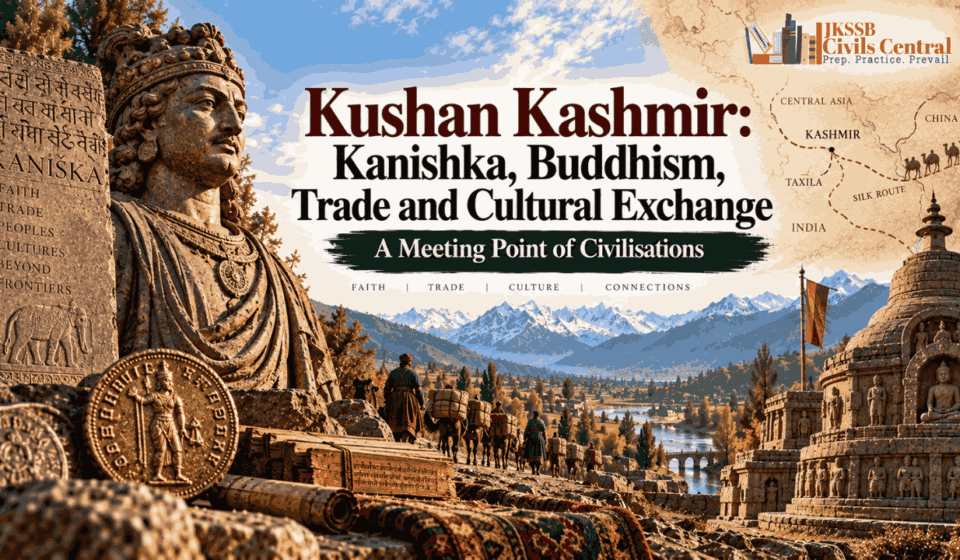
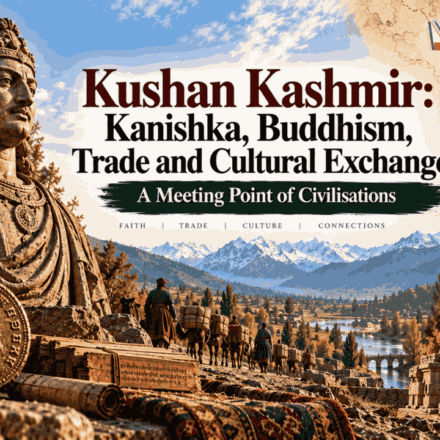
Kushan Kashmir: Kanishka, Buddhism, Trade and Cultural Exchange

J&K History Series Navigation
| Previous Article | Current Article | Next Article |
|---|---|---|
| Article 06 — Mauryan Influence in Kashmir under Ashoka: Buddhism, Settlement and Historical Evidence | Article 07 — Kushan Kashmir: Kanishka, Buddhism, Trade and Cultural Exchange | Article 08 — Buddhism in Jammu & Kashmir: Origins, Expansion, Buddhist Learning and Archaeological Evidence |
Learning Dashboard
| Component | Key Information |
|---|---|
| Historical Period | c. 1st–3rd centuries CE |
| Historical Phase | Ancient J&K / Kushan Period |
| Main Dynasty | Kushan |
| Key Ruler | Kanishka I |
| Other Important Rulers | Huvishka, Vasudeva I |
| Geographical Area | Kashmir Valley, Gandhara, north-western routes and wider Kushan world |
| Core Theme | Political integration, Buddhist patronage, trade and cultural exchange |
| Key Places | Kanispur/Kanishkapura, Harwan, Ushkur/Hushkapura, Semthan |
| Key Buddhist Tradition | Council associated with Kanishka and Kashmir |
| Important School | Sarvāstivāda |
| Key Archaeological Evidence | Kushan settlements, pottery, terracotta, architectural remains and coins |
| Major Trade Context | Jhelum Valley and north-western routes connecting Kashmir with Gandhara and Central Asia |
| Major Source Types | Archaeology, coins, inscriptions, Buddhist traditions, Rajatarangini and Chinese accounts |
| JKSSB Importance | Very High |
| Likely Question Types | Statement-based, chronology, matching, identification, source-based and conceptual-factual |
Introduction
The Kushan period marks a major transformation in the historical position of Kashmir. The Mauryan age had connected the Valley more closely with the political and economic networks of the north-west, while the Kushan period expanded those connections across a much wider zone extending from Central Asia through Gandhara and northern India. Kashmir became particularly important because of its geographical position between the north-western plains, the Himalayan routes and the Central Asian world.
The ruler most strongly associated with this transformation is Kanishka I, one of the principal emperors of the Kushan dynasty. His reign is remembered for political expansion, extensive coinage, patronage of Buddhism and a Buddhist council traditionally located in Kashmir. Later Kashmiri tradition also associates Kanishka with the foundation of Kanishkapura, generally identified with Kanispur/Kanispora in the Baramulla region. Archaeological excavations at Kanispur have revealed substantial Kushan-period remains, giving material support to the importance of the area during this period.
Yet the Kushan period should not be reduced to the career of one ruler or to the history of Buddhism alone. Its deeper significance lies in the interaction of empire, trade, urbanization, religious institutions, artistic production and cultural exchange. Kushan Kashmir became part of a wider zone in which Indian, Iranian, Central Asian and Hellenistic cultural elements interacted, while local traditions continued to shape the Valley’s own historical development.
CivilsCentral Historical Insight
The Kushan period transformed Kashmir from a region connected primarily to the north-western early historic world into an important participant in a much wider network linking South Asia, Central Asia and the routes leading towards China. Buddhism benefited greatly from this connectivity, but the Kushan transformation was broader than Buddhism: it involved settlement, commerce, coinage, architecture, artistic exchange and the movement of people and ideas.
Part I — Historical Background
1. From Mauryan Kashmir to the Kushan Age
The Kushan period cannot be understood without the developments discussed in the preceding articles. Neolithic and Megalithic communities had established long-term settlement traditions in Kashmir; early historic sites such as Semthan demonstrate increasing interaction with wider South Asian networks; and the Mauryan period created a stronger political connection between Kashmir and the north-western subcontinent.
After the decline of Mauryan power, the north-west experienced successive political changes involving Indo-Greeks, Shakas and other ruling groups. These political transformations did not isolate Kashmir. Instead, they contributed to the emergence of a wider north-western cultural zone in which Kashmir, Gandhara, the Punjab and Central Asian regions were increasingly interconnected.
The Kushans eventually emerged from the Yuezhi political world of Central Asia and established one of the most extensive empires of the early centuries CE. Under Kanishka and his successors, the empire connected territories across Central Asia, Afghanistan, the north-western subcontinent and northern India. The Metropolitan Museum of Art describes the Kushan realm under Kanishka as extending from Central Asian territories into northern India, while emphasizing its importance for commerce, urban development, Buddhist thought and visual culture.
2. Who Were the Kushans?
The Kushans emerged from the larger Yuezhi political grouping known from Chinese sources. The formation of the Kushan Empire was gradual rather than the result of one sudden conquest. Kujula Kadphises established the political foundations of the dynasty, followed by Vima Takto and Vima Kadphises, before Kanishka emerged as its most famous ruler.
Modern historians use “Kushan” as a dynastic and historical category based heavily on numismatic and epigraphic evidence. The precise chronology of the dynasty and especially the dating of Kanishka’s accession has been debated. Modern scholarship has increasingly favoured a second-century CE context for Kanishka, with a widely used chronology placing his accession around 127 CE, although the wider chronology of the Kushan period remains subject to scholarly discussion.
This dating issue is important for examination preparation. Older textbooks and conventional Indian-history material sometimes associate Kanishka with 78 CE and the beginning of the Shaka Era. That identification should not be presented as an unquestioned historical fact. The relationship between the Shaka Era and Kanishka remains debated, and modern scholarship does not treat “Kanishka = founder of 78 CE era” as a universally accepted conclusion.
Part II — Kushan Expansion into Kashmir
3. How Did Kashmir Enter the Kushan Sphere?
The expansion of Kushan power into Kashmir formed part of a larger movement through the north-west. Numismatic and archaeological evidence indicates Kushan involvement in Kashmir, while later literary sources explicitly associate Kushan rulers with the Valley.
The precise sequence of conquest is difficult to reconstruct. Encyclopaedia Iranica notes that Chinese sources describe the expansion of Kujula Kadphises from Bactria towards regions including Gandhara and Kashmir, while Kushan coinage provides evidence for the incorporation of different regions into the emerging empire.
Kashmir’s geographical position helps explain why it became important to the Kushans. The Valley was connected westward through the Jhelum corridor to Gandhara and the Punjab, while routes through northern Kashmir connected the region with the trans-Himalayan and Central Asian world. Archaeological research has identified concentrations of Kushan-period sites along the Jhelum basin, especially in the Baramulla region.
The Kushan presence should therefore be understood not merely as a military occupation but as the integration of Kashmir into a broader imperial and commercial system.
4. The Jhelum Valley as a Strategic Corridor
The Jhelum was central to this transformation. It provided a natural route through the Kashmir Valley towards Baramulla and onward towards the north-west. Archaeological studies of the Kushan period identify a concentration of settlements around the Jhelum basin in the Baramulla region. The same research connects the Baramulla-Jhelum route with the wider network leading towards Hazara, Taxila and other Kushan centres in the north-west.
This geography helps explain the distribution of Kushan archaeological sites. Political centres, settlements, commercial activity and religious establishments were not distributed randomly; they developed in relation to routes through which people and goods could move.
The Jhelum therefore continued a geographical role that had already been visible in earlier periods. What changed under the Kushans was the scale and intensity of the networks connected through it.
CivilsCentral Historical Insight
Geography did not merely provide the background to Kushan Kashmir; it helped shape its historical importance. The Jhelum corridor connected the Valley to Gandhara and the Punjab, while northern routes opened access towards Central Asia. Kushan political expansion therefore reinforced pre-existing geographical connections rather than creating an entirely new route system.
Part III — Kanishka and Kashmir
5. Kanishka I
Kanishka I was the most important Kushan ruler for the history of Kashmir. His reign is generally placed in the early to mid-second century CE in modern chronologies, although the exact dating of his accession remains a subject of scholarly debate. Under Kanishka, the Kushan Empire reached a high point of territorial expansion and commercial connectivity.
His importance rests on several dimensions. He was a powerful imperial ruler, issued a substantial and diverse coinage, patronized Buddhist institutions, and became deeply associated with the development of Buddhist intellectual traditions in Kashmir and the north-west.
The Kushan Empire under Kanishka was also culturally diverse. His coins depict a wide range of divine figures associated with Iranian, Greek and Indian religious traditions, alongside Buddhist imagery. This is an important reminder that Kanishka should not be represented simply as a Buddhist ruler presiding over a uniformly Buddhist empire. His coinage reflects a much more plural religious environment.
6. Kanishkapura and Kanispur
One of the most important Kashmir-specific traditions associated with Kanishka concerns Kanishkapura.
Kalhana’s Rajatarangini refers to a city founded by Kanishka. The modern archaeological site of Kanispur/Kanispora, near Baramulla, has long been identified by scholars with this Kanishkapura. Archaeological investigations have strengthened the association by revealing substantial Kushan-period occupation and structures.
The archaeological sequence at Kanispur is particularly significant because it extends from the Neolithic through early historic periods and into the Kushan period. Excavations identified Kushan-period structures, habitation deposits and decorated terracotta tiles. One excavated area contained a substantial Kushan-period deposit, interpreted by the excavator as representing the main township associated with Kanishkapura.
However, there is an important qualification. The identification of Kanispur with Kanishkapura is strong but should not be presented as an absolutely uncontested equation. Scholarship has discussed alternative identifications, including attempts to associate Kanishkapura with Purushapura/Peshawar. Recent archaeological work in Kashmir, however, provides substantial reasons for retaining the Kanispur identification as an important historical interpretation.
7. Kanishka’s Kashmir Foundations: What the Evidence Shows
The tradition concerning Kanishkapura fits a wider pattern in which Kushan rulers are remembered as founders or patrons of urban settlements. In Kashmir, later historical tradition associates Kanishka, Huvishka and possibly other Kushan rulers with settlements whose names preserve memories of their founders.
Kanishkapura is the best-known example, while Hushkapura, associated with Huvishka, is generally identified with Ushkur in the Baramulla region. Archaeological investigations at Ushkur have revealed earlier occupation beneath later structures, including evidence associated with the Kushan period.
The significance of these sites is greater than their association with royal names. Their distribution around the Jhelum corridor indicates the development of a settlement landscape tied to political authority, commerce and cultural exchange.
CivilsCentral Historical Insight
The Kushan urban presence in Kashmir is best understood as a combination of literary memory and archaeological evidence. Kanishkapura is preserved in Kalhana’s tradition, while Kanispur contains substantial Kushan-period archaeological remains. Together they suggest that Kushan rule was associated with genuine urban and settlement development in the Valley, even though every traditional attribution cannot automatically be treated as archaeologically proven.
Part IV — Buddhism under the Kushans
8. From Mauryan Buddhist Tradition to Kushan Expansion
The Mauryan period had already established an important Buddhist tradition in Kashmir. The Kushan age gave this tradition a new institutional and intellectual environment. Kushans ruled a geographically extensive empire in which Buddhist communities were connected with trade routes stretching through Gandhara and Central Asia. Buddhist monasteries could benefit from patronage by rulers, merchants and local elites, while monks and pilgrims themselves contributed to the movement of ideas across political boundaries.
The Kushan contribution therefore lay less in “introducing Buddhism” than in expanding the institutional and geographical environment in which Buddhism could flourish. This distinction is crucial because Buddhist activity in Kashmir clearly predates Kanishka. Kanishka’s importance was in strengthening and expanding an already existing tradition.
9. Kanishka and Buddhist Patronage
Kanishka is traditionally regarded as a major patron of Buddhism. His coinage provides particularly interesting evidence because the reverse types include a variety of deities, among them the Buddha. Encyclopaedia Iranica notes that Buddha appears among the divinities represented on Kanishka’s coinage, although the wider Kushan religious environment was highly diverse.
This evidence is important because it is contemporary material culture rather than a much later narrative. At the same time, a coin depicting the Buddha should not be interpreted as proof that the Kushan state was exclusively Buddhist.
Kanishka’s religious policy appears better understood as patronage within a plural religious environment. Iranian and Indian deities continued to appear prominently on Kushan coins, demonstrating that Buddhism existed alongside other religious traditions.
Part V — The Buddhist Council Associated with Kanishka
10. The So-Called Fourth Buddhist Council
The most famous Buddhist association of Kanishka is the Fourth Buddhist Council, traditionally located in Kashmir.
According to northern Buddhist traditions, Kanishka convened a major Buddhist assembly involving monks of the Sarvāstivāda school. Vasumitra is traditionally associated with its leadership, while Ashvaghosha is sometimes associated with the proceedings in later accounts. The council is said to have produced extensive commentarial literature, particularly the Mahāvibhāṣā tradition.
However, the expression “Fourth Buddhist Council” requires qualification. Different Buddhist traditions do not agree on the numbering, location or historical character of the councils. Sri Lankan Theravada traditions, for example, do not preserve the same Kashmir council tradition. Some northern accounts locate the assembly at Kashmir, while other traditions associate it with Gandhara or Jalandhar.
Therefore the safest historical formulation is:
Northern Buddhist traditions associate Kanishka with a major Buddhist council held in Kashmir, traditionally identified as the Fourth Buddhist Council and associated especially with the Sarvāstivāda school.
11. Where Was the Council Held?
The traditional location is often given as Kundalavana in Kashmir. The exact archaeological identification of Kundalavana is uncertain. Harwan is frequently associated with the council in popular and institutional descriptions, and the Archaeological Survey’s heritage documentation identifies Harwan with Shadarhadvana and records the tradition connecting it with the council during Kanishka’s reign.
But this requires an important archaeological distinction.
The surviving archaeological remains at Harwan cannot simply be dated to the council itself. The excavated complex contains material from later phases, and the decorative terracotta tile pavement has been dated by archaeological studies to the 4th century CE, later than Kanishka.
Thus: Harwan = important Kushan/post-Kushan Buddhist site and traditional council association, does not necessarily mean: The surviving Harwan structures = the exact physical remains of Kanishka’s council hall.
12. Vasumitra and the Sarvāstivāda Tradition
The council tradition is particularly associated with the Sarvāstivāda school of Buddhism. Vasumitra is traditionally identified as its leading intellectual figure in the council narrative.
The Sarvāstivādins developed an extensive Abhidharma intellectual tradition, and Kashmir subsequently became a major centre of Sarvāstivāda scholarship. The development of this school is one reason Kashmir later acquired importance in Buddhist intellectual history.
The council tradition should therefore not be reduced to a simple event—”Kanishka held the Fourth Council.” Its larger significance concerns the institutional organization, doctrinal debate and textual production of northern Buddhist communities.
CivilsCentral Historical Insight
The Kashmir council tradition is historically important even though its precise location and chronology remain debated. It reveals the emergence of Kashmir as a centre of Buddhist intellectual activity, especially within the Sarvāstivāda tradition. For examination purposes, the correct approach is to remember the standard association while understanding the evidence behind it is primarily textual and tradition-based rather than represented by a securely identified archaeological council hall.
Part VI — Did Kanishka Establish Mahayana Buddhism?
13. Kanishka and Mahayana: The Common Examination Trap
A common textbook formulation states that Kanishka founded or officially established Mahayana Buddhism. This is too simplistic.
The development of Mahayana was a gradual process involving multiple regions, communities and textual traditions. It cannot be reduced to one royal council or one ruler. Kanishka’s period was certainly important for the development and spread of Buddhist ideas, but the evidence does not justify saying that Kanishka single-handedly created Mahayana Buddhism.
The Buddhist council tradition is more securely associated with Sarvāstivāda scholasticism than with a simple institutional proclamation of Mahayana. This distinction is especially important because the rise of Mahayana involved doctrinal, devotional and literary developments that unfolded over time.
14. Kanishka and Buddhist Intellectual Expansion
The Kushan period provided favourable conditions for Buddhist intellectual development because monasteries were linked to urban centres and commercial routes. Scholars, monks, merchants and pilgrims could move between regions under a large political system.
Kashmir became especially important for the Sarvāstivāda tradition and its Abhidharma literature. Later Buddhist intellectual traditions preserved the reputation of Kashmiri scholars and monasteries, showing that the Kushan-period transformation had consequences extending well beyond the reign of Kanishka.
The historical significance therefore lies in the emergence of institutional networks, not simply royal patronage.
Part VII — Harwan and Kushan Buddhist Archaeology
15. Harwan
Harwan, north-east of Srinagar and overlooking the Dal Lake, is one of the most important Buddhist archaeological sites associated with ancient Kashmir.
Archaeological documentation describes a monastery and stupa complex at Harwan, with masonry techniques resembling those found in Gandhara and a distinctive paved courtyard decorated with terracotta tiles. The excavated remains include religious architecture, terracotta figures and fragments associated with Buddhist activity.
The site’s architectural and decorative evidence is particularly valuable for understanding cultural interaction. The diaper-pebble masonry and decorated tiles show that Kashmir’s Buddhist architecture participated in artistic traditions that extended beyond the Valley.
At the same time, the surviving decorated tiles should not automatically be assigned to Kanishka’s reign. Archaeological evidence suggests that some of the tile work belongs to a later phase, particularly the fourth century CE.
16. The Artistic Significance of Harwan
The terracotta tiles at Harwan are especially important because they display a mixture of motifs and artistic influences. Their designs include floral patterns, animals and human figures, demonstrating the interaction of local and external artistic traditions.
This is precisely the kind of material evidence expected in a region situated between cultural zones. Kashmir was not simply copying Gandhara, nor was it completely isolated from it. Instead, local craftsmen adapted forms within their own artistic environment.
Harwan therefore provides evidence for cultural exchange, not merely religious history.
Part VIII — Kanispur and Kushan Settlement
17. Archaeological Evidence from Kanispur
Kanispur is particularly important because it provides a direct archaeological context for the Kushan settlement tradition.
Excavations revealed Kushan-period structures constructed with diaper-pebble masonry, habitation deposits and decorated terracotta tiles. The site also produced a variety of artefacts associated with everyday life, including pottery, terracotta objects and other material remains.
The cultural sequence demonstrates that Kanispur was not a settlement created on an empty landscape. Neolithic and earlier historic occupations existed beneath the Kushan levels. This is historically important because it demonstrates continuity of occupation alongside political transformation.
The Kushans therefore did not replace an empty landscape with a completely new urban system. They developed new political and economic structures within a landscape that had already been inhabited for millennia.
Part IX — Ushkur and Huvishka
18. Hushkapura and Ushkur
Kanishka was not the only Kushan ruler associated with a named settlement in Kashmir. Later tradition associates Huvishka with Hushkapura, generally identified with Ushkur near Baramulla.
Archaeological research has identified Kushan-period remains at Ushkur, including evidence suggesting earlier Buddhist structures beneath later construction. This makes Ushkur an important site for tracing the long development of Buddhist and urban activity in Kashmir.
The association illustrates a broader Kushan pattern: rulers established or patronized settlements that became nodes in political, commercial and religious networks.
However, as with Kanishkapura, the relationship between the literary place-name and the archaeological settlement must be treated as an identification supported by evidence rather than as an unquestionable equation.
Part X — Trade and the Kushan World
19. Kashmir within the Kushan Commercial Network
The Kushan Empire occupied a strategically important position between Central Asia, South Asia and the routes leading towards China and the Roman world. Its political territory included major nodes such as Bactria, Gandhara, Purushapura and Mathura. The empire’s position along overland routes encouraged commercial activity and urban development.
Kashmir was not itself the main overland Silk Road corridor in the same sense as some Central Asian routes. Its importance arose from its connecting position between Gandhara, the Punjab, the Himalayan routes and Central Asian approaches.
Archaeological research identifies routes from Kashmir through northern valleys towards Gilgit, Chitral, Badakhshan and Central Asia, while the Jhelum route connected the Valley westward with Gandhara and Taxila.
This network enabled movement of more than commodities. Traders, monks, pilgrims, craftsmen and political representatives could also move along these routes.
20. Trade and Buddhism
Trade and Buddhism were closely interconnected in the Kushan world, although neither should be reduced to the other. Merchants benefited from monasteries as places of social and religious interaction, while monasteries could benefit from merchant patronage. Buddhist monks travelling between regions carried texts, ideas and artistic traditions along the same broad routes used by commercial networks.
The Metropolitan Museum’s research on Gandharan art emphasizes that the prosperity generated by Silk Road commerce provided resources for Buddhist monasteries and sacred complexes. Kashmir’s position allowed it to participate in this broader process. Its Buddhist institutions could therefore become part of networks extending beyond the Valley.
Part XI — Coinage and Cultural Exchange
21. Kushan Coins as Historical Evidence
Kushan coinage is one of the most important sources for reconstructing the empire’s political and cultural history. Kanishka and his successors issued extensive copper and gold coinage featuring royal portraits, inscriptions and a wide variety of divine figures.
The coinage is particularly important for Kashmir because numismatic research identifies a Kashmir mint or minting tradition during the Kushan period. Encyclopaedia Iranica notes that a minor copper mint associated with Kashmir continued using Kharoshthi during the reigns of Kanishka and Huvishka.
This is significant because coinage provides evidence not only of economic activity but also of political integration and regional monetary practices.
22. Religious Diversity on Kushan Coins
Kushan coins are among the clearest material demonstrations that the empire was religiously plural.
The reverse types include deities associated with Iranian religious traditions as well as Indian and Buddhist figures. Kanishka’s coinage includes representations of the Buddha, but this does not mean that other religious traditions disappeared from the imperial landscape.
This evidence provides an important corrective to simplistic descriptions of Kanishka as an exclusively Buddhist ruler.
A better historical formulation is: Kanishka was a major patron of Buddhism within a religiously diverse Kushan imperial environment.
Part XII — Art and Cultural Synthesis
23. Gandhara, Kashmir and the Kushan Cultural World
The Kushan age witnessed major artistic developments, particularly in Gandhara and Mathura. Gandharan art combined Indian Buddhist themes with artistic conventions influenced by the Hellenistic and Roman worlds.
Kashmir’s proximity to Gandhara enabled artistic interaction. Archaeological remains at Harwan and other Kushan sites demonstrate architectural and decorative connections with north-western traditions.
But cultural exchange should not be mistaken for complete cultural assimilation. Kashmir developed its own regional artistic expressions while selectively incorporating external forms.
24. Terracotta and Decorative Arts
Terracotta became an important medium of artistic expression in Kushan-period Kashmir. Harwan’s decorated tiles are especially notable for their variety of motifs, while Kanispur and other sites have produced terracotta objects and sculptures.
These objects are valuable historical evidence because they reveal aspects of daily life, artistic practice and cultural contact that literary sources rarely describe.
The presence of external motifs does not necessarily indicate that foreign craftsmen created all the objects. Cultural forms can travel through objects, people, imitation and local adaptation. The archaeological evidence therefore supports interaction, while the precise identity of individual craftsmen often remains unknown.
25. Buddha Images and the Kushan Period
The Kushan period is closely associated with the increasing production of anthropomorphic representations of the Buddha, particularly in Gandhara and Mathura. The Metropolitan Museum notes that some of the earliest representations of the Buddha in human form belong to the Kushan-era artistic environment.
The development should not, however, be described as a sudden invention occurring at one precise date. Evidence from Gandhara and other regions indicates that Buddhist imagery developed gradually.
Kashmir participated in this wider Buddhist artistic environment, although the surviving evidence from the Valley differs from the monumental sculptural corpus of Gandhara and Mathura.
CivilsCentral Historical Insight
Kushan cultural exchange was not a one-way process in which “foreign” culture entered Kashmir and replaced local traditions. The archaeological record instead shows selective adaptation: architectural techniques, artistic motifs, religious institutions and material forms travelled across regions, while local communities incorporated them into Kashmir’s own cultural landscape.
Part XIII — Political, Economic and Social Dimensions
26. Political Integration
Kushan control integrated Kashmir into a wider imperial network extending through the north-west and northern India. The evidence for Kushan presence is stronger than the evidence for a detailed reconstruction of local administrative institutions.
As with the Mauryan period, it would be inappropriate to simply import every administrative title known from other Kushan territories and assume that the same hierarchy operated identically in Kashmir. The strongest evidence concerns political presence, settlements, coinage and cultural connections.
The Valley therefore appears to have been integrated into the Kushan political sphere while retaining its regional social and cultural characteristics.
27. Urbanization
The Kushan period saw significant development of settlements in Kashmir. Kanispur, Ushkur and other sites reveal substantial construction and occupation.
This urban development was connected to several factors:
- imperial political organization,
- commercial routes,
- agricultural production,
- craft activity,
- religious institutions,
- and movement of people.
It would therefore be misleading to attribute urbanization to Kanishka alone. The Kushan state created favourable political and economic conditions, but urban development resulted from the interaction of several processes.
28. Settlement and Population Movement
The Kushan Empire was itself a product of population movement across Central Asia and the north-west. Kashmir’s location meant that the Valley experienced interaction with people from neighbouring regions.
Archaeological evidence demonstrates cultural connections with Gandhara, Central Asia and other areas, but it is difficult to quantify the scale of population movement. Therefore, claims that the Kushans “replaced” the existing population of Kashmir are not supported.
The more defensible interpretation is that new political, commercial, religious and artisanal networks brought additional cultural influences into a society with established local traditions.
29. Economic Life
Kushan economic activity in Kashmir can be approached through:
- coinage,
- settlement expansion,
- pottery production,
- craft activity,
- commercial routes,
- and connections with neighbouring regions.
The presence of coins and imported or stylistically connected materials demonstrates participation in wider exchange systems. Yet there is insufficient evidence to reconstruct a complete tax system or quantify the economic output of Kushan Kashmir.
The historical significance lies in greater connectivity and commercialization, not in a claim of uniformly prosperous conditions throughout the Valley.
Part XIV — Major Kushan Sites in Kashmir
| Site | District/Area | Kushan Significance |
|---|---|---|
| Kanispur/Kanispora | Baramulla | Kushan settlement; associated with Kanishkapura |
| Ushkur | Baramulla | Associated with Hushkapura; Kushan-period remains |
| Harwan | Srinagar | Buddhist monastery/stupa complex; Kushan/post-Kushan development |
| Semthan | Anantnag | Early historic sequence continuing into Kushan period |
| Hutmur | South Kashmir | Kushan-period archaeological evidence reported |
| Hoinar-Lidroo | South Kashmir | Kushan archaeological evidence |
| Kutbal | Kashmir Valley | Kushan-period archaeological evidence reported |
Part XV — Historical Sources
30. Rajatarangini
Kalhana’s Rajatarangini is a major source for the literary tradition concerning Kushan rulers in Kashmir. It associates Kanishka, Huvishka and another Kushan ruler traditionally identified as Jushka with cities in Kashmir. The text therefore preserves important memories of Kushan rule and settlement.
However, Kalhana wrote centuries after the Kushan period. His account must therefore be compared with archaeology and inscriptions rather than treated as a contemporary chronicle.
31. Archaeological Evidence
Archaeology is particularly important for Kushan Kashmir because it provides direct material evidence for occupation.
Kanispur, Harwan, Ushkur and Semthan have produced:
- structural remains,
- pottery,
- terracotta objects,
- decorative tiles,
- coins,
- and evidence of settlement.
These materials establish a strong Kushan archaeological presence in Kashmir.
32. Coins and Inscriptions
Kushan coins provide evidence for rulers, political authority, economic activity and religious symbolism. Kanishka’s coins are particularly valuable because they contain diverse divine representations, including the Buddha.
Inscriptions from the wider Kushan world help establish chronology and political organization. Their usefulness for Kashmir varies depending on whether the inscription is directly associated with the Valley.
This is another example of the J&K-specific evidence test: evidence from the wider Kushan Empire can establish the imperial context, but it should not automatically be treated as evidence of identical institutions in Kashmir.
Part XVI — Evidence and Historical Interpretation
33. What Is Strongly Established?
Several conclusions are relatively secure:
- The Kushan Empire controlled or exercised political influence over Kashmir.
- Kushan-period settlements existed in the Valley.
- Kanispur contains substantial Kushan-period archaeological remains.
- Kushan coinage is connected with Kashmir, including evidence of a Kashmir minting tradition.
- Buddhism flourished in the Kushan imperial world.
- Kanishka was an important patron of Buddhism.
- Kashmir became an important centre of Buddhist intellectual activity.
These conclusions rest on a combination of archaeological, numismatic and literary evidence.
34. What Requires Qualification?
Several popular statements need more careful treatment.
“Kanishka founded Kanispur.”
Qualified: Kanispur is widely identified with Kanishkapura of the Rajatarangini, and Kushan-period archaeology supports the importance of the settlement, but the exact founder cannot be established solely from the surviving archaeological remains.
“Kanishka held the Fourth Buddhist Council at Harwan.”
Qualified: Northern Buddhist tradition associates Kanishka with a major council in Kashmir, traditionally identified as the Fourth Buddhist Council; Harwan is a traditional identification, but the exact archaeological location remains uncertain.
“Kanishka founded Mahayana Buddhism.”
Incorrect as a simplified statement: Mahayana developed gradually over time and cannot be attributed to one ruler or council.
“Kanishka founded the Saka Era in 78 CE.”
Contested: The relationship between Kanishka and the beginning of the 78 CE era remains debated.
“Kushans introduced Buddhism to Kashmir.”
Incorrect: Buddhist traditions already associate Kashmir with Buddhism during the Mauryan period.
CivilsCentral Historical Insight
The Kushan period is one of the clearest examples of why historical reconstruction requires multiple types of evidence. Archaeology securely establishes Kushan settlements; coins demonstrate political and economic connections; Buddhist traditions preserve memories of intellectual developments; and Kalhana preserves later Kashmiri memory. The best history emerges when these sources are connected without treating them as equally direct evidence.
Part XVII — Historical Significance
35. Political Significance
The Kushan period integrated Kashmir more closely into a large transregional political system. The Valley became connected with an empire whose core territories extended across Central Asia, Afghanistan and northern India.
This integration strengthened Kashmir’s strategic significance because control over the Valley provided access to routes connecting different geographical zones.
36. Religious Significance
Kanishka’s patronage contributed to the expansion of Buddhist institutions and scholarship. Kashmir became associated particularly with Sarvāstivāda Buddhist intellectual traditions.
This development had consequences beyond Kashmir because Buddhist scholars, texts and ideas travelled along routes connecting the Valley with Central Asia and beyond.
37. Economic Significance
The Kushan period intensified Kashmir’s connections with commercial routes. The Jhelum corridor linked the Valley with Gandhara and the Punjab, while northern routes created connections towards Central Asia.
Coinage, settlement growth and craft production provide material evidence for this increased connectivity.
38. Cultural Significance
The Kushan age encouraged interaction among:
- Indian traditions,
- Gandharan culture,
- Iranian religious traditions,
- Central Asian influences,
- and local Kashmiri traditions.
Harwan’s architectural and decorative remains are particularly useful for understanding this cultural interaction. (IGNCA)
39. Long-Term Significance
The Kushan transformation helped establish conditions under which Kashmir could later become an important centre of Buddhist learning and transregional intellectual exchange.
The importance of the period therefore extends beyond the Kushan dynasty itself. Later Buddhist travellers, scholars and religious networks inherited a landscape already connected to wider routes and institutions.
Part XVIII — JKSSB Knowledge Matrix
| Question | Answer |
|---|---|
| Who? | Kanishka I and other Kushan rulers |
| When? | Mainly 1st–3rd centuries CE |
| Which dynasty? | Kushan |
| Key ruler? | Kanishka I |
| Other rulers? | Huvishka, Vasudeva I |
| Kashmir significance? | Political integration, Buddhist development, trade and cultural exchange |
| Important city? | Kanishkapura / Kanispur |
| Huvishka-associated city? | Hushkapura / Ushkur |
| Important Buddhist site? | Harwan |
| Important archaeological sites? | Kanispur, Harwan, Ushkur, Semthan |
| Important Buddhist school? | Sarvāstivāda |
| Council tradition? | Major Buddhist council associated with Kanishka in Kashmir |
| Traditional council leader? | Vasumitra |
| Important trade corridor? | Jhelum Valley |
| Major external connections? | Gandhara, Central Asia, northern India |
| Important source? | Rajatarangini |
| Key material source? | Kushan coins |
| Major examination trap? | Kanishka ≠ automatic founder of Mahayana or 78 CE era |
Part XIX — Examination Discrimination Points
1. Ashoka vs Kanishka
| Ashoka | Kanishka |
|---|---|
| Mauryan | Kushan |
| 3rd century BCE | Early/mid-2nd century CE in widely used modern chronology |
| Earlier Buddhist patron | Later major Buddhist patron |
| Srinagari tradition | Kanishkapura tradition |
| Madhyāntika tradition | Kashmir council tradition |
2. Kanishka vs Huvishka
Kanishka I
- major Kushan emperor
- Buddhist patron
- Kanishkapura tradition
- Kashmir council tradition
Huvishka
- successor of Kanishka
- Hushkapura tradition
- Kushan coinage and continued imperial development
3. Kanispur vs Harwan
Kanispur
→ settlement
→ Kanishkapura tradition
→ Baramulla
→ Kushan structural remains
Harwan
→ Buddhist monastery/stupa complex
→ Srinagar area
→ decorated terracotta tiles
→ traditional association with Shadarhadvana and Kanishka’s council
4. Kushan Buddhism vs Mauryan Buddhism
Mauryan/Ashokan phase
→ early missionary traditions
Kushan phase
→ institutional expansion
→ Sarvāstivāda scholarship
→ major Buddhist intellectual traditions
→ wider Central Asian connections
5. Council vs Mahayana
Kanishka’s Kashmir council tradition
→ strongly associated with Sarvāstivāda
Mahayana
→ gradual doctrinal and devotional development
Do not equate the two automatically.
Part XX — JKSSB Question-Type Mapping
Direct Fact
Which Kushan ruler is traditionally associated with Kanishkapura?
Answer: Kanishka I
Statement-Based
Consider the following statements:
- Kanispur has substantial Kushan-period archaeological remains.
- Kanishka is traditionally associated with Kanishkapura.
- The exact location of Kanishka’s Buddhist council is archaeologically proven at Harwan.
- Huvishka is associated with Hushkapura in Kashmir tradition.
Correct: 1, 2 and 4 only.
Chronology
Arrange chronologically:
- Ashoka
- Kanishka I
- Lalitaditya
- Avantivarman
Answer: Ashoka → Kanishka I → Lalitaditya → Avantivarman.
Match the Following
| Person / Site | Association |
|---|---|
| Kanishka | Kushan |
| Huvishka | Hushkapura tradition |
| Kanispur | Kanishkapura |
| Harwan | Buddhist archaeological complex |
| Vasumitra | Kashmir council tradition |
Identification by Clues
Identify the site:
- Baramulla region
- Kushan-period settlement
- Associated with Kanishkapura
- Neolithic and Kushan levels
- Decorated terracotta tiles
Answer: Kanispur/Kanispora
Correct / Incorrect Pair
Kanishka — Mauryan – Incorrect.
Kanishka — Kushan – Correct.
Harwan — Buddhist archaeological complex – Correct.
Kanispur — Kanishkapura tradition – Correct.
Conceptual-Factual
Why did Kashmir become important during the Kushan period?
Because its geographical position connected the Valley with Gandhara, the Punjab, Central Asian routes and wider Buddhist networks, allowing political, commercial and cultural interaction to intensify.
Part XXI — JKSSB Practice Questions
Question 1
Kanishka belonged to which dynasty?
A. Maurya
B. Kushan
C. Karkota
D. Indo-Greek
Correct Answer: B. Kushan
Kanishka I was one of the principal rulers of the Kushan dynasty.
Question 2
Which of the following sites is traditionally identified with Kanishkapura?
A. Kanispur
B. Harwan
C. Semthan
D. Burzahom
Correct Answer: A. Kanispur
Kanispur/Kanispora in the Baramulla region has long been associated with Kanishkapura mentioned in the Rajatarangini, and archaeological investigations have revealed substantial Kushan-period remains.
Question 3
Consider the following statements:
- Kanishka was a Kushan ruler.
- Kanishka is traditionally associated with a major Buddhist council in Kashmir.
- The council tradition is particularly associated with the Sarvāstivāda school.
- Kanishka founded Buddhism in Kashmir.
Which statements are correct?
A. 1 and 2 only
B. 1, 2 and 3 only
C. 2, 3 and 4 only
D. 1, 2, 3 and 4
Correct Answer: B
Buddhist traditions predate Kanishka in Kashmir; therefore statement 4 is incorrect.
Question 4
Who is traditionally associated with presiding over the Buddhist council held in Kashmir during Kanishka’s reign?
A. Nagarjuna
B. Vasumitra
C. Moggaliputta Tissa
D. Upali
Correct Answer: B. Vasumitra
The northern Buddhist council tradition associates Vasumitra with the assembly.
Question 5
Which of the following is most closely associated with Huvishka in Kashmir?
A. Srinagari
B. Hushkapura
C. Pravarapura
D. Parihasapura
Correct Answer: B. Hushkapura
Hushkapura is traditionally associated with Huvishka and is generally identified with Ushkur in the Baramulla region.
Question 6
Which archaeological site is particularly known for a Buddhist complex with decorated terracotta tile pavements?
A. Harwan
B. Burzahom
C. Gufkral
D. Semthan
Correct Answer: A. Harwan
Harwan contains a Buddhist monastery/stupa complex with distinctive decorated terracotta paving.
Question 7
Which statement about Kanishka and the 78 CE era is most accurate?
A. It is universally accepted that Kanishka founded the era in 78 CE.
B. The era is certainly unrelated to Kanishka.
C. The relationship between Kanishka and the 78 CE era remains debated.
D. The era began during Ashoka’s reign.
Correct Answer: C
Modern scholarship continues to debate the chronology of Kanishka and the relationship between his reign and the 78 CE era.
Question 8
Which of the following best describes Kushan coinage?
A. It contained only Buddhist symbols.
B. It represented a diverse range of religious figures.
C. It was exclusively made of silver.
D. It was confined to Kashmir.
Correct Answer: B
Kushan coinage includes Iranian, Indian, Greek-related and Buddhist divine imagery, reflecting the religious diversity of the empire.
Question 9
Why is the Jhelum Valley important for understanding Kushan Kashmir?
A. It isolated Kashmir from the Kushan Empire.
B. It provided a major geographical route connecting Kashmir with the north-west.
C. It was the location of the Mauryan capital.
D. It was exclusively a Buddhist pilgrimage route.
Correct Answer: B
The Jhelum corridor linked Kashmir with Gandhara and other north-western regions and became an important zone of settlement and exchange.
Question 10
Which statement is historically most accurate?
A. Kanishka created Mahayana Buddhism at the Kashmir council.
B. Kanishka’s reign was important for Buddhist development, but Mahayana emerged through a longer process.
C. Mahayana began only after the Gupta period.
D. Kanishka opposed Buddhism.
Correct Answer: B
The Kushan period was important for Buddhist development, but Mahayana cannot be reduced to a single royal foundation.
Part XXII — Rapid Revision Zone
Important Dates
| Period | Development |
|---|---|
| 1st century BCE–1st century CE | Formation and expansion of early Kushan power |
| c. 1st century CE | Kushan expansion under early rulers |
| Early/mid-2nd century CE | Widely used modern chronology for Kanishka I |
| 2nd century CE | Major phase of Kushan political, commercial and Buddhist expansion |
| Later 2nd–3rd centuries CE | Huvishka, Vasudeva I and continuing Kushan influence |
Chronology note: The exact dates of Kanishka’s accession and the relationship between his reign and the 78 CE era remain debated.
Important Rulers
Kanishka I
Kushan emperor; major Buddhist patron; associated with Kanishkapura and the Kashmir council tradition.
Huvishka
Kushan successor; associated with Hushkapura/Ushkur tradition.
Vasudeva I
Later major Kushan ruler; represents the continuation of Kushan power into the early 3rd century.
Important Places
- Kanispur/Kanispora
- Kanishkapura
- Ushkur
- Hushkapura
- Harwan
- Semthan
- Baramulla
- Jhelum Valley
Important Buddhist Associations
Kanishka → Buddhist patronage
Vasumitra → Kashmir council tradition
Sarvāstivāda → major Buddhist school associated with the council tradition
Harwan → Buddhist archaeological complex
Kashmir → later centre of Buddhist intellectual activity
Important Archaeological Associations
| Site | Association |
|---|---|
| Kanispur | Kushan settlement / Kanishkapura tradition |
| Harwan | Buddhist monastery and stupa |
| Ushkur | Hushkapura tradition / Kushan remains |
| Semthan | Early historic sequence continuing into Kushan period |
One-Line Revision Facts
- Kanishka I was a major Kushan ruler.
- The Kushan period belongs mainly to the early centuries CE.
- Kanishka’s exact accession date remains debated.
- Kanishka is traditionally associated with a major Buddhist council in Kashmir.
- Vasumitra is traditionally associated with the council’s leadership.
- The council tradition is strongly associated with Sarvāstivāda.
- Harwan is traditionally connected with Shadarhadvana.
- Harwan contains a major Buddhist archaeological complex.
- Kanispur is traditionally identified with Kanishkapura.
- Kanispur contains substantial Kushan-period remains.
- Ushkur is traditionally associated with Hushkapura.
- The Jhelum corridor was important for Kushan-period settlement and connectivity.
- Kushan coinage displays considerable religious diversity.
- Buddha appears on some Kanishka coins.
- Kanishka did not simply create Buddhism in Kashmir.
- Mahayana Buddhism cannot be attributed to one ruler alone.
- The 78 CE era cannot be safely described as unquestionably founded by Kanishka.
- Kushan Kashmir was connected to Gandhara and Central Asian networks.
Part XXIII — Frequently Confused Facts
| Confusion | Correct Distinction |
|---|---|
| Ashoka vs Kanishka | Ashoka = Mauryan; Kanishka = Kushan |
| Kanishka vs Huvishka | Kanishka = earlier major Kushan emperor; Huvishka = successor |
| Kanishkapura vs Hushkapura | Kanishkapura → Kanishka tradition; Hushkapura → Huvishka tradition |
| Kanispur vs Harwan | Kanispur = settlement/Kanishkapura; Harwan = Buddhist archaeological complex |
| Ashoka vs Kanishka Buddhism | Ashoka = earlier Buddhist patron; Kanishka = later major patron |
| Sarvāstivāda vs Mahayana | Sarvāstivāda strongly associated with Kashmir council tradition; Mahayana developed gradually |
| Council vs Harwan | Council is a textual tradition; exact archaeological location remains uncertain |
| Kanishka vs 78 CE era | Association is debated |
| Kanishka vs founder of Buddhism | Buddhism predated Kanishka by centuries |
| Kushan Empire vs purely Buddhist state | Kushan religious environment was plural |
| Gandhara vs Kashmir | Both interacted closely, but they were distinct regional zones |
| Kanishkapura vs Purushapura | Purushapura = Peshawar; Kanishkapura is generally associated with Kanispur but identification has been debated |
Part XXIV — What Can JKSSB Ask?
High-Value Question Areas
JKSSB-type questions can test:
- Kanishka’s dynasty
- Kushan chronology
- Kanishka vs Ashoka
- Kanishka vs Huvishka
- Kanishkapura and Kanispur
- Hushkapura and Ushkur
- Harwan
- Buddhist council tradition
- Vasumitra
- Sarvāstivāda
- Kushan coinage
- Buddha on Kanishka’s coins
- Jhelum Valley trade routes
- Gandhara-Kashmir connections
- Central Asian connections
- NBPW-to-Kushan chronological transition
- archaeology versus literary tradition
- Kanishka and the 78 CE era
- Kanishka and Mahayana Buddhism.
Chapter Summary
The Kushan period represents a major phase in the transformation of Kashmir’s position within the ancient world. Building upon the connections established during earlier centuries, Kushan political expansion brought the Valley into a transregional system linking Central Asia, Gandhara, northern India and routes leading towards China.
Kanishka I stands at the centre of this history. Later Kashmiri tradition associates him with Kanishkapura, generally identified with Kanispur, while archaeological excavations have demonstrated substantial Kushan occupation at the site. Huvishka is similarly associated with Hushkapura, generally identified with Ushkur. These settlements, together with Harwan, Semthan and other archaeological sites, demonstrate that Kushan influence involved actual settlement and construction rather than merely a literary or political connection.
The religious significance of the period is equally important. Kanishka became a major patron of Buddhism, and northern Buddhist traditions associate his reign with a major council in Kashmir connected particularly with the Sarvāstivāda school and Vasumitra. Harwan is traditionally associated with the council’s location, but the archaeological remains cannot simply be equated with the original council itself.
The Kushan transformation was nevertheless much broader than Buddhism. The Jhelum corridor connected Kashmir with Gandhara and the north-west, while northern routes linked the Valley with Central Asian networks. Kushan coinage, settlement archaeology, terracotta art, architectural techniques and Buddhist institutions all reveal an environment of intense cultural interaction.
Kanishka strengthened and expanded Buddhist institutions in Kashmir; he did not introduce Buddhism into the Valley for the first time, nor can Mahayana or the 78 CE era be attributed to him without qualification.
Mind Map
                 KUSHAN KASHMIR
                       │
                       ▼
                 KUSHAN EMPIRE
                       │
                       ▼
                   KANISHKA
                       │
       ┌───────────────┼────────────────┐
       ▼               ▼                ▼
   POLITICAL        BUDDHISM          TRADE
   INTEGRATION      & LEARNING        & ROUTES
       │               │                │
       ▼               ▼                ▼
  KANISHKAPURA     COUNCIL          JHELUM
   / KANISPUR      TRADITION         CORRIDOR
       │               │                │
       ▼               ▼                ▼
  HUSHKAPURA       VASUMITRA       GANDHARA
   / USHKUR       SARVASTIVADA        │
       │               │                ▼
       └───────────────┼────────── CENTRAL ASIA
                       │
                       ▼
                  HARWAN
                       │
                       ▼
             BUDDHIST ARCHAEOLOGY
                       │
                       ▼
               CULTURAL EXCHANGE
                       │
        ┌──────────────┼──────────────┐
        ▼              ▼              ▼
      INDIA         IRANIAN       CENTRAL ASIAN
     TRADITIONS     INFLUENCES      INFLUENCES
        │              │              │
        └──────────────┼──────────────┘
                       ▼
                 KASHMIRI
                 CULTURAL
                DEVELOPMENT
FAQs
1. Who was Kanishka?
Kanishka I was a major ruler of the Kushan dynasty and one of the most important rulers associated with the political, commercial and Buddhist history of ancient Kashmir.
2. What is Kanishka’s connection with Kashmir?
Kanishka is associated with Kashmir through literary traditions concerning Kanishkapura, the Buddhist council tradition, Buddhist patronage and archaeological evidence for Kushan-period settlements.
3. What is Kanishkapura?
Kanishkapura is a city mentioned in Kashmiri historical tradition as associated with Kanishka. It is generally identified with Kanispur/Kanispora near Baramulla, where substantial Kushan-period archaeological remains have been found.
4. What is Harwan famous for?
Harwan is an important Buddhist archaeological site near Srinagar, known for a monastery/stupa complex and distinctive decorated terracotta tile pavement. It is also traditionally associated with the Kashmir council of Kanishka, although the exact archaeological location of the council remains uncertain.
5. Who presided over Kanishka’s Buddhist council?
Northern Buddhist tradition associates Vasumitra with the council.
6. Which Buddhist school is associated with the Kashmir council?
The council tradition is particularly associated with the Sarvāstivāda school.
7. Did Kanishka establish Mahayana Buddhism?
No. Mahayana developed gradually over a long period. Kanishka’s reign was important for Buddhist development, but attributing the foundation of Mahayana to him alone is historically inaccurate.
8. Did Kanishka start the 78 CE era?
The relationship between Kanishka and the beginning of the 78 CE era remains debated. It should not be presented as an unquestioned fact.
9. How was Kashmir connected to Kushan trade?
The Jhelum Valley provided a major route connecting Kashmir with Gandhara and the north-west, while routes through northern Kashmir connected the Valley with Central Asian regions.
10. Was the Kushan Empire a Buddhist empire?
Not in an exclusive sense. Kanishka patronized Buddhism, but Kushan coinage shows a diverse religious environment containing Iranian, Indian and Buddhist divine imagery.
About The Author




[…] Article 07 — Kushan Kashmir: Kanishka, Buddhism, Trade and Cultural Exchange […]
[…] Article 07 — Kushan Kashmir: Kanishka, Buddhism, Trade and Cultural Exchange […]