Skip to content
-
Subscribe to our newsletter & never miss our best posts. Subscribe Now!
JKSSB-CivilsCentral JKSSB-CivilsCentral

Prep.Practice.Prevail.

JKSSB-CivilsCentral JKSSB-CivilsCentral

Prep.Practice.Prevail.

  • Home
  • Premium J&K History Series
    • Prehistoric & Early J&K
    • Ancient J&K
    • Early Medieval J&K
    • Medieval J&K
    • Mughal, Afghan & Sikh J&K
    • Dogra State & Princely J&K
    • 1947, Accession & Constitutional History
    • Political Awakening & Modern J&K
    • Post-1947 J&K
  • JKSSB
    • JE Civil
  • Contact Us
  • About us
  • Home
  • Premium J&K History Series
    • Prehistoric & Early J&K
    • Ancient J&K
    • Early Medieval J&K
    • Medieval J&K
    • Mughal, Afghan & Sikh J&K
    • Dogra State & Princely J&K
    • 1947, Accession & Constitutional History
    • Political Awakening & Modern J&K
    • Post-1947 J&K
  • JKSSB
    • JE Civil
  • Contact Us
  • About us
  • https://www.facebook.com/
  • https://twitter.com/
  • https://t.me/
  • https://www.instagram.com/
  • https://youtube.com/
JKSSB-CivilsCentral JKSSB-CivilsCentral

Prep.Practice.Prevail.

JKSSB-CivilsCentral JKSSB-CivilsCentral

Prep.Practice.Prevail.

  • Home
  • Premium J&K History Series
    • Prehistoric & Early J&K
    • Ancient J&K
    • Early Medieval J&K
    • Medieval J&K
    • Mughal, Afghan & Sikh J&K
    • Dogra State & Princely J&K
    • 1947, Accession & Constitutional History
    • Political Awakening & Modern J&K
    • Post-1947 J&K
  • JKSSB
    • JE Civil
  • Contact Us
  • About us
  • Home
  • Premium J&K History Series
    • Prehistoric & Early J&K
    • Ancient J&K
    • Early Medieval J&K
    • Medieval J&K
    • Mughal, Afghan & Sikh J&K
    • Dogra State & Princely J&K
    • 1947, Accession & Constitutional History
    • Political Awakening & Modern J&K
    • Post-1947 J&K
  • JKSSB
    • JE Civil
  • Contact Us
  • About us
  • https://www.facebook.com/
  • https://twitter.com/
  • https://t.me/
  • https://www.instagram.com/
  • https://youtube.com/
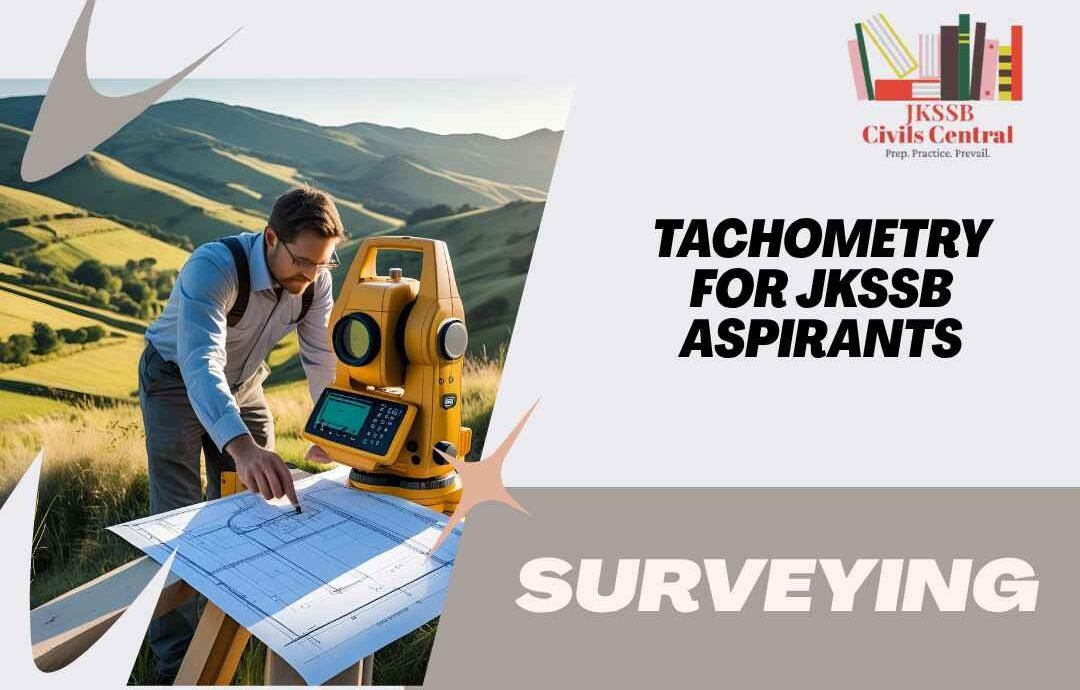
Tachometry setup in surveying showing theodolite and staff used to measure distance and elevation in uneven terrain
JE CivilSurveying

Tachometry in Surveying – Complete Guide for JKSSB Aspirants (2025 Edition)

By Sahil Digra
0

📚 Introduction

Tachometry is an essential technique in surveying used to measure horizontal distances, elevations, and gradients using angular observations. For JKSSB Civil Engineering and Diploma aspirants, mastering this topic is crucial as it regularly features in exams due to its practical relevance in hilly terrains like Jammu & Kashmir.

In this guide, we will cover:

  • Definition and purpose of tachometry
  • Instruments used
  • Principles and methods
  • Important formulas
  • Solved examples
  • FAQs and exam tips

📌 What is Tachometry in Surveying?

Tachometry (or Tacheometry) is a method of rapid surveying used to determine:

  • Horizontal distance
  • Elevation difference
  • Slope or gradient

…without physically measuring the distance with a chain or tape. Instead, observations are made through a telescope (theodolite or tachometer) using a staff with calibrated graduations.

🔍 Real-life Use Case:

When surveying in mountainous areas like Poonch or Anantnag, traditional chaining becomes difficult. Tachometry allows surveyors to quickly map features without needing to walk across rough terrain.


🧠 Why Tachometry Matters for JKSSB Exams

  • Included in JKSSB JE Civil and Diploma-level technical papers
  • Frequently asked in multiple-choice format
  • Practical relevance for field engineers working in J&K
  • Tests conceptual clarity and numerical accuracy

✅ Pro Tip: JKSSB often frames numerical problems based on the tachometric distance formula. Understanding constants (K and C) and their values is key!


🔧 Instruments Used in Tachometry

InstrumentFunction
TachometerA theodolite equipped with a stadia diaphragm
Leveling StaffHeld vertically on the point being observed
Stadia DiaphragmHas three crosshairs: upper, middle, and lower
Anallatic LensEliminates additive constant for simplification
Subtense BarUsed in the subtense method for distant readings

📐 Principle of Tachometry

Tachometry is based on optical triangulation. By using a telescope and a graduated staff, the intercept between the top and bottom stadia lines (staff readings) allows the surveyor to calculate:

  • Horizontal distance (D)
  • Vertical elevation (V)

📌 Key Formula (Stadia Method):

D=K⋅S+CD = K \cdot S + CD=K⋅S+C

Where:

  • D = Horizontal distance (in meters)
  • K = Multiplying constant (usually 100)
  • S = Staff intercept (difference between upper and lower stadia readings)
  • C = Additive constant (depends on the instrument setup)

📊 Tachometric Methods Explained

1️⃣ Stadia Method (Most Common)

  • Uses theodolite with stadia hairs
  • Staff is placed vertically
  • Simple and quick
  • Formula: D=KS+CD = KS + CD=KS+C

Vertical Elevation Formula:

If the line of sight is inclined: V=KS⋅sin⁡(2θ)2V = \frac{KS \cdot \sin(2θ)}{2}V=2KS⋅sin(2θ)​

Where:

  • θθθ = angle of elevation/depression

2️⃣ Tangential Method

  • No stadia hairs required
  • Two angular observations are taken to two known points on the staff
  • Used in older instruments

3️⃣ Subtense Method

  • Uses a known-length bar instead of staff
  • Angle subtended at the instrument is measured
  • Used when stadia reading isn’t practical

📈 Solved Numerical Example (JKSSB Pattern)

Q:
A tachometer with a multiplying constant K=100K = 100K=100, and an additive constant C=0C = 0C=0, is used. The stadia readings taken are:

  • Top: 2.50 m
  • Bottom: 1.00 m

Calculate the horizontal distance.

Solution: S=2.50−1.00=1.50 mS = 2.50 – 1.00 = 1.50 \, mS=2.50−1.00=1.50m D=100⋅1.5+0=150 mD = 100 \cdot 1.5 + 0 = \boxed{150 \, m}D=100⋅1.5+0=150m​


🗺️ Applications of Tachometry in Jammu & Kashmir

  • Topographical mapping of hilly regions
  • Highway alignment surveys
  • Hydrographic surveys (indirect distance measurement across rivers)
  • Irrigation project planning

In J&K’s terrain, where chain surveying is impractical, tachometry provides a fast and efficient solution.


📚 Tachometric Terms to Remember

TermDescription
Staff Intercept (S)Difference between top and bottom stadia readings
Stadia HairAdditional crosshairs above and below central crosshair
Multiplying Constant (K)Typically 100 (depends on instrument construction)
Additive Constant (C)Depends on lens setup; often 0 with anallatic lens
Line of CollimationLine of sight through the telescope


✅ Advantages of Tachometric Surveying

  • Rapid data collection
  • Ideal for inaccessible terrain
  • No need for chaining or taping
  • Useful for preliminary site analysis

❌ Limitations

  • Less precise than direct methods
  • Requires skilled observer
  • Accuracy affected by:
    • Instrument setup error
    • Staff misalignment
    • Incorrect vertical angle reading

🧠 Memory Tips for JKSSB Preparation

  • Remember the basic formula: D = KS + C
  • Use K = 100 and C = 0 unless stated
  • Practice visual identification of stadia readings
  • Revise instrument parts and uses weekly
  • Focus on unit conversions in numericals

🙋‍♂️ FAQs

Q1: Is tachometry part of JKSSB JE Civil Syllabus?
✅ Yes, it’s included under “Surveying and Levelling”.

Q2: What is the usual value of multiplying constant?
✅ Typically 100, but confirm based on the instrument.

Q3: Can tachometry be used at night?
❌ No, it requires clear line of sight and natural lighting.

Q4: What is the use of an anallatic lens?
✅ It removes the additive constant (C) for easier calculations.

Q5: Which is better – stadia or tangential method?
✅ Stadia method is faster, easier, and more widely used in modern surveying.


🎯 Final Words for JKSSB Aspirants

Tachometry is not just a theoretical concept but a field-tested method highly applicable in Jammu & Kashmir’s varied geography. Whether you’re preparing for JKSSB JE, Draughtsman Civil, or Surveyor posts, this topic can earn you easy marks if practiced well.

Make it a part of your weekly revision, and don’t forget to practice numerical problems. You can even simulate readings using virtual theodolite apps or YouTube videos to build intuition.

About The Author

Sahil Digra

See author's posts

Tags:

JKSSB Civil EngineeringJKSSB JE Civil SyllabusJKSSB JE SurveyingJKSSB Study MaterialRapid Survey MethodsStadia Method in SurveyingSubtense MethodSurveying Basics for JKSSBSurveying for Civil EngineeringSurveying for JKSSBSurveying MCQsSurveying TechniquesTacheometryTachometric SurveyingTachometry FormulasTachometry in SurveyingTachometry NotesTangential MethodTopographic SurveyingTypes of Tachometry
Author

Sahil Digra

Follow Me
Other Articles
Leveling in surveying process using dumpy level and staff on construction site
Previous

Leveling :- In-Depth Understanding of Leveling Concepts For JKSSB Aspirants

Theodolite instrument used for measuring horizontal and vertical angles in surveying
Next

Theodolite in Surveying – Complete Guide for JKSSB Aspirants

No Comment! Be the first one.

    Leave a Reply Cancel reply

    Your email address will not be published. Required fields are marked *

    Recent Posts

    • Sultanate Administration and Economy in Medieval Kashmir
    • Shah Mir Dynasty: Foundation, Major Sultans and Political Consolidation
    • Rinchen, Kota Rani and the Political Transition to Muslim Rule in Kashmir
    • Islam in Medieval Kashmir: Early Contacts, Migration, Settlement and Islamization
    • Lohara Dynasty in Kashmir: Rulers, Political Developments and Decline
    jkssb.Civilscentral.com
    • Sultanate Administration and Economy in Medieval Kashmir
    • Shah Mir Dynasty: Foundation, Major Sultans and Political Consolidation
    • Rinchen, Kota Rani and the Political Transition to Muslim Rule in Kashmir
    • Islam in Medieval Kashmir: Early Contacts, Migration, Settlement and Islamization
    • Lohara Dynasty in Kashmir: Rulers, Political Developments and Decline

    You May Have Missed

    Sultanate Administration and Economy in Medieval Kashmir
    Medieval J&K Premium J&K History Series

    Sultanate Administration and Economy in Medieval Kashmir

    Rohit Thapa
    By Rohit Thapa
    September 24, 2026
    Shah Mir Dynasty Foundation, Major Sultans and Political Consolidation
    Medieval J&K Premium J&K History Series

    Shah Mir Dynasty: Foundation, Major Sultans and Political Consolidation

    Rohit Thapa
    By Rohit Thapa
    September 22, 2026
    Rinchen, Kota Rani and the Political Transition to Muslim Rule in Kashmir
    Medieval J&K Premium J&K History Series

    Rinchen, Kota Rani and the Political Transition to Muslim Rule in Kashmir

    Rohit Thapa
    By Rohit Thapa
    September 22, 2026
    Islam in Medieval Kashmir Early Contacts, Migration, Settlement and Islamization
    Early Medieval J&K Premium J&K History Series

    Islam in Medieval Kashmir: Early Contacts, Migration, Settlement and Islamization

    Rohit Thapa
    By Rohit Thapa
    September 22, 2026
    Lohara Dynasty in Kashmir Rulers, Political Developments and Decline
    Early Medieval J&K Premium J&K History Series

    Lohara Dynasty in Kashmir: Rulers, Political Developments and Decline

    Rohit Thapa
    By Rohit Thapa
    September 22, 2026
    Queen Didda and the Lohara Dynasty Power, Politics and the Transition to Lohara Rule
    Early Medieval J&K Premium J&K History Series

    Queen Didda and the Lohara Dynasty: Power, Politics and the Transition to Lohara Rule

    Rohit Thapa
    By Rohit Thapa
    September 22, 2026
    Post-Utpala Kashmir Political Fragmentation, Yashaskara, Parvagupta and Kshemagupta
    Early Medieval J&K Premium J&K History Series

    Post-Utpala Kashmir: Political Fragmentation, Yashaskara, Parvagupta and Kshemagupta

    Rohit Thapa
    By Rohit Thapa
    September 22, 2026
    Shankaravarman and the Later Utpala Period Expansion, Fiscal Pressure and Political Instability
    Early Medieval J&K Premium J&K History Series

    Shankaravarman and the Later Utpala Period: Expansion, Fiscal Pressure and Political Instability

    Rohit Thapa
    By Rohit Thapa
    September 19, 2026
    Utpala Dynasty in Kashmir Avantivarman, Suyya and the Agrarian-Hydraulic Transformation
    Early Medieval J&K Premium J&K History Series

    Utpala Dynasty in Kashmir: Avantivarman, Suyya and the Agrarian-Hydraulic Transformation

    Rohit Thapa
    By Rohit Thapa
    September 18, 2026
    • Sultanate Administration and Economy in Medieval Kashmir
    • Shah Mir Dynasty: Foundation, Major Sultans and Political Consolidation
    • Rinchen, Kota Rani and the Political Transition to Muslim Rule in Kashmir
    • Islam in Medieval Kashmir: Early Contacts, Migration, Settlement and Islamization
    • Lohara Dynasty in Kashmir: Rulers, Political Developments and Decline
    • About us
    • Candidate Dashboard
    • Contact Us
    • Disclaimer
    • Privacy Policy
    • Terms and Conditions
    • Typing Practice
    Copyright 2026 — JKSSB-CivilsCentral. All rights reserved.