Skip to content
-
Subscribe to our newsletter & never miss our best posts. Subscribe Now!
JKSSB-CivilsCentral JKSSB-CivilsCentral

Prep.Practice.Prevail.

JKSSB-CivilsCentral JKSSB-CivilsCentral

Prep.Practice.Prevail.

  • Home
  • Premium J&K History Series
    • Prehistoric & Early J&K
    • Ancient J&K
    • Early Medieval J&K
    • Medieval J&K
    • Mughal, Afghan & Sikh J&K
    • Dogra State & Princely J&K
    • 1947, Accession & Constitutional History
    • Political Awakening & Modern J&K
    • Post-1947 J&K
  • JKSSB
    • JE Civil
  • Contact Us
  • About us
  • Home
  • Premium J&K History Series
    • Prehistoric & Early J&K
    • Ancient J&K
    • Early Medieval J&K
    • Medieval J&K
    • Mughal, Afghan & Sikh J&K
    • Dogra State & Princely J&K
    • 1947, Accession & Constitutional History
    • Political Awakening & Modern J&K
    • Post-1947 J&K
  • JKSSB
    • JE Civil
  • Contact Us
  • About us
  • https://www.facebook.com/
  • https://twitter.com/
  • https://t.me/
  • https://www.instagram.com/
  • https://youtube.com/
JKSSB-CivilsCentral JKSSB-CivilsCentral

Prep.Practice.Prevail.

JKSSB-CivilsCentral JKSSB-CivilsCentral

Prep.Practice.Prevail.

  • Home
  • Premium J&K History Series
    • Prehistoric & Early J&K
    • Ancient J&K
    • Early Medieval J&K
    • Medieval J&K
    • Mughal, Afghan & Sikh J&K
    • Dogra State & Princely J&K
    • 1947, Accession & Constitutional History
    • Political Awakening & Modern J&K
    • Post-1947 J&K
  • JKSSB
    • JE Civil
  • Contact Us
  • About us
  • Home
  • Premium J&K History Series
    • Prehistoric & Early J&K
    • Ancient J&K
    • Early Medieval J&K
    • Medieval J&K
    • Mughal, Afghan & Sikh J&K
    • Dogra State & Princely J&K
    • 1947, Accession & Constitutional History
    • Political Awakening & Modern J&K
    • Post-1947 J&K
  • JKSSB
    • JE Civil
  • Contact Us
  • About us
  • https://www.facebook.com/
  • https://twitter.com/
  • https://t.me/
  • https://www.instagram.com/
  • https://youtube.com/
Compressive strength test of concrete cube using compression testing machine as per IS 516
CONCRETE TECHNOLOGYJE Civil

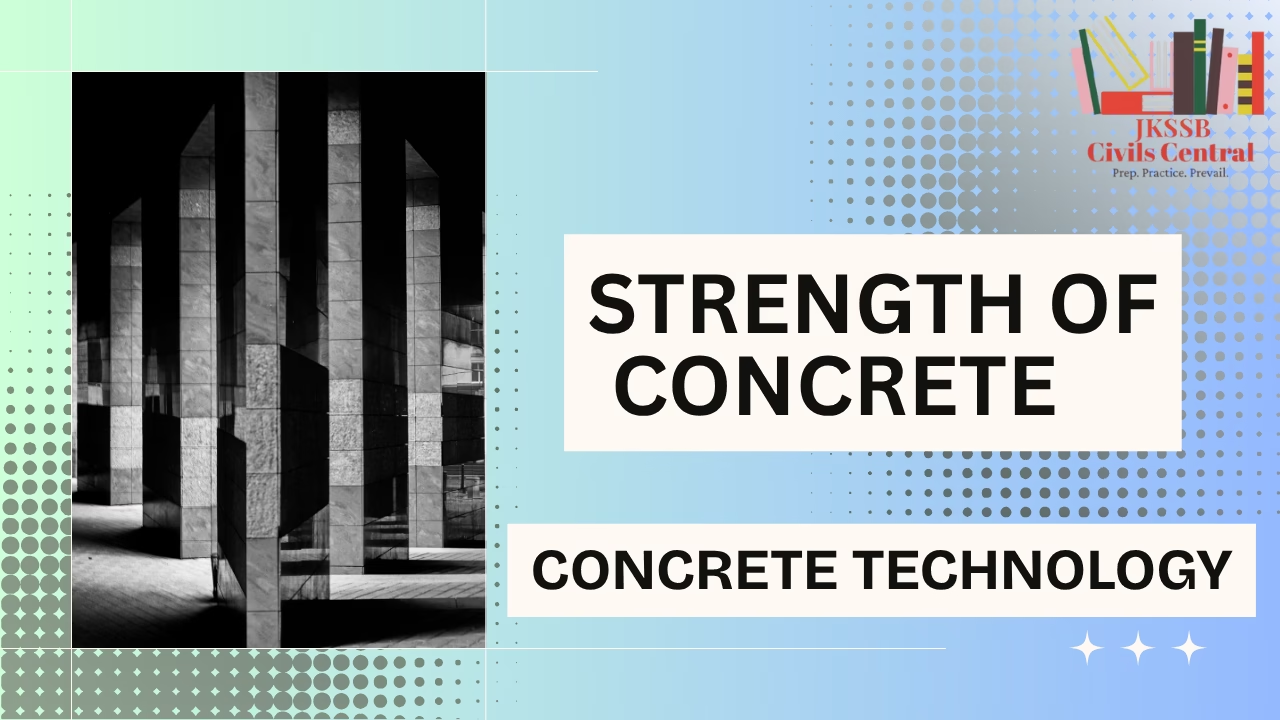
Strength of Concrete in Concrete Technology | JKSSB JE Civil Engineering

By Sahil Digra
0

Updated: July 2025

📌 Introduction

In civil engineering, concrete is regarded as the most widely used and versatile construction material, forming the backbone of buildings, bridges, roads, and dams. Among all its properties, strength stands out as the most vital characteristic because it governs the structural integrity and durability of the construction. Concrete must be capable of withstanding compressive, tensile, and flexural forces imposed during its service life. Hence, understanding the strength of concrete is not just theoretical—it plays a crucial role in site supervision, quality control, mix design, and compliance with building codes. For JKSSB Civil aspirants, a solid grasp of this topic is essential as it frequently appears in technical exams and practical field-based questions. Additionally, knowing the principles behind strength gain helps engineers ensure long-term performance and safety of civil infrastructure.


🔍 Why Strength of Concrete Matters in Civil Engineering?

  • It determines load-bearing capacity, which is the maximum load or force a concrete structural element can safely carry without failure. This includes the weight of the structure itself (dead load), occupants and furniture (live load), and environmental forces such as wind or earthquakes. High strength ensures the concrete can sustain these loads over time without cracking, buckling, or collapsing.
  • Influences design and durability of structures, as the strength of concrete directly affects the dimensions, reinforcement detailing, and safety factors used in structural elements like beams, columns, and slabs. Higher strength allows for slender members and longer spans, while also ensuring resistance against weathering, chemical attack, and repeated loading. Inadequate strength, on the other hand, can lead to early deterioration, cracks, or even collapse over time. Thus, strength is a critical parameter in both structural design and long-term durability of infrastructure.
  • Vital in mix design calculations, where the target strength (characteristic strength) forms the basis for determining the proportions of cement, water, aggregates, and admixtures in the concrete. Accurate knowledge of required strength ensures that the concrete performs as intended under service loads. Mix design is carried out using guidelines from IS 10262 and aims to achieve the target mean strength while maintaining workability and durability. The water-cement ratio, a key parameter in mix design, is directly linked to the desired compressive strength of the concrete.
  • Commonly asked topic in JKSSB JE, SSC JE, RRB JE exams.

🧪 Types of Strength in Concrete

1. Compressive Strength

  • Definition: Resistance of concrete to axial compressive loads, which means the ability of a concrete element to withstand loads that tend to reduce its size or cause it to be squashed. This property is crucial in columns, foundations, and load-bearing walls, where vertical forces are dominant. The compressive strength represents the maximum stress that concrete can resist without failing, and is typically measured in N/mm² (MPa). It serves as the primary parameter for determining the quality and grade of concrete used in construction.
  • Tested Using: Cube or Cylinder Test.
  • Standards: IS 516:1959.
  • Typical Values:
    • M15 → 15 MPa
    • M20 → 20 MPa
    • M25 → 25 MPa
  • Test Time: After 28 days of curing.

👉 Formula:

2. Tensile Strength

  • Definition: Resistance of concrete to cracking under tension.
  • Much lower than compressive strength.
  • Tested By:
    • Split Cylinder Test (IS 5816:1999)
    • Flexural Test

3. Flexural Strength (Modulus of Rupture)

  • Important for pavements and slabs.
  • Resistance to bending under load.

Where:

  • P = Load
  • L = Span
  • b = Breadth
  • d = Depth

🏗️ Factors Affecting Strength of Concrete

FactorDescription
Water-Cement RatioLower ratio = higher strength
CuringProper curing increases hydration & strength
Aggregate QualityStronger aggregates improve final strength
Mix ProportionsAccurate mix design ensures required strength
CompactionRemoves air voids, increasing density and strength

📊 Strength Development in Concrete Over Time

Age of ConcreteApproximate Strength Gained
1 Day16% of 28-day strength
3 Days40%
7 Days65%
14 Days90%
28 Days99% (standard for testing)

🏗️ Concrete Grades and Their Strength

GradeStrength (MPa)Usage
M1010Simple pathways
M1515Residential foundations
M2020RCC work
M2525Commercial structures
M30 and above≥30High-rise, bridges, etc.

📖 IS Code Guidelines on Concrete Strength

TestPurposeIS Code
Compressive Strength TestCube/Cylinder under compressionIS 516:1959
Split Tensile Strength TestMeasures indirect tensile strengthIS 5816:1999
Flexural Strength TestFor pavements/slabsIS 516:1959
Core TestFor in-situ strength checkIS 456:2000 (Annex C)
Rebound Hammer TestNon-destructive test (NDT)IS 13311 (Part 2)
Ultrasonic Pulse VelocityNDT for crack/void detectionIS 13311 (Part 1)

💡 Design Mix vs Nominal Mix

TypeStrength ControlUsed ForExample
Nominal MixApproximate strengthSmall worksM10, M15, M20
Design MixTargeted, calculated strengthLarge & critical worksM25, M30, M40…

🧠 Memory Trick for JKSSB Exams

  • “C-T-F” Rule:
    • C = Compressive (Strongest)
    • T = Tensile (Weakest)
    • F = Flexural (In-between)

🗒️ FAQs on Strength of Concrete

Q1. What is the standard test for compressive strength?
Ans: Cube test at 28 days as per IS 516:1959.

Q2. Which strength is the lowest in concrete?
Ans: Tensile strength.

Q3. What grade of concrete is used in RCC?
Ans: Minimum M20 as per IS 456:2000.

Q4. What affects concrete strength the most?
Ans: Water-cement ratio and curing.

Q5. Why is 28-day strength preferred?
Ans: Concrete gains about 99% of its strength by 28 days.


📃 Conclusion

Understanding the strength of concrete is vital for every civil engineering student and professional. For JKSSB JE and other competitive exams, this topic frequently appears in both objective and descriptive sections. Focus on compressive strength, testing standards, and influencing factors to strengthen your preparation.

📌 Join our Telegram Channel JKSSB CivilsCentral for regular updates, quizzes, PDF notes, and practice sets curated specifically for JKSSB aspirants.


About The Author

Sahil Digra

See author's posts

Tags:

Civil Engineering Strength of ConcreteCompressive Strength of ConcreteConcrete Mix Design StrengthConcrete StrengthConcrete Strength in MPaConcrete Technology JKSSBConcrete Testing MethodsFlexural StrengthIS 456 Concrete StrengthJKSSB Civil Study MaterialNDT of ConcreteSplit Tensile TestStrength of ConcreteTensile Strength of ConcreteTypes of Concrete Strength
Author

Sahil Digra

Follow Me
Other Articles
Types of chemical admixtures in concrete with their functions and IS code reference
Previous

Chemical Admixtures in Concrete Technology | JKSSB Civil

Types of Concrete in Civil Engineering – PCC, RCC, RMC, HPC & More
Next

Types of Concrete in Concrete Technology | Civil Engineering Guide for JKSSB

No Comment! Be the first one.

    Leave a Reply Cancel reply

    Your email address will not be published. Required fields are marked *

    Recent Posts

    • Sultanate Administration and Economy in Medieval Kashmir
    • Shah Mir Dynasty: Foundation, Major Sultans and Political Consolidation
    • Rinchen, Kota Rani and the Political Transition to Muslim Rule in Kashmir
    • Islam in Medieval Kashmir: Early Contacts, Migration, Settlement and Islamization
    • Lohara Dynasty in Kashmir: Rulers, Political Developments and Decline
    jkssb.Civilscentral.com
    • Sultanate Administration and Economy in Medieval Kashmir
    • Shah Mir Dynasty: Foundation, Major Sultans and Political Consolidation
    • Rinchen, Kota Rani and the Political Transition to Muslim Rule in Kashmir
    • Islam in Medieval Kashmir: Early Contacts, Migration, Settlement and Islamization
    • Lohara Dynasty in Kashmir: Rulers, Political Developments and Decline

    You May Have Missed

    Sultanate Administration and Economy in Medieval Kashmir
    Medieval J&K Premium J&K History Series

    Sultanate Administration and Economy in Medieval Kashmir

    Rohit Thapa
    By Rohit Thapa
    September 24, 2026
    Shah Mir Dynasty Foundation, Major Sultans and Political Consolidation
    Medieval J&K Premium J&K History Series

    Shah Mir Dynasty: Foundation, Major Sultans and Political Consolidation

    Rohit Thapa
    By Rohit Thapa
    September 22, 2026
    Rinchen, Kota Rani and the Political Transition to Muslim Rule in Kashmir
    Medieval J&K Premium J&K History Series

    Rinchen, Kota Rani and the Political Transition to Muslim Rule in Kashmir

    Rohit Thapa
    By Rohit Thapa
    September 22, 2026
    Islam in Medieval Kashmir Early Contacts, Migration, Settlement and Islamization
    Early Medieval J&K Premium J&K History Series

    Islam in Medieval Kashmir: Early Contacts, Migration, Settlement and Islamization

    Rohit Thapa
    By Rohit Thapa
    September 22, 2026
    Lohara Dynasty in Kashmir Rulers, Political Developments and Decline
    Early Medieval J&K Premium J&K History Series

    Lohara Dynasty in Kashmir: Rulers, Political Developments and Decline

    Rohit Thapa
    By Rohit Thapa
    September 22, 2026
    Queen Didda and the Lohara Dynasty Power, Politics and the Transition to Lohara Rule
    Early Medieval J&K Premium J&K History Series

    Queen Didda and the Lohara Dynasty: Power, Politics and the Transition to Lohara Rule

    Rohit Thapa
    By Rohit Thapa
    September 22, 2026
    Post-Utpala Kashmir Political Fragmentation, Yashaskara, Parvagupta and Kshemagupta
    Early Medieval J&K Premium J&K History Series

    Post-Utpala Kashmir: Political Fragmentation, Yashaskara, Parvagupta and Kshemagupta

    Rohit Thapa
    By Rohit Thapa
    September 22, 2026
    Shankaravarman and the Later Utpala Period Expansion, Fiscal Pressure and Political Instability
    Early Medieval J&K Premium J&K History Series

    Shankaravarman and the Later Utpala Period: Expansion, Fiscal Pressure and Political Instability

    Rohit Thapa
    By Rohit Thapa
    September 19, 2026
    Utpala Dynasty in Kashmir Avantivarman, Suyya and the Agrarian-Hydraulic Transformation
    Early Medieval J&K Premium J&K History Series

    Utpala Dynasty in Kashmir: Avantivarman, Suyya and the Agrarian-Hydraulic Transformation

    Rohit Thapa
    By Rohit Thapa
    September 18, 2026
    • Sultanate Administration and Economy in Medieval Kashmir
    • Shah Mir Dynasty: Foundation, Major Sultans and Political Consolidation
    • Rinchen, Kota Rani and the Political Transition to Muslim Rule in Kashmir
    • Islam in Medieval Kashmir: Early Contacts, Migration, Settlement and Islamization
    • Lohara Dynasty in Kashmir: Rulers, Political Developments and Decline
    • About us
    • Candidate Dashboard
    • Contact Us
    • Disclaimer
    • Privacy Policy
    • Terms and Conditions
    • Typing Practice
    Copyright 2026 — JKSSB-CivilsCentral. All rights reserved.