
Skip to content
-
Subscribe to our newsletter & never miss our best posts. Subscribe Now!
JKSSB-CivilsCentral JKSSB-CivilsCentral

Prep.Practice.Prevail.

JKSSB-CivilsCentral JKSSB-CivilsCentral

Prep.Practice.Prevail.

  • Home
  • Premium J&K History Series
    • Prehistoric & Early J&K
    • Ancient J&K
    • Early Medieval J&K
    • Medieval J&K
    • Mughal, Afghan & Sikh J&K
    • Dogra State & Princely J&K
    • 1947, Accession & Constitutional History
    • Political Awakening & Modern J&K
    • Post-1947 J&K
  • JKSSB
    • JE Civil
  • Contact Us
  • About us
  • Home
  • Premium J&K History Series
    • Prehistoric & Early J&K
    • Ancient J&K
    • Early Medieval J&K
    • Medieval J&K
    • Mughal, Afghan & Sikh J&K
    • Dogra State & Princely J&K
    • 1947, Accession & Constitutional History
    • Political Awakening & Modern J&K
    • Post-1947 J&K
  • JKSSB
    • JE Civil
  • Contact Us
  • About us
  • https://www.facebook.com/
  • https://twitter.com/
  • https://t.me/
  • https://www.instagram.com/
  • https://youtube.com/
JKSSB-CivilsCentral JKSSB-CivilsCentral

Prep.Practice.Prevail.

JKSSB-CivilsCentral JKSSB-CivilsCentral

Prep.Practice.Prevail.

  • Home
  • Premium J&K History Series
    • Prehistoric & Early J&K
    • Ancient J&K
    • Early Medieval J&K
    • Medieval J&K
    • Mughal, Afghan & Sikh J&K
    • Dogra State & Princely J&K
    • 1947, Accession & Constitutional History
    • Political Awakening & Modern J&K
    • Post-1947 J&K
  • JKSSB
    • JE Civil
  • Contact Us
  • About us
  • Home
  • Premium J&K History Series
    • Prehistoric & Early J&K
    • Ancient J&K
    • Early Medieval J&K
    • Medieval J&K
    • Mughal, Afghan & Sikh J&K
    • Dogra State & Princely J&K
    • 1947, Accession & Constitutional History
    • Political Awakening & Modern J&K
    • Post-1947 J&K
  • JKSSB
    • JE Civil
  • Contact Us
  • About us
  • https://www.facebook.com/
  • https://twitter.com/
  • https://t.me/
  • https://www.instagram.com/
  • https://youtube.com/
Compass surveying procedure for land measurement
JE CivilSurveying

Compass Surveying in Surveying – Complete Study Guide for JKSSB Aspirants (2025)

By Sahil Digra
0

📌 Introduction to Compass Surveying

Compass surveying is one of the earliest and most widely used methods in plane surveying, where a magnetic compass is employed to measure the direction of survey lines with respect to magnetic north. This method is primarily used for mapping small areas, where high precision is not critically required.

In JKSSB exams, especially for posts like Junior Engineer (Civil/Mechanical/Electrical) or Draftsman, compass surveying is a frequently asked topic in both objective and descriptive formats. Understanding it in detail gives you an edge.


🎓 Scope of Compass Surveying in JKSSB Exams

Why JKSSB Aspirants Must Study Compass Surveying:

  • Minimum 2–3 questions appear from Compass Surveying in JE (Civil) and Draftsman exams.
  • Topics like bearings, local attraction, declination, and included angles are often repeated.
  • Simple calculations based on field data are asked in MCQs.

📖 Example from Previous JKSSB JE Paper:
“What is the back bearing of a line having a fore bearing of 215°?”
✅ Correct Answer: 215° – 180° = 35°


🧭 Types of Compasses Used in Surveying

1. Prismatic Compass

  • Used widely in India.
  • Has a prism attached to the eye vane, enabling simultaneous sighting and reading.
  • Readings are taken from 0° to 360°, known as Whole Circle Bearing (WCB).
  • The compass needle aligns with magnetic north.

Features:

  • Portable and easy to use
  • Mounted on a tripod or held in hand
  • Graduation increases clockwise

2. Surveyor’s Compass

  • Graduated in Quadrantal Bearings (QB): 0° to 90° in each quadrant (NE, SE, SW, NW).
  • Used mostly in American systems.
  • Reading is taken using a sight vane, and graduation increases in both directions.

Note: Prismatic compass is preferred in competitive exams due to its widespread use in India.


🧭 Types of Bearings in Compass Surveying

Bearings are used to express the direction of a survey line with respect to magnetic north.

1. Whole Circle Bearing (WCB)

  • Measured clockwise from magnetic north.
  • Range: 0° to 360°
  • Common in Prismatic Compass
  • Example: North = 0°, East = 90°, South = 180°, West = 270°

2. Quadrantal Bearing (QB)

  • Measured from North or South towards East or West
  • Range: 0° to 90° in each quadrant
  • Example: N30°E, S45°W

🔁 Conversion between WCB and QB

WCBQB
45°N45°E
135°S45°E
225°S45°W
315°N45°W

📝 Important Tip: These conversions are common in JKSSB MCQs.


📏 Surveying Traverse – Key Concept

A traverse is a series of connected survey lines. The bearings of each line are measured using a compass.

🔄 Types of Traverse:

  1. Open Traverse: Starts and ends at different points.
  2. Closed Traverse: Forms a loop, starting and ending at the same point.

JKSSB Tip: Questions often involve computing included angles and checking for closure errors in closed traverse.


🧲 Magnetic Declination and Local Attraction

🌐 Magnetic Declination

  • It is the angle between magnetic north and true north.
  • Declination can be:
    • Easterly (Magnetic North is east of True North)
    • Westerly (Magnetic North is west of True North)
  • Necessary to apply corrections to measured bearings.

📝 Formula:
True Bearing = Magnetic Bearing ± Declination


⚠️ Local Attraction

Occurs when nearby magnetic materials disturb the compass needle.

How to Detect Local Attraction:

  • Measure Fore Bearing (FB) and Back Bearing (BB).
  • Normally: FB – BB = 180°
  • If not, local attraction is present.

Correction:

  • Adjust observed bearings using known unaffected lines as a reference.

📐 Important Surveying Formulas for JKSSB

ConceptFormula
Back Bearing (BB)FB ± 180° (Add if FB < 180°, Subtract if FB > 180°)
Included Angle (Interior)= FB of next line – BB of previous line
Declination CorrectionTrue Bearing = Magnetic Bearing ± Declination
Checking Local AttractionFB – BB = 180° (ideal condition)


📝 Field Procedure of Compass Surveying

  1. Select and mark stations in the field.
  2. Set up the compass over the station using a tripod and plumb bob.
  3. Level the compass properly using the bubble level.
  4. Take fore and back bearings for each line.
  5. Record the readings, ensuring minimal error.
  6. Check for local attraction and apply corrections.
  7. Plot the traverse using recorded bearings and lengths.

🎯 Tips for JKSSB Preparation (Compass Surveying)

  • Make a chart of bearing conversions (WCB ↔ QB).
  • Practice problems on included angles and declination.
  • Revise formulas daily.
  • Focus on previous year questions – many are repeated.
  • Use surveying instruments images to recognize them visually.


🏁 Final Words

Compass Surveying is simple yet scoring if prepared with concept clarity. Understanding types of compasses, types of bearings, and corrections like local attraction and declination will help you solve JKSSB questions with ease.

Stay consistent with revision and practice to master this section.

About The Author

Sahil Digra

See author's posts

Tags:

Bearings in SurveyingCompass SurveyingCompass Surveying for JKSSBCompass Traverse SurveyingField Surveying TechniquesJKSSB Civil Engineering NotesJKSSB JE Civil PreparationJKSSB Surveying NotesLocal Attraction in SurveyingMagnetic DeclinationPrismatic CompassQuadrantal BearingSurveying for Draftsman ExamSurveying Formulas JKSSBSurveying MCQs for JKSSBSurveyor’s CompassTypes of Compass in SurveyingWhole Circle Bearing
Author

Sahil Digra

Follow Me
Other Articles
JKSSB civil aspirant studying chain surveying methods
Previous

Chain Surveying in Surveying – Complete Guide for JKSSB Aspirants

Leveling in surveying process using dumpy level and staff on construction site
Next

Leveling :- In-Depth Understanding of Leveling Concepts For JKSSB Aspirants

No Comment! Be the first one.

    Leave a Reply Cancel reply

    Your email address will not be published. Required fields are marked *

    Recent Posts

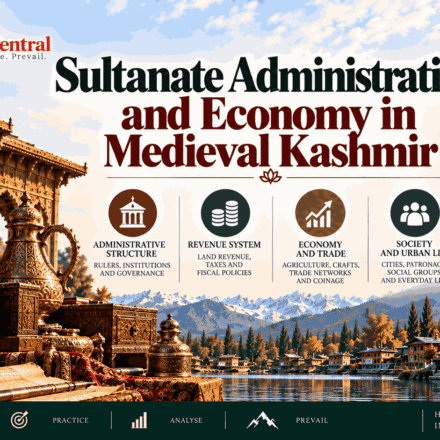
    • Sultanate Administration and Economy in Medieval Kashmir
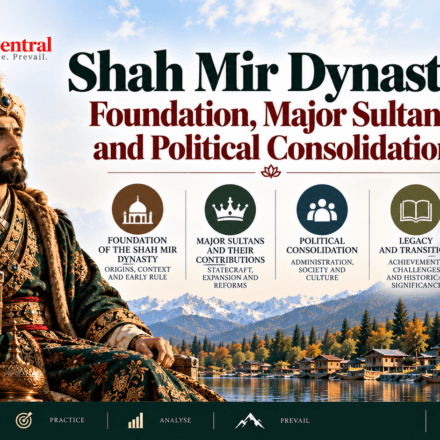
    • Shah Mir Dynasty: Foundation, Major Sultans and Political Consolidation
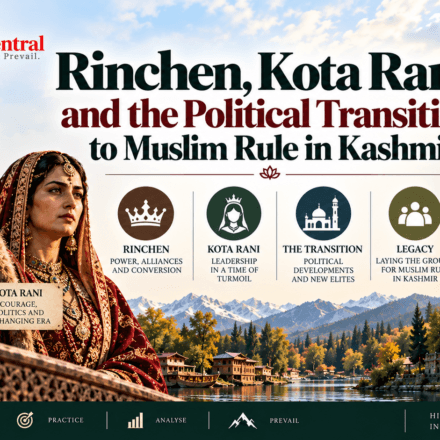
    • Rinchen, Kota Rani and the Political Transition to Muslim Rule in Kashmir
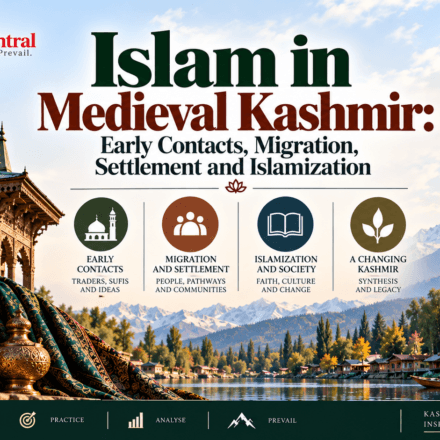
    • Islam in Medieval Kashmir: Early Contacts, Migration, Settlement and Islamization
    • Lohara Dynasty in Kashmir: Rulers, Political Developments and Decline
    jkssb.Civilscentral.com
    • Sultanate Administration and Economy in Medieval Kashmir
    • Shah Mir Dynasty: Foundation, Major Sultans and Political Consolidation
    • Rinchen, Kota Rani and the Political Transition to Muslim Rule in Kashmir
    • Islam in Medieval Kashmir: Early Contacts, Migration, Settlement and Islamization
    • Lohara Dynasty in Kashmir: Rulers, Political Developments and Decline

    You May Have Missed

    Sultanate Administration and Economy in Medieval Kashmir
    Medieval J&K Premium J&K History Series

    Sultanate Administration and Economy in Medieval Kashmir

    Rohit Thapa
    By Rohit Thapa
    September 24, 2026
    Shah Mir Dynasty Foundation, Major Sultans and Political Consolidation
    Medieval J&K Premium J&K History Series

    Shah Mir Dynasty: Foundation, Major Sultans and Political Consolidation

    Rohit Thapa
    By Rohit Thapa
    September 22, 2026
    Rinchen, Kota Rani and the Political Transition to Muslim Rule in Kashmir
    Medieval J&K Premium J&K History Series

    Rinchen, Kota Rani and the Political Transition to Muslim Rule in Kashmir

    Rohit Thapa
    By Rohit Thapa
    September 22, 2026
    Islam in Medieval Kashmir Early Contacts, Migration, Settlement and Islamization
    Early Medieval J&K Premium J&K History Series

    Islam in Medieval Kashmir: Early Contacts, Migration, Settlement and Islamization

    Rohit Thapa
    By Rohit Thapa
    September 22, 2026
    Lohara Dynasty in Kashmir Rulers, Political Developments and Decline
    Early Medieval J&K Premium J&K History Series

    Lohara Dynasty in Kashmir: Rulers, Political Developments and Decline

    Rohit Thapa
    By Rohit Thapa
    September 22, 2026
    Queen Didda and the Lohara Dynasty Power, Politics and the Transition to Lohara Rule
    Early Medieval J&K Premium J&K History Series

    Queen Didda and the Lohara Dynasty: Power, Politics and the Transition to Lohara Rule

    Rohit Thapa
    By Rohit Thapa
    September 22, 2026
    Post-Utpala Kashmir Political Fragmentation, Yashaskara, Parvagupta and Kshemagupta
    Early Medieval J&K Premium J&K History Series

    Post-Utpala Kashmir: Political Fragmentation, Yashaskara, Parvagupta and Kshemagupta

    Rohit Thapa
    By Rohit Thapa
    September 22, 2026
    Shankaravarman and the Later Utpala Period Expansion, Fiscal Pressure and Political Instability
    Early Medieval J&K Premium J&K History Series

    Shankaravarman and the Later Utpala Period: Expansion, Fiscal Pressure and Political Instability

    Rohit Thapa
    By Rohit Thapa
    September 19, 2026
    Utpala Dynasty in Kashmir Avantivarman, Suyya and the Agrarian-Hydraulic Transformation
    Early Medieval J&K Premium J&K History Series

    Utpala Dynasty in Kashmir: Avantivarman, Suyya and the Agrarian-Hydraulic Transformation

    Rohit Thapa
    By Rohit Thapa
    September 18, 2026
    • Sultanate Administration and Economy in Medieval Kashmir
    • Shah Mir Dynasty: Foundation, Major Sultans and Political Consolidation
    • Rinchen, Kota Rani and the Political Transition to Muslim Rule in Kashmir
    • Islam in Medieval Kashmir: Early Contacts, Migration, Settlement and Islamization
    • Lohara Dynasty in Kashmir: Rulers, Political Developments and Decline
    • About us
    • Candidate Dashboard
    • Contact Us
    • Disclaimer
    • Privacy Policy
    • Terms and Conditions
    • Typing Practice
    Copyright 2026 — JKSSB-CivilsCentral. All rights reserved.