
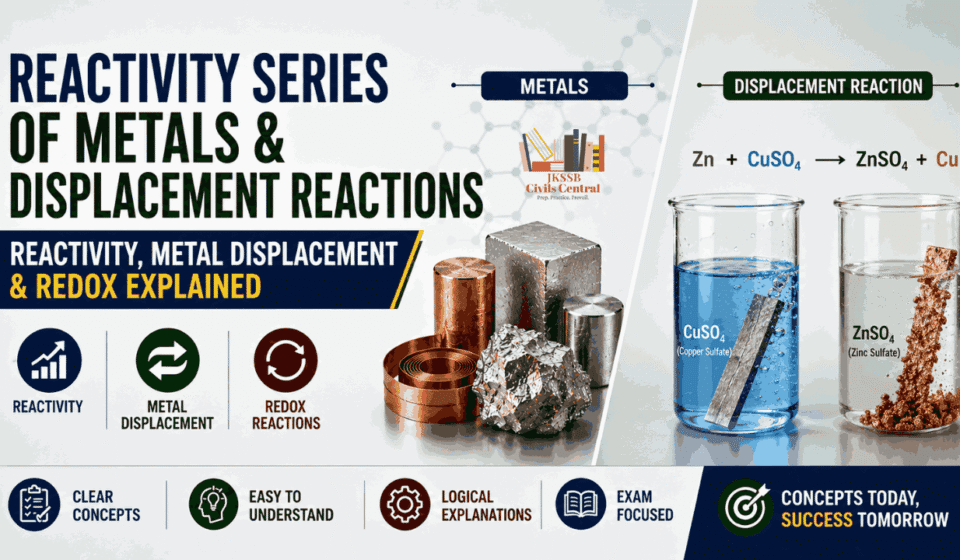
Reactivity Series of Metals & Displacement Reactions | Reactivity, Metal Displacement & Redox Explained

Reactivity Series of Metals & Displacement Reactions:
Understand the Reactivity Series of Metals, learn how more reactive metals displace less reactive metals from their salt solutions, explore displacement reactions with chemical equations, practical applications, and examination-oriented concepts for JKSSB, JKPSC, SSC, UPSC & State PSC examinations.
Learning Dashboard
| Chapter Information | Details |
|---|---|
| Subject | General Science – Chemistry |
| Series | Metals and Non-Metals |
| Lesson Number | Lesson 5 |
| Previous Lesson | Chemical Properties of Metals: Reaction of metals with Acids and Bases | Hydrogen Gas, Metal Salts & Amphoteric Metals |
| Current Lesson | Reactivity Series of Metals & Displacement Reactions | Reactivity, Metal Displacement & Redox Explained |
| Next Lesson | Corrosion and Prevention of Corrosion | Causes, Types, Rusting & Prevention Methods |
| Core Theme | Metals are arranged according to their reactivity. A more reactive metal can displace a less reactive metal from its salt solution, forming the basis of displacement reactions and predicting chemical behaviour. |
| Major Topics Covered | Reactivity Series, Basis of the Series, Highly Reactive Metals, Moderately Reactive Metals, Least Reactive Metals, Displacement Reactions, Predicting Reactions, Applications, Laboratory Demonstrations |
| Important Metals Studied | Potassium, Sodium, Calcium, Magnesium, Aluminium, Zinc, Iron, Lead, Hydrogen, Copper, Mercury, Silver, Gold, Platinum |
| Key Concepts | Reactivity Series, Metal Displacement, Salt Solutions, Single Displacement Reaction, Hydrogen Position, Predicting Chemical Reactions |
| Real-Life Applications | Extraction of Metals, Corrosion Prevention, Electroplating, Metal Purification, Industrial Manufacturing, Laboratory Experiments |
| Exam Focus | Frequently Asked in JKSSB FAA, JKPSC, JKAS, SSC, CDS, UPSC & State PSC Examinations |
Chapter Overview
In the previous lessons, we studied how metals react with oxygen, water, acids, and bases. These reactions revealed that all metals do not exhibit the same level of chemical activity. Some metals react violently with water and dilute acids, while others remain almost completely unreactive. This variation in chemical behaviour naturally leads to an important question: Can metals be arranged according to their reactivity?
The answer is yes. Chemists have arranged metals in a specific order known as the Reactivity Series, where metals are placed from the most reactive to the least reactive. This arrangement allows us to compare the chemical activity of different metals and predict how they will behave in various chemical reactions.
The reactivity series is one of the most fundamental concepts in inorganic chemistry because it explains why potassium reacts violently with water while copper does not, why magnesium displaces hydrogen from dilute acids but silver cannot, and why zinc can replace copper from copper sulphate solution. It also helps us understand corrosion, extraction of metals, electroplating, and numerous industrial processes.
Closely related to the reactivity series is the concept of displacement reactions. In these reactions, a more reactive metal replaces a less reactive metal from its salt solution. If the incoming metal is more reactive, the displacement occurs; if it is less reactive, no reaction takes place. This simple principle enables us to predict the outcome of many chemical reactions without performing laboratory experiments.
Throughout this lesson, we will study the complete reactivity series, understand how it was developed, learn the principle behind displacement reactions, solve practical examples with balanced chemical equations, explore real-life applications, and examine important facts frequently asked in JKSSB FAA, JKPSC, JKAS, SSC, CDS, UPSC, and State PSC examinations.
The reactivity series serves as the connecting link between all the chemical properties studied so far and provides the foundation for advanced topics such as metallurgy, electrochemistry, corrosion, and extraction of metals. It is therefore one of the most important chapters in the study of Metals and Non-Metals.
What is the Reactivity Series?
Before understanding displacement reactions, it is essential to know what the Reactivity Series actually is. The reactivity series is one of the most important concepts in chemistry because it provides a systematic arrangement of metals based on their chemical reactivity. It helps us predict how metals will behave when they react with oxygen, water, acids, bases, and even with the salts of other metals.
Rather than studying the chemical behaviour of each metal individually, chemists developed a single series that ranks metals from the most reactive to the least reactive. Once the position of a metal in this series is known, its behaviour in many chemical reactions can be predicted with considerable accuracy.
Definition of the Reactivity Series
The Reactivity Series is a list of metals arranged in decreasing order of their chemical reactivity, that is, from the metal that loses electrons most readily to the one that loses electrons least readily. Metals placed at the top of the series are highly reactive and easily participate in chemical reactions. Metals placed at the bottom are much less reactive and are often found in nature in their free or native state.
The position of a metal in the series therefore reflects its tendency to undergo chemical change.
Standard Reactivity Series
Standard Reactivity Series

Potassium (K)
       ↓
Sodium (Na)
       ↓
Calcium (Ca)
       ↓
Magnesium (Mg)
       ↓
Aluminium (Al)
       ↓
Zinc (Zn)
       ↓
Iron (Fe)
       ↓
Lead (Pb)
       ↓
Hydrogen (H) [Reference Element]
       ↓
Copper (Cu)
       ↓
Mercury (Hg)
       ↓
Silver (Ag)
       ↓
Gold (Au)
       ↓
Platinum (Pt)
Note: Hydrogen is not a metal, but it is included as a reference point. Metals above hydrogen can generally displace hydrogen from dilute acids, whereas metals below hydrogen generally cannot.
Why is Hydrogen Included?
Students often wonder why hydrogen appears in the reactivity series even though it is a non-metal. Hydrogen is included because it helps compare the ability of metals to displace hydrogen from dilute acids.
- Metals above hydrogen react with dilute acids and liberate hydrogen gas.
- Metals below hydrogen do not react with dilute acids under ordinary conditions.
Thus, hydrogen acts as a dividing line between reactive and less reactive metals.
Basis of the Reactivity Series
The arrangement of metals in the reactivity series is based on their tendency to lose electrons. A metal that loses electrons easily is more reactive because it readily forms positive ions and participates in chemical reactions. Conversely, a metal that holds its electrons strongly is less reactive and therefore reacts only under limited conditions or not at all.
This electron-losing tendency explains all the reactions studied in previous lessons:
- Highly reactive metals reacted vigorously with oxygen.
- They also reacted rapidly with water.
- They displaced hydrogen from acids.
- Some even reacted with strong bases.
Thus, the reactivity series is simply a summary of the chemical behaviour of metals based on their tendency to lose electrons.
Classification of Metals Based on Reactivity
For easier understanding, the metals in the reactivity series can be divided into three broad categories.
Highly Reactive Metals
These metals readily lose electrons and react vigorously with oxygen, water, and dilute acids.
Examples include:
- Potassium
- Sodium
- Calcium
These metals are never found in the free state in nature because they react very quickly with surrounding substances.
Moderately Reactive Metals
These metals react less vigorously but still undergo chemical reactions under suitable conditions.
Examples include:
- Magnesium
- Aluminium
- Zinc
- Iron
- Lead
These metals are commonly used in construction, engineering, and manufacturing because they combine reasonable reactivity with good mechanical strength.
Least Reactive Metals
These metals have a very low tendency to lose electrons.
Examples include:
- Copper
- Mercury
- Silver
- Gold
- Platinum
Because of their low reactivity, they resist corrosion and are often found in nature in their metallic form.
Importance of the Reactivity Series
The reactivity series is one of the most useful tools in chemistry because it allows us to predict the behaviour of metals without performing experiments.
Using the series, we can determine:
- Whether a metal will react with oxygen.
- Whether it will react with water.
- Whether it can displace hydrogen from dilute acids.
- Whether it can replace another metal from its salt solution.
- Which metals require electrolysis for extraction.
- Which metals are more prone to corrosion.
Thus, a single series explains a wide range of chemical properties and industrial processes.
Exam Tip
The following order should be memorized for competitive examinations:
K > Na > Ca > Mg > Al > Zn > Fe > Pb > H > Cu > Hg > Ag > Au > Pt
Students should also remember:
- Metals above hydrogen react with dilute acids.
- Metals below hydrogen do not react with dilute acids.
- Reactivity decreases from top to bottom.
- Potassium is the most reactive commonly studied metal.
- Platinum is among the least reactive metals.
The reactivity series forms the foundation for understanding displacement reactions, where the relative positions of two metals determine whether a chemical reaction will occur. This concept will be explored in the next section.
Why Are Metals Arranged in the Reactivity Series?
After learning the order of metals in the Reactivity Series, an important question naturally arises: How did scientists decide the position of each metal? The arrangement is not arbitrary. Each metal occupies its position based on carefully observed chemical behaviour and experimental evidence.
Chemists compared the reactions of different metals with oxygen, water, dilute acids, and salt solutions. Metals that reacted more readily were placed higher in the series, whereas metals that reacted less readily were placed lower. Thus, the reactivity series represents the relative chemical activity of metals.
Basis 1: Tendency to Lose Electrons
The primary basis of the reactivity series is the ability of metals to lose electrons. Metals that lose electrons easily form positive ions (cations) readily and therefore participate in chemical reactions more quickly. Such metals are classified as highly reactive.
For example, potassium loses its outermost electron very easily and reacts violently with water, oxygen, and dilute acids. Gold, on the other hand, holds its electrons strongly and rarely undergoes chemical reactions.
Thus, greater the tendency to lose electrons, higher the position of the metal in the reactivity series.
Basis 2: Reaction with Oxygen
The reaction of metals with oxygen provides another important criterion for determining reactivity. Highly reactive metals combine rapidly with oxygen to form metal oxides. Some even react spontaneously in air.
For example:
- Potassium and sodium oxidize rapidly when exposed to air.
- Magnesium burns with a dazzling white flame.
- Iron reacts more slowly and forms rust over time.
- Gold and platinum remain almost unaffected by atmospheric oxygen.
The speed and ease with which metals combine with oxygen indicate their relative reactivity.
Basis 3: Reaction with Water
The behaviour of metals towards water also helps determine their position in the reactivity series. Highly reactive metals react with cold water, moderately reactive metals react with hot water or steam, and least reactive metals do not react with water.
For example:
- Potassium, sodium, and calcium react with cold water.
- Magnesium reacts with hot water.
- Aluminium, zinc, and iron react with steam.
- Copper, silver, gold, and platinum do not react with water.
These observations clearly demonstrate the decreasing order of reactivity.
Basis 4: Reaction with Dilute Acids
Another important method of comparing metals is by studying their reactions with dilute acids. Metals placed above hydrogen readily displace hydrogen from dilute acids, producing salts and hydrogen gas.
Metals below hydrogen fail to do so.
For example:
- Magnesium reacts vigorously with dilute hydrochloric acid.
- Zinc reacts moderately.
- Iron reacts slowly.
- Copper shows no reaction.
This behaviour confirms their respective positions in the reactivity series.
Basis 5: Ability to Displace Other Metals
One of the strongest pieces of evidence for arranging metals in the reactivity series comes from displacement reactions. A more reactive metal can displace a less reactive metal from its salt solution.
For example:
Zn + CuSO₄ → ZnSO₄ + Cu
In this reaction, zinc replaces copper because zinc is more reactive. However,
Cu + ZnSO₄ → No Reaction
Copper cannot replace zinc because it is less reactive. This principle forms the foundation of displacement reactions and confirms the order of metals in the reactivity series.
Experimental Development of the Series
The reactivity series was developed through repeated laboratory experiments.
Scientists compared metals by observing:
- Their reaction with oxygen.
- Their reaction with water.
- Their reaction with dilute acids.
- Their ability to displace other metals from salt solutions.
- Their ease of oxidation.
The combined results of these experiments enabled chemists to arrange metals in a logical order from most reactive to least reactive.
Why is the Reactivity Series Important?
The reactivity series is much more than a simple list of metals. It acts as a powerful predictive tool in chemistry.
Using the reactivity series, we can determine:
- Whether a metal will react with water.
- Whether it will react with dilute acids.
- Whether hydrogen gas will be evolved.
- Whether one metal can displace another from a salt solution.
- Which metals are easily corroded.
- Which extraction method is suitable for a particular metal.
Thus, the reactivity series connects several important topics into one unified concept.
Summary Table
| Basis | What It Indicates |
|---|---|
| Tendency to lose electrons | Higher tendency means higher reactivity. |
| Reaction with oxygen | Faster oxidation indicates greater reactivity. |
| Reaction with water | More vigorous reaction indicates higher reactivity. |
| Reaction with dilute acids | Ability to displace hydrogen determines reactivity. |
| Displacement reactions | More reactive metals replace less reactive metals from their salts. |
Exam Tip
For competitive examinations, always remember the following principles:
- Metals are arranged according to their chemical reactivity.
- The ability to lose electrons is the primary basis of the reactivity series.
- Highly reactive metals react readily with oxygen, water, and dilute acids.
- Metals above hydrogen can displace hydrogen from dilute acids.
- A more reactive metal always displaces a less reactive metal from its salt solution.
- The reactivity series helps predict the outcome of chemical reactions without performing experiments.
These principles provide the scientific foundation for the next topic, Displacement Reactions, where the position of metals in the reactivity series is used to predict whether one metal can replace another in a chemical reaction.
What are Displacement Reactions?
After understanding the Reactivity Series, the next logical step is to study one of its most important applications—Displacement Reactions. These reactions provide direct evidence that metals differ in their chemical reactivity and demonstrate how the reactivity series can be used to predict whether a chemical reaction will occur.
A displacement reaction occurs when a more reactive metal replaces a less reactive metal from its salt solution. The more reactive metal loses electrons more readily and forms its own salt, while the less reactive metal is displaced and deposited in its elemental form.
This simple principle is widely used in laboratories, industries, metallurgy, and competitive examinations. In fact, many questions on the reactivity series can be answered simply by applying the rule governing displacement reactions.
Definition of a Displacement Reaction
A displacement reaction is a chemical reaction in which a more reactive metal displaces a less reactive metal from its salt solution, forming a new salt and liberating the less reactive metal.
The general reaction can be represented as: More Reactive Metal + Salt of Less Reactive Metal → New Salt + Less Reactive Metal
Only a metal that is higher in the reactivity series can displace a metal that is below it.
Why Do Displacement Reactions Occur?
Displacement reactions occur because different metals have different tendencies to lose electrons. A more reactive metal loses electrons more readily than a less reactive metal. When it is placed in a solution containing ions of a less reactive metal, it donates electrons to those ions.
As a result:
- The more reactive metal dissolves into the solution as positive ions.
- The less reactive metal gains electrons and is deposited as a solid metal.
Thus, the driving force behind displacement reactions is the difference in the reactivity of metals.
General Rule for Displacement Reactions
The outcome of every displacement reaction depends upon the relative positions of the two metals in the reactivity series.
The rule is straightforward:
- A more reactive metal displaces a less reactive metal from its salt solution.
- A less reactive metal cannot displace a more reactive metal.
This single rule allows us to predict the outcome of almost every metal displacement reaction.
Example 1: Zinc and Copper Sulphate
One of the most common examples of a displacement reaction is the reaction between zinc and copper sulphate solution.
Chemical Equation
Zn + CuSO₄ → ZnSO₄ + Cu
Observation
During the reaction:
- The blue colour of copper sulphate gradually fades.
- A reddish-brown layer of copper is deposited on the zinc strip.
- Zinc gradually dissolves into the solution.
Scientific Explanation
Zinc is above copper in the reactivity series. Therefore, zinc loses electrons more readily than copper and displaces copper from copper sulphate solution. The reaction produces zinc sulphate while elemental copper is deposited.
Example 2: Iron and Copper Sulphate
Iron also reacts with copper sulphate because iron is more reactive than copper.
Chemical Equation
Fe + CuSO₄ → FeSO₄ + Cu
Observation
During the reaction:
- The blue solution gradually turns light green.
- A reddish-brown coating of copper appears on the iron nail.
- Iron slowly dissolves.
Scientific Explanation
Iron is placed above copper in the reactivity series. Hence, iron replaces copper from copper sulphate solution and forms iron(II) sulphate.
Example 3: Copper and Zinc Sulphate
Now consider the reverse situation.
Chemical Equation
Cu + ZnSO₄ → No Reaction
Observation
- No visible change occurs.
- The zinc sulphate solution remains unchanged.
- Copper does not dissolve.
Scientific Explanation
Copper is below zinc in the reactivity series. Therefore, copper cannot displace zinc from zinc sulphate solution, and no reaction takes place. This example confirms that only a more reactive metal can displace a less reactive metal.
Conditions Required for a Displacement Reaction
For a displacement reaction to occur, the following conditions must be satisfied:
- The reacting metal must be more reactive than the metal present in the salt solution.
- The salt should be soluble in water so that metal ions are available in solution.
- Suitable experimental conditions, such as proper concentration and temperature, should be maintained.
If the incoming metal is less reactive, the reaction does not occur.
Importance of Displacement Reactions
Displacement reactions are important because they:
- Verify the reactivity series.
- Help compare the chemical reactivity of metals.
- Explain many laboratory demonstrations.
- Form the basis of several metallurgical processes.
- Help predict chemical reactions without performing experiments.
These reactions are also extensively used in industries for metal extraction, metal purification, and chemical manufacturing.
Exam Tip
Always remember the golden rule:
- Higher in the Reactivity Series → Displaces Lower Metal
- Lower in the Reactivity Series → Cannot Displace Higher Metal
Some important examples to remember are:
- Zn + CuSO₄ → ZnSO₄ + Cu ✔
- Fe + CuSO₄ → FeSO₄ + Cu ✔
- Cu + ZnSO₄ → No Reaction ✘
Understanding this rule is the key to solving most questions on displacement reactions in JKSSB, JKPSC, SSC, UPSC, CDS, and other competitive examinations. It also prepares you for the next section, where we will study more examples of displacement reactions and learn how to predict their outcomes using the reactivity series.
Predicting Displacement Reactions Using the Reactivity Series
One of the greatest advantages of the Reactivity Series is that it enables us to predict whether a displacement reaction will occur without actually performing the experiment. By simply comparing the positions of two metals in the reactivity series, we can determine whether one metal will displace another from its salt solution.
This predictive ability makes the reactivity series an extremely useful tool in chemistry. It saves time in laboratories, helps explain industrial processes, and forms the basis of many objective questions asked in competitive examinations.
The Golden Rule
The prediction of displacement reactions depends on one simple rule: A metal higher in the reactivity series can displace a metal that is below it from its salt solution.
However, A metal lower in the reactivity series cannot displace a metal that is above it.
This single principle is sufficient to predict the outcome of most displacement reactions.
Step 1: Compare the Positions of the Metals
The first step is to locate both metals in the reactivity series.
For example: K > Na > Ca > Mg > Al > Zn > Fe > Pb > H > Cu > Hg > Ag > Au > Pt
If the reacting metal is above the metal present in the salt solution, displacement will occur. If it is below, no reaction will take place.
Example 1: Zinc and Copper Sulphate
Suppose a zinc strip is placed in copper sulphate solution.
Step 1
Compare their positions: Zinc (Zn) is above Copper (Cu).
Step 2
Since zinc is more reactive, it will displace copper.
Chemical Equation
Zn + CuSO₄ → ZnSO₄ + Cu
Prediction
✔ Reaction Occurs
Example 2: Copper and Zinc Sulphate
Now place a copper strip in zinc sulphate solution.
Step 1
Compare the positions: Copper (Cu) is below Zinc (Zn).
Step 2
Copper is less reactive and therefore cannot replace zinc.
Chemical Equation
Cu + ZnSO₄ → No Reaction
Prediction
✘ No Reaction
Example 3: Iron and Copper Sulphate
Consider an iron nail placed in copper sulphate solution.
Step 1
Iron is above copper in the reactivity series.
Step 2
Iron will displace copper.
Chemical Equation
Fe + CuSO₄ → FeSO₄ + Cu
Prediction
✔ Reaction Occurs
Example 4: Magnesium and Zinc Sulphate
Now consider magnesium placed in zinc sulphate solution.
Step 1
Magnesium is above zinc.
Step 2
Magnesium will displace zinc.
Chemical Equation
Mg + ZnSO₄ → MgSO₄ + Zn
Prediction
✔ Reaction Occurs
Example 5: Silver and Copper Sulphate
Suppose silver is placed in copper sulphate solution.
Step 1
Silver is below copper in the reactivity series.
Step 2
Silver cannot displace copper.
Chemical Equation
Ag + CuSO₄ → No Reaction
Prediction
✘ No Reaction
Quick Method for Solving Questions
Whenever a displacement reaction is given, follow these three simple steps:
Step 1: Identify the reacting metal.
Step 2: Compare its position with the metal present in the salt solution.
Step 3:
- If the reacting metal is higher, the reaction occurs.
- If the reacting metal is lower, there is no reaction.
This method can solve almost every displacement-reaction question within a few seconds.
Practice Table
| Reaction | Prediction | Reason |
|---|---|---|
| Zn + CuSO₄ | ✔ Reaction | Zinc is more reactive than copper. |
| Fe + CuSO₄ | ✔ Reaction | Iron is more reactive than copper. |
| Mg + ZnSO₄ | ✔ Reaction | Magnesium is more reactive than zinc. |
| Cu + ZnSO₄ | ✘ No Reaction | Copper is less reactive than zinc. |
| Ag + CuSO₄ | ✘ No Reaction | Silver is less reactive than copper. |
| Au + FeSO₄ | ✘ No Reaction | Gold is less reactive than iron. |
Why is Prediction Important?
The ability to predict displacement reactions has numerous practical applications.
It helps chemists:
- Predict the outcome of laboratory reactions.
- Select suitable metals for industrial processes.
- Understand corrosion and metal protection.
- Design extraction methods for metals.
- Explain the behaviour of metals in chemical industries.
Instead of memorizing hundreds of reactions, students need only remember the reactivity series and apply the displacement rule.
Exam Tip
Always remember these high-scoring rules:
- Higher metal → Displaces lower metal.
- Lower metal → Cannot displace higher metal.
- Compare the positions of the two metals before writing the chemical equation.
- If the reacting metal is below the metal in the salt solution, write “No Reaction.”
- Questions based on predicting displacement reactions are among the most frequently asked in JKSSB, JKPSC, SSC, UPSC, CDS, and other State PSC examinations.
Mastering this simple prediction technique will allow you to solve most displacement reaction questions quickly and accurately, making it one of the most valuable concepts in the study of the Reactivity Series of Metals.
Factors Affecting the Reactivity of Metals
After learning how to predict displacement reactions using the Reactivity Series, an important question naturally arises: Why are some metals more reactive than others? Why does potassium react violently with water while gold remains almost completely unreactive? The answer lies in the atomic structure of metals and their tendency to lose electrons.
The reactivity of a metal is determined by how easily it can lose its outermost (valence) electrons and form positive ions. Several factors influence this ability, including the number of valence electrons, atomic size, shielding effect, and ionization energy. Understanding these factors provides a scientific explanation for the order of metals in the reactivity series.
Tendency to Lose Electrons
The most important factor affecting the reactivity of a metal is its tendency to lose electrons. Metals become chemically stable by losing one or more electrons from their outermost shell. A metal that can lose these electrons easily is highly reactive because it readily forms positive ions and participates in chemical reactions.
For example, potassium loses its single valence electron very easily and is therefore one of the most reactive metals. Gold, however, holds its electrons much more strongly and is one of the least reactive metals.
Thus, the greater the tendency to lose electrons, the greater is the reactivity of the metal.
Atomic Size
The size of an atom also influences its reactivity. In larger atoms, the outermost electrons are farther away from the nucleus. The attractive force of the nucleus on these electrons is comparatively weaker, making them easier to remove.
Consequently, metals with larger atomic sizes generally lose electrons more easily and are more reactive. For example, potassium has a larger atomic size than sodium and is therefore more reactive.
Shielding Effect
The shielding effect refers to the reduction in the attractive force of the nucleus on the outermost electrons due to the presence of inner electron shells. As the number of electron shells increases, the inner electrons shield the outermost electrons from the positive charge of the nucleus.
This reduced attraction allows the outermost electrons to be removed more easily, thereby increasing the reactivity of the metal.
Ionization Energy
Ionization energy is the amount of energy required to remove the outermost electron from an atom. Metals with low ionization energy lose electrons easily and are highly reactive.
Metals with high ionization energy require more energy to remove electrons and are therefore less reactive.
For example:
- Potassium has low ionization energy and is highly reactive.
- Gold has high ionization energy and is much less reactive.
Thus, lower ionization energy corresponds to higher reactivity.
Stability of the Positive Ion
Another factor influencing reactivity is the stability of the positive ion formed after electron loss. If a metal can easily attain a stable electronic configuration after losing electrons, it reacts readily. For example, sodium loses one electron to form Na⁺, while magnesium loses two electrons to form Mg²⁺. Both ions possess stable electronic configurations, making these metals chemically reactive.
Summary Table
| Factor | Effect on Reactivity |
|---|---|
| Tendency to lose electrons | Greater tendency → Higher reactivity |
| Atomic size | Larger size → Higher reactivity |
| Shielding effect | Greater shielding → Higher reactivity |
| Ionization energy | Lower ionization energy → Higher reactivity |
| Stability after electron loss | Greater stability → Higher reactivity |
Importance of These Factors
Understanding these factors helps explain many observations already studied in this chapter.
For example:
- Potassium and sodium react vigorously with water because they lose electrons very easily.
- Magnesium reacts less vigorously because its electrons are held more strongly.
- Copper and gold do not readily participate in displacement reactions because they have a much lower tendency to lose electrons.
Thus, the reactivity series is not simply a list to memorize; it is based on fundamental atomic properties that determine the chemical behaviour of metals.
Exam Tip
Remember these important points:
- Reactivity depends mainly on the ease of losing electrons.
- Larger atomic size generally increases metallic reactivity.
- Greater shielding effect makes electron removal easier.
- Lower ionization energy means higher reactivity.
- Highly reactive metals form positive ions easily and occupy the top of the reactivity series.
These factors provide the scientific explanation for the arrangement of metals in the reactivity series and help students understand why displacement reactions occur, rather than simply memorizing the order of metals.
Applications of the Reactivity Series
The Reactivity Series is much more than a list of metals arranged according to their chemical activity. It is one of the most useful tools in chemistry because it enables scientists, engineers, and students to predict chemical reactions, select suitable materials for industrial processes, and understand many natural phenomena. From laboratories to large-scale industries, the reactivity series plays an essential role in decision-making and problem-solving.
The practical applications of the reactivity series extend to metal extraction, corrosion prevention, displacement reactions, electroplating, hydrogen production, and material selection. Understanding these applications helps students connect theoretical chemistry with real-life situations.
Predicting Chemical Reactions
The most important application of the reactivity series is its ability to predict whether a chemical reaction will occur.
By comparing the positions of two metals in the reactivity series, we can determine:
- Whether a metal will react with water.
- Whether it will react with dilute acids.
- Whether it can displace another metal from its salt solution.
- Whether hydrogen gas will be evolved.
This predictive ability saves time in laboratories because many reactions can be anticipated without performing experiments.
Understanding Displacement Reactions
The reactivity series forms the basis of displacement reactions. Whenever a metal is placed in the salt solution of another metal, the reactivity series helps determine whether displacement will occur.
For example: Zn + CuSO₄ → ZnSO₄ + Cu
Since zinc is above copper in the reactivity series, zinc displaces copper from its salt solution.
However, Cu + ZnSO₄ → No Reaction
Because copper is less reactive than zinc, it cannot replace zinc from zinc sulphate solution.
Extraction of Metals
The reactivity series is extremely important in metallurgy, the branch of science concerned with the extraction of metals from their ores.
Different metals require different extraction methods depending on their reactivity.
- Highly reactive metals such as potassium, sodium, and calcium cannot be extracted using carbon because they are more reactive than carbon. They are extracted by electrolysis.
- Moderately reactive metals such as zinc, iron, and lead are generally extracted by reduction with carbon or carbon monoxide.
- Least reactive metals such as gold and platinum often occur in the native (free) state and require very little chemical processing.
Thus, the reactivity series helps determine the most suitable extraction technique.
Corrosion Prevention
The reactivity series also helps explain why some metals corrode rapidly while others remain unaffected. Highly reactive metals lose electrons easily and are generally more susceptible to corrosion if left unprotected. Less reactive metals such as gold and platinum resist corrosion because they have a very low tendency to undergo chemical reactions.
The knowledge of metal reactivity is therefore used to develop methods of corrosion prevention such as:
- Galvanization
- Protective coatings
- Painting
- Alloy formation
Selection of Materials
Engineers use the reactivity series to select appropriate materials for different purposes.
For example:
- Copper is used in electrical wiring and water pipes because of its low reactivity.
- Aluminium is used in aircraft because it combines moderate reactivity with corrosion resistance.
- Stainless steel is widely used in kitchen utensils and construction because of its resistance to corrosion.
Choosing the correct material improves durability, safety, and efficiency.
Electroplating and Metal Coating
The reactivity series plays an important role in electroplating and metal coating. More reactive metals are often coated with less reactive metals to improve appearance and corrosion resistance. Similarly, understanding the relative reactivity of metals helps industries choose suitable metals for electroplating processes.
Laboratory Experiments
The reactivity series is frequently used during laboratory experiments.
It helps students:
- Predict displacement reactions.
- Identify unknown metals.
- Prepare hydrogen gas.
- Compare the chemical behaviour of different metals.
Many practical chemistry experiments are based directly on the principles of the reactivity series.
Importance in Competitive Examinations
Questions based on the applications of the reactivity series are common in competitive examinations.
Students should remember:
- The reactivity series predicts chemical reactions.
- It explains displacement reactions.
- It determines the method of metal extraction.
- It helps explain corrosion.
- It guides material selection in engineering.
- It is useful in electroplating and industrial manufacturing.
Real-Life Examples at a Glance
| Application | Role of the Reactivity Series |
|---|---|
| Predicting reactions | Determines whether a chemical reaction will occur. |
| Displacement reactions | Identifies whether one metal can replace another. |
| Metal extraction | Helps select the appropriate extraction method. |
| Corrosion prevention | Explains why some metals corrode while others resist corrosion. |
| Material selection | Assists engineers in choosing suitable metals for different applications. |
| Electroplating | Helps select metals for coating and protection. |
| Laboratory experiments | Predicts outcomes of practical chemistry reactions. |
The Reactivity Series is therefore one of the most valuable concepts in chemistry because it links together the chemical properties of metals, displacement reactions, metallurgy, corrosion, and industrial applications. Instead of memorizing individual reactions, students who understand the reactivity series can predict the behaviour of metals in a wide variety of situations, making it an indispensable tool for both academic study and competitive examinations.
JKSSB CivilsCentral Insight
The Reactivity Series is one of the most fundamental concepts in chemistry because it provides a single framework for understanding the chemical behaviour of metals. Instead of memorizing the reactions of each metal separately, students can use the reactivity series to predict how a metal will react with oxygen, water, acids, salt solutions, and even during extraction processes.
The most important idea is that metals are arranged in decreasing order of their chemical reactivity. Metals at the top of the series lose electrons very easily and therefore react readily with other substances. As we move down the series, the tendency to lose electrons decreases, making the metals progressively less reactive.
One of the most significant uses of the reactivity series is in predicting displacement reactions. A metal placed higher in the series can displace a metal that is below it from its salt solution. However, a metal lower in the series cannot replace a metal above it. This simple rule allows students to determine whether a displacement reaction will occur without performing the experiment.
The inclusion of hydrogen in the reactivity series is another important concept. Although hydrogen is not a metal, it serves as a reference point. Metals above hydrogen react with dilute acids and liberate hydrogen gas, whereas metals below hydrogen generally do not react with dilute hydrochloric acid or dilute sulphuric acid.
The reactivity series also explains why different extraction methods are used for different metals. Highly reactive metals such as potassium, sodium, and calcium require electrolysis for extraction because they cannot be reduced by carbon. Moderately reactive metals such as zinc and iron can be extracted by reduction with carbon, whereas least reactive metals such as gold and platinum are often found in their native state.
The concept is equally important in understanding corrosion. Highly reactive metals are generally more prone to corrosion, while less reactive metals such as gold and platinum resist corrosion because they have a very low tendency to undergo chemical reactions.
Thus, the reactivity series is not merely a list of metals—it is a powerful predictive tool that connects the chemical properties of metals with their industrial extraction, displacement reactions, corrosion, and practical applications.
High-Yield Facts for Competitive Examinations
Remember the following examination-oriented points:
- Reactivity Series is the arrangement of metals in decreasing order of their reactivity.
- The standard order is:K > Na > Ca > Mg > Al > Zn > Fe > Pb > H > Cu > Hg > Ag > Au > Pt
- Potassium is the most reactive commonly studied metal.
- Gold and platinum are among the least reactive metals.
- Hydrogen is included as a reference element, although it is not a metal.
- Metals above hydrogen react with dilute acids and evolve hydrogen gas.
- Metals below hydrogen do not react with dilute hydrochloric acid or dilute sulphuric acid.
- A more reactive metal displaces a less reactive metal from its salt solution.
- A less reactive metal cannot displace a more reactive metal.
- Zn + CuSO₄ → ZnSO₄ + Cu is a classic displacement reaction.
- Cu + ZnSO₄ → No Reaction because copper is less reactive than zinc.
- Highly reactive metals are extracted by electrolysis.
- Moderately reactive metals are extracted by reduction with carbon.
- Least reactive metals often occur in the native state.
- The reactivity series helps predict reactions with oxygen, water, acids, and salt solutions.
- It also explains corrosion, metallurgy, electroplating, and displacement reactions.
Instead of memorizing numerous chemical equations, focus on the position of a metal in the reactivity series. Once the order is remembered, you can quickly predict whether a metal will react with water, acids, or another metal’s salt solution, identify the extraction method, and determine the likelihood of corrosion. This makes the reactivity series one of the highest-scoring topics in JKSSB, JKPSC, SSC, CDS, UPSC, and other competitive examinations.
Quick Revision
Before moving to the final lesson of this series, it is important to revise the key concepts discussed in this chapter. The following points summarize the complete lesson and serve as an excellent resource for last-minute revision before competitive examinations.
- The Reactivity Series is the arrangement of metals in decreasing order of their chemical reactivity.
- The standard reactivity series is:K > Na > Ca > Mg > Al > Zn > Fe > Pb > H > Cu > Hg > Ag > Au > Pt
- Metals at the top of the series are highly reactive, while those at the bottom are least reactive.
- Hydrogen is included in the series as a reference element, although it is not a metal.
- Metals above hydrogen react with dilute acids and liberate hydrogen gas.
- Metals below hydrogen do not react with dilute hydrochloric acid or dilute sulphuric acid.
- The reactivity of a metal depends mainly on its tendency to lose electrons.
- Metals with larger atomic size, greater shielding effect, and lower ionization energy are generally more reactive.
- A displacement reaction occurs when a more reactive metal replaces a less reactive metal from its salt solution.
- The general reaction is:More Reactive Metal + Salt of Less Reactive Metal → New Salt + Less Reactive Metal
- A less reactive metal cannot displace a more reactive metal from its salt solution.
- Zinc displaces copper from copper sulphate solution:Zn + CuSO₄ → ZnSO₄ + Cu
- Copper cannot displace zinc from zinc sulphate solution:Cu + ZnSO₄ → No Reaction
- The reactivity series helps predict reactions with:
- Oxygen
- Water
- Dilute acids
- Salt solutions
- It also helps determine the method of extraction of metals.
- Highly reactive metals such as potassium, sodium, and calcium are extracted by electrolysis.
- Moderately reactive metals such as zinc and iron are extracted by reduction with carbon.
- Least reactive metals such as gold and platinum often occur in the native state.
- The reactivity series is also important in understanding:
- Corrosion
- Electroplating
- Metal purification
- Material selection
- Industrial chemical processes
Frequently Asked Questions (FAQs)
The following frequently asked questions address the most common doubts related to the Reactivity Series and Displacement Reactions. These questions reinforce the key concepts discussed in this lesson and are highly relevant for JKSSB FAA, JKPSC, JKAS, SSC, CDS, UPSC, and other State PSC examinations.
1. What is the Reactivity Series?
The Reactivity Series is the arrangement of metals in decreasing order of their chemical reactivity.
The commonly accepted order is: K > Na > Ca > Mg > Al > Zn > Fe > Pb > H > Cu > Hg > Ag > Au > Pt
It helps predict the chemical behaviour of metals.
2. Why is the Reactivity Series important?
The Reactivity Series helps us:
- Predict reactions of metals with oxygen, water, and acids.
- Predict displacement reactions.
- Determine methods of metal extraction.
- Understand corrosion and metal protection.
- Select suitable metals for industrial applications.
3. Why is hydrogen included in the Reactivity Series?
Although hydrogen is not a metal, it is included as a reference element.
It divides the metals into two groups:
- Metals above hydrogen react with dilute acids.
- Metals below hydrogen do not react with dilute acids.
4. What is a displacement reaction?
A displacement reaction is a chemical reaction in which a more reactive metal replaces a less reactive metal from its salt solution.
General reaction: More Reactive Metal + Salt of Less Reactive Metal → New Salt + Less Reactive Metal
5. Why do displacement reactions occur?
Displacement reactions occur because a more reactive metal loses electrons more readily than a less reactive metal. The more reactive metal forms positive ions, while the less reactive metal is displaced from its salt solution.
6. How can we predict whether a displacement reaction will occur?
Simply compare the positions of the two metals in the Reactivity Series.
- If the reacting metal is above the metal present in the salt solution, the reaction occurs.
- If it is below, no reaction takes place.
7. Why does zinc displace copper from copper sulphate solution?
Zinc is more reactive than copper.
Therefore, Zn + CuSO₄ → ZnSO₄ + Cu
Zinc replaces copper because it occupies a higher position in the Reactivity Series.
8. Why does copper not displace zinc from zinc sulphate solution?
Copper is less reactive than zinc. Therefore,
Cu + ZnSO₄ → No Reaction
Copper cannot replace a metal that is above it in the Reactivity Series.
9. Which metals are above hydrogen in the Reactivity Series?
Some important metals above hydrogen are:
- Potassium
- Sodium
- Calcium
- Magnesium
- Aluminium
- Zinc
- Iron
- Lead
These metals react with dilute acids and evolve hydrogen gas.
10. Which metals are below hydrogen?
The important metals below hydrogen are:
- Copper
- Mercury
- Silver
- Gold
- Platinum
These metals generally do not react with dilute hydrochloric acid or dilute sulphuric acid.
11. Why are highly reactive metals extracted by electrolysis?
Highly reactive metals such as potassium, sodium, and calcium have a very strong attraction for oxygen and other non-metals. Carbon cannot reduce their compounds.
Therefore, these metals are extracted by electrolysis.
12. Why are moderately reactive metals extracted by reduction with carbon?
Metals such as zinc, iron, and lead are less reactive than carbon. Therefore, carbon or carbon monoxide can remove oxygen from their oxides, making extraction by reduction possible.
13. Why are gold and platinum found in the native state?
Gold and platinum are among the least reactive metals. They rarely react with oxygen, water, or other substances found in nature. Therefore, they often occur in the free (native) state.
14. What factors determine the reactivity of a metal?
The reactivity of a metal mainly depends on:
- Ease of losing electrons.
- Atomic size.
- Shielding effect.
- Ionization energy.
- Stability of the positive ion formed.
These factors determine the position of a metal in the Reactivity Series.
15. What are the practical applications of the Reactivity Series?
The Reactivity Series is widely used in:
- Predicting chemical reactions.
- Studying displacement reactions.
- Extraction of metals.
- Corrosion prevention.
- Electroplating.
- Selection of engineering materials.
- Laboratory experiments.
16. Which concepts from this lesson are most important for competitive examinations?
Students should always remember these high-yield facts:
- K > Na > Ca > Mg > Al > Zn > Fe > Pb > H > Cu > Hg > Ag > Au > Pt
- Hydrogen is a reference element.
- Metals above hydrogen react with dilute acids.
- Metals below hydrogen do not react with dilute acids.
- More reactive metal displaces a less reactive metal.
- Less reactive metal cannot displace a more reactive metal.
- Zn + CuSO₄ → ZnSO₄ + Cu
- Cu + ZnSO₄ → No Reaction
- Highly reactive metals → Electrolysis
- Moderately reactive metals → Reduction with carbon
- Least reactive metals → Native state
17. Why is the Reactivity Series considered one of the most important topics in chemistry?
The Reactivity Series connects several important concepts into one unified framework. It explains:
- Chemical properties of metals.
- Reactions with oxygen, water, and acids.
- Displacement reactions.
- Methods of metal extraction.
- Corrosion and its prevention.
- Industrial applications of metals.
Mind Maps
Mind Map 1: Reactivity Series
             REACTIVITY SERIES OF METALS
                      │
                      ▼
        Decreasing Order of Reactivity

K
│
Na
│
Ca
│
Mg
│
Al
│
Zn
│
Fe
│
Pb
│
H
│
Cu
│
Hg
│
Ag
│
Au
│
Pt

Top → Most Reactive

Bottom → Least Reactive
Mind Map 2: Displacement Reaction Rule
            DISPLACEMENT REACTION
                     │
                     ▼
      Compare Positions in Reactivity Series
                     │
        ┌────────────┴────────────┐
        │                         │
        ▼                         ▼

Higher Metal               Lower Metal

Displaces                  Cannot Displace

Lower Metal                Higher Metal

Reaction Occurs            No Reaction
Mind Map 3: Predicting Reactions
          HOW TO PREDICT A REACTION
                    │
                    ▼

Step 1

Find Both Metals
in Reactivity Series

        │
        ▼

Step 2

Compare Their Positions

        │
        ▼

Higher Metal ?

      │
 ┌────┴─────┐
 │          │
 ▼          ▼

YES        NO

Reaction   No Reaction

Occurs
Mind Map 4: Applications of the Reactivity Series
           APPLICATIONS OF THE
             REACTIVITY SERIES
                     │
 ┌───────────────────┼────────────────────┐
 │                   │                    │
 ▼                   ▼                    ▼

Predict         Displacement        Extraction
Reactions         Reactions          of Metals

 │                   │                    │

Water            Salt Solutions      Electrolysis

Acids            Metal Replacement   Carbon Reduction

Oxygen

Corrosion
Mind Map 5: Complete Chapter Summary
          REACTIVITY SERIES &
        DISPLACEMENT REACTIONS
                  │
                  ▼

Metals Arranged

Most Reactive

↓

Least Reactive

────────────────────────────

K > Na > Ca > Mg > Al > Zn > Fe > Pb > H > Cu > Hg > Ag > Au > Pt

────────────────────────────

Hydrogen

Reference Element

────────────────────────────

Above Hydrogen

React with Dilute Acids

────────────────────────────

Below Hydrogen

Do Not React with
Dilute Acids

────────────────────────────

Golden Rule

Higher Metal

↓

Displaces

↓

Lower Metal

────────────────────────────

Examples

Zn + CuSO₄

↓

ZnSO₄ + Cu

✔ Reaction

Cu + ZnSO₄

↓

No Reaction

────────────────────────────

Applications

✓ Predict Reactions

✓ Metal Extraction

✓ Corrosion

✓ Electroplating

✓ Material Selection
About The Author












[…] Reactivity Series of Metals & Displacement Reactions | Reactivity, Metal Displacement & Redo… […]