
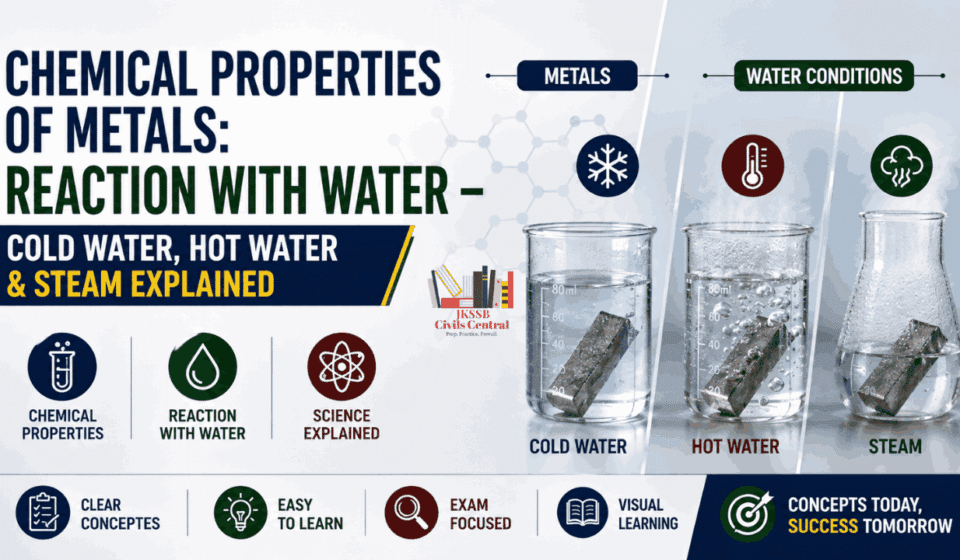
Chemical Properties of Metals: Reaction with Water – Cold Water, Hot Water & Steam Explained

Chemical Properties of Metals: Reaction with Water – Cold Water, Hot Water & Steam Explained:
Understand how metals react with cold water, hot water, and steam, the formation of metal hydroxides and hydrogen gas, the reactivity of different metals, and their practical applications for JKSSB, JKPSC, SSC, UPSC & State PSC examinations.
Learning Dashboard
| Chapter Information | Details |
|---|---|
| Subject | General Science – Chemistry |
| Series | Metals and Non-Metals |
| Lesson Number | Lesson 3 |
| Previous Lesson | Chemical Properties of Metals: Reaction with Oxygen, Metal Oxides & Corrosion |
| Current Lesson | Chemical Properties of Metals: Reaction with Water – Cold Water, Hot Water & Steam Explained |
| Next Lesson | Chemical Properties of Metals: Reaction with Acids and Bases | Hydrogen Gas, Metal Salts & Amphoteric Metals |
| Core Theme | Metals react with water according to their reactivity. Highly reactive metals react violently with cold water, moderately reactive metals react with hot water or steam, while least reactive metals do not react with water under ordinary conditions. |
| Major Topics Covered | Reaction with Cold Water, Reaction with Hot Water, Reaction with Steam, Metal Hydroxides, Hydrogen Gas, Reactivity Towards Water, Safety Precautions, Practical Applications |
| Important Metals Studied | Potassium (K), Sodium (Na), Calcium (Ca), Magnesium (Mg), Aluminium (Al), Zinc (Zn), Iron (Fe), Copper (Cu), Silver (Ag), Gold (Au) |
| Key Concepts | Chemical Properties, Reactivity with Water, Metal Hydroxides, Hydrogen Gas, Reactivity Series, Cold Water, Hot Water, Steam |
| Real-Life Applications | Storage of Sodium, Hydrogen Production, Industrial Steam Reactions, Laboratory Demonstrations, Corrosion Studies |
| Exam Focus | Frequently Asked in JKSSB FAA, JKSSB, JKPSC, JKAS, SSC, CDS, UPSC & State PSC Examinations |
Chapter Overview
In the previous lesson, we studied how metals react with oxygen to form metal oxides and learned that the nature of the oxide formed depends upon the reactivity of the metal. We also explored important concepts such as basic and amphoteric oxides, oxidation, passivation, and corrosion, which explain why some metals corrode while others remain protected by stable oxide layers.
In this lesson, we move one step further by studying the reaction of metals with water. Water is one of the most common substances found on Earth, and metals frequently come into contact with it in the atmosphere, rivers, industries, laboratories, and households. However, not all metals behave in the same way when exposed to water. Some metals react so violently with cold water that they catch fire, while others react only with steam, and a few do not react at all.
These differences arise because every metal possesses a different level of chemical reactivity. By observing how metals react with water, we can compare their reactivity and understand why certain metals require special storage conditions, while others can safely be used in pipelines, cooking utensils, water tanks, and industrial equipment.
Another important outcome of these reactions is the evolution of hydrogen gas. Most reactions between metals and water produce hydrogen gas along with metal hydroxides or metal oxides. Since hydrogen is highly combustible, understanding these reactions is essential not only from an examination perspective but also for laboratory safety and industrial applications.
Throughout this lesson, we will study the reactions of different metals with cold water, hot water, and steam, understand why these reactions differ, examine the products formed, and relate these concepts to the reactivity series of metals. Each topic will be explained with balanced chemical equations, scientific reasoning, practical examples, and examination-oriented insights.
Since the reaction of metals with water is a frequently tested topic in JKSSB FAA, JKPSC, JKAS, SSC, CDS, UPSC, and State PSC examinations, mastering this lesson will strengthen your understanding of chemical properties and prepare you for more advanced topics such as reaction with acids, displacement reactions, and the reactivity series.
Why Do Metals React with Water?
Before studying the reactions of individual metals with water, it is important to understand why these reactions occur in the first place. Just as metals react with oxygen because they tend to lose electrons, they also react with water for the same fundamental reason. The only difference is that, in this case, water acts as the reacting substance instead of oxygen.
The reaction between metals and water is one of the most important chemical properties of metals because it helps us understand the relative reactivity of different metals. It also explains why some metals are stored under kerosene oil, why hydrogen gas is produced during these reactions, and why certain metals can safely be used in water pipes and household utensils.
The Role of Electronic Configuration
Every metal atom strives to achieve a stable electronic configuration. Since most metals have only a few electrons in their outermost shell, they can attain stability by losing these electrons during a chemical reaction. When a metal comes into contact with water, it donates electrons to the water molecules. As a result, the metal is converted into a positively charged ion (cation), while the water molecules are reduced, leading to the formation of hydrogen gas.
Thus, the tendency of metals to lose electrons remains the driving force behind their reaction with water, just as it was in their reaction with oxygen.
Why Do Different Metals React Differently?
One of the most interesting aspects of this reaction is that all metals do not react with water in the same manner. Some metals, such as potassium and sodium, react so vigorously with cold water that the heat produced during the reaction may ignite the hydrogen gas released. On the other hand, metals such as magnesium react only with hot water, while metals like iron react only with steam. Metals such as copper, silver, gold, and platinum do not react with water under ordinary conditions.
These differences arise because each metal has a different tendency to lose electrons. Metals that lose electrons easily react rapidly with water, whereas those that hold their electrons more strongly react slowly or may not react at all.
This variation in behaviour forms the basis of the reactivity series of metals, which will be studied in detail in a later lesson.
What Happens When a Metal Reacts with Water?
When a reactive metal comes into contact with water, a chemical reaction takes place that generally produces a metal hydroxide and hydrogen gas. The metal loses electrons and combines with the hydroxide ions derived from water, while hydrogen ions gain electrons to form hydrogen gas.
The general reaction can be represented as:
Metal + Water → Metal Hydroxide + Hydrogen Gas
For example, sodium reacts with water to form sodium hydroxide and hydrogen gas.
2Na + 2H₂O → 2NaOH + H₂↑
The upward arrow (↑) indicates the evolution of hydrogen gas.
In some cases, especially when metals react with steam instead of liquid water, the products are slightly different. Instead of metal hydroxides, metal oxides are formed along with hydrogen gas.
For example:
3Fe + 4H₂O (steam) → Fe₃O₄ + 4H₂↑
Thus, the products formed depend on both the reactivity of the metal and the physical state of water.
Formation of Hydrogen Gas
One of the most important observations during the reaction of metals with water is the release of hydrogen gas. Hydrogen is a colourless, odourless, and highly combustible gas. During the reaction, bubbles of hydrogen gas are seen escaping from the surface of the metal. In the case of highly reactive metals, the heat generated may even ignite the hydrogen, producing a characteristic flame.
The evolution of hydrogen gas is therefore an important indicator that a chemical reaction between a metal and water has taken place.
Why is This Reaction Important?
The reaction of metals with water has immense practical importance in chemistry as well as in everyday life. It explains why sodium and potassium cannot be stored in the open, why calcium reacts slowly with water, why iron water pipes do not immediately react with water, and why gold jewellery remains unaffected even after years of use.
This reaction is also important in industries where hydrogen gas is produced, in laboratories where metal reactivity is demonstrated, and in understanding corrosion, metallurgy, and the extraction of metals.
From an examination perspective, questions are frequently asked about which metals react with cold water, which react with hot water or steam, the products formed, and the order of reactivity. Therefore, a clear conceptual understanding of this topic is essential for success in competitive examinations.
Reaction of Metals with Cold Water
Among all the reactions of metals with water, the reaction with cold water is the most vigorous and spectacular. Only highly reactive metals are capable of reacting with cold water under ordinary conditions. These reactions occur rapidly, release a large amount of heat, and produce metal hydroxides along with hydrogen gas.
The intensity of the reaction depends on the reactivity of the metal. Metals that lose electrons very easily react almost instantaneously, whereas less reactive metals either react slowly or do not react with cold water at all. The reaction of metals with cold water therefore provides an excellent basis for comparing their chemical reactivity.
The most important metals that react with cold water are potassium, sodium, and calcium. Although all three belong to the highly reactive category, the speed and intensity of their reactions differ considerably.
Potassium (K)
Potassium is one of the most reactive metals known. It reacts violently with cold water even at room temperature. The reaction is so vigorous that the heat produced immediately ignites the hydrogen gas evolved, producing a characteristic lilac (violet) flame.
Because of its extreme reactivity, potassium is never handled with bare hands and is always stored under kerosene oil, which prevents contact with oxygen and moisture in the air.
Chemical Equation
2K + 2H₂O → 2KOH + H₂↑
Observation
When a small piece of potassium is placed in cold water, the following observations can be made:
- It floats on the surface of water because its density is lower than that of water.
- It moves rapidly across the water surface.
- A large amount of heat is released.
- Hydrogen gas is evolved.
- The hydrogen gas catches fire, producing a lilac flame.
- A colourless solution of potassium hydroxide is formed.
Scientific Explanation
Potassium has only one electron in its outermost shell, which it loses very easily. This makes potassium extremely electropositive and highly reactive.
When potassium reacts with water, it forms potassium hydroxide (KOH) and liberates hydrogen gas (H₂). The reaction is highly exothermic, and the heat generated is sufficient to ignite the hydrogen gas immediately.
Applications
Although pure potassium is rarely used because of its high reactivity, its compounds have numerous industrial and agricultural applications.
Potassium compounds are widely used in:
- Fertilizers
- Glass manufacturing
- Soap production
- Chemical industries
The reaction of potassium with water is mainly demonstrated in laboratories to illustrate the behaviour of highly reactive metals.
Exam Tip
Remember the following points:
- Potassium reacts violently with cold water.
- It forms potassium hydroxide (KOH).
- Hydrogen gas is evolved.
- The hydrogen burns with a lilac flame.
- Potassium is stored under kerosene oil.
Sodium (Na)
Sodium is also a highly reactive metal, although it is slightly less reactive than potassium. Like potassium, sodium reacts readily with cold water and forms sodium hydroxide along with hydrogen gas.
The reaction is highly exothermic and may produce enough heat to melt the sodium into a small silvery ball that moves rapidly over the surface of water.
Chemical Equation
2Na + 2H₂O → 2NaOH + H₂↑
Observation
During the reaction, the following changes are observed:
- Sodium floats on water.
- It moves rapidly across the surface.
- The metal melts into a small spherical ball because of the heat generated.
- Hydrogen gas is evolved.
- In some cases, the hydrogen gas may ignite.
- Sodium hydroxide is formed in the solution.
Scientific Explanation
Like potassium, sodium contains one valence electron, which it readily loses during the reaction. The transfer of this electron to water molecules results in the formation of sodium hydroxide and hydrogen gas. Since the reaction releases a large amount of heat, the low-melting sodium melts during the reaction and moves rapidly on the water surface.
Applications
Sodium is an important industrial metal, and its compounds are widely used in:
- Manufacturing soaps and detergents
- Paper industry
- Textile processing
- Chemical synthesis
Because metallic sodium reacts vigorously with water, it is stored under kerosene oil to prevent accidental reactions.
Exam Tip
Important points to remember:
- Sodium reacts vigorously with cold water.
- It forms sodium hydroxide (NaOH).
- Hydrogen gas is evolved.
- Sodium is stored under kerosene oil.
- It is less reactive than potassium but more reactive than calcium.
Calcium (Ca)
Calcium is also capable of reacting with cold water, but its reaction is much less vigorous than those of potassium and sodium. Instead of producing flames, calcium reacts slowly, releasing hydrogen gas and forming calcium hydroxide.
Because calcium is denser than water, it initially sinks to the bottom of the container. As hydrogen bubbles begin to form on its surface, the metal gradually rises and may float temporarily.
Chemical Equation
Ca + 2H₂O → Ca(OH)₂ + H₂↑
Observation
The reaction of calcium with cold water shows the following features:
- Calcium initially sinks in water.
- Bubbles of hydrogen gas appear on its surface.
- The metal may start floating as hydrogen bubbles stick to it.
- A slightly milky solution is formed due to the presence of calcium hydroxide.
Scientific Explanation
Calcium loses its two outermost electrons and reacts with water to produce calcium hydroxide and hydrogen gas. Since calcium is less reactive than sodium and potassium, the reaction proceeds more slowly and does not generate sufficient heat to ignite the hydrogen gas.
Applications
Calcium compounds have several practical uses, including:
- Manufacture of cement
- Production of plaster of Paris
- Soil treatment in agriculture
- Water purification
- Construction industry
Although metallic calcium is not commonly encountered in daily life, its compounds are widely used in engineering and agriculture.
Exam Tip
Remember these important facts:
- Calcium reacts slowly with cold water.
- It forms calcium hydroxide [Ca(OH)₂].
- Hydrogen gas is released.
- The reaction is less vigorous than that of sodium and potassium.
- Calcium initially sinks but may float due to hydrogen bubbles.
Comparison of Metals Reacting with Cold Water
| Property | Potassium | Sodium | Calcium |
|---|---|---|---|
| Reactivity | Extremely High | Very High | Moderate |
| Reaction with Cold Water | Violent | Vigorous | Slow |
| Product Formed | Potassium Hydroxide | Sodium Hydroxide | Calcium Hydroxide |
| Hydrogen Gas Evolved | Yes | Yes | Yes |
| Flame Produced | Lilac Flame | May Ignite | No |
| Storage Method | Under Kerosene Oil | Under Kerosene Oil | Ordinary Storage Possible |
The reactions of potassium, sodium, and calcium clearly demonstrate that the intensity of reaction decreases as the reactivity of the metal decreases. These observations also provide the first practical evidence for arranging metals according to their reactivity, a concept that will later be formalized in the reactivity series of metals.
Reaction of Metals with Hot Water
After studying the reactions of highly reactive metals with cold water, the next category includes metals that do not react with cold water but react with hot water. The increase in temperature provides additional energy to overcome the activation barrier, allowing these metals to react.
Among the commonly studied metals, magnesium is the most important example of a metal that reacts with hot water. It reacts much more slowly than sodium or potassium, and the reaction is comparatively less vigorous.
The study of this reaction helps us understand that temperature plays an important role in determining the rate of a chemical reaction. As the temperature increases, the kinetic energy of particles also increases, making chemical reactions occur more readily.
Magnesium (Mg)
Magnesium is a moderately reactive metal. Under ordinary conditions, it reacts very slowly with cold water because a thin layer of magnesium oxide present on its surface prevents direct contact with water. However, when magnesium is placed in hot water, the reaction proceeds more rapidly. During the reaction, magnesium combines with water to form magnesium hydroxide and hydrogen gas.
Chemical Equation
Mg + 2H₂O (hot) → Mg(OH)₂ + H₂↑
Observation
When magnesium reacts with hot water, the following observations can be made:
- Small bubbles of hydrogen gas appear on the metal surface.
- The reaction is slow compared to sodium and potassium.
- A white suspension of magnesium hydroxide is formed.
- No flame is produced because the reaction is not vigorous enough to ignite hydrogen gas.
Scientific Explanation
Magnesium possesses two valence electrons, which it loses during the reaction with water. Although magnesium is sufficiently reactive to react with water, its surface is covered by a thin oxide layer that slows down the reaction. Heating the water provides enough energy to overcome this barrier, allowing magnesium to react more readily.
During the reaction, magnesium is oxidized to magnesium ions, while water is reduced to produce hydrogen gas. The magnesium ions then combine with hydroxide ions to form magnesium hydroxide.
Why Does Magnesium React Slowly with Cold Water?
Many students wonder why magnesium, despite being a reactive metal, does not react vigorously with cold water. The main reason is the protective oxide layer present on the surface of magnesium. This thin layer prevents direct contact between the metal and water, thereby slowing the reaction considerably. When the water is heated, this barrier becomes less effective, and the increased temperature accelerates the reaction.
Thus, the slow reaction of magnesium with cold water is due to surface protection, not because magnesium is an unreactive metal.
Applications
Although metallic magnesium is not commonly used in contact with water, its compounds and chemical behaviour have several important applications.
Magnesium is widely used in:
- Lightweight alloys used in aircraft and automobiles
- Fireworks and emergency flares
- Flash photography (historically)
- Refractory materials capable of withstanding high temperatures
- Medical preparations such as antacids and laxatives (magnesium compounds)
Understanding its reaction with water also helps industries determine suitable storage and handling conditions.
Exam Tip
Remember the following important facts:
- Magnesium does not react appreciably with cold water.
- It reacts with hot water to form magnesium hydroxide.
- Hydrogen gas is evolved during the reaction.
- The reaction is much slower than that of sodium and potassium.
- The oxide layer on magnesium slows its reaction with cold water.
Comparison: Cold Water vs Hot Water Reactions
The behaviour of metals with cold and hot water can be summarized as follows:
| Metal | Reaction with Cold Water | Reaction with Hot Water | Product Formed |
|---|---|---|---|
| Potassium | Violent | Violent | Potassium Hydroxide + Hydrogen |
| Sodium | Vigorous | Vigorous | Sodium Hydroxide + Hydrogen |
| Calcium | Slow | Faster | Calcium Hydroxide + Hydrogen |
| Magnesium | Very Slow | Reacts Readily | Magnesium Hydroxide + Hydrogen |
This comparison clearly shows that as the reactivity of metals decreases, higher temperatures are required for the reaction with water to occur efficiently. Temperature, therefore, becomes an important factor influencing the chemical behaviour of moderately reactive metals.
Reaction of Metals with Steam
Not all metals react with cold or hot water. As the reactivity of metals decreases further, ordinary water is no longer capable of supplying enough energy for a chemical reaction to occur. However, when water is converted into steam, its higher temperature provides sufficient energy for some moderately reactive metals to react.
An important difference between the reaction of metals with liquid water and steam is the nature of the products formed. When metals react with cold or hot water, they generally produce metal hydroxides along with hydrogen gas. In contrast, when metals react with steam, they usually form metal oxides and liberate hydrogen gas.
Thus, the reaction with steam represents another stage in the decreasing reactivity of metals and helps us understand why different metals require different conditions to undergo chemical reactions.
Aluminium (Al)
Aluminium is a highly reactive metal, yet it does not normally react with cold water because its surface is covered by a thin, hard, and protective layer of aluminium oxide. This oxide layer prevents water from coming into direct contact with the metal.
However, when aluminium is heated and exposed to steam, the protective layer can be overcome, allowing aluminium to react and form aluminium oxide along with hydrogen gas.
Chemical Equation
2Al + 3H₂O (steam) → Al₂O₃ + 3H₂↑
Observation
The reaction between aluminium and steam shows the following characteristics:
- No reaction occurs with cold water under ordinary conditions.
- Aluminium reacts only at high temperatures with steam.
- Hydrogen gas is evolved.
- Aluminium oxide is formed as the final product.
Scientific Explanation
Although aluminium has a strong tendency to lose electrons, its protective oxide layer prevents reaction with water. Steam provides sufficient thermal energy to overcome this barrier, allowing aluminium to react.
The aluminium atoms lose electrons and combine with oxygen obtained from steam to form aluminium oxide, while hydrogen gas is released.
Applications
Understanding the behaviour of aluminium with steam is important in:
- Metallurgical industries
- High-temperature industrial processes
- Manufacture of heat-resistant equipment
- Engineering applications involving steam
Exam Tip
Remember:
- Aluminium does not react with cold water.
- It reacts with steam.
- Product formed: Aluminium oxide (Al₂O₃).
- Hydrogen gas is evolved.
Zinc (Zn)
Zinc is another moderately reactive metal that does not react with cold or hot water under ordinary conditions. However, it reacts readily with steam, producing zinc oxide and hydrogen gas.
Chemical Equation
Zn + H₂O (steam) → ZnO + H₂↑
Observation
During the reaction:
- No reaction occurs with cold water.
- Steam reacts with heated zinc.
- Hydrogen gas is evolved.
- Zinc oxide is produced.
Scientific Explanation
Zinc loses two electrons during the reaction and combines with oxygen obtained from steam to form zinc oxide. The remaining hydrogen atoms combine to produce hydrogen gas.
Since zinc is less reactive than magnesium but more reactive than copper, it requires steam rather than liquid water to react.
Applications
The reaction of zinc with steam is useful in:
- Industrial hydrogen production
- Metallurgical processes
- Laboratory demonstrations of metal reactivity
Zinc is also extensively used for galvanization, where it protects iron from corrosion.
Exam Tip
Important facts:
- Zinc reacts with steam only.
- Forms zinc oxide (ZnO).
- Evolves hydrogen gas.
- Does not react with cold water.
Iron (Fe)
Iron is less reactive than aluminium and zinc with respect to water. It does not react with cold or hot water under normal conditions. However, when red-hot iron comes into contact with steam, a chemical reaction takes place. During this reaction, iron forms magnetite (Fe₃O₄) and releases hydrogen gas.
Chemical Equation
3Fe + 4H₂O (steam) → Fe₃O₄ + 4H₂↑
Observation
The reaction exhibits the following features:
- No reaction occurs with cold water.
- No significant reaction occurs with hot water.
- Red-hot iron reacts with steam.
- Hydrogen gas is evolved.
- Black magnetite (Fe₃O₄) is formed.
Scientific Explanation
Iron requires a much higher temperature than magnesium or calcium because its tendency to lose electrons is comparatively lower. Steam supplies sufficient thermal energy for iron atoms to react with oxygen present in water vapour. The oxygen combines with iron to produce magnetite, while hydrogen gas is liberated.
Applications
This reaction is important in:
- Metallurgical industries
- Industrial hydrogen production
- Understanding the reactivity of iron
- High-temperature engineering processes
Exam Tip
Remember:
- Iron reacts only with steam.
- Product formed: Magnetite (Fe₃O₄).
- Hydrogen gas is released.
- Iron does not react with cold or hot water.
Comparison of Metals Reacting with Steam
| Metal | Reacts with Cold Water | Reacts with Hot Water | Reacts with Steam | Product Formed |
|---|---|---|---|---|
| Aluminium | No | No | Yes | Aluminium Oxide (Al₂O₃) |
| Zinc | No | No | Yes | Zinc Oxide (ZnO) |
| Iron | No | No | Yes | Magnetite (Fe₃O₄) |
The reactions with steam clearly demonstrate that higher temperatures are required as the reactivity of metals decreases. While highly reactive metals react readily with cold water, moderately reactive metals require hot water or steam, and the products formed also change from metal hydroxides to metal oxides. This progressive change in behaviour forms the basis for arranging metals according to their reactivity and is an important concept in competitive examinations.
Metals That Do Not React with Water
After studying the reactions of metals with cold water, hot water, and steam, one important question remains: Do all metals react with water? The answer is no. A number of metals are so less reactive that they do not react with water under ordinary conditions, even when the water is heated or converted into steam.
These metals possess a very low tendency to lose electrons. As a result, water molecules are unable to remove electrons from these metals, and no chemical reaction takes place. Consequently, neither metal hydroxides nor metal oxides are formed, and hydrogen gas is not evolved.
The most important metals that do not react with water are copper, silver, gold, and platinum.
Copper (Cu)
Copper is a low-reactivity metal that does not react with cold water, hot water, or steam under ordinary conditions. This chemical stability makes copper highly suitable for applications where continuous contact with water is required. Although copper does not react with water, it slowly reacts with oxygen, moisture, and carbon dioxide present in the atmosphere over a long period to form a green protective coating known as patina.
Because copper remains unaffected by water, it has been used for centuries in household utensils, plumbing systems, and water storage containers.
Observation
When copper is placed in water:
- No bubbles of hydrogen gas are produced.
- No chemical change is observed.
- The metal retains its original appearance.
- No metal hydroxide or oxide is formed due to water.
Applications
Copper’s resistance to water makes it valuable in:
- Water supply pipes
- Plumbing fittings
- Heat exchangers
- Electrical wiring
- Household utensils
Its excellent corrosion resistance contributes to its long service life.
Exam Tip
Remember:
- Copper does not react with water.
- No hydrogen gas is evolved.
- Copper is widely used in plumbing and water pipes because of its resistance to corrosion.
Silver (Ag)
Silver is another least reactive metal that remains unaffected by water under normal conditions. It neither reacts with cold water nor with hot water or steam.
Its low chemical reactivity is one of the reasons why silver retains its appearance for a long time. However, silver may slowly tarnish in air due to its reaction with sulphur compounds, but this is not a reaction with water.
Observation
When silver is placed in water:
- No visible reaction occurs.
- No hydrogen gas is evolved.
- The metal remains unchanged.
Applications
Silver is extensively used in:
- Jewellery
- Coins
- Electrical contacts
- Mirrors
- Electronic components
Its resistance to water contributes to its durability in these applications.
Exam Tip
Remember:
- Silver does not react with water.
- It belongs to the least reactive metals.
- Its tarnishing is mainly due to sulphur compounds, not water.
Gold (Au)
Gold is one of the least reactive metals known. It neither reacts with water nor with atmospheric oxygen under ordinary conditions. Because of this exceptional chemical stability, gold is classified as a noble metal.
The resistance of gold to chemical attack explains why ancient gold ornaments and coins have survived for centuries with very little change in appearance.
Observation
Gold shows:
- No reaction with cold water.
- No reaction with hot water.
- No reaction with steam.
- No evolution of hydrogen gas.
Scientific Explanation
Gold has a very low tendency to lose electrons. Therefore, water molecules are unable to oxidize gold or remove electrons from it. This chemical inertness makes gold one of the most corrosion-resistant metals known.
Applications
Gold is widely used in:
- Jewellery
- Coins and medals
- Electronic connectors
- Space technology
- Dentistry
Its chemical stability ensures long-term durability and resistance to corrosion.
Exam Tip
Remember:
- Gold is a noble metal.
- It does not react with water.
- It retains its lustre for many years because of its extremely low reactivity.
Platinum (Pt)
Platinum is another noble metal that exhibits exceptional resistance to chemical reactions. Like gold, it remains unaffected by water under ordinary conditions. Its remarkable chemical stability makes platinum suitable for applications involving high temperatures and corrosive environments.
Observation
When platinum is placed in water:
- No reaction occurs.
- No hydrogen gas is produced.
- The metal remains chemically unchanged.
Applications
Platinum is used in:
- Laboratory apparatus
- Catalytic converters
- High-quality jewellery
- Chemical industries
- Medical instruments
Its resistance to corrosion and chemical attack makes it highly valuable despite its high cost.
Exam Tip
Remember:
- Platinum is among the least reactive metals.
- It does not react with water.
- It is widely used where corrosion resistance is essential.
Comparison of Metals That Do Not React with Water
| Metal | Reaction with Cold Water | Reaction with Hot Water | Reaction with Steam | Important Use |
|---|---|---|---|---|
| Copper | No Reaction | No Reaction | No Reaction | Plumbing, Electrical Wiring |
| Silver | No Reaction | No Reaction | No Reaction | Jewellery, Electrical Contacts |
| Gold | No Reaction | No Reaction | No Reaction | Jewellery, Electronics |
| Platinum | No Reaction | No Reaction | No Reaction | Catalysts, Laboratory Equipment |
Why Do These Metals Not React with Water?
The common feature among copper, silver, gold, and platinum is their very low chemical reactivity. These metals hold their outermost electrons strongly and therefore do not lose them easily.
Since water cannot remove electrons from these metals, no chemical reaction occurs. As a result:
- No metal hydroxides are formed.
- No metal oxides are formed due to water.
- No hydrogen gas is evolved.
- The metals remain chemically stable even after prolonged contact with water.
This exceptional stability makes these metals ideal for applications requiring high corrosion resistance, long service life, and minimal maintenance.
Formation of Metal Hydroxides and Hydrogen Gas
One of the most important outcomes of the reaction between metals and water is the formation of metal hydroxides and the evolution of hydrogen gas. Regardless of whether the reaction is vigorous or slow, the products formed help us understand the chemical behaviour of metals and provide valuable information about their reactivity.
However, it is important to note that not all metals produce the same products. The nature of the products depends upon the reactivity of the metal as well as whether the metal reacts with cold water, hot water, or steam.
Understanding these products is essential because questions based on metal hydroxides, metal oxides, and hydrogen gas are frequently asked in competitive examinations.
Formation of Metal Hydroxides
Highly reactive metals and some moderately reactive metals react with cold or hot water to produce metal hydroxides. A metal hydroxide is a compound formed when a positively charged metal ion combines with one or more hydroxide ions (OH⁻). Since hydroxide ions are basic in nature, most metal hydroxides behave as bases and turn red litmus paper blue.
The general chemical equation is:
Metal + Water → Metal Hydroxide + Hydrogen Gas
Some important examples include:
2Na + 2H₂O → 2NaOH + H₂↑
2K + 2H₂O → 2KOH + H₂↑
Ca + 2H₂O → Ca(OH)₂ + H₂↑
Mg + 2H₂O (hot) → Mg(OH)₂ + H₂↑
In each of these reactions, the metal combines with the hydroxide part of the water molecule, while hydrogen gas is liberated.
Properties of Metal Hydroxides
Although different metals form different hydroxides, most metal hydroxides exhibit certain common properties.
They are generally:
- Basic in nature.
- Alkaline when dissolved in water.
- Capable of neutralizing acids.
- Ionic compounds.
- Useful in several industrial and laboratory applications.
For example, sodium hydroxide (NaOH) and potassium hydroxide (KOH) are strong alkalis widely used in soap manufacturing, paper industries, and chemical laboratories. Similarly, calcium hydroxide, commonly known as slaked lime, is extensively used in whitewashing, water treatment, and the manufacture of bleaching powder.
Evolution of Hydrogen Gas
The second important product formed during the reaction of metals with water is hydrogen gas. Hydrogen is produced because water molecules contain hydrogen atoms. During the reaction, the metal removes oxygen from water to form either a hydroxide or an oxide, leaving hydrogen atoms free. These hydrogen atoms combine to form hydrogen gas (H₂).
The release of hydrogen gas is one of the most important observations that confirms a chemical reaction between a metal and water.
Properties of Hydrogen Gas
Hydrogen possesses several important physical and chemical properties.
It is:
- Colourless.
- Odourless.
- Tasteless.
- The lightest known gas.
- Highly combustible.
Because hydrogen burns readily in the presence of oxygen, it must be handled carefully during laboratory experiments. One of the simplest tests for hydrogen gas is the burning splint test. When a burning splint is brought near hydrogen gas, it burns with a characteristic ‘pop’ sound. This serves as a simple laboratory test for identifying hydrogen.
Why Does Hydrogen Burn During Some Reactions?
Students often observe that hydrogen catches fire during the reaction of potassium and sodium with water but not during the reaction of calcium or magnesium. The reason lies in the amount of heat produced.
Potassium and sodium react so vigorously that the reaction releases enough heat to ignite the hydrogen gas immediately. Calcium and magnesium, however, react much more slowly. Although hydrogen gas is produced, the heat released is insufficient to ignite it.
Thus, the presence or absence of a flame depends upon the reactivity of the metal.
Formation of Metal Oxides with Steam
An important exception must also be remembered. When metals react with steam, they generally form metal oxides instead of metal hydroxides.
For example:
Zn + H₂O (steam) → ZnO + H₂↑
3Fe + 4H₂O (steam) → Fe₃O₄ + 4H₂↑
2Al + 3H₂O (steam) → Al₂O₃ + 3H₂↑
Thus:
- Cold water → Metal Hydroxide + Hydrogen
- Hot water → Metal Hydroxide + Hydrogen
- Steam → Metal Oxide + Hydrogen
This distinction is extremely important for competitive examinations.
Comparison of Products Formed
| Reaction with Water | Main Product | Gas Evolved |
|---|---|---|
| Potassium + Cold Water | Potassium Hydroxide (KOH) | Hydrogen |
| Sodium + Cold Water | Sodium Hydroxide (NaOH) | Hydrogen |
| Calcium + Cold Water | Calcium Hydroxide [Ca(OH)₂] | Hydrogen |
| Magnesium + Hot Water | Magnesium Hydroxide [Mg(OH)₂] | Hydrogen |
| Aluminium + Steam | Aluminium Oxide (Al₂O₃) | Hydrogen |
| Zinc + Steam | Zinc Oxide (ZnO) | Hydrogen |
| Iron + Steam | Magnetite (Fe₃O₄) | Hydrogen |
Importance of These Reactions
The formation of metal hydroxides, metal oxides, and hydrogen gas is important not only for understanding the chemical properties of metals but also for various industrial and laboratory applications.
Hydrogen gas produced during these reactions is used in chemical industries, petroleum refining, fertilizer production, and clean energy technologies. Metal hydroxides such as sodium hydroxide, potassium hydroxide, and calcium hydroxide are indispensable in industries producing soaps, detergents, paper, cement, textiles, and water treatment chemicals.
From an examination perspective, students should clearly remember which metals form hydroxides, which form oxides, and under what conditions these products are formed, as these concepts are repeatedly tested in JKSSB, SSC, JKPSC, UPSC, and other competitive examinations.
Reactivity of Metals Towards Water
By now, we have studied that different metals react differently with water. Some metals react violently with cold water, others react only with hot water or steam, while a few do not react with water at all. These differences are not accidental; they reflect the relative reactivity of metals.
The reaction of metals with water provides one of the simplest methods of comparing their chemical activity. The more readily a metal reacts with water, the more reactive it is. Conversely, metals that do not react with water are considered less reactive.
Understanding this order of reactivity is important because it explains not only the behaviour of metals with water but also their reactions with oxygen, acids, and salt solutions. It also forms the basis for the Reactivity Series of Metals, which will be discussed in detail in a later lesson.
Highly Reactive Metals
Highly reactive metals react readily with cold water under ordinary conditions. These reactions are usually vigorous and highly exothermic, producing metal hydroxides and hydrogen gas.
The most important highly reactive metals are:
- Potassium (K)
- Sodium (Na)
- Calcium (Ca)
These metals lose their outermost electrons very easily. Consequently, they react immediately upon contact with water. In the case of potassium and sodium, the heat generated is often sufficient to ignite the hydrogen gas produced. Because of their extreme reactivity, potassium and sodium are always stored under kerosene oil to prevent accidental contact with moisture and oxygen.
Moderately Reactive Metals
Moderately reactive metals do not react vigorously with cold water. Instead, they require hot water or steam to undergo a noticeable chemical reaction.
Important moderately reactive metals include:
- Magnesium (Mg)
- Aluminium (Al)
- Zinc (Zn)
- Iron (Fe)
Magnesium reacts slowly with hot water, whereas aluminium, zinc, and iron react only when exposed to steam. These metals occupy the middle position in terms of chemical reactivity. They are sufficiently stable for engineering applications but still capable of reacting under suitable conditions.
Least Reactive Metals
Least reactive metals show little or no reaction with water, regardless of whether it is cold, hot, or in the form of steam.
The most common examples are:
- Copper (Cu)
- Silver (Ag)
- Gold (Au)
- Platinum (Pt)
These metals have a very low tendency to lose electrons. Therefore, water molecules cannot initiate a chemical reaction with them.
Their low reactivity is one of the reasons why these metals resist corrosion and retain their appearance for long periods. Gold and platinum, in particular, are known as noble metals because of their exceptional chemical stability.
Comparison of Reactivity Towards Water
The behaviour of different metals with water can be summarized in the following table.
| Category | Metals | Reaction with Water | Products Formed |
|---|---|---|---|
| Highly Reactive | Potassium, Sodium, Calcium | React with cold water | Metal Hydroxide + Hydrogen Gas |
| Moderately Reactive | Magnesium | Reacts with hot water | Magnesium Hydroxide + Hydrogen Gas |
| Moderately Reactive | Aluminium, Zinc, Iron | React with steam | Metal Oxide + Hydrogen Gas |
| Least Reactive | Copper, Silver, Gold, Platinum | No reaction with water | No Reaction |
Trend in Reactivity
The reactions studied so far reveal a clear trend in the behaviour of metals with water.
As the reactivity of the metal decreases, the conditions required for the reaction become more severe.
- Highly reactive metals react with cold water.
- Moderately reactive metals require hot water.
- Less reactive metals react only with steam.
- Least reactive metals do not react with water.
This gradual change demonstrates that the ability of a metal to react with water depends directly on how easily it loses its outermost electrons.
Importance of Reactivity Towards Water
The reaction of metals with water has great practical significance in chemistry and industry. It helps scientists and engineers determine how metals should be stored, transported, and used. For example, highly reactive metals like sodium and potassium require special storage under kerosene oil, whereas copper and stainless steel can safely be used in water pipes, tanks, and household appliances because they do not react with water.
The study of these reactions also provides valuable information for metallurgy, corrosion prevention, hydrogen production, and chemical manufacturing. Moreover, understanding the reactivity of metals towards water makes it easier to predict their behaviour with oxygen, acids, and salt solutions.
Exam Tip
The following order should always be remembered for competitive examinations:
| Water Used | Metals That React |
|---|---|
| Cold Water | Potassium, Sodium, Calcium |
| Hot Water | Magnesium |
| Steam | Aluminium, Zinc, Iron |
| No Reaction | Copper, Silver, Gold, Platinum |
This order is one of the most frequently asked concepts in JKSSB FAA, JKPSC, SSC, CDS, UPSC, and other State PSC examinations and serves as an introduction to the Reactivity Series of Metals, one of the most important topics in inorganic chemistry.
Safety Precautions While Handling Reactive Metals
The study of the reaction of metals with water clearly shows that not all metals can be handled in the same manner. While metals such as copper and iron can be handled safely under ordinary conditions, highly reactive metals like potassium and sodium require special precautions because they react violently with water and even with moisture present in the air.
Understanding these safety measures is important not only for laboratory work but also for industrial operations where reactive metals are manufactured, transported, and stored. Proper handling prevents accidents, protects laboratory personnel, and ensures the safe use of these metals in scientific and industrial applications.
Why Are Safety Precautions Necessary?
Highly reactive metals possess a strong tendency to lose electrons. As a result, they react rapidly with substances such as water, oxygen, and moisture. These reactions are highly exothermic, meaning they release a large amount of heat. When metals like sodium or potassium come into contact with water, hydrogen gas is produced. Since hydrogen is highly combustible, the heat generated during the reaction may ignite the gas, causing fire or even small explosions.
Therefore, appropriate safety measures are essential whenever reactive metals are handled.
Storage of Sodium and Potassium
Among all commonly studied metals, sodium and potassium require the greatest care during storage. These metals are always stored under kerosene oil because kerosene acts as a protective barrier between the metal and the surrounding air. It prevents direct contact with oxygen and moisture, thereby stopping unwanted chemical reactions.
If sodium or potassium were left exposed to air, they would quickly react with atmospheric moisture and oxygen, generating heat that could ignite the metal. For this reason, storage under kerosene is one of the most frequently asked concepts in competitive examinations.
Safe Handling in Laboratories
During laboratory demonstrations, only very small pieces of highly reactive metals are used. This reduces the amount of heat produced and minimizes the risk of accidents. Students should never touch sodium or potassium with bare hands. Instead, these metals are handled using forceps or tongs. They should also be cut only under kerosene oil using appropriate laboratory equipment.
Any experiment involving these metals should be performed under the supervision of a trained instructor while wearing suitable protective equipment.
Personal Protective Equipment (PPE)
While performing experiments involving reactive metals, appropriate personal protective equipment (PPE) should always be used.
Essential safety equipment includes:
- Safety goggles to protect the eyes.
- Laboratory gloves to prevent skin contact.
- Laboratory coat or apron.
- Closed footwear to protect the feet.
Using PPE significantly reduces the risk of injury in the event of accidental splashing or ignition.
Fire Safety
One of the most important safety rules is never to use water to extinguish fires caused by sodium or potassium. Since these metals react violently with water, adding water only increases the intensity of the reaction and produces more hydrogen gas, making the fire even more dangerous.
Instead, such fires should be extinguished using:
- Dry sand
- Class D fire extinguishers
- Special dry chemical powders designed for metal fires
This is an important laboratory safety rule as well as a frequently tested examination concept.
Disposal of Reactive Metals
Unused pieces of sodium or potassium should never be thrown into sinks, drains, or water containers. They must be returned to their kerosene container or disposed of according to approved laboratory safety procedures. Improper disposal can result in violent reactions and serious accidents.
Industries handling reactive metals also follow strict disposal protocols to ensure environmental and workplace safety.
Everyday Importance of Safety Measures
Although most people do not directly handle highly reactive metals in daily life, these safety precautions are extremely important in industries that manufacture chemicals, fertilizers, pharmaceuticals, and laboratory reagents. Proper storage and handling prevent fires, explosions, equipment damage, and environmental hazards. They also ensure that reactive metals remain stable until they are required for industrial or scientific use.
Understanding these precautions therefore combines chemical knowledge with practical safety awareness, making it valuable for both examinations and real-world applications.
Exam Tip
The following facts are frequently asked in JKSSB, SSC, JKPSC, UPSC, and other competitive examinations:
- Sodium and potassium are stored under kerosene oil.
- They react violently with water and atmospheric moisture.
- Their reactions are highly exothermic.
- Hydrogen gas evolved during the reaction may ignite.
- Water should never be used to extinguish sodium or potassium fires.
- Dry sand or a Class D fire extinguisher should be used instead.
These safety precautions are direct consequences of the high reactivity of certain metals with water and highlight the importance of understanding chemical properties before handling reactive substances.
Everyday Applications of the Reaction of Metals with Water
The reaction of metals with water is not merely a laboratory experiment or a topic studied for examinations. It has significant applications in industry, engineering, energy production, construction, and everyday life. Understanding how different metals behave in the presence of water enables scientists and engineers to select suitable materials for specific purposes and adopt appropriate safety measures during their use.
The practical applications of these reactions are based on the fact that different metals exhibit different levels of reactivity towards water. Highly reactive metals require special handling and storage, whereas less reactive metals can safely be used in environments where continuous contact with water is unavoidable.
Storage of Highly Reactive Metals
One of the most familiar applications of this concept is the storage of sodium and potassium. Since these metals react violently with water and even with moisture present in the atmosphere, they cannot be stored in the open. To prevent accidental reactions, they are kept immersed in kerosene oil, which acts as a protective barrier and prevents contact with air and water.
This simple storage technique allows these highly reactive metals to be transported and used safely in laboratories and industries.
Production of Hydrogen Gas
The reaction between metals and water is an important method for the production of hydrogen gas. During these reactions, hydrogen is liberated as a by-product. Hydrogen is a valuable industrial gas used in:
- Manufacture of ammonia by the Haber Process.
- Petroleum refining.
- Hydrogenation of vegetable oils.
- Production of methanol and other chemicals.
- Clean energy technologies and fuel cells.
Although large-scale commercial hydrogen is usually produced by other industrial methods, the reaction of metals with water remains an important laboratory method for demonstrating hydrogen evolution.
Selection of Materials for Water Systems
The study of metal-water reactions helps engineers choose suitable materials for pipelines, storage tanks, and water distribution systems. Highly reactive metals such as sodium and potassium cannot be used because they react violently with water. Instead, metals such as copper, stainless steel, and aluminium are preferred because they either do not react with water or are protected by stable oxide layers.
This understanding ensures the durability, safety, and reliability of water supply systems.
Industrial Steam Processes
Many industrial operations involve the use of high-temperature steam. Knowledge of how metals behave with steam is essential while designing:
- Steam boilers.
- Heat exchangers.
- Power plants.
- High-pressure industrial pipelines.
- Thermal processing equipment.
Engineers select metals that can withstand prolonged exposure to steam without undergoing rapid corrosion or structural damage.
Laboratory Demonstrations
The reaction of metals with water is one of the most commonly performed demonstrations in chemistry laboratories. These experiments help students understand:
- Differences in metal reactivity.
- Evolution of hydrogen gas.
- Formation of metal hydroxides.
- Exothermic chemical reactions.
- Safe handling of reactive substances.
Observing these reactions provides a much clearer understanding than simply memorizing chemical equations.
Understanding Corrosion and Metal Selection
The reaction of metals with water also contributes to our understanding of corrosion. Metals that react readily with moisture are generally more susceptible to corrosion unless they develop protective oxide layers. On the other hand, metals with low reactivity remain stable even after prolonged exposure to water.
This knowledge helps engineers select suitable metals for:
- Bridges.
- Ships.
- Water tanks.
- Household appliances.
- Industrial machinery.
Choosing the correct material greatly increases the lifespan of these structures and reduces maintenance costs.
Importance in Competitive Examinations
Questions based on the practical applications of metal-water reactions are frequently asked in competitive examinations.
Students are expected to know:
- Why sodium and potassium are stored under kerosene oil.
- Why copper is used in water pipes.
- Why stainless steel is preferred for kitchen utensils.
- Why hydrogen gas is evolved during reactions with water.
- Why different metals are used for different industrial applications.
Understanding the scientific reasoning behind these applications makes it easier to answer both objective and descriptive questions.
Real-Life Examples at a Glance
| Application | Scientific Principle |
|---|---|
| Storage of sodium and potassium | Prevents reaction with air and moisture by keeping the metals under kerosene oil. |
| Hydrogen production | Reactive metals liberate hydrogen gas when they react with water. |
| Water supply pipelines | Less reactive metals such as copper and stainless steel resist corrosion. |
| Steam boilers and power plants | Metals are selected based on their resistance to high-temperature steam. |
| Laboratory experiments | Demonstrates metal reactivity, hydrogen evolution, and exothermic reactions. |
| Engineering structures | Proper metal selection increases durability and reduces corrosion. |
The reaction of metals with water is therefore not only a fundamental chemical property but also a concept with wide-ranging practical applications. From storing highly reactive metals safely to designing industrial equipment and producing hydrogen gas, this reaction influences numerous scientific, engineering, and everyday activities. A sound understanding of these applications enables students to connect theoretical chemistry with real-world observations, making the subject more meaningful and easier to remember.
JKSSB CivilsCentral Insight
The reaction of metals with water is one of the most important topics in the study of the chemical properties of metals. It not only explains the behaviour of different metals in the presence of water but also provides the basis for understanding the reactivity series, hydrogen evolution, corrosion, and several industrial applications.
One of the key concepts to remember is that the reactivity of a metal determines how it reacts with water. Highly reactive metals lose electrons very easily and react vigorously with cold water, whereas moderately reactive metals require hot water or steam. Least reactive metals do not react with water under ordinary conditions because they hold their outermost electrons more strongly.
Another important observation is that the products formed depend on the form of water used. When highly reactive metals react with cold or hot water, they generally form metal hydroxides along with hydrogen gas. However, when moderately reactive metals react with steam, they usually produce metal oxides and hydrogen gas. This distinction is frequently tested in competitive examinations.
Students should also remember that the evolution of hydrogen gas is one of the characteristic observations during these reactions. Hydrogen is a colourless, odourless, and highly combustible gas, and in the case of sodium and potassium, the heat released during the reaction is sufficient to ignite the hydrogen immediately.
The behaviour of different metals with water also explains their practical uses. Highly reactive metals such as sodium and potassium cannot be stored in the open and are therefore kept under kerosene oil to prevent contact with moisture and oxygen. In contrast, less reactive metals such as copper are used in water pipes because they do not react with water, while aluminium and stainless steel are widely used in engineering because of their corrosion resistance.
Understanding these reactions also prepares students for the Reactivity Series of Metals, where metals are arranged according to their tendency to lose electrons. The reaction with water provides one of the simplest methods of comparing the relative reactivity of different metals.
High-Yield Facts for Competitive Examinations
Remember the following examination-oriented points:
- Metal + Water → Metal Hydroxide + Hydrogen Gas (for cold and hot water reactions).
- Metal + Steam → Metal Oxide + Hydrogen Gas (for steam reactions).
- Potassium, sodium, and calcium react with cold water.
- Magnesium reacts with hot water.
- Aluminium, zinc, and iron react with steam.
- Copper, silver, gold, and platinum do not react with water under ordinary conditions.
- Potassium is the most reactive among the commonly studied metals and burns with a lilac flame during its reaction with water.
- Sodium melts into a small silvery ball while reacting with water because of the heat released.
- Calcium reacts less vigorously than sodium and potassium and forms calcium hydroxide.
- Hydrogen gas produced during these reactions burns with a characteristic ‘pop’ sound when tested using a burning splint.
- Sodium and potassium are stored under kerosene oil because they react violently with water and atmospheric moisture.
- Water should never be used to extinguish fires caused by sodium or potassium; dry sand or a Class D fire extinguisher should be used instead.
Rather than memorizing individual reactions, focus on the relationship between reactivity and the conditions required for reaction. As the reactivity of metals decreases, the reaction changes from cold water → hot water → steam → no reaction. Once this pattern is understood, it becomes much easier to predict the behaviour of unfamiliar metals and answer both objective and descriptive questions in competitive examinations.
Quick Revision
Before moving to the next lesson, it is important to revise the key concepts discussed in this chapter. The following points summarize the complete lesson and serve as an excellent resource for last-minute revision before competitive examinations.
- Metals react with water because they tend to lose electrons and attain a stable electronic configuration.
- The products formed depend on the reactivity of the metal and whether the reaction occurs with cold water, hot water, or steam.
- Highly reactive metals react with cold water to form metal hydroxides and hydrogen gas.
- Moderately reactive metals may react with hot water or steam, while least reactive metals generally do not react with water.
- The general reaction with cold or hot water is:Metal + Water → Metal Hydroxide + Hydrogen Gas
- The general reaction with steam is:Metal + Steam → Metal Oxide + Hydrogen Gas
- Potassium reacts violently with cold water, producing potassium hydroxide and hydrogen gas. The hydrogen ignites, producing a lilac flame.
- Sodium also reacts vigorously with cold water, producing sodium hydroxide and hydrogen gas. During the reaction, sodium melts into a small silvery ball because of the heat released.
- Calcium reacts more slowly with cold water and forms calcium hydroxide along with hydrogen gas.
- Magnesium reacts very slowly with cold water but reacts more readily with hot water, producing magnesium hydroxide and hydrogen gas.
- Aluminium, zinc, and iron do not react with cold or hot water under ordinary conditions but react with steam, forming metal oxides and hydrogen gas.
- Copper, silver, gold, and platinum do not react with water because they are least reactive metals.
- Hydrogen gas produced during these reactions is colourless, odourless, highly combustible, and burns with a characteristic ‘pop’ sound when tested using a burning splint.
- Sodium and potassium are stored under kerosene oil to prevent contact with air and moisture.
- Water should never be used to extinguish fires involving sodium or potassium. Dry sand or a Class D fire extinguisher should be used instead.
- The reaction of metals with water helps us understand the relative reactivity of metals, which forms the basis of the Reactivity Series.
Frequently Asked Questions (FAQs)
The following frequently asked questions address the most common doubts related to the reaction of metals with water. They reinforce the key concepts discussed in this lesson and are highly useful for JKSSB FAA, JKPSC, JKAS, SSC, CDS, UPSC, and other State PSC examinations.
1. Why do metals react with water?
Metals react with water because they tend to lose electrons and attain a stable electronic configuration. During the reaction, the metal is oxidized, while water is reduced, resulting in the formation of metal hydroxides or metal oxides along with hydrogen gas.
2. What is the general reaction between metals and water?
For highly reactive metals reacting with cold or hot water, the general reaction is:
Metal + Water → Metal Hydroxide + Hydrogen Gas
For metals reacting with steam, the general reaction is:
Metal + Steam → Metal Oxide + Hydrogen Gas
3. Why do some metals react with cold water while others react only with steam?
The difference depends on the reactivity of the metal. Highly reactive metals lose electrons easily and react even with cold water. Moderately reactive metals require additional heat, so they react with hot water or steam. Least reactive metals do not react with water because they hold their electrons strongly.
4. Which metals react with cold water?
The most important metals that react with cold water are:
- Potassium (K)
- Sodium (Na)
- Calcium (Ca)
These reactions produce metal hydroxides and hydrogen gas.
5. Which metal reacts with hot water?
Among the commonly studied metals, magnesium reacts with hot water to form magnesium hydroxide and hydrogen gas. It reacts only very slowly with cold water because of the protective oxide layer on its surface.
6. Which metals react with steam?
The important metals that react with steam are:
- Aluminium (Al)
- Zinc (Zn)
- Iron (Fe)
These reactions produce metal oxides and hydrogen gas.
7. Which metals do not react with water?
The least reactive metals do not react with cold water, hot water, or steam under ordinary conditions.
These include:
- Copper (Cu)
- Silver (Ag)
- Gold (Au)
- Platinum (Pt)
Their low reactivity makes them resistant to corrosion and suitable for long-term use.
8. Why is hydrogen gas produced during the reaction?
Water contains hydrogen atoms. During the reaction, the metal combines with oxygen (or hydroxide ions) from water, while the hydrogen atoms combine to form hydrogen gas (H₂). The evolution of hydrogen gas is one of the characteristic observations during these reactions.
9. How can hydrogen gas be identified in the laboratory?
Hydrogen gas is identified using the burning splint test. When a burning splint is brought near hydrogen gas, it burns with a characteristic ‘pop’ sound, confirming the presence of hydrogen.
10. Why are sodium and potassium stored under kerosene oil?
Sodium and potassium are highly reactive metals. They react violently with water and even with moisture present in the atmosphere. Keeping them under kerosene oil prevents contact with air and water, thereby preventing dangerous reactions.
11. Why should water never be used to extinguish sodium or potassium fires?
Water reacts violently with sodium and potassium, producing more heat and additional hydrogen gas. This makes the fire even more dangerous. Such fires should be extinguished using dry sand or a Class D fire extinguisher, not water.
12. Why does magnesium react slowly with cold water?
Magnesium is covered by a thin layer of magnesium oxide, which prevents direct contact between the metal and water. When the water is heated, this protective layer becomes less effective, allowing magnesium to react more readily.
13. What is the difference between reactions with water and steam?
The main difference lies in the products formed. When metals react with cold or hot water, they usually produce metal hydroxides and hydrogen gas. When metals react with steam, they generally produce metal oxides and hydrogen gas. This distinction is frequently tested in competitive examinations.
14. Why are copper pipes used for water supply?
Copper does not react with water under ordinary conditions and possesses excellent corrosion resistance. This makes it an ideal material for water pipes, plumbing systems, and household fittings, where long-term contact with water is unavoidable.
15. What is the order of reactivity of metals towards water?
Based on their behaviour with water:
- Cold Water: Potassium > Sodium > Calcium
- Hot Water: Magnesium
- Steam: Aluminium, Zinc, Iron
- No Reaction: Copper, Silver, Gold, Platinum
This trend forms the basis for understanding the Reactivity Series of Metals.
16. Why is the reaction of metals with water important?
The reaction of metals with water is important because it helps us:
- Compare the reactivity of different metals.
- Understand the evolution of hydrogen gas.
- Explain the storage of highly reactive metals.
- Select suitable metals for industrial and household applications.
- Build the foundation for the Reactivity Series, metallurgy, and electrochemistry.
17. Which concepts from this lesson are most important for competitive examinations?
Students should always remember the following high-yield facts:
- Metal + Water → Metal Hydroxide + Hydrogen Gas
- Metal + Steam → Metal Oxide + Hydrogen Gas
- Potassium, sodium, and calcium react with cold water.
- Magnesium reacts with hot water.
- Aluminium, zinc, and iron react with steam.
- Copper, silver, gold, and platinum do not react with water.
- Hydrogen gas burns with a ‘pop’ sound.
- Sodium and potassium are stored under kerosene oil.
- Water should never be used to extinguish sodium or potassium fires.
Mind Map 1: Reaction of Metals with Water
                 REACTION OF METALS WITH WATER
                            │
                            ▼
                 Metals Lose Electrons
                            │
                            ▼
                     React with Water
                            │
      ┌─────────────────────┼─────────────────────┐
      │                     │                     │
      ▼                     ▼                     ▼
 Cold Water             Hot Water              Steam
      │                     │                     │
      ▼                     ▼                     ▼
Metal Hydroxide      Metal Hydroxide       Metal Oxide
       +                    +                    +
 Hydrogen Gas         Hydrogen Gas        Hydrogen Gas
Mind Map 2: Reactivity Towards Water
                   REACTIVITY TOWARDS WATER
                             │
     ┌───────────────────────┼────────────────────────┐
     │                       │                        │
     ▼                       ▼                        ▼
 Highly Reactive      Moderately Reactive      Least Reactive
     │                       │                        │
     ▼                       ▼                        ▼
 Potassium              Magnesium                Copper
 Sodium                 Aluminium               Silver
 Calcium                Zinc                    Gold
                         Iron                   Platinum

────────────────────────────────────────────────────────

Cold Water → K, Na, Ca

Hot Water → Mg

Steam → Al, Zn, Fe

No Reaction → Cu, Ag, Au, Pt
Mind Map 3: Products Formed
                PRODUCTS OF METAL-WATER REACTIONS
                           │
          ┌────────────────┴────────────────┐
          │                                 │
          ▼                                 ▼
 Cold / Hot Water                      Steam
          │                                 │
          ▼                                 ▼
 Metal Hydroxide                     Metal Oxide
          │                                 │
          ▼                                 ▼
 Hydrogen Gas                       Hydrogen Gas

Examples

Na + H₂O → NaOH + H₂

Ca + H₂O → Ca(OH)₂ + H₂

Zn + Steam → ZnO + H₂

Fe + Steam → Fe₃O₄ + H₂
Mind Map 4: Safety & Applications
                METALS AND WATER
                       │
      ┌────────────────┼────────────────┐
      │                │                │
      ▼                ▼                ▼
 Safety           Hydrogen          Applications
                   Evolution
      │                │                │
      ▼                ▼                ▼

Store Na & K     Colourless Gas     Water Pipes

Under            Pop Test           Copper

Kerosene         Highly             Stainless Steel

Oil              Combustible        Industrial Boilers

      │
      ▼

Never Use Water
to Extinguish
Na or K Fires
Mind Map 5: Complete Chapter Summary
              CHEMICAL PROPERTIES OF METALS
                     REACTION WITH WATER
                             │
                             ▼

Why Metals React
        │
Lose Electrons
        │
        ▼

Reaction Depends on Reactivity
        │
        ▼

Cold Water
K • Na • Ca
        │
Metal Hydroxides + H₂

Hot Water
Mg
        │
Mg(OH)₂ + H₂

Steam
Al • Zn • Fe
        │
Metal Oxides + H₂

No Reaction
Cu • Ag • Au • Pt

────────────────────────────────────

Key Facts

✓ Hydrogen Gas Evolved

✓ Sodium & Potassium Stored
  Under Kerosene

✓ Water Never Used to
  Extinguish Na/K Fires

✓ Reactivity Decreases

Cold Water → Hot Water → Steam → No Reaction
About The Author












[…] Chemical Properties of Metals: Reaction with Water – Cold Water, Hot Water & Steam Explained […]
[…] Chemical Properties of Metals: Reaction with Water – Cold Water, Hot Water & Steam Explained […]