

🧪 Seepage Analysis in Soil Mechanics – Complete Guide for JKSSB Civil Aspirants

📌 Introduction to Seepage in Soil
Seepage refers to the movement of water through soil pores under hydraulic gradients. This movement occurs due to the difference in water pressure or head at different points in the soil mass. Seepage can occur in both natural and man-made structures, and it is a critical aspect in the design and analysis of geotechnical systems. The presence of seepage can affect the strength, stability, and safety of soil structures. It plays a critical role in geotechnical engineering and is essential for analyzing stability of earth dams, retaining walls, underground structures, canal beds, basements, and foundations, particularly in areas with a high water table or poor drainage.
In civil engineering, seepage affects:
- Stability of slopes: Seepage forces can reduce shear strength of soil, leading to slope failure.
- Design of earth dams and embankments: Uncontrolled seepage can cause internal erosion or piping, endangering the entire structure.
- Safety of foundations: Excess pore water pressure due to seepage can reduce effective stress, compromising foundation load-bearing capacity.
- Retaining structures: Seepage behind retaining walls increases hydrostatic and seepage forces, which may lead to overturning or sliding.
- Basement and underground structures: Water seepage can cause uplift pressure and leakage problems.
- Canals and reservoirs: Leads to water loss and undermining of banks and lining.
- Tunnels and subways: High seepage can compromise structural integrity and create maintenance challenges.
💧 Types of Seepage in Soil
| Type | Description |
|---|---|
| Vertical Seepage | Water flows vertically through soil due to gravity. This type of seepage is commonly observed beneath dams, embankments, and foundations where water moves from a higher elevation to a lower elevation. It is especially important in the design of deep excavations and pile foundations. |
| Horizontal Seepage | Water flows laterally through soil, common in retaining structures. It is often seen in earth dams and canal embankments, where water moves along the length of the structure. The presence of horizontal seepage can induce lateral pressures and influence stability. |
| Radial Seepage | Found around wells and circular foundations. Radial seepage is significant in confined aquifers and for the design of deep well dewatering systems. The flow is directed radially inward or outward from a central point, and it plays a crucial role in pump testing and drainage systems. |
📀 Darcy’s Law – Governing Equation of Seepage
💡 Darcy’s Law: It states that the flow of water through soil is proportional to the hydraulic gradient. It was proposed by Henry Darcy based on experiments with water flowing through sand. The law is fundamental to groundwater flow and seepage studies in soil mechanics. It assumes laminar flow and is valid for most fine-grained soils and slow velocities. The hydraulic gradient is the driving force, and the proportionality constant is the coefficient of permeability, which varies widely with soil type and structure. In practical engineering, Darcy’s Law is used to calculate flow rates beneath structures like dams, through embankments, and around foundations.
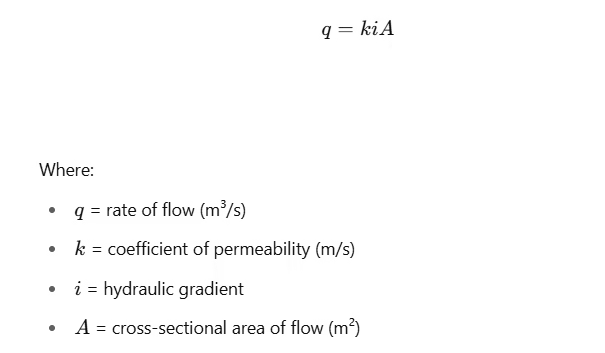
Darcy’s Law is valid for:
- Laminar flow
- Homogeneous and isotropic soils
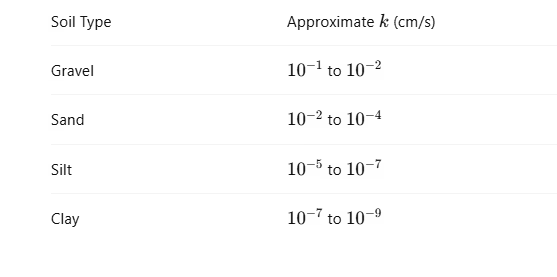
🧪 Coefficient of Permeability (k)
It indicates the ease with which water can flow through soil.
🏜️ Flow Net – Graphical Tool for Seepage Analysis
Flow Net is a graphical representation of seepage through soil used to simplify complex seepage problems, especially for two-dimensional steady flow conditions. It is a visual tool comprising:
- Flow lines: These lines trace the path followed by water particles through the soil. They represent the direction of seepage or flow of water and never cross each other.
- Equipotential lines: These lines connect points of equal total head or potential energy. Water flows from higher to lower potential across these lines.
Flow nets are typically drawn for homogeneous and isotropic soils and are useful in estimating the quantity of seepage, uplift pressure, and exit gradient. Creating an accurate flow net requires adherence to certain principles:
- The flow lines and equipotential lines should intersect each other at right angles.
- The curvilinear squares formed should be approximately square in shape.
- Boundary conditions such as impermeable or permeable layers must be respected.
Flow nets are indispensable in geotechnical engineering for designing safe and efficient hydraulic structures like dams, sheet piles, and cofferdams.
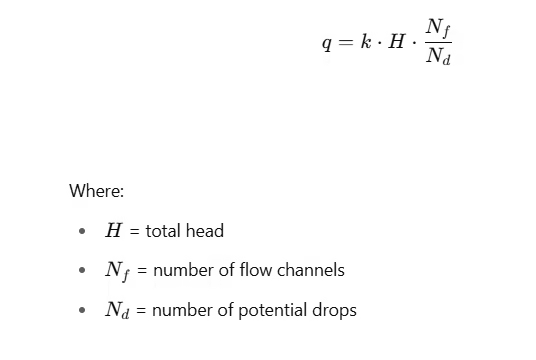
Seepage Discharge from Flow Net:
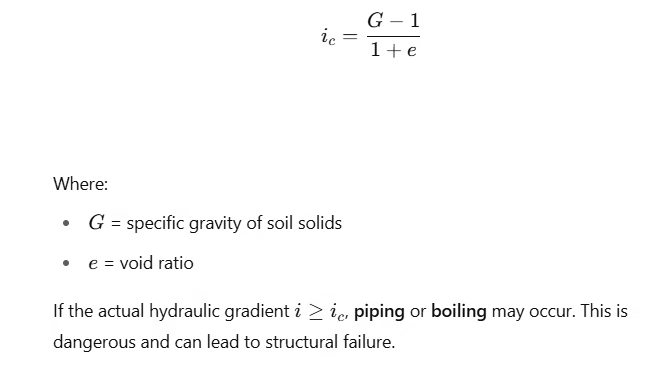
⚠️ Critical Hydraulic Gradient & Piping Failure
🏠 Application of Seepage Analysis in Engineering
| Structure | Seepage Concern |
|---|---|
| Earth Dams | Seepage may lead to piping and erosion |
| Retaining Walls | Causes uplift pressure |
| Canal Linings | Helps in estimating loss through seepage |
| Underground Tanks | Prevents floatation due to uplift force |
📋 JKSSB Exam Tips – Seepage Analysis
- Focus on Darcy’s Law and its conditions.
- Understand how to draw and interpret flow nets.
- Revise formulas for seepage discharge, critical hydraulic gradient.
- Practice numerical questions on piping and flow net analysis.
- Learn permeability ranges of different soils.
🔄 Summary
- Seepage = Flow of water through soil due to hydraulic head.
- Governed by Darcy’s Law.
- Permeability depends on soil type.
- Flow Net helps visualize seepage paths.
- Know how to calculate discharge and identify piping risk.
📚 Suggested Practice for JKSSB Civil:
- Previous Year Questions (PYQs) on seepage
- Flow net-based numericals
- Definitions & short formulas
🧾 Conclusion
Seepage analysis is a cornerstone of geotechnical engineering and plays a pivotal role in ensuring the safety and stability of civil structures such as earth dams, retaining walls, canals, tunnels, and foundations. Understanding how water flows through soil under hydraulic gradients is essential for preventing common geotechnical failures like piping, erosion, slope instability, and structural uplift.
By applying Darcy’s Law, engineers can quantify seepage flow through different soil types and determine appropriate design measures. Flow nets serve as a powerful graphical method for visualizing seepage paths and estimating quantities like uplift pressure and seepage discharge. Moreover, the concept of critical hydraulic gradient is crucial in assessing the risk of piping or boiling failures, especially in high water table areas.
From an exam perspective, especially for JKSSB Civil Engineering aspirants, mastering seepage concepts provides a significant advantage. Many objective and numerical questions in competitive exams revolve around Darcy’s Law, flow net interpretation, types of seepage, and critical gradient calculations.
To conclude, a strong grasp of seepage analysis not only helps in academic success but also equips future engineers with the knowledge required to design safer and more sustainable infrastructure. Continual practice of numerical problems and real-life case studies will further solidify your understanding of this vital topic in soil mechanics.
About The Author