
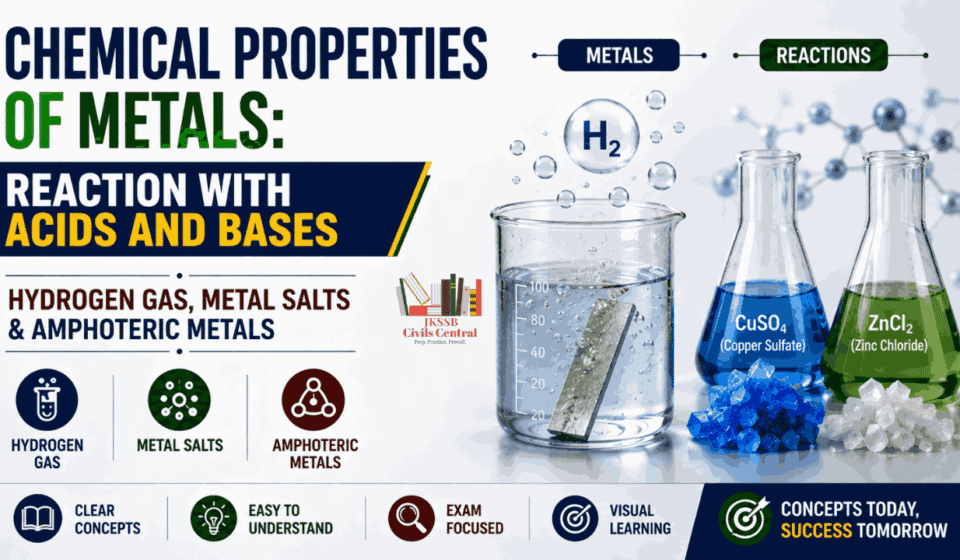
Chemical Properties of Metals: Reaction of metals with Acids and Bases | Hydrogen Gas, Metal Salts & Amphoteric Metals

Chemical Properties of Metals: Reaction with Acids and Bases | Hydrogen Gas, Metal Salts & Amphoteric Metals
Learn how metals react with dilute acids and bases, understand the formation of salts and hydrogen gas, amphoteric metals, and their importance in the reactivity series for JKSSB, JKPSC, SSC, UPSC & State PSC examinations.
Learning Dashboard
| Chapter Information | Details |
|---|---|
| Subject | General Science – Chemistry |
| Series | Metals and Non-Metals |
| Lesson Number | Lesson 4 |
| Previous Lesson | Chemical Properties of Metals: Reaction with Water – Cold Water, Hot Water & Steam Explained |
| Current Lesson | Chemical Properties of Metals: Reaction with Acids and Bases | Hydrogen Gas, Metal Salts & Amphoteric Metals |
| Next Lesson | Reactivity Series of Metals & Displacement Reactions | Reactivity, Metal Displacement & Redox Explained |
| Core Theme | Metals react with dilute acids to form salts and hydrogen gas. Certain metals also react with strong bases because of their amphoteric nature. |
| Major Topics Covered | Reaction with Dilute Acids, Formation of Salts, Evolution of Hydrogen Gas, Metals That Do Not React with Acids, Reaction with Bases, Amphoteric Metals, Industrial Applications |
| Important Metals Studied | Magnesium, Zinc, Iron, Aluminium, Sodium, Potassium, Copper, Silver, Gold |
| Key Concepts | Dilute Acids, Salts, Hydrogen Gas, Amphoteric Metals, Sodium Hydroxide, Reactivity, Metal Chlorides, Metal Sulphates |
| Real-Life Applications | Metal Cleaning, Laboratory Hydrogen Preparation, Pickling of Steel, Industrial Chemical Manufacturing |
| Exam Focus | Frequently Asked in JKSSB FAA, JKPSC, JKAS, SSC, CDS, UPSC & State PSC Examinations |
Chapter Overview
In the previous lesson, we studied how metals react with water and observed that the nature of the reaction depends upon the reactivity of the metal. Highly reactive metals react with cold water, moderately reactive metals react with hot water or steam, while least reactive metals do not react with water under ordinary conditions. We also learned that these reactions generally produce metal hydroxides or metal oxides along with hydrogen gas, providing an important basis for understanding the reactivity of metals.
In this lesson, we shall examine another important chemical property of metals—their reaction with acids and bases. Acids are among the most commonly used chemicals in laboratories and industries, and many metals react readily with dilute acids. During these reactions, the metal replaces hydrogen from the acid, resulting in the formation of a salt and the evolution of hydrogen gas.
However, not every metal behaves in the same manner. Highly reactive metals react vigorously with dilute acids, moderately reactive metals react at a slower rate, whereas metals such as copper, silver, gold, and platinum do not react with dilute acids because they are less reactive than hydrogen. Understanding this behaviour helps explain the reactivity series of metals, which is one of the most important concepts in inorganic chemistry.
Besides acids, certain metals also react with strong bases such as sodium hydroxide. Interestingly, not all metals show this behaviour. Only a few metals, particularly aluminium and zinc, react with both acids and bases. Because of this unique property, they are known as amphoteric metals. Their reactions with bases produce complex salts along with hydrogen gas and have important industrial applications.
Throughout this lesson, we will study the reaction of metals with dilute acids, the formation of salts and hydrogen gas, metals that do not react with acids, the reaction of amphoteric metals with bases, and the practical significance of these reactions. Each concept will be explained with balanced chemical equations, scientific reasoning, comparison tables, examination tips, and real-life applications.
Reaction of Metals with Dilute Acids
After studying the reactions of metals with oxygen and water, the next important chemical property is their reaction with acids. This reaction is of great importance because it not only demonstrates the chemical reactivity of metals but also provides a simple method for preparing hydrogen gas in laboratories. It also explains why some metals dissolve readily in acids, while others remain unaffected.
Most metals react with dilute acids by displacing hydrogen from the acid. As a result, a salt and hydrogen gas are formed. The ability of a metal to displace hydrogen depends upon its position in the reactivity series. Metals that are more reactive than hydrogen can replace it from dilute acids, whereas metals that are less reactive than hydrogen cannot.
Among the commonly used acids, dilute hydrochloric acid (HCl) and dilute sulphuric acid (H₂SO₄) are most frequently used to study these reactions. Strong oxidizing acids such as concentrated nitric acid behave differently and are discussed separately because they generally do not evolve hydrogen gas.
Why Do Metals React with Acids?
Metals are electropositive elements, meaning they readily lose electrons. When a metal comes into contact with a dilute acid, the metal atoms lose electrons and are converted into positively charged metal ions. The hydrogen ions (H⁺) present in the acid accept these electrons and combine to form hydrogen gas (H₂).
Thus, the reaction is essentially an oxidation-reduction (redox) reaction, where:
- The metal is oxidized (loses electrons).
- Hydrogen ions are reduced (gain electrons).
General Reaction of Metals with Dilute Acids
The general reaction can be represented as:
Metal + Dilute Acid → Salt + Hydrogen Gas
The type of salt formed depends upon the acid used.
- With hydrochloric acid, metals form metal chlorides.
- With sulphuric acid, metals form metal sulphates.
This simple relationship should always be remembered because it forms the basis of numerous examination questions.
Reaction with Dilute Hydrochloric Acid (HCl)
Hydrochloric acid is one of the most commonly used laboratory acids for studying metal reactions. When a reactive metal reacts with dilute hydrochloric acid, metal chloride and hydrogen gas are produced.
Examples
Mg + 2HCl → MgCl₂ + H₂↑
Zn + 2HCl → ZnCl₂ + H₂↑
Fe + 2HCl → FeCl₂ + H₂↑
In each reaction:
- A metal chloride is formed.
- Hydrogen gas is liberated.
- Effervescence (bubbles) is observed due to the escape of hydrogen gas.
Reaction with Dilute Sulphuric Acid (H₂SO₄)
Reactive metals also react with dilute sulphuric acid in a similar manner. In this case, metal sulphates and hydrogen gas are produced.
Examples
Mg + H₂SO₄ → MgSO₄ + H₂↑
Zn + H₂SO₄ → ZnSO₄ + H₂↑
Fe + H₂SO₄ → FeSO₄ + H₂↑
The observations are similar to those seen with hydrochloric acid, although the salts formed are different.
Observations During the Reaction
When a reactive metal is added to a dilute acid, several characteristic observations can be made.
- Bubbles of hydrogen gas appear on the surface of the metal.
- The metal gradually dissolves in the acid.
- A salt solution is formed.
- The reaction releases heat and is therefore exothermic.
- The rate of bubbling depends upon the reactivity of the metal.
For example, magnesium reacts much more rapidly than iron because magnesium is more reactive.
Scientific Explanation
The reaction occurs because metals have a tendency to lose electrons. When a metal atom loses electrons, it forms a positive metal ion. At the same time, hydrogen ions present in the acid gain these electrons and combine to produce hydrogen gas. This transfer of electrons makes the reaction a redox reaction.
The more easily a metal loses electrons, the faster it reacts with dilute acids.
Importance of These Reactions
The reaction of metals with dilute acids is important in both laboratories and industries.
These reactions are used for:
- Laboratory preparation of hydrogen gas.
- Manufacture of metal salts.
- Cleaning metal surfaces before galvanization or electroplating.
- Removal of rust and oxide layers from metals.
- Understanding the relative reactivity of metals.
The study of these reactions also provides the conceptual foundation for the Reactivity Series, where metals are arranged according to their ability to displace hydrogen from acids.
Reactions of Important Metals with Dilute Acids
Although the general reaction between metals and dilute acids is similar, different metals react at different rates depending on their position in the reactivity series. Highly reactive metals react vigorously, moderately reactive metals react slowly, and least reactive metals show little or no reaction.
Studying the behaviour of individual metals helps us understand the relationship between metal reactivity and the evolution of hydrogen gas. It also enables us to predict how unfamiliar metals are likely to behave when treated with dilute acids.
The most important metals discussed at this level are magnesium, zinc, iron, and copper.
Magnesium (Mg)
Magnesium is one of the most reactive metals commonly studied in chemistry. It reacts vigorously with dilute hydrochloric acid and dilute sulphuric acid.
During the reaction, magnesium rapidly dissolves in the acid, producing a colourless solution of the corresponding magnesium salt and liberating hydrogen gas.
Chemical Equations
Mg + 2HCl → MgCl₂ + H₂↑
Mg + H₂SO₄ → MgSO₄ + H₂↑
Observation
When magnesium ribbon is placed in a dilute acid:
- Rapid effervescence is observed.
- Hydrogen gas is evolved.
- The magnesium ribbon gradually dissolves.
- The test tube becomes warm because the reaction is exothermic.
Scientific Explanation
Magnesium readily loses its two valence electrons to form Mg²⁺ ions. Hydrogen ions present in the acid accept these electrons and combine to form hydrogen gas. Since magnesium has a high tendency to lose electrons, the reaction proceeds rapidly.
Exam Tip
Remember:
- Magnesium reacts vigorously with dilute acids.
- Forms magnesium chloride with HCl.
- Forms magnesium sulphate with H₂SO₄.
- Evolves hydrogen gas.
Zinc (Zn)
Zinc is moderately reactive and reacts readily with dilute acids, although the reaction is less vigorous than that of magnesium. Like magnesium, zinc displaces hydrogen from dilute acids to produce the corresponding zinc salt and hydrogen gas.
Chemical Equations
Zn + 2HCl → ZnCl₂ + H₂↑
Zn + H₂SO₄ → ZnSO₄ + H₂↑
Observation
During the reaction:
- Bubbles of hydrogen gas are produced.
- Zinc gradually dissolves.
- The reaction is slower than that of magnesium.
- Heat is released.
Scientific Explanation
Zinc loses two electrons to form Zn²⁺ ions. Hydrogen ions are reduced to hydrogen gas. Because zinc is less reactive than magnesium, the reaction proceeds at a comparatively slower rate.
Exam Tip
Remember:
- Zinc reacts with dilute acids.
- Forms zinc chloride and zinc sulphate.
- Hydrogen gas is evolved.
- Reaction is slower than magnesium.
Iron (Fe)
Iron also reacts with dilute acids, but the reaction is noticeably slower than those of magnesium and zinc. When iron reacts with dilute hydrochloric acid or dilute sulphuric acid, it forms iron(II) salts and liberates hydrogen gas.
Chemical Equations
Fe + 2HCl → FeCl₂ + H₂↑
Fe + H₂SO₄ → FeSO₄ + H₂↑
Observation
The following changes are observed:
- Slow evolution of hydrogen gas.
- Iron gradually dissolves.
- A pale green solution of iron(II) sulphate is formed with dilute sulphuric acid.
- The reaction is less vigorous than those of magnesium and zinc.
Scientific Explanation
Iron loses electrons less readily than magnesium and zinc. Consequently, the displacement of hydrogen from dilute acids occurs more slowly. This slower rate of reaction reflects iron’s lower position in the reactivity series.
Exam Tip
Remember:
- Iron reacts slowly with dilute acids.
- Forms iron(II) chloride or iron(II) sulphate.
- Hydrogen gas is evolved.
- Reaction is slower than zinc.
Copper (Cu)
Copper behaves very differently from magnesium, zinc, and iron. Copper does not react with dilute hydrochloric acid or dilute sulphuric acid because it is less reactive than hydrogen. As a result, it cannot displace hydrogen from dilute acids. Therefore, no hydrogen gas is produced, and no chemical reaction is observed under ordinary conditions.
Observation
When copper is placed in dilute hydrochloric acid or dilute sulphuric acid:
- No bubbles of hydrogen gas are observed.
- Copper remains unchanged.
- The acid shows no visible reaction.
Scientific Explanation
Copper has a much lower tendency to lose electrons than hydrogen. Since it cannot replace hydrogen ions from dilute acids, no reaction occurs. This property places copper below hydrogen in the reactivity series.
Exam Tip
Remember:
- Copper does not react with dilute HCl.
- Copper does not react with dilute H₂SO₄.
- No hydrogen gas is evolved.
- Copper is less reactive than hydrogen.
Comparison of Metals Reacting with Dilute Acids
| Metal | Reaction with Dilute Acids | Product Formed | Hydrogen Gas |
|---|---|---|---|
| Magnesium | Very Vigorous | Magnesium Salt | Yes |
| Zinc | Moderate | Zinc Salt | Yes |
| Iron | Slow | Iron(II) Salt | Yes |
| Copper | No Reaction | No Salt Formed | No |
The behaviour of these metals demonstrates a clear trend: the more reactive the metal, the faster it displaces hydrogen from dilute acids. Magnesium reacts most vigorously, followed by zinc and iron, while copper remains unreactive because it is less reactive than hydrogen.
This relationship between metal reactivity and the ability to displace hydrogen from acids is a fundamental concept that leads directly to the Reactivity Series of Metals, one of the most important topics in inorganic chemistry and competitive examinations.
Metals That Do Not React with Dilute Acids
The reactions discussed so far show that magnesium, zinc, and iron readily react with dilute acids and liberate hydrogen gas. However, not all metals behave in the same way. Some metals are so less reactive that they cannot displace hydrogen from dilute acids.
A metal can react with a dilute acid only if it is more reactive than hydrogen. Metals that are less reactive than hydrogen are unable to replace hydrogen ions from the acid. As a result, no salt is formed, no hydrogen gas is evolved, and no visible chemical reaction takes place.
The most important metals in this category are copper (Cu), silver (Ag), gold (Au), and platinum (Pt).
Why Do Some Metals Not React with Dilute Acids?
The ability of a metal to react with an acid depends upon its position in the reactivity series. Metals placed above hydrogen in the reactivity series readily lose electrons and displace hydrogen from dilute acids. Metals placed below hydrogen hold their electrons more strongly. Consequently, hydrogen ions present in dilute acids cannot remove electrons from these metals, and no reaction occurs.
This principle is one of the most important applications of the reactivity series and frequently appears in competitive examinations.
Copper (Cu)
Copper is one of the most commonly used metals that does not react with dilute hydrochloric acid or dilute sulphuric acid. When a copper strip is placed in either of these acids, no visible change occurs. No bubbles of hydrogen gas are produced, and the metal remains unchanged.
Observation
- No effervescence is observed.
- No hydrogen gas is evolved.
- Copper does not dissolve.
- No salt is formed.
Scientific Explanation
Copper is less reactive than hydrogen and therefore cannot displace hydrogen ions from dilute acids. This property makes copper highly resistant to attack by dilute acids under ordinary conditions.
Applications
Copper’s resistance to dilute acids makes it suitable for:
- Water pipes
- Electrical wiring
- Heat exchangers
- Roofing materials
- Household utensils
Silver (Ag)
Silver is another low-reactivity metal that remains unaffected by dilute hydrochloric acid and dilute sulphuric acid. Its resistance to chemical attack contributes to its long-lasting shine and durability.
Observation
- No reaction occurs.
- Hydrogen gas is not evolved.
- Silver remains unchanged.
Scientific Explanation
Silver lies below hydrogen in the reactivity series and therefore cannot replace hydrogen from dilute acids.
Applications
Silver is widely used in:
- Jewellery
- Coins
- Electrical contacts
- Electronic devices
Gold (Au)
Gold is one of the least reactive metals known. It does not react with dilute acids because it has an extremely low tendency to lose electrons. This remarkable chemical stability is one of the reasons why gold is classified as a noble metal.
Observation
- No visible reaction.
- No hydrogen gas evolved.
- Gold retains its appearance.
Scientific Explanation
Gold is positioned well below hydrogen in the reactivity series. Therefore, hydrogen ions are unable to oxidize gold atoms.
Applications
Gold is extensively used in:
- Jewellery
- Coins and medals
- Electronics
- Dentistry
- Aerospace technology
Platinum (Pt)
Platinum is another noble metal that exhibits exceptional resistance to chemical reactions. Like gold, platinum does not react with dilute hydrochloric acid or dilute sulphuric acid under ordinary conditions.
Observation
- No chemical reaction occurs.
- No hydrogen gas is evolved.
- Platinum remains unaffected.
Scientific Explanation
Platinum has an extremely low chemical reactivity and is unable to displace hydrogen from dilute acids.
Applications
Platinum is used in:
- Catalytic converters
- Laboratory equipment
- Medical instruments
- High-quality jewellery
- Chemical industries
Important Exception: Nitric Acid
Students should remember an important exception. Although metals such as copper and silver do not react with dilute hydrochloric acid or dilute sulphuric acid, they can react with concentrated nitric acid (HNO₃) because nitric acid is a strong oxidizing acid. Instead of producing hydrogen gas, concentrated nitric acid generally produces nitrogen oxides (NO or NO₂).
For this reason, the simple rule:
Metal + Acid → Salt + Hydrogen
does not apply to nitric acid in many cases.
This exception is frequently asked in competitive examinations.
Comparison of Metals That Do Not React with Dilute Acids
| Metal | Dilute HCl | Dilute H₂SO₄ | Hydrogen Gas | Reason |
|---|---|---|---|---|
| Copper | No Reaction | No Reaction | No | Less reactive than hydrogen |
| Silver | No Reaction | No Reaction | No | Less reactive than hydrogen |
| Gold | No Reaction | No Reaction | No | Noble metal |
| Platinum | No Reaction | No Reaction | No | Noble metal |
Exam Tip
Always remember these high-yield facts:
- Metals above hydrogen react with dilute acids.
- Metals below hydrogen do not react with dilute acids.
- Copper, silver, gold, and platinum do not liberate hydrogen gas with dilute HCl or dilute H₂SO₄.
- Nitric acid is an important exception because it is an oxidizing acid and usually does not evolve hydrogen gas.
- The ability of a metal to displace hydrogen from acids depends upon its position in the reactivity series.
Understanding why certain metals do not react with dilute acids is just as important as understanding why reactive metals do. Together, these reactions establish the principle that only metals more reactive than hydrogen can displace hydrogen from dilute acids, a concept that forms the foundation for the next topic on the reactivity series of metals.
Reaction of Amphoteric Metals with Bases
Most metals react readily with dilute acids, but only a few metals react with strong bases. This is because the majority of metals exhibit only metallic or basic behaviour and therefore do not react with alkalis such as sodium hydroxide (NaOH) or potassium hydroxide (KOH).
However, certain metals possess a unique property—they can react with both acids and bases. Such metals are known as amphoteric metals, and the compounds they form are called amphoteric oxides or amphoteric hydroxides.
Among the commonly studied metals, aluminium and zinc are the most important examples of amphoteric metals. Their reactions with strong bases are frequently asked in competitive examinations and also have significant industrial applications.
What Are Amphoteric Metals?
Amphoteric metals are metals that react with both acids and strong bases. When these metals react with dilute acids, they produce salts and hydrogen gas, just like other reactive metals. However, when they react with concentrated solutions of strong bases such as sodium hydroxide (NaOH) or potassium hydroxide (KOH), they form complex salts along with hydrogen gas.
This dual behaviour distinguishes amphoteric metals from ordinary metals.
Aluminium (Al)
Aluminium is one of the most important amphoteric metals. Although aluminium is protected by a thin oxide layer under normal conditions, it reacts readily with concentrated sodium hydroxide solution. During the reaction, the oxide layer dissolves, allowing the metal to react further.
The products formed are sodium aluminate and hydrogen gas.
Chemical Equation
2Al + 2NaOH + 2H₂O → 2NaAlO₂ + 3H₂↑
(In aqueous solution, the product may also be represented as sodium tetrahydroxoaluminate, depending on the level of study.)
Observation
When aluminium reacts with sodium hydroxide:
- The aluminium gradually dissolves.
- Bubbles of hydrogen gas are produced.
- Heat is evolved because the reaction is exothermic.
- A colourless solution containing sodium aluminate is formed.
Scientific Explanation
Aluminium is capable of reacting with both acids and bases because its oxide and hydroxide are amphoteric. In sodium hydroxide solution, aluminium loses electrons and combines with hydroxide ions to form sodium aluminate, while hydrogen ions from water are reduced to produce hydrogen gas.
Applications
The reaction of aluminium with sodium hydroxide is important in:
- Extraction and purification of aluminium.
- Manufacture of sodium aluminate.
- Chemical industries.
- Laboratory demonstrations of amphoteric behaviour.
Exam Tip
Remember:
- Aluminium is an amphoteric metal.
- Reacts with NaOH.
- Forms sodium aluminate.
- Hydrogen gas is evolved.
Zinc (Zn)
Zinc is another important amphoteric metal. Like aluminium, zinc reacts with strong sodium hydroxide solution to produce sodium zincate and hydrogen gas.
Chemical Equation
Zn + 2NaOH → Na₂ZnO₂ + H₂↑
(In aqueous solution, sodium zincate may also exist in hydrated forms depending on the reaction conditions.)
Observation
During the reaction:
- Zinc gradually dissolves.
- Hydrogen gas is evolved.
- The reaction proceeds steadily.
- A solution containing sodium zincate is formed.
Scientific Explanation
Zinc exhibits amphoteric behaviour because zinc oxide (ZnO) and zinc hydroxide [Zn(OH)₂] react with both acids and bases. When zinc reacts with sodium hydroxide, it forms sodium zincate, while hydrogen gas is released.
Applications
The reaction of zinc with sodium hydroxide is useful in:
- Metallurgical industries.
- Production of zinc compounds.
- Laboratory identification of amphoteric metals.
- Chemical manufacturing.
Exam Tip
Remember:
- Zinc is an amphoteric metal.
- Reacts with strong NaOH.
- Forms sodium zincate.
- Evolves hydrogen gas.
Why Do Most Metals Not React with Bases?
Unlike aluminium and zinc, most metals do not react with strong bases. This is because their oxides and hydroxides are purely basic and do not possess amphoteric character. Consequently, they cannot dissolve in alkalis or form complex salts.
For example:
- Iron does not normally react with sodium hydroxide.
- Copper does not react with sodium hydroxide.
- Silver, gold, and platinum also do not react with bases under ordinary conditions.
Thus, the ability to react with both acids and bases is limited to only a few metals.
Comparison of Amphoteric Metals
| Property | Aluminium | Zinc |
|---|---|---|
| Amphoteric Metal | Yes | Yes |
| Reacts with Dilute Acids | Yes | Yes |
| Reacts with Strong Bases | Yes | Yes |
| Base Used | Sodium Hydroxide | Sodium Hydroxide |
| Product Formed | Sodium Aluminate | Sodium Zincate |
| Hydrogen Gas Evolved | Yes | Yes |
Importance of Amphoteric Metals
The amphoteric behaviour of aluminium and zinc is of great importance in chemistry and industry.
It helps in:
- Identifying amphoteric metals.
- Extraction and purification of aluminium.
- Manufacture of industrial chemicals.
- Understanding the behaviour of amphoteric oxides.
- Explaining why aluminium and zinc differ from most other metals.
From an examination perspective, students should remember that only a few metals, especially aluminium and zinc, react with both acids and strong bases. This unique behaviour is one of their most distinguishing chemical properties and is frequently tested in JKSSB, SSC, JKPSC, UPSC, and other competitive examinations.
Everyday Applications of the Reaction of Metals with Acids and Bases
The reactions of metals with acids and bases are not confined to chemistry laboratories. They have numerous applications in industry, metallurgy, engineering, medicine, manufacturing, and everyday life. These reactions are used to prepare useful chemicals, clean metal surfaces, extract metals from ores, and manufacture a wide range of industrial products.
Understanding these applications helps students appreciate the practical importance of chemical reactions while also strengthening their conceptual understanding for competitive examinations.
Laboratory Preparation of Hydrogen Gas
One of the most common applications of the reaction between metals and dilute acids is the preparation of hydrogen gas. In school and college laboratories, hydrogen is usually prepared by reacting zinc granules with dilute hydrochloric acid or dilute sulphuric acid.
Zn + 2HCl → ZnCl₂ + H₂↑
The hydrogen gas produced is collected and later identified using the burning splint test, where it burns with a characteristic ‘pop’ sound. This method is simple, economical, and widely used for demonstrating the chemical properties of metals.
Pickling of Metals
Before metals such as iron and steel are galvanized, electroplated, or painted, their surfaces must be cleaned to remove rust, oxide layers, and other impurities. This cleaning process is known as pickling.
Dilute hydrochloric acid or dilute sulphuric acid is commonly used to dissolve the oxide layer present on the metal surface without significantly attacking the metal itself. Pickling improves the adhesion of protective coatings and increases the durability of finished products.
Manufacture of Metal Salts
The reaction between metals and dilute acids is widely used for the manufacture of metal salts, which have numerous industrial applications.
Some common examples include:
- Zinc sulphate used in agriculture and medicine.
- Magnesium sulphate (Epsom salt) used in medicine.
- Iron sulphate used in water treatment and fertilizers.
- Aluminium salts used in water purification.
These salts are prepared by carefully controlling the reaction between suitable metals and acids.
Extraction and Purification of Aluminium
The amphoteric nature of aluminium is utilized during its extraction and purification. During the Bayer Process, aluminium compounds react with concentrated sodium hydroxide to form soluble sodium aluminate. This property helps separate aluminium from many impurities present in bauxite ore.
Thus, the reaction of aluminium with bases has immense industrial significance.
Production of Industrial Chemicals
The reactions of amphoteric metals with strong bases are used in the manufacture of important industrial chemicals.
For example:
- Sodium aluminate is used in water treatment, paper manufacturing, and the cement industry.
- Sodium zincate is used in electroplating, chemical manufacturing, and laboratory research.
These compounds are valuable intermediates in several industrial processes.
Metal Cleaning and Surface Treatment
Acids are widely used for cleaning metal surfaces before manufacturing operations.
They help remove:
- Rust
- Oxide coatings
- Scale deposits
- Surface impurities
This treatment improves the quality of welding, electroplating, galvanization, and painting.
Understanding Corrosion and Material Selection
Knowledge of acid and base reactions helps engineers select suitable materials for chemical industries. Metals that react readily with acids are generally avoided in equipment designed to store or transport acidic substances. Instead, corrosion-resistant materials such as stainless steel, certain alloys, or specially coated metals are preferred.
This understanding helps prevent corrosion, reduces maintenance costs, and increases the service life of industrial equipment.
Importance in Competitive Examinations
Questions based on the practical applications of acid-base reactions are frequently asked in competitive examinations.
Students should remember:
- Hydrogen gas is prepared in laboratories using zinc and dilute hydrochloric acid.
- Pickling removes rust and oxide layers before galvanization or electroplating.
- Aluminium reacts with sodium hydroxide during the Bayer Process.
- Amphoteric metals are important in industrial chemical manufacturing.
- Metal salts produced by acid reactions have applications in agriculture, medicine, water treatment, and industry.
Real-Life Examples at a Glance
| Application | Scientific Principle |
|---|---|
| Laboratory preparation of hydrogen | Reactive metals react with dilute acids to produce hydrogen gas. |
| Pickling of steel | Dilute acids remove rust and oxide layers before galvanization or painting. |
| Manufacture of metal salts | Metals react with acids to form useful industrial salts. |
| Bayer Process | Aluminium reacts with sodium hydroxide to form sodium aluminate for purification. |
| Chemical manufacturing | Amphoteric metals form compounds such as sodium aluminate and sodium zincate. |
| Corrosion-resistant equipment | Material selection depends on the reactivity of metals towards acids and bases. |
The reactions of metals with acids and bases are therefore fundamental to both chemistry and modern industry. They are used to produce hydrogen gas, manufacture essential chemicals, clean and protect metal surfaces, extract valuable metals, and design corrosion-resistant industrial equipment. A thorough understanding of these applications not only strengthens conceptual learning but also enables students to relate classroom chemistry to real-world technologies and industrial processes.
JKSSB CivilsCentral Insight
The reactions of metals with acids and bases are among the most important chemical properties studied in inorganic chemistry. These reactions explain why some metals readily dissolve in acids with the evolution of hydrogen gas, while others remain completely unaffected. They also introduce the unique concept of amphoteric metals, which react with both acids and strong bases.
The most important principle to remember is that only metals more reactive than hydrogen can displace hydrogen from dilute acids. When such metals react with dilute hydrochloric acid or dilute sulphuric acid, they form the corresponding metal salt and liberate hydrogen gas. The speed of the reaction depends upon the reactivity of the metal. Thus, magnesium reacts vigorously, zinc reacts moderately, iron reacts slowly, and copper does not react at all.
Another key concept is the formation of different salts depending on the acid used. When hydrochloric acid is used, metal chlorides are formed. When sulphuric acid is used, metal sulphates are produced. This relationship is simple but frequently tested in competitive examinations.
Students should also understand that hydrogen gas is one of the characteristic products of these reactions. It is colourless, odourless, highly combustible, and can be identified by the burning splint test, where it burns with a characteristic ‘pop’ sound.
An important exception that every aspirant should remember is nitric acid (HNO₃). Unlike dilute hydrochloric acid and dilute sulphuric acid, nitric acid is a strong oxidizing acid. Therefore, it generally does not evolve hydrogen gas during its reaction with metals. Instead, nitrogen oxides such as nitric oxide (NO) or nitrogen dioxide (NO₂) are usually produced. This exception is frequently asked in objective examinations.
Another high-yield concept is the amphoteric behaviour of aluminium and zinc. These two metals are unique because they react with both dilute acids and strong bases. Their reactions with sodium hydroxide produce sodium aluminate and sodium zincate, respectively, along with hydrogen gas. This dual behaviour distinguishes them from most other metals and is one of the most important properties to remember.
The practical applications of these reactions are equally important. The reaction of zinc with dilute acids is commonly used for the laboratory preparation of hydrogen gas, while dilute acids are widely employed in pickling to remove rust and oxide layers from metal surfaces before galvanization or electroplating. Similarly, the amphoteric nature of aluminium forms the basis of the Bayer Process, which is used for the purification of bauxite during aluminium extraction.
High-Yield Facts for Competitive Examinations
Remember the following examination-oriented points:
- Metal + Dilute Acid → Salt + Hydrogen Gas
- Hydrochloric acid forms metal chlorides.
- Sulphuric acid forms metal sulphates.
- Only metals above hydrogen in the reactivity series react with dilute acids.
- Magnesium reacts vigorously with dilute acids.
- Zinc reacts moderately with dilute acids.
- Iron reacts slowly with dilute acids.
- Copper, silver, gold, and platinum do not react with dilute hydrochloric acid or dilute sulphuric acid.
- Hydrogen gas burns with a characteristic ‘pop’ sound.
- Nitric acid is an important exception because it usually does not evolve hydrogen gas.
- Aluminium and zinc are amphoteric metals.
- Aluminium reacts with sodium hydroxide to form sodium aluminate.
- Zinc reacts with sodium hydroxide to form sodium zincate.
- Hydrogen gas is prepared in laboratories using zinc and dilute hydrochloric acid.
- Pickling is the process of removing rust and oxide layers from metal surfaces using dilute acids.
Rather than memorizing individual chemical equations, focus on the relationship between metal reactivity and its ability to displace hydrogen from acids. Also remember that only a few metals exhibit amphoteric behaviour, making aluminium and zinc exceptionally important in both chemistry and competitive examinations. A strong understanding of these concepts will make the next lesson on the Reactivity Series and Displacement Reactions much easier to understand.
Quick Revision
Before moving to the next lesson, it is important to revise the key concepts discussed in this chapter. The following points summarize the entire lesson and are useful for quick revision before competitive examinations.
- Metals react with dilute acids because they tend to lose electrons and displace hydrogen from the acid.
- The general reaction between a metal and a dilute acid is:Metal + Dilute Acid → Salt + Hydrogen Gas
- The type of salt formed depends on the acid used:
- Hydrochloric Acid (HCl) → Metal Chloride
- Sulphuric Acid (H₂SO₄) → Metal Sulphate
- Hydrogen gas is evolved when metals more reactive than hydrogen react with dilute acids.
- Hydrogen is colourless, odourless, highly combustible, and burns with a characteristic ‘pop’ sound when tested using a burning splint.
- Magnesium reacts vigorously with dilute hydrochloric acid and dilute sulphuric acid.
- Zinc reacts readily with dilute acids but less vigorously than magnesium.
- Iron reacts slowly with dilute acids and forms iron(II) salts.
- Copper does not react with dilute hydrochloric acid or dilute sulphuric acid because it is less reactive than hydrogen.
- Silver, gold, and platinum also do not react with dilute acids under ordinary conditions.
- Only metals above hydrogen in the reactivity series can displace hydrogen from dilute acids.
- Nitric acid (HNO₃) is an important exception because it is a strong oxidizing acid and generally does not evolve hydrogen gas during its reaction with metals.
- Aluminium and zinc are amphoteric metals because they react with both acids and strong bases.
- Aluminium reacts with sodium hydroxide to form sodium aluminate and hydrogen gas.
- Zinc reacts with sodium hydroxide to form sodium zincate and hydrogen gas.
- Most metals do not react with strong bases because they are not amphoteric.
- The reaction of metals with dilute acids is widely used for the laboratory preparation of hydrogen gas.
- Pickling is the process of cleaning metal surfaces with dilute acids before galvanization, electroplating, or painting.
- The amphoteric behaviour of aluminium is utilized in the Bayer Process for the extraction and purification of aluminium.
Frequently Asked Questions (FAQs)
The following frequently asked questions address the most common doubts related to the reaction of metals with acids and bases. These questions reinforce the key concepts discussed in this lesson and are highly relevant for JKSSB FAA, JKPSC, JKAS, SSC, CDS, UPSC, and other State PSC examinations.
1. Why do metals react with dilute acids?
Metals react with dilute acids because they are electropositive and readily lose electrons. During the reaction, the metal displaces hydrogen from the acid, resulting in the formation of a salt and the evolution of hydrogen gas.
2. What is the general reaction between a metal and a dilute acid?
The general reaction is: Metal + Dilute Acid → Salt + Hydrogen Gas
For example: Zn + 2HCl → ZnCl₂ + H₂↑
3. Why is hydrogen gas evolved during the reaction?
Acids contain hydrogen ions (H⁺). When a reactive metal loses electrons, these hydrogen ions gain the electrons and combine to form hydrogen gas (H₂). The evolution of hydrogen gas indicates that a displacement reaction has taken place.
4. Which metals react with dilute acids?
Most metals that are above hydrogen in the reactivity series react with dilute acids.
Some important examples are:
- Magnesium
- Aluminium
- Zinc
- Iron
These metals displace hydrogen from dilute acids and form salts.
5. Which metals do not react with dilute acids?
Metals that are below hydrogen in the reactivity series do not react with dilute hydrochloric acid or dilute sulphuric acid.
These include:
- Copper
- Silver
- Gold
- Platinum
These metals cannot displace hydrogen from dilute acids.
6. Why does copper not react with dilute hydrochloric acid?
Copper is less reactive than hydrogen. Therefore, it cannot replace hydrogen ions from dilute hydrochloric acid or dilute sulphuric acid. As a result:
- No salt is formed.
- No hydrogen gas is evolved.
- No visible reaction occurs.
7. What is the difference between hydrochloric acid and sulphuric acid in these reactions?
Both acids react similarly with reactive metals, but the salts formed are different.
- Hydrochloric acid (HCl) forms metal chlorides.
- Sulphuric acid (H₂SO₄) forms metal sulphates.
For example:
Mg + 2HCl → MgCl₂ + H₂↑
Mg + H₂SO₄ → MgSO₄ + H₂↑
8. Why is nitric acid considered an exception?
Nitric acid is a strong oxidizing acid. Instead of liberating hydrogen gas, it generally oxidizes the hydrogen formed into water and itself gets reduced to nitrogen oxides such as nitric oxide (NO) or nitrogen dioxide (NO₂). Therefore, hydrogen gas is usually not evolved during reactions with nitric acid.
9. What are amphoteric metals?
Amphoteric metals are metals that react with both acids and strong bases.
The most important amphoteric metals are:
- Aluminium
- Zinc
This property makes them different from most other metals.
10. Why do aluminium and zinc react with sodium hydroxide?
Aluminium and zinc possess amphoteric character. When treated with concentrated sodium hydroxide, they dissolve to form complex salts such as sodium aluminate and sodium zincate while liberating hydrogen gas.
11. What products are formed when aluminium reacts with sodium hydroxide?
The reaction produces:
- Sodium aluminate
- Hydrogen gas
This reaction demonstrates the amphoteric nature of aluminium.
12. What products are formed when zinc reacts with sodium hydroxide?
Zinc reacts with sodium hydroxide to produce:
- Sodium zincate
- Hydrogen gas
This is another example of amphoteric behaviour.
13. Why do most metals not react with bases?
Most metals are not amphoteric. Their oxides and hydroxides are basic in nature and therefore do not dissolve in strong alkalis like sodium hydroxide. Only a few metals, especially aluminium and zinc, exhibit this unique property.
14. What is pickling?
Pickling is the process of cleaning metal surfaces using dilute acids to remove:
- Rust
- Oxide layers
- Scale
- Surface impurities
It is carried out before galvanization, electroplating, welding, or painting.
15. How is hydrogen gas prepared in the laboratory?
Hydrogen gas is commonly prepared by reacting zinc granules with dilute hydrochloric acid.
Zn + 2HCl → ZnCl₂ + H₂↑
The gas is collected and identified by its characteristic ‘pop’ sound when tested with a burning splint.
16. Why is the reaction of metals with acids important?
These reactions are important because they help us:
- Compare the reactivity of metals.
- Understand displacement reactions.
- Prepare hydrogen gas.
- Manufacture useful metal salts.
- Clean metal surfaces through pickling.
- Understand industrial extraction and purification processes.
17. Which facts from this lesson are most important for competitive examinations?
Students should always remember the following high-yield facts:
- Metal + Dilute Acid → Salt + Hydrogen Gas
- Hydrochloric acid forms metal chlorides.
- Sulphuric acid forms metal sulphates.
- Only metals above hydrogen react with dilute acids.
- Copper, silver, gold, and platinum do not react with dilute acids.
- Nitric acid is an important exception.
- Aluminium and zinc are amphoteric metals.
- Aluminium + NaOH → Sodium Aluminate + Hydrogen
- Zinc + NaOH → Sodium Zincate + Hydrogen
- Hydrogen gas burns with a characteristic ‘pop’ sound.
- Pickling removes rust and oxide layers before galvanization and electroplating.
- Zinc and dilute hydrochloric acid are commonly used for the laboratory preparation of hydrogen gas.
Mind Maps
Mind Map 1: Reaction of Metals with Acids
               REACTION OF METALS WITH ACIDS
                           │
                           ▼
                 Metal + Dilute Acid
                           │
            ┌──────────────┴──────────────┐
            │                             │
            ▼                             ▼
          Salt                    Hydrogen Gas
Mind Map 2: Reactivity with Dilute Acids
              REACTIVITY OF METALS WITH ACIDS
                          │
     ┌────────────────────┼────────────────────┐
     │                    │                    │
     ▼                    ▼                    ▼

 Highly Reactive     Moderately Reactive    Least Reactive

 Magnesium              Zinc                 Copper

                         Iron                Silver

                                             Gold

                                             Platinum

────────────────────────────────────────────────────────

React with Dilute Acids

Mg → Very Vigorous

Zn → Moderate

Fe → Slow

Cu, Ag, Au, Pt → No Reaction
Mind Map 3: Amphoteric Metals
                  AMPHOTERIC METALS
                         │
             ┌───────────┴───────────┐
             │                       │
             ▼                       ▼

        Aluminium               Zinc

             │                       │

 Reacts with Acids         Reacts with Acids

 Reacts with Bases         Reacts with Bases

             │                       │

 Sodium Aluminate        Sodium Zincate

             │                       │

 Hydrogen Gas            Hydrogen Gas
Mind Map 4: Important Exceptions
                 IMPORTANT EXAM FACTS
                         │
 ┌───────────────────────┼────────────────────────┐
 │                       │                        │
 ▼                       ▼                        ▼

Only Metals          Nitric Acid          Hydrogen Gas
Above Hydrogen         Exception

│                      │                     │

React with         Strong Oxidizing      Pop Sound

Dilute Acids           Acid

│                      │

Salt + H₂         Usually NO / NO₂
Mind Map 5: Complete Chapter Summary
          CHEMICAL PROPERTIES OF METALS
           REACTION WITH ACIDS & BASES
                     │
                     ▼

          Reaction with Dilute Acids
                     │
                     ▼

        Salt + Hydrogen Gas

────────────────────────────────────

HCl → Metal Chlorides

H₂SO₄ → Metal Sulphates

────────────────────────────────────

Reactive Metals

Mg → Very Vigorous

Zn → Moderate

Fe → Slow

Cu • Ag • Au • Pt → No Reaction

────────────────────────────────────

Amphoteric Metals

Aluminium

Zinc

│

React with Acids

React with Bases

│

Hydrogen Gas Produced

────────────────────────────────────

Important Facts

✓ Hydrogen burns with
  'Pop' Sound

✓ Nitric Acid is an Exception

✓ Pickling removes Rust

✓ Zn + Dilute HCl
  → Laboratory Preparation
  of Hydrogen
About The Author













[…] Chemical Properties of Metals: Reaction with Acids and Bases | Hydrogen Gas, Metal Salts & Ampho… […]
[…] Chemical Properties of Metals: Reaction of metals with Acids and Bases | Hydrogen Gas, Metal Salts &… […]