Introduction & Population Forecasting in Environmental Engineering – Complete Guide for JKSSB JE, SSC JE, RRB JE

🗓️ Updated: July 2025
📚 Target Exams: JKSSB JE, SSC JE, RRB JE Civil
🌱 Introduction to Environmental Engineering
Environmental Engineering is a critical and evolving branch of civil engineering that focuses on protecting human health and the environment by designing sustainable systems for water supply, wastewater treatment, solid waste management, air pollution control, and environmental sanitation. It integrates principles of biology, chemistry, hydrology, and geology with engineering to tackle challenges related to public health, resource management, and pollution prevention.
One of the foundational tasks in environmental engineering planning is Population Forecasting. This step is crucial because all future infrastructure design—whether it’s for drinking water distribution, sewage collection networks, or waste disposal facilities—depends on accurately estimating how many people the system will need to serve in the coming years or decades. Reliable forecasting helps engineers ensure that systems are neither under-designed (leading to failure or overload) nor over-designed (leading to unnecessary expenditure).
📌 What is Population Forecasting?
Population Forecasting is the process of estimating the future population of an area based on current and historical data, demographic trends, and anticipated changes in economic, social, and environmental factors. This estimate forms the foundation for planning and designing public infrastructure such as water supply networks, sewerage systems, stormwater drainage, transportation facilities, and solid waste management systems.
Forecasts are typically done for design periods ranging from 10 to 50 years, depending on the type of infrastructure. For example, water supply and sanitation systems are generally designed for a longer life cycle, often up to 30 years. Therefore, a well-analyzed population forecast ensures that the public utilities do not fail prematurely or incur excess investment due to overdesign. It also helps governments and engineers formulate appropriate development strategies and allocate resources efficiently for sustainable urban and rural development.
🎯 Objectives of Population Forecasting:
- Estimating future water demand involves predicting how much water will be required by a projected population over a specific period. This includes domestic consumption, industrial and commercial usage, firefighting reserves, and losses due to leakage or wastage. Accurate estimation ensures the designed water supply system meets the demands of the population without failure or overburden. The estimate is typically based on per capita consumption multiplied by the forecasted population, and must also account for seasonal variations and future urban development plans.
- Designing sanitary and sewerage systems involves estimating the amount of wastewater that will be generated by the projected population. This includes domestic sewage, industrial effluents, and stormwater runoff (in combined systems). Engineers must determine peak flow rates, select appropriate pipe diameters and slopes, and ensure proper treatment and disposal methods. Forecasting ensures the designed systems remain effective, prevent overflows, and maintain environmental and public health standards for decades.
- Planning solid waste management
- Forecasting transportation and housing needs
- Aiding urban planning and zoning
⚙️ Factors Affecting Population Growth
- Birth Rate and Death Rate
- Migration (inward and outward)
- Industrialization and Job Opportunities
- Availability of Basic Amenities
- Natural Disasters or Epidemics
- Government Policies and Infrastructure Development
These factors must be considered before choosing a forecasting method.
📚 Commonly Used Population Forecasting Methods
Let’s look at the most important methods used in civil/environmental engineering:
1️⃣ Arithmetic Increase Method
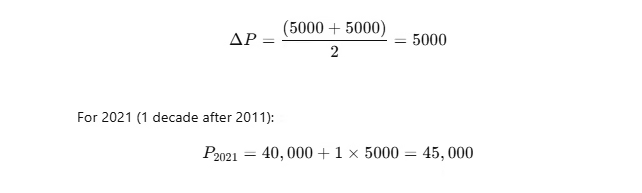
This is the simplest method, assuming the population increases by a constant number every decade.
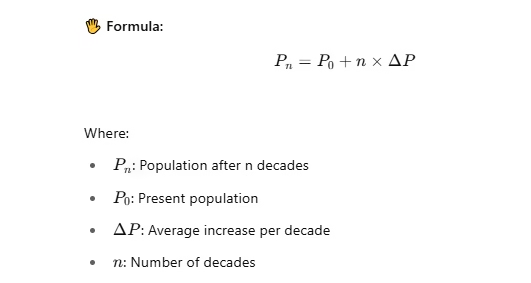
✅ When to Use:
- For cities with stable, slow, and uniform growth
- Historical data shows little variation over decades
📌 Example:
| Year | Population |
|---|---|
| 1991 | 30,000 |
| 2001 | 35,000 |
| 2011 | 40,000 |
2️⃣ Geometric Increase Method
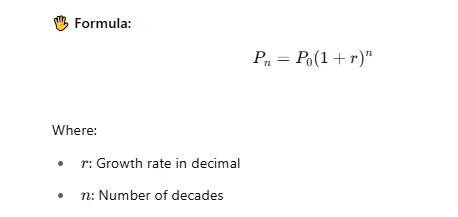
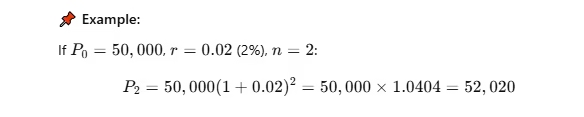
This method assumes population grows at a constant percentage (growth rate).
✅ When to Use:
- Towns with fast-growing population
- Urban areas with increasing economic opportunities
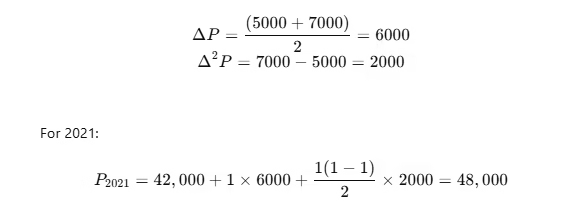
3️⃣ Incremental Increase Method
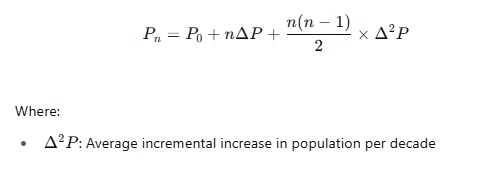
A modification of the arithmetic method. It accounts for the increase in population growth rate.
🖐️ Formula:
✅ When to Use:
- Cities with accelerating growth rate
- Large towns transitioning into metro cities
📌 Example:
| Year | Population | Increase |
|---|---|---|
| 1991 | 30,000 | – |
| 2001 | 35,000 | 5000 |
| 2011 | 42,000 | 7000 |
4️⃣ Graphical Method
- Population data is plotted on graph paper.
- A best-fit curve is drawn.
- The curve is extrapolated to future decades.
✅ When to Use:
- For visual analysis
- When historical data is erratic
❌ Disadvantage:
- Less accurate, subjective interpretation
5️⃣ Comparative Method
In this method, population growth is predicted based on a similar city or town with comparable geography, economy, and population trends.
✅ When to Use:
- For new or developing towns with limited historical data
❌ Limitation:
- Accuracy depends on choosing the right comparable town
🧠 Memory Trick for JKSSB
Remember the first letters: AGIGC
A – Arithmetic
G – Geometric
I – Incremental
G – Graphical
C – Comparative
🔀 Use “All Good Ideas Grow Consistently” to recall them!
📞 Summary Table
| Method | Growth Pattern | Formula Type | Ideal Use Case | Accuracy |
|---|---|---|---|---|
| Arithmetic Increase | Linear growth | Linear | Small towns, stable growth | Moderate |
| Geometric Increase | Exponential growth | Exponential | Urban, fast-growing areas | High |
| Incremental Increase | Increasing growth | Polynomial | Transitioning cities | Very High |
| Graphical Method | Historical trends | Visual estimate | For irregular past data | Low |
| Comparative Method | Relative estimation | Based on other | New or developing towns | Low |
🌟 Frequently Asked in JKSSB Exams:
- Match the forecasting method to formula
- Choose best method for a given scenario
- Calculate population using given data
- Analyze historical population data trends
🎯 Conclusion
Population forecasting is a core topic in Environmental Engineering. For JKSSB JE Civil and other technical exams, mastering these methods is crucial.
Always remember:
- Choose the right method based on data pattern.
- Understand the logic behind each formula.
- Practice with real datasets from census records.
📜 Bonus Tip:
Download past JKSSB Environmental Engineering PYQs from our Telegram channel and solve at least 5 questions daily.
About The Author