


🌀 Fluid Dynamics in Fluid Mechanics | JKSSB JE Civil Engineering Guide
📅 Updated on: July 31, 2025
📘 What is Fluid Dynamics?
Fluid Dynamics is a sub-discipline of Fluid Mechanics that studies fluids in motion, analyzing how forces affect flow and how fluids interact with boundaries and internal surfaces. It involves understanding the behavior of fluids under various flow conditions, such as steady or unsteady, laminar or turbulent, and compressible or incompressible. Fluid Dynamics combines the principles of mass conservation (continuity), momentum conservation (Newton’s second law), and energy conservation (first law of thermodynamics) to solve real-world engineering problems. It plays a key role in predicting fluid behavior, calculating pressure drops, designing piping systems, and ensuring hydraulic stability in civil engineering structures like water treatment plants, bridges, storm drains, and dams. Advanced fluid dynamic analysis may involve computational techniques (CFD), especially in complex systems or irregular geometries where analytical solutions are difficult.
In civil engineering, it is a core subject needed for:
- Designing drainage systems, irrigation canals, and culverts
- Managing flood control and stormwater runoff
- Designing efficient water treatment and distribution systems
🔍 Difference between Fluid Statics and Fluid Dynamics
| Criteria | Fluid Statics | Fluid Dynamics |
|---|---|---|
| Motion | Fluids at rest | Fluids in motion |
| Forces Considered | Pressure, gravity | Pressure, gravity, velocity, friction |
| Applications | Dam design, tanks | Sewers, pipelines, pumps, irrigation |
🔎 Classification of Fluid Flow (Expanded)
1. Steady vs. Unsteady Flow
- Steady Flow: In a steady flow, the fluid characteristics such as velocity, pressure, and density at any given point do not vary with time. This implies that the flow parameters are constant with respect to time, although they may vary across space.
📌 Example: Continuous flow through a long, straight water pipe with constant cross-section and no change in conditions over time. - Unsteady Flow: In this type of flow, the fluid parameters such as velocity, pressure, and density at a particular point change with respect to time. Unlike steady flow, the fluid behavior is dynamic, and time becomes an important variable for analysis.
📌 Example: Flow in a river during rainfall or when a valve is suddenly opened or closed in a pipeline.
📌 Example: Starting or stopping a pump in a pipeline.
2. Uniform vs. Non-uniform Flow
- Uniform Flow: In uniform flow, the velocity of the fluid is consistent at every point across a particular cross-section at a given instant. This means the fluid particles move in parallel layers with equal velocity and no acceleration in the direction of flow. It typically occurs in prismatic channels or pipes with constant cross-sectional area and slope.
📌 Example: Flow of water in a straight, wide rectangular channel at a constant depth and discharge. - Non-uniform Flow: Non-uniform flow occurs when the velocity, depth, or other flow parameters change with respect to space (i.e., along the length of the channel or pipe). Unlike uniform flow where conditions are consistent across all cross-sections, non-uniform flow has spatial variations that need to be considered in engineering design.
- 🔹 Types of Non-uniform Flow:
- Non-uniform flow can further be classified into:
- Gradually Varied Flow (GVF):
- Changes in flow depth and velocity are smooth and gradual over a long distance.
- Common in open channels such as rivers or canals.
- Governed by differential equations and analyzed using flow profiles like backwater curves.
- 📘 Example: Flow approaching a dam or spillway.
- Rapidly Varied Flow (RVF):
- Sudden changes in depth and velocity over a short distance.
- Accompanied by turbulent conditions and large energy losses.
- Involves flow features like hydraulic jumps, weirs, and sluice gates.
- 📘 Example: Sudden rise in water level after flow hits a barrier.
- 🔹 Characteristics of Non-uniform Flow:
- Velocity varies along the flow direction.
- Flow depth changes with position.
- Energy line and hydraulic grade line are not parallel to the bed.
- Mathematical analysis is more complex and often requires numerical or graphical methods.
- 🔹 Civil Engineering Relevance:
- Essential in canal transitions, culverts, and spillway design.
- Helps in designing energy dissipators to reduce erosion.
- Accurate analysis ensures stability and safety of hydraulic structures.
📌 Example: Flow near pipe bends or valves.
3. Laminar vs. Turbulent Flow
- Laminar: Laminar Flow is a type of fluid flow in which the fluid moves in smooth, parallel layers, with little to no disruption between them. Each layer of the fluid slides over the adjacent layers in an orderly fashion. There is no cross-currents perpendicular to the direction of flow, and mixing of fluid particles is minimal.
- ✅ Key Characteristics of Laminar Flow:
- Orderly motion of fluid particles.
- Streamlines are straight and parallel.
- Velocity at any point remains constant over time.
- Shear stress is directly proportional to the rate of strain.
- No turbulence or mixing between layers.
- Occurs at low velocities and high viscosity.
- 🔁 Flow Profile:
- In a pipe or a narrow channel, the velocity is maximum at the center and gradually decreases to zero near the pipe walls due to viscous resistance. This creates a parabolic velocity profile in circular pipes.
- Occurs at Re<2000R_e < 2000.
📌 Example: Oil flow in narrow tubes. - Turbulent: Turbulent Flow is a type of fluid motion characterized by irregular, chaotic mixing of fluid particles. Unlike laminar flow, turbulent flow involves eddies, swirls, and random fluctuations in velocity and pressure.
It occurs at high velocities or in situations where inertial forces dominate over viscous forces.
🔹 Key Characteristics of Turbulent Flow:
Random and chaotic particle movement
Flow is dominated by eddy currents and vortices
Mixing of layers occurs, enhancing momentum and energy transfer
Pressure and velocity fluctuate continuously
Occurs typically at high Reynolds numbers - Occurs at Re>4000R_e > 4000.
📌 Example: River water, wind over structures.
4. Compressible vs. Incompressible Flow
- Compressible: Density changes with pressure.
- Compressible Flow refers to fluid motion where the fluid density (ρ) changes significantly during flow due to variations in pressure and temperature. This type of flow is typical in gases, especially at high velocities or under large pressure differences.
In contrast to incompressible flow (where density is considered constant), compressible flow accounts for changes in volume and density as the fluid moves.
🔹 Key Characteristics of Compressible Flow:
Density varies with pressure and temperature
Mostly occurs in gases (not liquids)
Pressure waves and shock waves can be present
Requires thermodynamic analysis (e.g., energy equations and equations of state)
Changes in temperature, velocity, and pressure are significant
📌 Example: Air at high velocity. - Incompressible: Constant density.
- Incompressible Flow refers to fluid motion in which the density (ρ) of the fluid remains constant throughout the flow. This assumption greatly simplifies fluid mechanics equations and is commonly used in the analysis of liquids, especially water.
- In real scenarios, even compressible fluids (like gases) can be treated as incompressible if the changes in pressure and temperature are small enough that the density change is negligible.
📌 Example: Water in civil systems (assumed).
🧪 Fundamental Equations in Fluid Dynamics
1. Continuity Equation (Conservation of Mass)
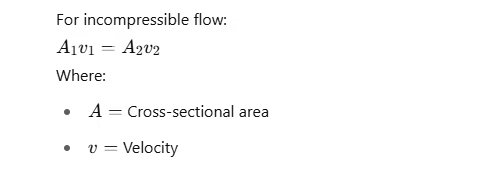
Explanation: Volume flow rate remains constant. Useful to find velocities or pipe diameters.
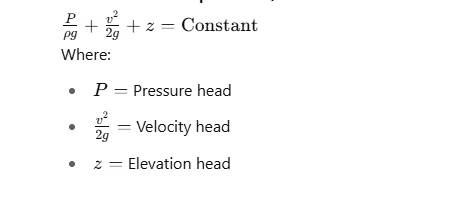
2. Bernoulli’s Equation (Conservation of Energy)
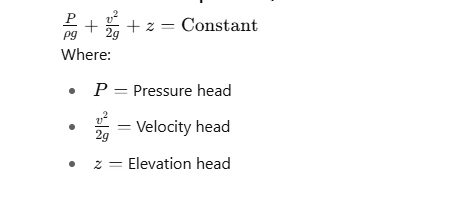
Used in: Pumps, pipes, flow meters.
3. Reynolds Number (Flow Classification)
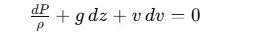
4. Euler’s Equation of Motion
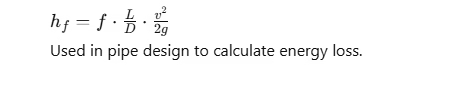
5. Darcy-Weisbach Head Loss Formula
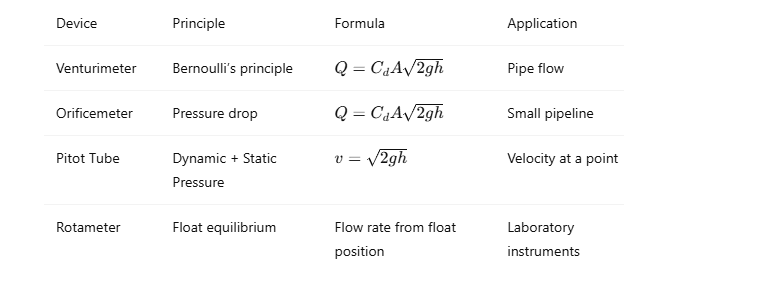
⚙️ Flow Measurement Devices
🏧 Civil Engineering Applications
1. Urban Water Supply
- Pressure head ensures water reaches elevated locations.
- Friction loss calculation is critical for pump selection.
2. Sewage Design
- Turbulent flow analysis helps in sizing manholes.
- Avoid sedimentation by ensuring minimum velocity.
3. Canal Design
- Flow behavior affects lining material choice.
4. Hydraulic Structures
- Weirs and spillways are designed based on energy head and discharge rate.
🧐 PYQs for JKSSB/SSC
- Bernoulli’s equation is based on which law?
✔️ Law of Conservation of Energy - Which device is used to measure flow velocity?
✔️ Pitot Tube - Reynolds number greater than 4000 indicates which flow?
✔️ Turbulent Flow - Continuity equation applies to which type of fluid?
✔️ Incompressible Fluids
✅ Conclusion
Fluid Dynamics is a core area of fluid mechanics that plays a pivotal role in the planning, design, and maintenance of civil engineering systems such as water supply networks, sewage systems, irrigation canals, hydraulic machines, and drainage structures. Understanding the behavior of fluids in motion—including how pressure, velocity, and flow patterns vary under different conditions—is essential for solving real-world civil engineering problems.
Through key concepts such as uniform and non-uniform flow, laminar and turbulent flow, compressible and incompressible flow, and dimensional analysis, aspirants gain a deep understanding of fluid behavior in practical scenarios. Tools like the Reynolds number and equations like the Bernoulli’s Equation and Continuity Equation are foundational for analyzing flow systems efficiently.
For JKSSB and similar competitive exams, Fluid Dynamics frequently appears in both theoretical and numerical questions. Therefore, mastering this topic not only strengthens your technical base but also significantly boosts your exam performance.
🎯 Final Preparation Tip:
- Focus on conceptual clarity over memorization.
- Practice solving previous year questions on flow types, Bernoulli’s applications, and dimensional analysis.
- Understand practical examples like pipe flow, open channel flow, and turbine operation.
📥 Join Our Telegram for More Notes, MCQs, and PDFs
👉 Join JKSSB CivilsCentral Telegram
About The Author