
📖 Introduction
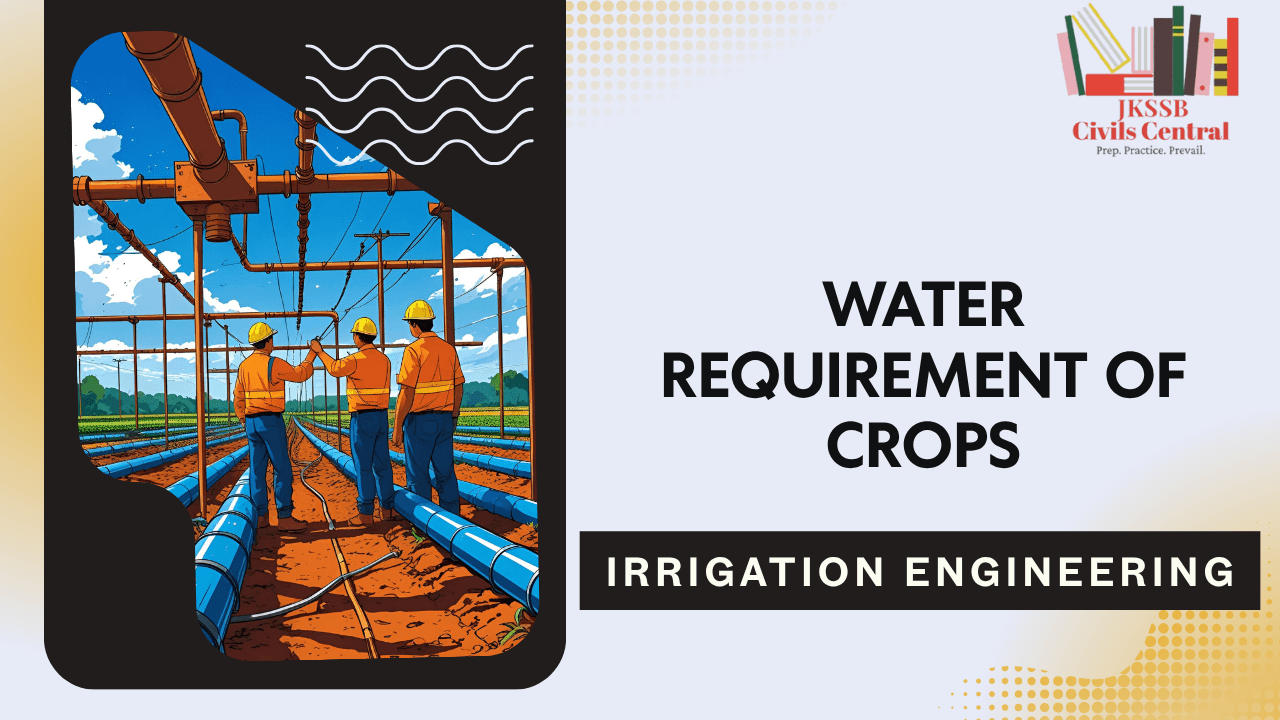
In agriculture, water is not just a resource—it’s the lifeline of crop production. From germination to harvesting, every phase of a crop’s lifecycle demands specific quantities of water. In the field of Irrigation Engineering, calculating and managing the water requirement of crops ensures optimal use of water resources while maximizing agricultural yield.
For JKSSB aspirants, this topic is frequently covered under Civil Engineering (JE, AE) and Agriculture Engineering exams. Questions are often conceptual or numerical, so understanding both theory and practice is key.
💧 What is the Water Requirement of Crops?
The Water Requirement (WR) of a crop refers to the total amount of water required from the time of sowing to harvesting to fulfill the following needs:
- Evapotranspiration (ET) – water lost through evaporation from soil and transpiration from plants.
- Soil moisture preservation – maintaining the root zone moisture for healthy growth.
- Percolation & leaching – excess water movement to deeper soil layers or removal of salts.
- Germination and metabolic needs – aiding biological and physiological functions.
✅ Definition
“Water requirement is the total quantity of water required by a crop from sowing to harvesting for its normal growth under field conditions.”
🔍 Why is Understanding Water Requirement Important?
- Efficient irrigation planning
- Water conservation
- Higher crop productivity
- Avoidance of over-irrigation and under-irrigation
- Prevention of soil salinity and waterlogging
🧾 Components of Crop Water Requirement
The total water requirement includes the following components:
- Consumptive Use (CU)
➤ Also called evapotranspiration, it is the water consumed by the plant for growth and lost to the atmosphere. - Application Losses
➤ Water lost during application due to seepage, deep percolation, and conveyance losses. - Special Requirements
➤ Additional water needed for:- Germination
- Frost protection
- Leaching salts (especially in saline soils)
🧮 Formula for Water Requirement
WR=CU+Losses+Special Needs\text{WR} = \text{CU} + \text{Losses} + \text{Special Needs}WR=CU+Losses+Special Needs
Where:
- WR = Water Requirement
- CU = Consumptive Use
- Losses = Application, seepage, deep percolation
- Special Needs = Cultural operations (germination, leaching)
🌱 Types of Water Requirements
| Type | Meaning | Remarks |
|---|---|---|
| Net Irrigation Requirement (NIR) | Water required by crops through irrigation after subtracting effective rainfall | NIR = WR – Effective Rainfall |
| Gross Irrigation Requirement (GIR) | Total water required at the source, including conveyance and application losses | GIR = NIR / Efficiency |
| Effective Rainfall (Re) | Portion of rainfall that is actually available to crops | Helps reduce irrigation demand |
| Field Irrigation Requirement | Water required per irrigation turn | Used in irrigation scheduling |
| Leaching Requirement (LR) | Extra water needed to wash salts beyond the root zone | Important in saline soils |
🌦️ Factors Affecting Crop Water Requirements
| Factor | Description |
|---|---|
| Crop Type | Different crops have different rooting depths and transpiration rates. Example: rice needs more water than wheat. |
| Growth Stage | Crops need more water during critical stages like flowering and fruit setting. |
| Soil Type | Sandy soil drains faster → more frequent irrigation; clay retains moisture longer. |
| Climate | Hot, dry, and windy climates → more evaporation → higher water demand. |
| Irrigation Method | Drip irrigation minimizes loss; flood irrigation causes more seepage and runoff. |
📋 Crop-wise Approximate Water Requirements
| Crop | Water Requirement (mm/season) | Remarks |
|---|---|---|
| Rice | 1200 – 1800 | Standing water required during most growth stages |
| Wheat | 450 – 650 | Moderate water use crop |
| Sugarcane | 1500 – 2500 | Long duration, high water demand |
| Maize | 500 – 800 | Water stress affects yield |
| Cotton | 700 – 1300 | Sensitive to waterlogging |
| Vegetables | 300 – 700 | Frequent irrigation needed |
🔢 Estimating Water Requirement – Methods
1. Blaney-Criddle Method
- Uses temperature and crop coefficient
- Easy and suitable for regions with limited data
2. Penman-Monteith Method
- Based on temperature, wind, humidity, radiation
- Very accurate (FAO recommends it)
3. Pan Evaporation Method
- Uses evaporation pan data and crop coefficient
4. CROPWAT Model
- FAO’s software to compute crop water needs and irrigation schedules
🧠 JKSSB Exam Relevance
For JKSSB Civil and Agriculture Engineering exams, this topic may appear as:
- Conceptual MCQs (e.g., “What is Net Irrigation Requirement?”)
- Numerical problems (e.g., Calculate GIR given efficiency and NIR)
- Theory questions (e.g., Discuss factors affecting crop water requirement)
🔚 Conclusion
Understanding the water requirements of crops is essential for efficient irrigation management. It ensures optimal water use, enhances crop yield, and supports sustainable farming practices. For JKSSB aspirants, this is a scoring topic with practical importance in both academic and professional fields.
About The Author