
Formation of Jammu and Kashmir Princely State (1846)
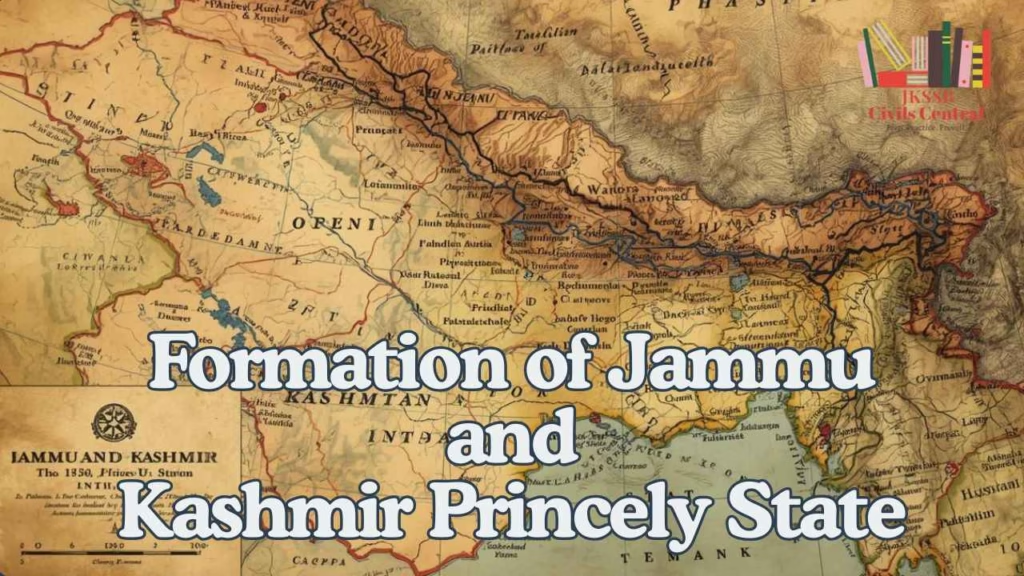
The emergence of Jammu and Kashmir as a single political and geographical entity in 1846 is a watershed moment in the history of the Indian subcontinent. For candidates preparing for the Jammu and Kashmir Services Selection Board (JKSSB) examinations, particularly those appearing for the Naib Tehsildar, Patwari, Junior Assistant, and Finance Accounts Assistant posts, this period represents a core component of the “General Knowledge with Special Reference to J&K” syllabus. The formation of the state was not merely a territorial transaction but a complex geopolitical realignment involving the British East India Company, the crumbling Sikh Empire of Lahore, and the ambitious Dogra lineage of Jammu.
The Ancient Roots and the Rise of the Dogra Dynasty
The historical narrative of the Jammu region precedes the 1846 formation by several millennia. According to local tradition and historical accounts, the city of Jammu was founded by Raja Jambu Lochan in the 14th century BCE. The legend describes the Raja witnessing a tiger and a deer drinking from the same pond on the banks of the Tawi River, a sight that symbolized a land of peace and virtue where no creature bore enmity toward another. This soil became the foundation of “Jambupura,” which eventually evolved into the modern city of Jammu. Over the centuries, the region was divided into approximately twenty-two small Dogra fiefdoms, with the Jammu principality gradually asserting dominance under the leadership of the Jamwal Rajputs.
The modern administrative history of the state finds its anchor in the life of Gulab Singh, born in 1792 at Anderwah near Samba. A descendant of the powerful King Dhruv Dev, Gulab Singh entered the service of Maharaja Ranjit Singh of the Sikh Empire in 1809. His entry coincided with a period of rapid Sikh expansion. Gulab Singh’s military acumen was first demonstrated during the defense of Jammu against a force dispatched by Ranjit Singh himself; his bravery so impressed the Sikh Maharaja that Gulab Singh and his brothers, Dhian Singh and Suchet Singh, were quickly elevated to high positions in the Lahore court.
The Raj Tilak and the Grant of Jammu
Gulab Singh’s ascent within the Sikh hierarchy was spectacular. By 1820, in recognition of his role in crushing local rebellions and extending the boundaries of the Lahore State, Maharaja Ranjit Singh granted the province of Jammu to him as a jagir. The formal coronation took place on June 17, 1822, at the historic Jeo Pota tree on the bank of the Chenab River at Akhnoor Fort. In a symbolic gesture frequently cited in JKSSB history questions, Maharaja Ranjit Singh personally applied the tilak on Gulab Singh’s forehead from top to bottom, signifying a wish that the Dogra ruler’s roots would go deep into the soil and his reign would be long-lasting.
| Feature | Detail |
| Founder of Jammu City | Raja Jambu Lochan |
| Birth of Gulab Singh | October 21, 1792 |
| Entry into Sikh Service | 1809 |
| Coronation (Raj Tilak) | June 17, 1822 |
| Location of Coronation | Jeo Pota Ghat, Akhnoor |
| Title Conferred | Raja of Jammu |
Territorial Expansion and the Role of General Zorawar Singh
Before the state of Jammu and Kashmir was formally created in 1846, Raja Gulab Singh had already expanded his influence far beyond the Jammu plains. This expansion was spearheaded by his most trusted and legendary general, Zorawar Singh Kahaluria. Between 1834 and 1841, Zorawar Singh led a series of arduous campaigns into the high-altitude frontier regions, a feat that earned him the sobriquet “Napoleon of India” among some historians.
In 1834, Zorawar Singh crossed the Himalayan ranges to attack Ladakh, defeating the local ruler Tsepal Namgyal. By 1836, Ladakh was formally annexed to the Jammu Kingdom. Not content with this, Zorawar Singh pushed further into Baltistan in 1840, subjugating the region and bringing it under Dogra control. His final, most ambitious campaign was directed toward Western Tibet in 1841. Although Zorawar Singh was killed in the Battle of To-yo in December 1841, his conquests had already pushed the boundaries of the Jammu principality to the edges of Central Asia and Tibet. Consequently, when the British negotiated the transfer of Kashmir in 1846, Gulab Singh was not just a local chieftain but the master of a vast mountainous empire comprising Jammu, Ladakh, and Baltistan.
The First Anglo-Sikh War and the Decline of the Lahore Durbar
The death of Maharaja Ranjit Singh in 1839 triggered a period of extreme instability in the Sikh Empire, characterized by successive assassinations and internal power struggles. This vacuum eventually led to the First Anglo-Sikh War in 1845-46. During this conflict, Raja Gulab Singh adopted a calculated policy of neutrality, remaining aloof from the direct military confrontations at Mudki, Ferozeshah, and Aliwal.
The decisive battle took place at Sobraon in February 1846, where the British forces emerged victorious. In the aftermath, the defeated Sikh Durbar appointed Gulab Singh as their representative to negotiate peace terms with the British. The British, under Governor-General Sir Henry Hardinge, demanded a war indemnity of 1.5 crore rupees. The Sikh treasury, depleted by years of internal strife, was unable to meet this demand. As a compromise, the Lahore Durbar offered to cede all hilly territories between the River Beas and the River Indus, including the province of Kashmir and the Hazara region, in lieu of 1 crore rupees.
| Treaty of Lahore (March 9, 1846) | Key Provisions |
| Indemnity Demanded | 1.5 Crore Rupees |
| Territory Ceded | Lands between River Beas and Indus (Kashmir & Hazara) |
| British Resident | Sir Henry Lawrence appointed at Lahore |
| Article XII | Recognition of Gulab Singh’s independent sovereignty |
| Army Reduction | Sikh army limited to 20k infantry and 12k cavalry |
The Treaty of Amritsar (1846): The Birth of the Princely State
The formal creation of the Princely State of Jammu and Kashmir was achieved through the Treaty of Amritsar, signed on March 16, 1846. This document, often debated in academic circles as a “sale deed,” transferred the possession of Kashmir to Gulab Singh in exchange for a monetary payment to the British. For JKSSB aspirants, it is crucial to distinguish between the Treaty of Amritsar of 1809 (between Ranjit Singh and the British) and this 1846 treaty which established the Dogra state.
Detailed Analysis of the Treaty Articles
The Treaty of Amritsar consists of ten articles that defined the legal and political status of the new state.
- Article 1: The British Government transferred and made over “for ever, in independent possession” to Maharaja Gulab Singh and his male heirs all the hilly or mountainous country with its dependencies situated to the eastward of the River Indus and the westward of the River Ravi. This included the Kashmir Valley, Ladakh, and Chamba (though Chamba’s status was later modified).
- Article 3: In consideration of this transfer, Maharaja Gulab Singh agreed to pay the British Government the sum of 75 lakh Nanakshahee rupees. Of this, 50 lakhs were to be paid upon ratification and 25 lakhs on or before October 1, 1846.
- Article 4: The limits of the territories could not be changed without the concurrence of the British Government.
- Article 5: Any disputes with neighboring states (like the Lahore Durbar) were to be referred to the arbitration of the British Government.
- Article 6: The Maharaja engaged to join British troops with his entire military force when they were employed in the hills or adjoining territories.
- Article 9: The British Government promised to protect the Maharaja’s territories from external enemies.
- Article 10: The Maharaja acknowledged the supremacy of the British Government and agreed to present an annual tribute: one horse, twelve perfect shawl goats (six male, six female), and three pairs of Kashmiri shawls.
The Resistance of Sheikh Imam-ud-din
The transition of power was not seamless. The incumbent Sikh Governor of Kashmir, Sheikh Imam-ud-din, refused to hand over the valley to Gulab Singh. He was secretly encouraged by Wazir Lal Singh of the Lahore court, who resented Gulab Singh’s separate pact with the British. A conflict ensued in which Gulab Singh’s forces, led by Wazir Lakhpat, were initially defeated. Invoking Article 9 of the treaty, Gulab Singh requested British aid. A British force under Sir Henry Lawrence marched to Kashmir, leading to the surrender of the Sheikh. Consequently, Maharaja Gulab Singh entered Srinagar on November 9, 1846 (some sources cite November 1), marking the effective start of Dogra rule in the valley.
| Article Number | Summary of Content |
| Article 1 | Transfer of territory (Indus to Ravi) |
| Article 3 | Payment of 75 Lakh Nanakshahee Rupees |
| Article 6 | Military assistance to the British |
| Article 9 | British protection from external enemies |
| Article 10 | Annual tribute of horse, goats, and shawls |
Administrative Evolution and Rulers of the Dogra Dynasty
The Dogra rule lasted for exactly 101 years, from 1846 to 1947. This period is often divided into epochs of foundation, expansion, and modernization.
Maharaja Gulab Singh (1846–1857): The Architect
Gulab Singh’s reign was dedicated to the stabilization of a state comprised of diverse linguistic and cultural zones. He established a centralized system of government, though it remained largely feudal in character. His primary focus was the maintenance of law and order and the streamlining of tax collection. He introduced the “Chilki Rupee” to standardize the currency and took the first steps toward banning social evils like Sati and female infanticide.
Maharaja Ranbir Singh (1856–1885): The Consolidator
Ranbir Singh succeeded his father and is credited with formalizing the administration. He drew up a comprehensive penal code, reorganized the judicial system with appeal courts in Jammu and Srinagar, and established three main departments: Revenue, Civil, and Military. He was a great patron of learning, establishing the Raghunath Sanskrit Mahavidyalaya and the Ranbir Printing Press. He also initiated the “Darbar Move” practice in 1872, the biannual shifting of the capital between Srinagar and Jammu to ensure regional accessibility.
Maharaja Pratap Singh (1885–1925): The Modernizer
Pratap Singh’s reign saw the introduction of modern infrastructure. He linked the state to the British Indian rail network via the Jammu-Sialkot railway in 1890 and constructed major roads like the Jhelum Valley Road and the Banihal Cart Road. He established the world’s largest silk factory in Srinagar and commissioned government hospitals in both major cities. Most notably, he finally abolished the oppressive Begar (forced labor) system in 1920.
Maharaja Hari Singh (1925–1949): The Last Ruler
Hari Singh ascended the throne in 1925 and introduced several progressive reforms, including the “State Subject” laws to protect land and job rights for locals. His reign was dominated by the rising political consciousness among the masses and the eventually turbulent transition of 1947.
| Maharaja | Key Contribution / Event |
| Gulab Singh | Founded the State; Treaty of Amritsar |
| Ranbir Singh | Penal Code; Darbar Move; Telegraph system |
| Pratap Singh | Silk Factory; Jammu-Sialkot Railway; Banihal Road |
| Hari Singh | Accession to India; State Subject Laws |
Socio-Economic Context and the “Sale Deed” Controversy
The 1846 formation has been a subject of significant historical critique. Critics and some nationalistic leaders have referred to the Treaty of Amritsar as a “sale deed,” lamenting that “Kashmiris were sold, along with their land, water, and sky over their heads” for a mere 75 lakh rupees. This sentiment was echoed by the famous poet Dr. Sir Muhammad Iqbal, who wrote that the fate of human beings was sold for 75 lakhs.
Economically, the early Dogra state was characterized by absolute monarchy where the Maharaja claimed ownership of all land, forests, and resources. The peasantry, particularly in the Kashmir Valley, lived as tenants without proprietary rights. Taxation was extreme; historians note that almost everything was taxed save for air and water. The shawl industry, which was the backbone of the economy, saw its weavers living in squalor, heavily taxed and forbidden from changing their profession to ensure a steady revenue stream for the state.
The 1947 Crisis and the Instrument of Accession
The independence of India and Pakistan in August 1947 placed Maharaja Hari Singh in a precarious position. Unlike other princely states that had chosen sides by August 15, Hari Singh initially sought to remain independent. However, the situation changed dramatically on October 22, 1947, when tribal militias from Pakistan launched a massive invasion of the state.
Facing the threat of Srinagar falling to the invaders, the Maharaja sought military help from India. India agreed on the condition that the state formally accede to the Indian Union. Maharaja Hari Singh signed the legal document known as the “Instrument of Accession” on October 26, 1947, which was accepted by the Governor-General of India, Lord Mountbatten, on October 27. This act made Jammu and Kashmir an integral part of India, transferring control of defense, foreign affairs, and communications to the central government.
Post-Monarchy Transitions and the Reorganisation Act 2019
The political structure of Jammu and Kashmir continued to evolve after 1947. In 1951, a Constituent Assembly was formed, which officially ended the hereditary rule of the Dogra dynasty on January 26, 1957. The position of the Maharaja was replaced by the Sadr-i-Riyasat (Head of State), a title later changed to Governor in 1965.
A major administrative shift occurred on August 5, 2019, when the Government of India abrogated Article 370, which had previously granted the state special autonomous status. The Jammu and Kashmir Reorganisation Act, 2019, bifurcated the state into two Union Territories: Jammu & Kashmir (with a legislature) and Ladakh (without a legislature). This reorganisation became formally effective on October 31, 2019.
Current Affairs and Recent Commemorations (2024–2026)
For JKSSB aspirants, staying updated with current affairs is as important as historical knowledge. Recent years have seen several government initiatives and commemorations related to the Dogra legacy.
- Maharaja Hari Singh Birth Anniversary: In 2022, the J&K administration declared September 23, the birth anniversary of Maharaja Hari Singh, as a public holiday.
- Awards and Honors: In January 2025, Lieutenant Governor Manoj Sinha was honored with the “Maharaja Hari Singh Peace and Harmony Award 2024-25” for his contributions to reforms and planning in the Union Territory.
- 100-Year Ascension Anniversary: September 23, 2025, marked exactly 100 years since Maharaja Hari Singh ascended the throne of Jammu and Kashmir.
- Administrative Milestones: The 2025-26 budget for the UT of Jammu and Kashmir was presented in the newly formed Assembly in March 2025, the first budget in the Assembly after seven years.
- Commemorative Events: On October 21, 2024, the 232nd birth anniversary of Maharaja Gulab Singh was celebrated with the presentation of the Maharaja Gulab Singh Award to Justice Permod Kohli and Dr. Dara Singh.
| Date | Event / Significance |
| August 5, 2019 | Abrogation of Article 370 |
| October 31, 2019 | Formation of UT of J&K and UT of Ladakh |
| September 23, 2022 | First official holiday on Maharaja Hari Singh’s birthday |
| January 28, 2025 | LG Manoj Sinha receives Maharaja Hari Singh Award |
| March 2025 | Omar Abdullah elected as Chief Minister of J&K UT |
| January 22, 2026 | Latest update to official government history portals |
Strategic Study Guide for JKSSB Aspirants
Success in the JKSSB exams requires the ability to recall specific dates, locations, and names associated with the Dogra period. Candidates should categorize their study into primary themes.
Key Chronology of the 1846 Formation
The sequence of events is a favorite for multiple-choice questions. It begins with the Battle of Sobraon (Feb 1846), followed by the Treaty of Lahore (March 9), the Treaty of Amritsar (March 16), and culminates in the entry of Gulab Singh into Srinagar (Nov 1846).
Important Geographical Identifiers
Understand the boundaries as defined in 1846: East of the Indus and West of the Ravi. Note the exclusion of Lahol from the initial transfer. Identify the locations of the royal palaces—Mubarak Mandi in Jammu and the Sher Garhi palace in Srinagar (the latter was the seat of power in the valley).
Significant Administrative Terms
- Dagh-shawl: The department that regulated and taxed the shawl industry.
- Chilki Rupee: The local currency introduced by Gulab Singh.
- Darbar Move: The seasonal shifting of the capital, a practice that lasted from 1872 to 2021.
- State Subject: The 1927 definition of permanent residents that protected local interests.
Essential Personalities for MCQs
- Raja Jambu Lochan: Founder of Jammu.
- General Zorawar Singh: Conqueror of Ladakh and Baltistan.
- Sheikh Imam-ud-din: The last Sikh Governor of Kashmir who resisted the Dogras.
- Walter Lawrence: The British settlement officer whose land reforms under Pratap Singh significantly improved the lives of Kashmiri peasants.
- Sir Henry Lawrence: The first British Resident at Lahore and later the first Agent at Jammu.
By mastering these details, aspirants will be well-equipped to handle the historical and administrative sections of the JKSSB exams. The formation of the Princely State of Jammu and Kashmir in 1846 remains one of the most significant chapters in the history of North India, providing the foundational context for the Union Territory’s current political and geographical identity. Candidates are advised to cross-reference these historical facts with current affairs from 2024 and 2025 to ensure they are prepared for the most recent trends in examination questions.
About The Author