
Treaty of Amritsar (1846)
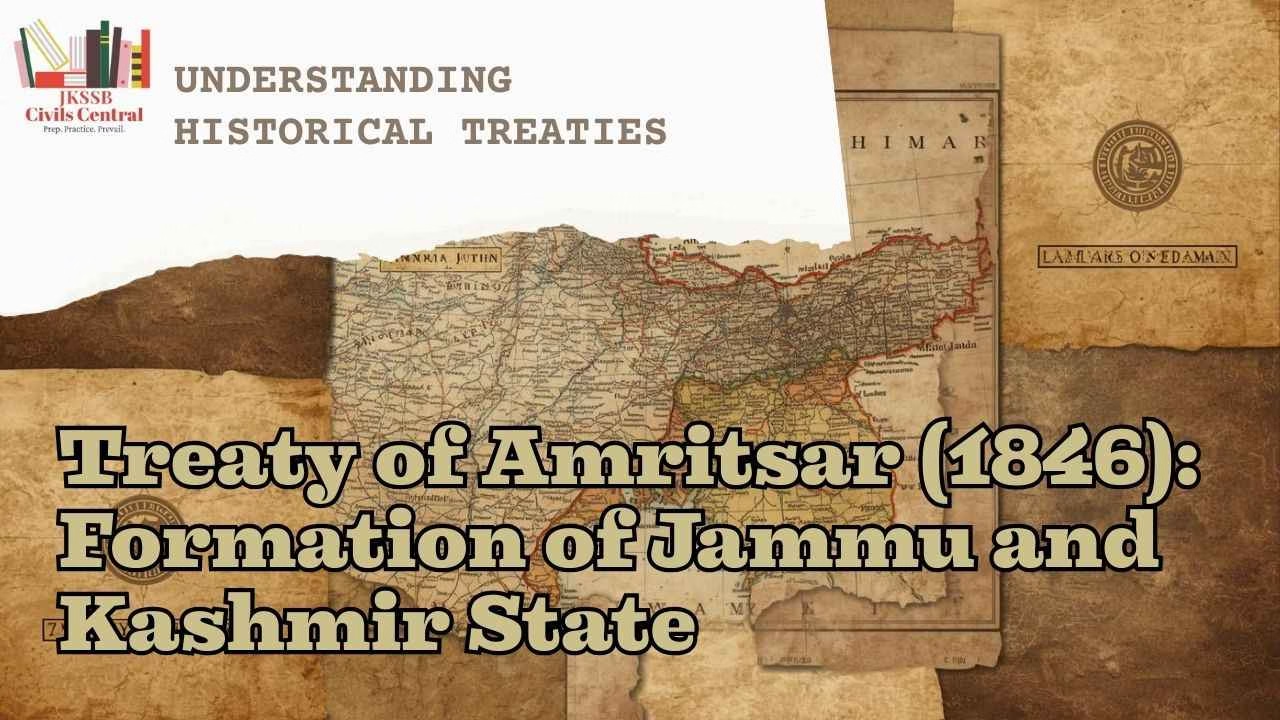
The geopolitical architecture of modern South Asia was fundamentally reshaped on March 16, 1846, with the signing of the Treaty of Amritsar. This diplomatic instrument did not merely signify the end of a regional conflict; it served as the foundational legal document for the creation of the Princely State of Jammu and Kashmir, a political entity that would persist for over a century until the monumental shifts of 1947. For candidates preparing for the Jammu and Kashmir Services Selection Board (JKSSB) examinations, the Treaty of Amritsar represents a critical historical juncture, as it marks the transition of the region from the crumbling hegemony of the Sikh Empire to the structured, albeit controversial, sovereignty of the Dogra dynasty under British suzerainty.
The formation of this state was not an organic development of local nationalism but rather a strategic calculation by the British East India Company to consolidate its pan-Indian territorial interests. By the mid-nineteenth century, the British sought to stabilize the northwestern frontiers of their expanding empire through indirect rule, utilizing regional agents to manage difficult terrains and diverse populations. The Treaty of Amritsar emerged as an offshoot of the First Anglo-Sikh War, a conflict that exhausted the resources of the Lahore Durbar and provided an opportunity for Maharaja Gulab Singh, a shrewd Dogra chieftain, to elevate his status from a vassal to an independent monarch.
The Geopolitical Context of the mid-19th Century
To comprehend the causes of the Treaty of Amritsar, one must examine the decade of instability that followed the death of Maharaja Ranjit Singh in 1839. Under Ranjit Singh, the Sikh Empire had been a formidable power, maintaining a delicate balance with the British while expanding its reach into Kashmir, Ladakh, and Peshawar. However, his passing triggered a violent struggle for succession within the Lahore Durbar, characterized by court intrigues, assassinations, and the rising political influence of the Khalsa Army.
During this period, the Dogra brothers—Gulab Singh, Dhyan Singh, and Suchet Singh—held prominent positions in the Sikh court. Gulab Singh, in particular, had demonstrated exceptional military and administrative talent, having been installed as the Raja of Jammu by Ranjit Singh himself in 1822. While the Sikh Empire spiraled into chaos, Gulab Singh focused on consolidating his own power base in the Jammu region and expanding his territories into Ladakh and Baltistan.
The First Anglo-Sikh War (1845–1846)
The collapse of order in Lahore eventually led to a direct confrontation with the British East India Company. Mutual suspicions, the Refusal of the Sikhs to allow British passage during the Afghan wars, and the crossing of the River Sutlej by the Khalsa Army in December 1845 sparked the First Anglo-Sikh War. The conflict consisted of several brutal encounters, most notably the battles of Mudki, Ferozeshah, Aliwal, and the final, decisive engagement at Sobraon on February 10, 1846.
Maharaja Gulab Singh’s role during this war was strategically ambiguous. While he was a prominent vassal of the Sikh state, he maintained a degree of neutrality that the British found useful. Following the Sikh defeat at Sobraon, Gulab Singh acted as a mediator between the defeated Lahore Durbar and the victorious British forces, a position that allowed him to negotiate terms that favored both the British desire for a stable buffer state and his own ambition for sovereign status.
| Battle | Date | Significant Outcome |
| Battle of Mudki | Dec 18, 1845 | First major encounter; heavy British casualties. |
| Battle of Ferozeshah | Dec 21-22, 1845 | British victory; Sikh forces retreated across the Sutlej. |
| Battle of Aliwal | Jan 28, 1846 | Decisive British win; secured the upper Sutlej. |
| Battle of Sobraon | Feb 10, 1846 | Final defeat of the Khalsa Army; led to the Treaty of Lahore. |
The Treaty of Lahore: A Strategic Precursor
Before the Treaty of Amritsar could be finalized, the British dictated the Treaty of Lahore on March 9, 1846, to settle the terms of the Sikh surrender. This treaty imposed a massive war indemnity of 1.5 crore rupees on the Lahore Durbar. Unable to meet this financial demand, the Sikh state was forced to cede the hilly territories between the River Beas and the River Indus, including the provinces of Kashmir and Hazara, to the British in lieu of one crore rupees.
Article 12 of the Treaty of Lahore is particularly significant for JKSSB aspirants. It explicitly stated that the British Government, in consideration of the services rendered by Raja Gulab Singh, would recognize his independent sovereignty in such territories as might be made over to him by a separate agreement. This clause essentially paved the way for the transaction that would occur one week later in Amritsar.
The Motivation for the British Transfer
Historians have often debated why the British chose to transfer the valuable Kashmir Valley to Gulab Singh rather than annexing it directly. Several factors influenced this decision:
- Economic Liability: The British perceived the mountainous regions of Kashmir as a financial drain that would require expensive military garrisons and administrative overhead.
- Strategic Buffer: They required a loyal ally to guard the northern frontiers against potential threats from the Afghan tribes and the Russian Empire.
- Reward for Neutrality: Gulab Singh’s non-intervention during the Anglo-Sikh War was a critical factor in the British victory, and the transfer of Kashmir served as a reward for his collaboration.
Comprehensive Analysis of the Treaty of Amritsar (1846)
The Treaty of Amritsar was signed on March 16, 1846, by Gulab Singh in person and British representatives Frederick Currie and Henry Montgomery Lawrence, acting under the orders of Governor-General Lord Hardinge. The treaty consisted of ten articles that defined the territorial, financial, and political relationship between the newly created state and the British Empire.
Territorial Provisions (Articles 1 and 2)
Article 1 formalizes the transfer of “all the hilly or mountainous country with its dependencies situated to the eastward of the River Indus and the westward of the River Ravi,” including Chamba and excluding Lahul. This created the geographical core of the state of Jammu and Kashmir. Article 2 mandated that the eastern boundary of this tract would be defined by commissioners appointed by both parties after a formal survey.
The Financial Transaction (Article 3)
Perhaps the most famous and debated provision is Article 3, which established the “price” of Kashmir. In consideration of the territorial transfer, Gulab Singh agreed to pay the British Government seventy-five lakh Nanakshahee rupees. The payment schedule required fifty lakhs to be paid immediately upon ratification and the remaining twenty-five lakhs on or before October 1, 1846. This specific financial detail is a staple of JKSSB history questions.
Political and Military Obligations (Articles 4–10)
The remaining articles established the state as a subsidiary power under British suzerainty. Article 4 prohibited any territorial changes without British consent, while Article 5 required the Maharaja to refer all disputes with neighboring states (specifically the Government of Lahore) to British arbitration.
| Article | Key Provision | Implication for the State |
| Article 1 | Transfer of territory between Indus and Ravi. | Established the initial borders of J&K. |
| Article 3 | Payment of 75 Lakh Nanakshahee Rupees. | Led to the “Sale Deed” label and heavy taxation. |
| Article 6 | Military aid to British when required. | Integrated J&K forces into British imperial strategy. |
| Article 7 | Prohibition of employing Europeans/Americans. | Restricted foreign influence in the Dogra court. |
| Article 9 | British protection against external enemies. | Guaranteed the security of the new dynasty. |
| Article 10 | Acknowledgement of British supremacy. | Confirmed the Maharaja’s status as a vassal. |
Article 10 also mandated an annual tribute as a token of supremacy, consisting of one horse, twelve shawl goats (six male and six female), and three pairs of Kashmir shawls. This tribute remained a symbolic tradition for decades, reflecting the indirect control exercised by the British over the princely states.
The “Sale Deed” Controversy and Local Resistance
The Treaty of Amritsar is frequently referred to by political leaders and historians as the “Sale Deed” of Kashmir. This characterization stems from the fact that the territory and its inhabitants were transferred in a purely commercial transaction between the British and Gulab Singh, without any consultation with the local population. The absence of any Kashmiri signature or consent in the treaty inaugurated a long-standing crisis of political legitimacy.
The transfer did not occur without immediate resistance. Sheikh Imamu’d-din, the Sikh-appointed Nazim (Governor) of Kashmir, refused to hand over the province to Gulab Singh. He was encouraged in this resistance by Lal Singh, the Wazir of the Lahore Durbar. It was only after British intervention and the dispatch of troops to Srinagar in October 1846 that Gulab Singh was able to take physical possession of his new capital. He officially entered Srinagar as the first Dogra Maharaja on November 1, 1846.
The Evolution of Dogra Administration and Governance
The establishment of the Dogra state introduced a new administrative paradigm characterized by a mix of traditional feudalism and British-inspired bureaucratic structures. Gulab Singh, and later his successors Ranbir Singh, Pratap Singh, and Hari Singh, sought to consolidate their authority through a centralized revenue and police system.
Revenue and Land Reforms
One of the most immediate and enduring consequences of the treaty was the implementation of a harsh revenue system to recover the 75 lakh rupees paid to the British. The state claimed personal ownership of all land, and the revenue demand was exorbitant, often leaving cultivators with as little as a quarter of their gross product.
The administration divided the state into four Wazarats (districts), with trusted officials placed in charge of audits, accounts, and the Dagshawl (shawl department). Despite these structural changes, the peasantry continued to suffer under heavy taxation on almost every form of production, which crippled the traditional arts and crafts industries for which the Kashmir Valley was famous.
The “Beggar” System (Forced Labor)
A particularly oppressive feature of the Dogra regime was the Beggar system, an inhuman practice of forced labor. Villagers were forcibly conscripted to carry military supplies and provisions to remote frontier regions like Gilgit and Ladakh, often without pay and under life-threatening conditions. This practice became a major point of contention and a catalyst for early political mobilization in the 20th century. Public pressure eventually led to its formal abolition in 1920.
| Aspect of Governance | Characteristic Under Dogra Rule | Impact on Population |
| Land Rights | Maharaja claimed ownership of all land. | Deprived peasants of hereditary rights. |
| Taxation | Heavy levies on agricultural and craft goods. | Led to widespread poverty and migration. |
| Labor | Forced labor (Beggar) for military supply. | Inhuman conditions; social resentment. |
| Bureaucracy | Divided into Wazarats; recruitment from Jammu. | Perceived as an “alien” administration in Kashmir. |
The Dogra Dynasty: Key Rulers and Their Contributions
For JKSSB aspirants, understanding the lineage of the Dogra rulers is essential, as questions often test specific contributions of each Maharaja.
- Maharaja Gulab Singh (1846–1857): The founder of the state who consolidated the diverse regions of Jammu, Kashmir, and Ladakh. He focused on territorial stabilization and the initial establishment of revenue systems.
- Maharaja Ranbir Singh (1857–1885): Known for introducing legal reforms and expanding the state’s reach into the Gilgit region. He was a patron of learning and established various educational institutions.
- Maharaja Pratap Singh (1885–1925): His reign saw the introduction of modern infrastructure, including the first government hospitals in Jammu and Srinagar (1889) and the establishment of municipalities. However, it was also during his time that a British Resident was permanently appointed, reducing the Maharaja’s internal autonomy.
- Maharaja Hari Singh (1925–1949): The last ruling Maharaja, who is remembered for his reformist agenda, including efforts to promote education and equality for all communities. He signed the Instrument of Accession in October 1947, integrating the state with the Union of India.
Geographical and Cultural Consolidation
The Treaty of Amritsar was unique because it merged three distinct political, geographical, and cultural entities—the Jammu region, the Kashmir Valley, and the Ladakh plateau—into a single political unit. This amalgamation was not always seamless, as each region had its own history and linguistic characteristics.
- Jammu: The homeland of the Dogras, characterized by a collection of small fiefdoms.
- Kashmir Valley: Historically an independent kingdom, later ruled by Mughals, Afghans, and Sikhs.
- Ladakh and Baltistan: Annexed through the military campaigns of General Zorawar Singh under the orders of Gulab Singh in the 1830s and 1840s.
The treaty also sparked territorial disputes, such as the Hazara dispute, which was settled through a territory exchange where Gulab Singh ceded Hazara to the British in exchange for lands east of the River Jhelum. Chamba, initially included in the treaty, eventually became an independent state under British protection.
Impact on Modern History and Current Affairs (2024–2026)
The legacy of the Treaty of Amritsar continues to influence contemporary politics and cultural commemorations in Jammu and Kashmir. For instance, the birth anniversary of Maharaja Gulab Singh (October 21) is celebrated annually in Jammu, with awards presented by the Maharaja Gulab Singh Memorial Trust to recognize excellence in various fields like the judiciary and sports.
In late 2025 and early 2026, several regional events have kept the history of the Dogra dynasty in the public eye:
- Maharaja Hari Singh Centenary: September 23, 2025, marked the centenary of Maharaja Hari Singh’s ascension to the throne, an event celebrated with tributes to his reformist legacy.
- Security Developments: Modern security challenges in the hilly districts of Kishtwar and the Chenab Valley continue to be framed by the difficult terrain that the British once deemed an “economic liability”.
- Infrastructure Projects: Large-scale investments like the world’s highest rail bridge in the Chenab region and various tunnel projects (Zojila, Banihal) are modern efforts to integrate the geography that was first unified by the 1846 treaty.
| Modern Event | Date | Contextual Relevance to History |
| 232nd Birth Anniversary of Gulab Singh | Oct 21, 2024 | Honors the founder of the state. |
| 100 Years of Hari Singh’s Rule | Sept 23, 2025 | Reflections on the last Maharaja’s reforms. |
| JKSSB Junior Assistant Exam | Feb 22, 2026 | Testing knowledge of J&K history and the treaty. |
| ICC T20 World Cup Update | Jan 2026 | Broad regional context; Scotland replacing Bangladesh. |
High-Yield Points for JKSSB Aspirants
Based on previous year question papers (PYQs) and current syllabus patterns for exams like Naib Tehsildar and Junior Assistant, aspirants should focus on the following details :
- Signatories: The treaty was settled by Frederick Currie and Henry Montgomery Lawrence (representing the British) and Maharaja Gulab Singh in person.
- Financial Terms: The sum paid was 75 lakh Nanakshahee rupees.
- Foundational Date: March 16, 1846.
- First Maharaja: Gulab Singh was the first Maharaja of the princely state of J&K.
- Last Maharaja: Hari Singh was the last ruling monarch.
- Relationship with Lahore Treaty: The Treaty of Amritsar was an offshoot of the Treaty of Lahore (March 9, 1846).
- The “Beggar” Practice: Known as forced labor, it was a hallmark of socio-economic oppression under early Dogra rule.
- Territorial Limits: The region transferred was between the River Indus (East) and River Ravi (West).
Sample Question Pattern for Practice
- Question: The Treaty of Amritsar (1846) was signed between the British and which ruler?
- Answer: Gulab Singh.
- Question: In which year did the modern state of Jammu and Kashmir come into existence?
- Answer: 1846.
- Question: What was the total amount paid by Gulab Singh for the territory of Kashmir?
- Answer: 75 Lakh Rupees.
Causes and Consequences
In summary, the Treaty of Amritsar was the product of a specific set of historical circumstances: the decline of the Sikh Empire, the British need for a cost-effective border defense, and the personal ambition of Gulab Singh. Its consequences were far-reaching and multifaceted. Politically, it created a unified princely state that lasted for a century. Socially, it introduced a period of heavy taxation and forced labor that fundamentally altered the lives of the Kashmiri people. Geographically, it consolidated diverse regions that remain at the heart of South Asian geopolitics today. For students of Jammu and Kashmir’s history and aspirants of the JKSSB, this treaty is not just a past event but the definitive starting point of the region’s modern administrative and political journey.
About The Author