
Utpala Dynasty and Medieval Kashmir History: Guide for JKSSB Aspirants

Utpala Dynasty and Medieval Kashmir History
The history of Jammu and Kashmir is a sophisticated tapestry of political transitions, engineering marvels, and cultural syntheses that demand a nuanced understanding from competitive examination aspirants. Among the various historical epochs, the Utpala Dynasty (c. 855–939 CE) stands as a pivotal era that transitioned the region from the expansive imperial traditions of the Karkota Empire to a period of localized consolidation, followed by complex military and bureaucratic upheavals. For candidates preparing for the Jammu and Kashmir Services Selection Board (JKSSB) exams, this period is not merely a collection of dates but a case study in how governance, hydraulic engineering, and religious patronage can define the destiny of a civilization. This report provides a comprehensive analysis of the Utpala period, integrating historical accounts with recent archaeological current affairs to ensure high accuracy and depth.
Historical Transition: The Eclipse of the Karkotas
The genesis of the Utpala Dynasty is found in the administrative decay of the late Karkota period. The Karkota Dynasty, which ruled from roughly 625 to 855 CE, had elevated Kashmir to an imperial power under Lalitaditya Muktapida, whose campaigns reached as far as Central Asia and the shores of the Indian Ocean. However, the late 8th century witnessed a gradual erosion of this central authority. The descendants of Lalitaditya, such as Jayapida, founded new capitals like Jayapura (Inderkote), but these shifts often signaled administrative decentralization rather than growth. By the mid-9th century, the dynasty had reached its “nadir of power,” characterized by weak monarchs who were effectively puppets of powerful ministerial factions.
The political vacuum of this era was exploited by a series of powerful brothers who dominated the royal court through palace factionalism. Among these influencers was Utpala, a minister who had unsuccessfully sought the throne earlier. It was his grandson, Avantivarman, who eventually managed to depose the last weak Karkota ruler, Utpalapida, with the assistance of a wise counselor named Sura (or Sura). This transition in 855 CE did not just change the ruling family; it shifted the state’s focus from external military expansion to internal economic reconstruction.
| Parameter | Karkota Dynasty (c. 625–855 CE) | Utpala Dynasty (c. 855–939 CE) |
| Primary Focus | Imperial expansion and trans-regional conquest. | Internal peace, economic reforms, and irrigation. |
| Famous Ruler | Lalitaditya Muktapida. | Avantivarman. |
| Capital City | Parihaspora. | Avantipura (modern Awantipora). |
| Religious Patronage | Synthesis of Buddhism and Vaishnavism. | Predominantly Shaivite and Vaishnavite Hindu traditions. |
| Decline Factors | Ministerial factionalism and weak succession. | Rise of military factions (Tantrins) and fiscal greed. |
The Golden Era of Avantivarman (855–883 CE)
Avantivarman is widely regarded as the most magnificent king of ancient Kashmir, particularly for his ability to restore order to a valley that had been ravaged by forty years of civil war and social displacement. His 27-year reign is often contrasted with the military aggression of his predecessors; the Rajatarangini records almost no military activity during this time, as Avantivarman prioritized winning the confidence of his people over the acquisition of foreign territory.
Administrative Reforms and Political Stabilization
The first challenge for the new monarch was the restoration of centralized law and order. The rural landed aristocrats, known as Damaras, had emerged as the primary source of internal strife, acting as independent warlords during the late Karkota decline. Avantivarman successfully neutralized their influence, thereby regaining control of the state administration. His political acumen was also reflected in his placement of close blood relatives in high positions of power, a move that effectively reduced the risk of family-led rebellions that had plagued the previous dynasty.
Furthermore, Avantivarman established the ‘Panchamahasabha’ or five great offices, a legacy of the administrative framework that ensured the sovereign was assisted by ministers overseeing specific domains such as finance, justice, and the military. His primary advisor, Sura, is described as a wise administrator who was instrumental in the establishment of the Utpala line.
The Hydraulic Engineering Revolution of Suyya
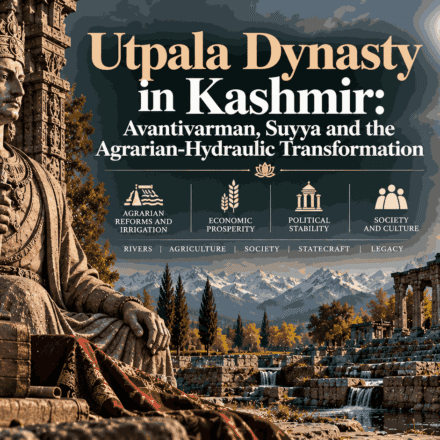
The most enduring achievement of Avantivarman’s reign was an agricultural and economic revolution facilitated by the genius of a common-born engineer named Suyya. For generations, the Kashmir Valley had suffered from severe flooding and waterlogging because the Jhelum River (Vitasta) could not flow swiftly through the narrow gorge below Baramulla. This led to frequent famines and a decline in cultivation.
Suyya, who had observed the river’s behavior meticulously, proposed a plan to drain the valley. In a legendary display of behavioral psychology and practical engineering, Suyya convinced the king to provide him with pots of coins (dinnaras). At locations like Nankaka and Yaksodara—where the river was bottlenecked by silt and boulders—he threw the coins into the water. The desperate, famine-stricken people dived into the river to retrieve the coins, and in doing so, they cleared the boulders and silt that were obstructing the flow.
| Engineering Project | Mechanism and Strategic Impact |
| Jhelum Desilting | Clearing the gorge below Baramulla increased the river’s flow and drained marshy lands. |
| Confluence Alteration | Moved the meeting point of the Jhelum and Sindh rivers from Trigam to Shadipur to prevent vast swamp formation. |
| Irrigation Canals | Constructed an extensive network of canals that transformed dry interior lands into fertile fields. |
| Circular Embankments | Introduced ‘Kundala’ embankments around villages, protecting them from floods while creating storage for irrigation. |
| Agricultural Science | Implemented early soil-testing methods to determine irrigation needs based on soil drying times. |
This engineering feat had a profound economic impact. The price of rice, which had reached 200 dinars per khari during the famine, fell to a mere 36 dinars, ushering in a period of plenty. Modern researchers have used hydraulic modeling to estimate that Suyya’s breach of the landslide debris would have released up to 21 km3 of water with surge velocities reaching 12 m/s. To commemorate his work, the town of Suyyapur (modern Sopore) was founded, which today remains a vital commercial hub often referred to as the “Apple Town of Kashmir”.
Architectural Legacy: The Temples of Avantipura
The economic prosperity of the 9th century enabled a flourishing of art and architecture. Avantivarman moved the capital to Avantipura (modern Awantipora) and commissioned two monumental temple complexes dedicated to Lord Vishnu and Lord Shiva. These structures reflect a “local school of construction” that utilized the valley’s limestone and timber to create a distinct Kashmiri aesthetic.
The Avantiswami Temple
The Avantiswami Temple, dedicated to Lord Vishnu, is the grander of the two and represents the zenith of Utpala artistic achievement. Architecturally, it is classified as a ‘pancharatna’ (five jewels) temple because it features a central principal shrine surrounded by four smaller chapels at the corners of the courtyard.
Key features for aspirants to note include:
- Site Dimensions: The temple sits within a peristyle (a colonnaded courtyard) measuring approximately 174 yards by 148 yards.
- Decorative Motifs: The walls are adorned with intricate reliefs of the river goddesses Ganga and Yamuna, identifiable by their animal mounts, the crocodile and the turtle.
- Royal Portraits: Sculptures on the staircase parapets depict King Avantivarman and his queen, serving as a rare contemporary visual record of the 9th-century Kashmiri royalty.
- Excavation History: The temple was largely buried until the early 20th century, when excavations led by Dr. Sahni revealed the structure under 15 feet of sediment and trash.
The Avantishwara Temple
Located approximately 800 meters from its Vaishnavite counterpart, the Avantishwara Temple is dedicated to Lord Shiva. While it shares structural similarities with the Avantiswami Temple, it is characterized by its massive stone barriers and a more desolate, majestic appearance. Historical records suggest it was built before Avantivarman ascended the throne, indicating his early devotion to Shaivism even before his formal coronation. Both sites are now centrally protected by the Archaeological Survey of India (ASI).
The Expansionist Turn: Shankaravarman (883–902 CE)
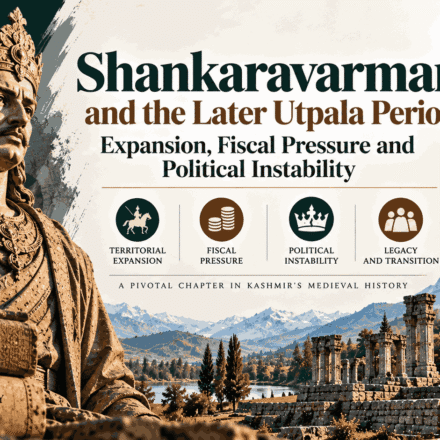
The death of Avantivarman in 883 CE ended the “Golden Age” of internal development and sparked a renewed period of imperial ambition. His son, Shankaravarman, secured the throne after a series of battles against rival claimants like Sukhavarman. His reign is a study in contradictions: while he was a successful military conqueror, his domestic policies led to significant social and economic distress.
Military Campaigns and Foreign Policy
Shankaravarman sought to restore the borders of the Kashmiri state to the levels seen during the Karkota era. Kalhana records that he invaded Gujarat (modern Pakistan region) with a staggering force of nine lac infantrymen, one lac cavalry, and three hundred elephants. He successfully defeated Alakhana, the local ruler, and secured territorial concessions that preserved Kashmir’s sovereignty in the northwestern subcontinent. He also founded the strategic town of Sankarapurapattana (modern Pattan) to serve as a base for his operations.
Economic Oppression and the System of Begar
The cost of maintaining a massive standing army and funding foreign wars proved catastrophic for the state’s coffers. Shankaravarman is remembered for his unbound greed and the introduction of several oppressive fiscal measures:
- Grahkrtya: A domestic tax that targeted various aspects of the household, placing a heavy burden on the common subjects.
- Bharodhi (Forced Labor): He is credited with introducing the formal system of ‘Begar’ or forced labor in Kashmir. This system, also called Rudhabharodhi, compelled villagers to carry the army’s loads across mountainous terrain without pay.
- Temple Confiscations: To generate revenue, the king began seizing the lands and wealth of temples, marking a decline from his father’s pious patronage.
Shankaravarman died in 902 CE from a stray arrow at Urusha (modern Hazara, Pakistan) while returning from a campaign. His death marked the beginning of a prolonged period of political instability.
The Regency and Reign of Queen Sugandha (902–906 CE)
In the wake of Shankaravarman’s death, his widow, Queen Sugandha, became the most powerful political actor in the valley. She initially served as the regent for her minor son, Gopalavarman (r. 902–904 CE), and managed the affairs of the kingdom with recognized ability. However, her reign was fraught with intrigue involving her treasury minister and paramour, Prabhakaradeva.
After the mysterious deaths of Gopalavarman and his brother Samkata within a short period, the public and the army (assembled as a ‘Maha-Panchayat’) asked Sugandha to take the throne as a sovereign monarch in 904 CE. She was a popular ruler who sought to stabilize the state through religious merit and the construction of temples, but she became embroiled in the rising power struggle between the Tantrins and the Ekangas.
The Rise of the Tantrins
The late Utpala period is defined by the emergence of the Tantrins, a military faction or royal bodyguard unit that became the ultimate “kingmakers” of Kashmir. They eventually turned against Sugandha when she attempted to nominate Nirjitavarman (Pangu) as her successor.
- Conflict and Exile: The Tantrins deposed Sugandha in 906 CE and installed the ten-year-old Partha as a puppet monarch.
- The Final Struggle: Sugandha went to war against the Tantrins in 914 CE with the support of the Ekangas (loyalist palace guards), but her forces were routed at Srinagar. She was captured and eventually killed in a Buddhist monastery, signaling the end of effective royal authority in the Utpala line.
Political Decay and the Transition to the Loharas
Following the fall of Sugandha, Kashmir descended into a dark period of military anarchy. The Tantrins auctioned the throne to various claimants, leading to short and tumultuous reigns. For example, Cakravarman (r. 936 CE) managed a brief comeback by forming an alliance with the Damaras to crush the Tantrins at Padmapura (Pampore), but he could not sustain a long-term stabilization.
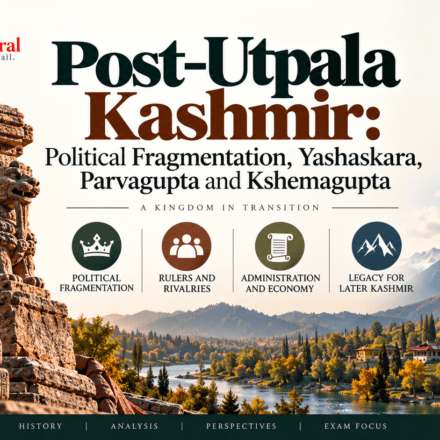
The Utpala Dynasty finally dissolved in 939 CE with the ascent of Yashaskara, a Brahman choice meant to restore civil order. This paved the way for the Gupta Dynasty and eventually the Lohara Dynasty (c. 1003–1320 CE), founded by Sangramaraja, the nephew of the famous Queen Didda.
| Dynasty | Foundation Year (CE) | Key Transition Note |
| Karkota | c. 625 | Founded by Durlabhavardhana; built Martand. |
| Utpala | 855 | Founded by Avantivarman; irrigation reforms. |
| Gupta | 948 | Parvagupta ascended the throne after the Utpalas. |
| Lohara | 1003 | Established by Sangramaraja after Queen Didda. |
Recent Archaeological Discoveries and Current Affairs (2024–2026)
For JKSSB aspirants, staying updated on recent heritage developments is critical, as current affairs questions often link contemporary events with historical context. The years 2024 through early 2026 have seen a significant revival of interest and investment in Kashmir’s medieval sites.
Archaeological Breakthroughs
In August 2025, renovations at the Karkoot Nag spring in Aishmuquam led to the discovery of 21 ancient stone relics, including 11 Shivlings and ‘hero stones’ (stelas) honoring warriors and ascetics. Archaeologists from the University of Kashmir suggest these artifacts likely date to the Karkota-Utpala era, highlighting the valley’s deep religious fabric and the tradition of placing memorial markers near sacred springs.
Furthermore, in Baramulla (Zehanpora), a major collaborative excavation between the J&K Department of Archives and the University of Kashmir recently uncovered architectural remnants of a pivotal Kushan-era Buddhist complex. While older than the Utpala Dynasty, such finds provide the stratigraphic context in which later dynasties like the Utpalas operated, often building upon or patronizing these older spiritual hubs.
Heritage Restoration Projects
The Jammu and Kashmir government has embarked on an ambitious project under the “Scheme for Revival, Restoration, Preservation, and Maintenance of Architecture and Heritage”.
- Vachar Nag Temple Restoration: In July 2025, Chief Secretary Atal Dullu and Srinagar DC Akshay Labroo initiated the restoration of the Vachar Nag Temple, which had been abandoned since the 1990s.
- Martand Sun Temple: Efforts were initiated in March 2024 to restore the iconic 8th-century Martand Sun Temple, including the installation of a statue of Emperor Lalitaditya Muktapida to honor the Karkota heritage.
- Sopore Heritage: The government has prioritized the preservation of Sopore’s historical identity as “Suyyapur,” focusing on the irrigation legacy of the Utpala period as part of broader agricultural tourism initiatives.
- Handicraft Heritage: In January 2026, Chief Minister Omar Abdullah launched a special heritage calendar for 2026 that celebrates traditional Kashmiri crafts like Kani shawl and Papier-mâché, whose roots and patronage can be traced back to the medieval periods of economic prosperity.
Strategic Exam Insights for JKSSB Aspirants
Based on previous year questions (PYQs) and the current syllabus for exams like the Junior Assistant, FAA, and Sub-Inspector, the following areas represent high-yield topics.
Frequently Asked Questions and Key Facts
- Founder of Utpala Dynasty: Avantivarman (855 CE).
- Founder of Sopore: The engineer Suyya (originally named Suyyapur) during Avantivarman’s reign.
- Temple Locations: Both Avantiswami and Avantishwara temples are in the Pulwama district at Avantipura.
- Taxation System: Shankaravarman is noted for Grahkrtya and the Begar (forced labor) system.
- Succession: The Utpala Dynasty replaced the Karkota Dynasty and was succeeded by the Gupta/Lohara lines.
- The Rajatarangini: Most of our information about the Utpala Dynasty comes from Book V of Kalhana’s Rajatarangini, which was written in Sanskrit between 1148 and 1150 CE.
Conclusion: The Endurance of the Utpala Legacy
The Utpala Dynasty remains a cornerstone of Kashmiri historical identity, representing a period where human ingenuity, in the form of Suyya’s engineering, triumphed over natural disasters to create economic stability. While the dynasty eventually succumbed to the pressures of military factionalism and fiscal overreach, its contributions to the valley’s geography and culture are indelible. The circular embankments of the ‘Kundalas’ and the majestic limestone blocks of Avantipura serve as a reminder of an era that balanced religious devotion with scientific pragmatism. For the JKSSB aspirant, mastering this period is not just about memorizing a list of rulers, but about understanding the mechanisms of governance that shaped the modern geography and heritage of Jammu and Kashmir. By integrating these historical facts with recent current affairs and government-led restoration efforts, candidates can approach their examinations with a comprehensive and nuanced perspective that goes beyond the textbook.
About The Author