
Introduction
The economy of Jammu and Kashmir is a unique tapestry where historical heritage and modern financial strategies interlace to support millions of livelihoods. For aspirants preparing for the Jammu and Kashmir Services Selection Board (JKSSB) examinations, the study of handicrafts is not merely an exercise in cultural appreciation but a core component of the “General Knowledge with Special Reference to J&K UT” syllabus.
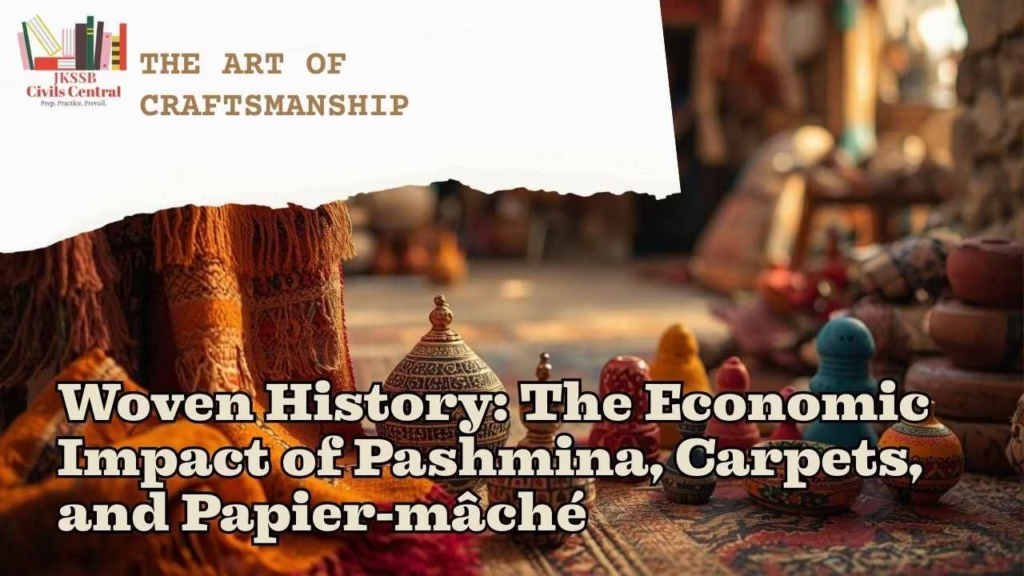
The traditional sectors of Pashmina, Hand-knotted Carpets, and Papier-mâché represent the second-largest employer in the region, surpassed only by agriculture, and serve as a primary source of foreign exchange earnings. As the Union Territory navigates the economic landscape of 2024-2026, these crafts have demonstrated remarkable resilience, adapting to global market shifts through technological interventions such as Geographical Indication (GI) tagging and QR-code-based authentication.
The Historical Genesis of Kashmiri Craftsmanship
The foundation of Kashmir’s handicraft industry is traditionally attributed to two pivotal historical figures whose contributions are frequently tested in JKSSB history modules. The first wave of Persian influence arrived in the 14th century with Mir Sayyid Ali Hamadani, a Sufi mystic from Iran affectionately known as Shah-i-Hamadan. Fleeing political upheaval, Hamadani arrived in the valley accompanied by 700 craftsmen who were masters of various arts, including woodwork, weaving, and paper pulp decoration. This initial migration established the “Karkhana” (workshop) system, turning every household in the valley into a potential production unit—a decentralized model that persists to this day.
The second major era of institutionalization occurred during the 15th-century reign of Sultan Zain-ul-Abidin, popularly known as ‘Budshah’ or the Great King. Budshah’s reign (1420–1470 AD) is considered the “Golden Age” of Kashmiri handicrafts. He recognized that for the valley to be economically self-sufficient, it needed to produce high-value luxury goods that could be exported to the royal courts of Samarkand and Central Asia. Budshah is specifically credited with bringing specialized carpet weavers from Persia and providing them with royal patronage, thereby founding the organized carpet weaving industry in Kashmir.
| Historical Figure | Contribution | Era/Century | JKSSB Context |
| Mir Sayyid Ali Hamadani | Introduced 700 Persian craftsmen; brought Papier-mâché | 14th Century | Introduction of Islam & Arts |
| Sultan Zain-ul-Abidin (Budshah) | Institutionalized Carpets & Pashmina; founded Karkhanas | 15th Century | Golden Age of Kashmir |
| Akhun Mulla Rahnuma | Revived Carpet weaving during the Mughal period | 17th Century | Post-Budshah recovery |
| Maharaja Gulab Singh | Founded Dogra Dynasty; promoted shawl trade | 19th Century | Treaty of Amritsar (1846) |
Pashmina: The Economic Weight of “Soft Gold”
Pashmina is the most celebrated luxury textile in the world, and its economic significance in Jammu and Kashmir cannot be overstated. Derived from the Persian word ‘Pashm’, meaning wool, it specifically refers to the downy undercoat of the Changthangi goat (Capra hircus), which is reared in the high-altitude plateaus of Ladakh. For JKSSB aspirants, it is vital to note that while the raw wool comes from Ladakh, the intricate processing, spinning, and weaving are traditionally performed in the Kashmir Valley, particularly in Srinagar, Ganderbal, and Budgam.
The Mechanism of Production and Quality Standards
The authenticity of Pashmina is determined by its fiber diameter, which typically measures between 12 and 15 microns—roughly six times thinner than a human hair. This fineness is a biological adaptation of the Changthangi goat to the extreme cold of the Himalayas, where temperatures can plummet to −40 degree C. The production cycle involves several labor-intensive steps:
- Combing: The wool is manually combed from the goat during the spring molting season rather than shorn, ensuring the preservation of long, fine fibers.
- Spinning: Traditionally performed by women on a ‘Charkha’ (spinning wheel), this process transforms the raw wool into delicate yarn. This stage is a critical source of unpaid family labor that sustains rural household economies.
- Weaving and Embroidery: The yarn is woven on handlooms, often followed by ‘Sozni’ embroidery—a needle-and-thread technique that creates identical patterns on both sides of the cloth, known locally as ‘Dorukha’.
Economic Contribution and Market Protection
As of the 2024-25 fiscal period, Pashmina remains a dominant player in the handicraft export basket. The sector benefits from a recent reduction in the Goods and Services Tax (GST) from 12% to 5%, a policy change designed to make authentic hand-woven Pashmina more competitive against machine-made imitations. In the first quarter of FY 2025-26, Pashmina and related shawls contributed to a 243% surge in total handicraft exports compared to the previous year.
The implementation of the ‘Kashmir Pashmina’ GI tag has been a game-changer for the industry. By 2025, the use of QR-code-based labeling has allowed international buyers to verify the fiber content and the hand-woven nature of the product, thereby commanding premium prices in markets like Europe and North America.
Hand-Knotted Carpets: Weaving Global Resilience
Kashmiri carpets, known as ‘Kaleen’ or ‘Kal baffi’, are distinguished by their hand-knotted construction, a technique that differs fundamentally from the tufted carpets produced in other parts of India. The economic impact of this industry is rooted in its high value-addition and labor intensity; a single high-density silk carpet can take an entire family over a year to complete.
The Technical Edge: Talim and Knot Density
The “Talim” system is a unique coded script used in carpet weaving that aspirants must recognize as a cornerstone of Kashmiri heritage. Instead of following a visual pattern, weavers follow a “Talim” sheet read aloud by a “Wasta” (master weaver). This ensures that every knot—numbering from 200 to over 900 per square inch—is placed with mathematical precision.
The economic value of a carpet is directly proportional to its Knot Density:
- Low to Moderate Quality: 200–400 Knots Per Square Inch (KPSI), typically wool or wool-silk blends.
- High Luxury Quality: 600–900+ KPSI, usually pure Mulberry silk on a silk base, referred to as “Silk-on-Silk”.
| Carpet Grade | Knot Density (KPSI) | Primary Material | Market Segment |
| Standard | 200–324 | Wool on Cotton | Domestic & Mid-range |
| Premium | 400–576 | Silk on Wool | High-end Export |
| Luxury (GI Certified) | 600–900+ | Pure Mulberry Silk | Global Elite/Investment |
Current Export Performance (2024–2026)
The carpet industry has shown remarkable recovery following pandemic-era disruptions. In FY 2022-23, exports peaked at over Rs 1,116 crore, before stabilizing at Rs 733.59 crore in FY 2024-25 due to global geopolitical tensions like the Russia-Ukraine conflict. However, the 2025-26 fiscal year has started on a buoyant note, with the first two quarters recording exports worth Rs 410 crore. The government’s decision to facilitate raw silk procurement at reduced rates from Karnataka has significantly lowered production costs, supporting the growth of world-famous carpets.
Papier-mâché: The Art of the Painted Pulp
Kashmir Papier-mâché, or ‘Kar-i-qalamdan’ (the art of the pen-case), is a testament to the region’s ability to transform simple waste into high-end luxury. Historically, this craft was a symbol of intellectual refinement, initially used to create decorative cases for pens and manuscripts for the royal courts.
The Specialized Labor Market
The creation of Papier-mâché is a bifurcated process involving two distinct artisan classes, which is a frequent topic in local recruitment exams:
- Sakhtsazi: These artisans prepare the “Sakhta” (structure) using paper pulp mixed with a natural adhesive called ‘aitij’ (made from rice flour). The pulp is molded over wooden or brass forms and smoothed with a chalk-glue paste.
- Naqashi: The “Naqash” (painter) then applies the elaborate designs. This phase uses fine brushes often made from cat hair to ensure the precision required for motifs like the “Chinar” leaf, “Hazara” (thousand flowers), and Mughal battle scenes.
Economic Resilience and Niche Marketing
Papier-mâché holds the distinction of being the highest-earning non-textile craft in the region, with exports reaching Rs 212.06 crore over the last decade. To combat the threat of machine-carved imitations and plastic substitutes, the J&K government has leveraged the GI status of “Kashmir Paper Machie” to promote it as a premier luxury product. The sector also benefits from the ‘Soulful Kashmir’ initiative, which showcases these products at national and international trade fairs like the Surajkund Mela and IITF.
Macroeconomic Landscape: GSDP and Employment
For aspirants analyzing the “Economy of Jammu and Kashmir,” the handicraft sector is a vital industrial pillar. As a Union Territory, J&K’s GSDP is projected to reach Rs 2.65 lakh crore in 2024-25, with a real growth rate of 7.06%. The industrial sector, dominated by small-scale and cottage units like handicrafts, contributes 18.3% to the Gross State Value Added (GSVA).
Employment Density and Socio-Economic Impact
The sector acts as a massive employment buffer, particularly in areas with limited large-scale industrialization.
- Artisan Population: Estimates suggest between 3.4 lakh and 5 lakh artisans are directly engaged in handicrafts.
- Decentralized Nature: Roughly 90% of production is cottage-based, effectively turning every household into a micro-production unit.
- Skill Training: The Directorate of Handicrafts operates over 634 training centers across the UT, training approximately 8,500 people annually in crafts ranging from Kani shawls to walnut wood carving.
| Economic Indicator | Value/Statistic | Source Context |
| Projected GSDP (2024-25) | Rs 2.65 Lakh Crore | Economic Survey 2024-25 |
| Industry Contribution to GSVA | 18.3% | Shift from traditional Agriculture |
| Total Artisan Population | ~4–5 Lakh | Largest employer after Agriculture |
| Q1 FY 2025-26 Export Total | Rs 309.62 Crore | 243% YoY increase |
| Per Capita Income (2024-25) | Rs 1,54,703 | 10.6% increase from previous year |
Government Schemes: Current Affairs for Aspirants
Understanding government policy is crucial for the JKSSB “Government Schemes” section. Several landmark initiatives have been launched or expanded between 2021 and 2026 to modernize the craft sector.
The Karkhandar Scheme (2021–Present)
This flagship scheme targets the revival of “languishing crafts”—those at risk of extinction due to lack of new practitioners.
- Mechanism: Master craftsmen (Karkhandars) receive an honorarium of Rs 2,000 per trainee per month to mentor new artisans.
- Stipend: Trainees receive Rs 2,000 per month, disbursed through Direct Benefit Transfer (DBT) to ensure transparency.
- Coverage: Crafts covered include silver filigree, walnut wood carving, Kani shawl weaving, and copperware.
Artisan Credit Card (ACC) and Financial Inclusion
To provide artisans with liquidity, the ACC scheme provides loans of up to Rs 1 lakh with a 10% interest subsidy paid by the government for five years. As of 2022, over 1,167 artisans had been covered in District Kupwara alone, highlighting the scheme’s widespread reach. This is complemented by the “Dastkar Finance” product from J&K Bank, which offers working capital term loans for activities like crewel and carpet weaving.
One District One Product (ODOP) and Export Hubs
The ODOP initiative identifies and brands one specific product from each district to enhance global competitiveness. For instance, Srinagar is dedicated to “Hand Knotted Silk Carpets,” while Ganderbal focuses on “Willow Wicker”. This scheme aligns with the “Districts as Export Hubs” (DEH) vision, which saw J&K win the Gold Award at the National ODOP 2024 ceremony for its exceptional implementation.
GI Tags and Modern Authentication: 2024–2026 Updates
One of the most frequent topics in recent JKSSB exams is the list of Geographical Indication (GI) tags. As of 2024-2026, Jammu and Kashmir has achieved the milestone of issuing QR-code-based labels for its entire craft basket, a first for any region in India.
The Significance of the QR Code
Each GI-tagged product features a QR label embedded with:
- Artisan Identity: The name and location of the weaver/artist.
- Materials Used: Verification of pure silk, hand-spun wool, etc.
- Authentication Code: A unique identifier that distinguishes the handmade item from machine-made replicas.
| Product Name | Category | GI Year/Update | Key Feature |
| Kashmir Pashmina | Textile | 2005 | Hand-spun wool of Changthangi goat |
| Kani Shawl | Textile | 2008 | Weaving using small wooden needles |
| Kashmir Paper Machie | Handicraft | 2011 | Paper pulp with intricate Naqashi |
| Kashmiri Carpet | Handicraft | Certified 2022 | Hand-knotted with high KPSI |
| Basohli Painting | Handicraft | 2023 | Miniature art from Kathua |
| Basohli Pashmina | Textile | 2023 | Hand-woven with local ‘chalita’ starch |
| Ramban Sulai Honey | Food | 2021 | Organic honey from Plectranthus rugosus |
| Bhaderwah Rajmash | Agricultural | 2023 | Sweet, small red kidney beans |
| Mushqbudji Rice | Agricultural | 2023 | Short-grain aromatic rice from Anantnag |
| Rajouri Chikri Wood | Handicraft | 2023 | Fine, light honey-colored softwood carving |
Infrastructure and Global Market Positioning
The administration has recently focused on institutionalizing the sector to meet international standards. The 2024-25 Economic Survey notes the establishment of “Ekta Malls” in Srinagar and Jammu, which act as dedicated retail hubs for ODOP and GI-tagged products. Furthermore, the Craft Development Institute (CDI) in Srinagar is being transformed into a “Pre-Export Testing Facility Centre,” allowing certified products to be exported directly to international buyers with government-backed quality assurance.
UNESCO Creative Cities Network (UCCN)
Srinagar’s inclusion in the UNESCO Creative Cities Network in the field of Crafts and Folk Arts has provided a platform for “Craft Safaris”. These safaris guide tourists through artisan clusters in Downtown Srinagar, covering Pashmina weaving, Sozni embroidery, and Walnut wood carving, thereby boosting the “Soulful Kashmir” branding initiative.
Historical Timelines and Personalities for Quick Revision
JKSSB history questions often delve into specific dates and rulers associated with the economy.
- Treaty of Amritsar (March 16, 1846): This “sale deed” of Kashmir to Maharaja Gulab Singh for 75 lakh Nanakshahi rupees is a foundational event in Dogra history.
- Annexation by Akbar (1586 AD): Marked the end of local Sultanates and the beginning of Mughal influence, which refined Papier-mâché and carpet designs.
- Invasion by Maharaja Ranjit Singh (1819 AD): Began the Sikh rule in Kashmir, lasting until 1846.
- The 1931 Uprising: A turning point in J&K’s political and economic history, beginning at the Srinagar Jail.
The 2026 Union Budget and Future Outlook
The Union Budget 2026-27 has allocated Rs 43,290.29 crore to Jammu and Kashmir, focusing on infrastructure and economic acceleration. While much of this assistance is earmarked for revenue deficits, the emphasis on ecologically sustainable mountain trails and the “India Semiconductor Mission” (ISM) 2.0 indicates a broader strategy to modernize J&K’s service and manufacturing sectors. For the handicraft sector, this means better connectivity through highway tunnels like Zoji La and Sinthan Pass, which will reduce the high logistics costs that currently plague the export of fragile items like Papier-mâché.
Causal Factors for Recent Growth
The 243% increase in export performance in early FY 2025-26 can be traced to three primary causal relationships:
- GST Reduction: The cut from 12% to 5% lowered retail prices, stimulating demand in domestic and festive markets.
- QR Authentication: Solved the “trust deficit” in international markets, allowing Kashmiri products to compete with machine-made replicas from China and Turkey.
- Bespoke Services: Traditional artisans have begun offering custom designs for the luxury interior decor market, a move supported by the ‘Soulful Kashmir’ design inputs.
Conclusion for Aspirants
The economy of Jammu and Kashmir is inextricably linked to its artisanal heritage. For a JKSSB aspirant, mastering the details of the Pashmina, Carpet, and Papier-mâché industries is not just about scoring marks but about understanding the very soul of the region’s prosperity. The shift from a labor-intensive traditional industry to a technology-backed global luxury sector represents a major trend in J&K’s economic evolution between 2019 and 2026. By focusing on the historical roots (Hamadani and Budshah), the technical nuances (Talim and Sakhtsazi), and the current government frameworks (Karkhandar and GI Tags), aspirants can build a comprehensive understanding of how the Union Territory’s history is woven into its future economic success.
About The Author