
Introduction
The economic landscape of the Union Territory of Jammu and Kashmir is currently navigating a period of profound structural transformation, moving away from traditional subsistence models toward a modern, enterprise-driven agrarian economy. For candidates preparing for the Jammu and Kashmir Services Selection Board (JKSSB) examinations, understanding the intricacies of the primary sector is not merely a requirement for the geography and economics components of the syllabus but a necessity for grasping the developmental trajectory of the region.
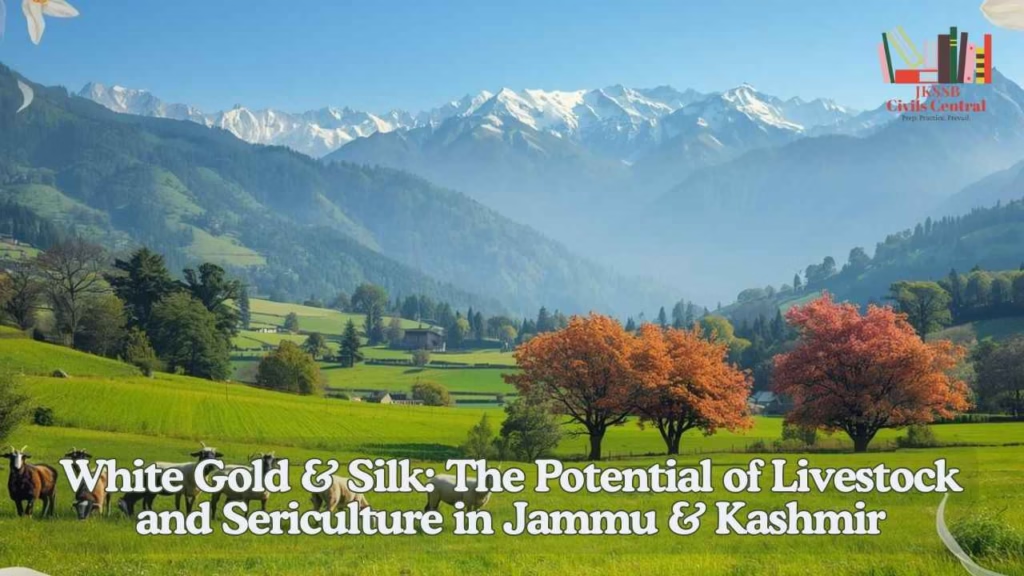
The twin pillars of this transformation are the livestock sector—frequently referred to as “White Gold” due to its immense value in dairy, wool, and the recent discovery of strategic minerals—and the sericulture sector, which represents the “Golden Thread” of the region’s heritage. In the fiscal year 2024-25, the real Gross State Domestic Product (GSDP) of Jammu and Kashmir is projected to grow at a robust 7.06 percent, while the nominal GSDP is anticipated to increase by 11.19 percent, reaching an estimated Rs. 2.65 lakh crores. This economic buoyancy is underpinned by the primary sector, which contributes a vital 20.00 percent to the Gross State Value Added (GSVA), supporting over 13 lakh families across the Union Territory.
The Macro-Economic Pulse of Jammu and Kashmir (2024-2025)
To comprehend the potential of livestock and sericulture, one must first analyze the broader economic framework within which they operate. The per capita income of Jammu and Kashmir at current prices is estimated to attain a level of Rs. 1,54,703 in 2024-25, reflecting a growth rate of 10.6 percent. This growth is significant when compared to northern states like Punjab and Himachal Pradesh, where the compound annual growth rate of per capita income has been recorded at 6.22 percent and 6 percent respectively, trailing J&K’s 8.3 percent CAGR over the same period. Such economic indicators suggest that the residents of the Union Territory are experiencing improved economic well-being, which in turn drives the demand for high-value agricultural products like milk, meat, and silk.
| Economic Indicator (Advance Estimates 2024-25) | Jammu & Kashmir Value | National Value/Comparison |
| Nominal GSDP | Rs. 2.65 Lakh Crores | Growth: 11.19% |
| Real GSDP | Rs. 1.45 Lakh Crores | Growth: 7.06% |
| Per Capita Income (NSDP) | Rs. 1,54,703 | National: Rs. 2,00,162 |
| Primary Sector GSVA Share | 20.00% | Integral to rural economy |
| Inflation (2024) | 4.5% | National: 5% |
| Credit-Deposit Ratio | 62.01% | Increased flow to MSMEs |
The fiscal health of the region is further evidenced by a 77 percent realization of revenue in the first nine months of the fiscal year 2024-25, amounting to Rs. 15,737.80 crore. The primary sector’s resilience is particularly noteworthy, as it acts as a buffer against global economic fluctuations, much like the national livestock sector, which consistently accounts for 5.5 percent of the national GVA.
The “White Gold” of Jammu and Kashmir: Livestock and Dairy
In the developmental lexicon of Jammu and Kashmir, “White Gold” has traditionally symbolized the milk and wool industries. However, the term has gained a dual significance with the 2023 discovery of 5.9 million tonnes of lithium in the Reasi district, a mineral often called “White Gold” due to its critical role in the global battery economy. For the agrarian economist and the JKSSB aspirant, the focus remains on the biological “White Gold”—the livestock sector—which contributes approximately 13 percent to the GSDP and serves as the mainstay of nearly 70 percent of the population.
Global and National Standing of the Livestock Sector
India’s livestock sector is a global powerhouse, and Jammu and Kashmir is a significant contributor to this narrative. The country remains the world’s largest milk producer, accounting for 25 percent of global milk production. The Basic Animal Husbandry Statistics (BAHS) 2025 report highlights that national milk production reached 247.87 million tonnes in 2024-25, a growth of 3.58 percent over the previous year.
| Livestock Product (2024-25) | India’s Global Rank | Total Production | Growth Rate (%) |
| Milk | 1st | 247.87 Million Tonnes | 3.58% |
| Eggs | 2nd | 149.11 Billion Nos. | 4.44% |
| Meat | 4th | 10.50 Million Tonnes | 2.46% |
| Wool | Significant Player | 34.57 Million Kg | 2.63% |
For aspirants, a crucial data point is the per capita availability of livestock products. Nationally, the per capita availability of milk has risen from 319 grams per day in 2014-15 to a record 485 grams per day in 2024-25. Similarly, the per capita availability of eggs has increased from 62 per annum to 106 per annum over the same decade.
Jammu and Kashmir’s Dominance in Wool Production
Jammu and Kashmir is a titan in the wool sector. It is the second-largest producer of wool in India, trailing only Rajasthan. In 2024-25, J&K contributed a substantial 22.88 percent to the national wool output, while Rajasthan led with 47.85 percent. The Union Territory’s unique climatic conditions make it suitable for rearing fine-wool sheep, particularly the Kashmir Merino, which is celebrated for its high greasy fleece yield and superior fiber quality.
The wool produced in J&K is not just a commodity but the raw material for the world-famous handicraft and textile industries of the region. The high altitude and temperate climate of the valley are perfectly suited for the Changthangi goat, the source of Pashmina—the finest natural fiber known to man. Pashmina, which was granted Geographical Indication (GI) status in 2008, remains a cornerstone of the region’s cultural and economic identity.
Population and Biodiversity of Livestock in J&K
The livestock population in Jammu and Kashmir is a reflection of its diverse agro-climatic zones, ranging from the sub-tropical Jammu plains to the cold arid heights of Ladakh. As per the 20th Livestock Census, the region (including Ladakh) boasts a livestock and poultry population of 8.32 million and 7.37 million respectively.
| Species | Share of Total J&K Population (%) | National Rank/Status |
| Sheep | 36.84% | 6th in India |
| Cattle | 30.41% | Increasing crossbred focus |
| Goats | 21.93% | Integral for marginal farmers |
| Buffalo | 8.03% | Preferred for high-fat milk |
| Yak | N/A (Significant) | 1st in India |
| Horses/Ponies | N/A (Significant) | 2nd in India |
The presence of specific breeds is a key area for JKSSB exam questions. The Gurez sheep, found in the Bandipora district, is known for its sturdiness and quality mutton, while the Karnah sheep of Kupwara is prized for its fine wool. In the dairy sector, there is a clear trend toward crossbreeding indigenous cattle with exotic breeds to boost productivity. Nationally, milk production from crossbred cattle grew by 4.97 percent in 2024-25, outpacing the 3.51 percent growth of indigenous varieties.
The Meat and Poultry Challenge
While J&K excels in wool, it faces a structural deficit in meat production. The region is a high consumer of mutton, yet it relies heavily on imports from neighboring states. Under the Holistic Agriculture Development Programme (HADP), the government has set an ambitious roadmap for self-sufficiency in mutton production. The national meat production stands at 10.50 million tonnes, with poultry meat contributing approximately 50 percent of the total. In J&K, poultry development is being prioritized through the establishment of local hatcheries and the promotion of backyard poultry, which currently contributes about 15.51 percent to the national egg output.
Sericulture: The Golden Heritage of J&K
Sericulture, the art and science of silk production, is an age-old occupation in Jammu and Kashmir that has historically positioned the region on the global map. Known as the only traditional univoltine belt in India, J&K is capable of producing bivoltine silk that rivals the best in the international market. The industry provides employment—both full-time and subsidiary—to approximately 2.15 lakh people, including 33,000 farming families.
Historical Context and the Legacy of Sultan Zain-ul-Abideen
The roots of silk in Kashmir can be traced back to ancient times, with evidence suggesting that the valley may have been one of the original homes of silk. Medieval historian Mirza Muhammad Haider, in his “Tarikhi Rashide,” described the mulberry trees of Kashmir as wonders of the region. The industry reached new heights under Sultan Zain-ul-Abideen, the 15th-century ruler often called “Budshah” or the “Great King.” He is credited with introducing advanced weaving techniques and consolidating the silk trade.
By 1855, Kashmir’s silk industry was so advanced that it exported 2.5 lakh disease-free layings (dfls) of silkworm seeds to Europe, effectively saving the European sericulture industry from a devastating disease outbreak. However, for much of the 20th century, the industry was a state monopoly, which limited the benefits reaching the actual rearers. The de-monopolization of the industry in 1988 allowed farmers to own trees and sell cocoons in an open market, ushering in a new era of growth.
The Sericulture Value Chain and Production Dynamics
Silk production is a labor-intensive process that spans from mulberry cultivation to high-end weaving. The industry is categorized as a low-volume, high-value sector, making it ideal for the rural economy of J&K.
| Sericulture Metric | Current Status in J&K | Economic Significance |
| Annual Cocoon Production | ~1,022 to 1,105 Metric Tons | Generates ~Rs. 22 Crore income |
| Annual Raw Silk Output | ~6,680 Quintals | Worth approx. Rs. 50 Crore |
| Mulberry Tree Wealth | 110 Lakh Trees | Distributed across 2,800 villages |
| Rearers (Households) | 33,000 | Primarily subsidiary occupation |
| Weavers (Private Sector) | 10,000 | Operational in ~2,000 units |
One of the most attractive features of sericulture for marginal farmers is the short gestation period. Mulberry once planted can support silkworm rearing for 15-20 years, and the rearers can take multiple crops in a year under controlled conditions. In J&K, the spring crop in May-June remains the primary harvest, followed by an autumn crop in September-October.
Biological Excellence: Mulberry and Silkworm Varieties
The quality of silk is directly proportional to the quality of mulberry leaves and the silkworm races used. J&K uses high-yielding mulberry varieties such as Goshoerami, Ichinose, and KNG, which provide the nutritional support required for bivoltine silkworms. The common silkworm races reared include SK6, SKUAST-31, and DUN22.
The industry’s economic equity is a significant highlight for aspirants. Approximately 56.8 percent of the gross value of silk fabric flows back to the cocoon grower, ensuring that wealth is redistributed to the rural grassroots rather than being concentrated in urban trade centers.
The Holistic Agriculture Development Programme (HADP): A Systems Reform
For any JKSSB aspirant, the Holistic Agriculture Development Programme (HADP) is perhaps the most critical current affairs topic. Launched in 2024 with a massive outlay of Rs. 5,013 crore, HADP is not just a collection of schemes but a comprehensive systems reform aimed at re-engineering the agricultural and livestock economy.
Core Principles and Strategic Vision
HADP was conceptualized by an apex committee chaired by Dr. Mangala Rai, former Director General of the Indian Council of Agricultural Research (ICAR). The mission is to transform subsistence-driven practices into resilient, market-oriented agri-businesses. The programme targets the “vicious cycle” of low capital infusion and low mechanization that has historically plagued J&K’s primary sector.
| Feature of HADP | Detail | Objective |
| Total Projects | 29 Interlinked Projects | Coverage of all agri-allied sectors |
| Projected Job Creation | 2.8 Lakh Jobs | Employment for rural youth |
| Enterprise Goal | 19,000 Agri-Enterprises | Creating “Agripreneurs” |
| Skill Development | 2.5 Lakh Persons | Technical backstopping for farmers |
| Total Units Established | >92,000 Units | Real-time monitoring via OTA app |
Key Livestock and Sericulture Projects under HADP
Of the 29 projects, several are dedicated to revitalizing the sectors discussed in this report. These include:
- Dairy Development: Aimed at doubling milk output and establishing processing clusters.
- Mutton Self-Sufficiency: Focused on intensive rearing and breed improvement of sheep and goats.
- Poultry Development: Scaling up local production to reduce the Rs. 1000+ crore annual import bill for poultry products.
- Promotion of Wool and Pelt: Modernizing the processing and marketing of J&K’s significant wool output.
- Sericulture Push: Upgrading technology, expanding mulberry plantations, and enhancing silkworm seed production.
Digital Public Infrastructure (DPI) in Agriculture
HADP is distinguished by its heavy reliance on technology for delivery and monitoring. Aspirants should be familiar with the following digital platforms:
- Kisan Sathi Portal: The single-window system for applying for schemes and subsidies.
- Daksh Kisan: A learning management system offering over 160 specialized courses to skill farmers in modern practices.
- Kisan Khidmat Ghars (KKGs): Entrepreneur-led IT centers at the panchayat level that provide last-mile facilitation for all HADP-related services.
- Output Tracking App (OTA): A real-time app used by the administration to track the physical and financial progress of established units.
Financial Empowerment and J&K Bank’s Role
The success of any development programme hinges on credit availability. J&K Bank has taken a leading role in financing HADP projects, offering customized loan products for livestock and sericulture enterprises.
Loan and Subsidy Structures
Aspirants should note the financial parameters of HADP loans, as these are often the subject of economics-based questions. The bank provides financing for up to 90 percent of the project cost, requiring a minimum promoter’s margin of only 10 percent.
| Financial Parameter | Detail |
| Repayment Period | Up to 8 years (including moratorium) |
| Moratorium Period | Up to 2 years |
| Interest Rate (Up to Rs. 15 Lac) | 1-year MCLR + 1.50% |
| Collateral for Small Loans | Nil for loans up to Rs. 1.60 Lac |
| Processing Charges | NIL |
The government provides back-ended subsidies, which are released via Direct Benefit Transfer (DBT) once substantial progress is ascertained. This ensures that public funds are utilized for genuine enterprise creation.
Current Affairs and Recent Milestones (2024-2026)
Staying updated with current events is paramount for success in JKSSB exams. The years 2024 and 2025 have been particularly productive for Jammu and Kashmir in terms of national recognition and policy initiatives.
National ODOP Awards 2024
In July 2024, Jammu and Kashmir clinched the Gold Medal at the National One District One Product (ODOP) Awards held in New Delhi. This was the second consecutive year J&K received this distinction. Pulwama district secured a Silver Medal in the Agriculture category, while Ganderbal district earned a Silver Medal in the Non-Agriculture category. These awards underscore the success of the region in promoting traditional craftsmanship and district-specific agricultural products.
The Geographical Indication (GI) Revolution
The granting of GI tags is a strategic move to protect the intellectual property rights of local artisans and farmers. As of 2024, 17 products from J&K have been successfully registered, with several more pending.
| GI Tagged Product | Category | Notable Detail |
| Kashmir Pashmina | Handicraft | World’s finest wool (12-15 microns) |
| Basohli Pashmina | Handicraft | Registered in Oct 2023 |
| Ramban Anardana | Agriculture | Sole GI addition in Jan 2024 |
| Udhampur Kaladi | Food Product | Indigenous cheese, registered in 2023 |
| Bhaderwah Rajmash | Agriculture | Famous red beans from Doda |
| Mushqbudji Rice | Agriculture | Aromatic rice from Anantnag |
The GI tag ensures that products bearing these names are authentic and produced in their designated regions, thereby boosting their presence in global markets and protecting artisans from counterfeits.
Lithium: The New “White Gold” in Reasi
In February 2023, the Geological Survey of India (GSI) discovered 5.9 million tonnes of lithium reserves in the Salal-Haimana area of Reasi district. This discovery is of global significance, as lithium is essential for the transition to green energy. For the JKSSB aspirant, this is a prime topic for both geography (resource distribution) and economics (future growth potential).
Recent Sericulture Milestones
The sericulture department has been proactive in setting roadmaps for future production. In January 2026, the department unveiled “SILK KASH,” a quarterly journal dedicated to sericulture trends. The action plan for 2025-26 emphasizes enhancing silkworm seed production and expanding mulberry plantations to make J&K’s silk resilient and globally competitive.
Strategic Tips for JKSSB Aspirants
Success in JKSSB exams requires more than just memorizing facts; it requires an understanding of how different topics are interlinked. Here is how to approach the subjects discussed in this report:
- Geography of J&K: Focus on the agro-climatic zones. For instance, the Kashmir Valley (JK-3) is the “cultivator’s paradise” for silk and saffron, while the cold arid zone (JK-4) of Ladakh is the hub for Yaks and Pashmina goats.
- Economics of J&K: Understand the sectoral contributions. Note that while the tertiary sector dominates GSDP, the primary sector remains the largest employer.
- Current Affairs: Keep a dedicated section for HADP, GI tags, and national awards. Memorize the names of portals like Kisan Sathi and Daksh Kisan.
- District-wise Specialization: Know which district is famous for what. For example, Bandipora for Gurez sheep, Reasi for Lithium, and Anantnag for Mushqbudji rice.
The Road Ahead: Potential and Sustainability
The future of Jammu and Kashmir’s livestock and sericulture sectors is intertwined with the principles of sustainability and technology integration. The focus is shifting toward AI-enabled agriculture, precision dairy farming, and the promotion of “Vanya” (wild) silks like Muga and Eri to diversify the silk basket.
The Export Preparedness Index (EPI) 2024 emphasizes that states must adopt a global perspective to enhance trade ecosystems. For J&K, this means moving beyond the export of raw materials and focusing on value-added products like processed meat, branded silk garments, and high-quality dairy derivatives. The integration of blockchain technology for traceability in the livestock supply chain is another emerging trend that could help J&K’s premium products fetch better prices in international markets.
Comprehensive Economic Conclusion
The developmental narrative of Jammu and Kashmir in 2024-2025 is one of optimism and structural reform. The livestock and sericulture sectors, representing the “White Gold” and the “Silk” of the region, are no longer just traditional livelihoods but are the vanguard of a modern economic revolution.
Under the HADP, the Union Territory has moved away from subsidy-driven interventions to an integrated, outcome-oriented reform model. This shift is clearly visible in the establishment of over 92,000 productive units and the generation of significant employment in rural areas. The impressive growth in real GSDP (7.06%) and per capita income (10.6%) reflects a region that is finally tapping into its untapped potential.
For the JKSSB aspirant, the message is clear: the geography and economics of Jammu and Kashmir are dynamic and evolving. Mastery of these subjects requires an appreciation of the region’s rich history—from the Silk Route to the modern-day GI revolution—and a firm grasp of the contemporary policies that are shaping its future. As J&K positions itself as a global hub for craft and a leader in high-value agriculture, those who understand these nuances will be well-prepared to contribute to and lead this transformation.
As we move toward the vision of “Viksit Bharat @2047,” the “White Gold” and Silk of Jammu and Kashmir will undoubtedly remain central to the nation’s progress.
About The Author