
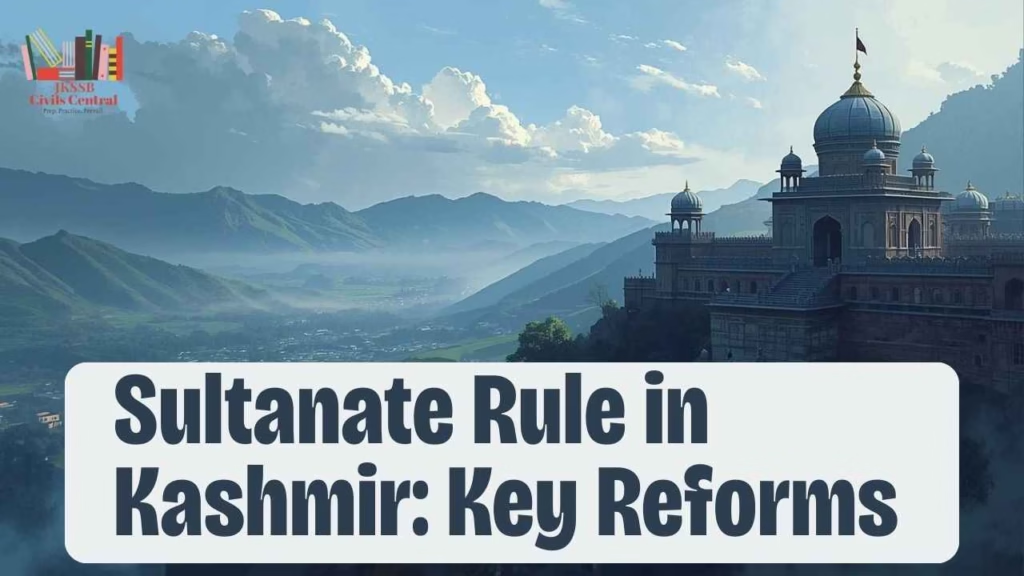

Sultanate Rule in Kashmir
The historical narrative of the Kashmir Valley during the medieval period constitutes one of the most vibrant and transformative chapters in the annals of the Indian subcontinent. For candidates preparing for the Jammu and Kashmir Services Selection Board (JKSSB) and other state-level competitive examinations, the Sultanate period (1320–1586 CE) is a cornerstone of the “General Knowledge with Special Reference to J&K” syllabus.
This epoch represents more than just a change in the religious identity of the ruling elite; it marks the birth of a unique socio-cultural synthesis known as Kashmiriyat, the introduction of world-renowned handicrafts, and the implementation of administrative reforms that would influence the region for centuries. Understanding this period requires an exhaustive examination of the two primary dynasties—the Shah Miris and the Chaks—and the visionary leaders who steered Kashmir toward its “Golden Age”.
Historical Foundation and the Transition to Muslim Rule
To appreciate the rise of the Sultanate, one must first understand the state of Kashmir in the early 14th century. The valley was governed by the Lohara dynasty, which, by 1301 CE, had become a shadow of its former self. Internal squabbles among the landed aristocracy, known as the Damaras, and a series of weak monarchs had left the central authority in shambles. The last significant Hindu ruler, Sahadeva (1301–1320 CE), faced a catastrophic turning point in 1320 CE when the Mongol commander Dulucha (also known as Zulchu) invaded the valley with a force of 70,000 men.
The invasion by Dulucha was a watershed moment. Sahadeva fled to Kishtwar, leaving his subjects to face unprecedented brutality. The Mongol forces engaged in mass looting, destruction of property, and the enslavement of the population. When Dulucha finally retreated through the mountain passes during winter, he and his entire army perished in a blizzard, but the Kashmir he left behind was a political vacuum. In this void, three pivotal figures emerged, each representing a different regional and cultural background: Rinchan, a Buddhist prince from Ladakh; Shah Mir, a migrant from Swat (in modern Pakistan); and Lankar Chak, a leader from the Dardic regions of Gilgit.
The Reign of Sultan Sadr-ud-Din (Rinchan)
Rinchan, a man of sharp intellect and ambition, seized the opportunity presented by the chaos. He eliminated the local governor Ramachandra and established himself as the ruler. Seeking legitimacy, he initially approached the Hindu priests to be admitted into the Brahminical fold, but his request was rejected on the grounds of his “unclear” religious background. This rejection led to one of the most significant conversions in history. Influenced by the simple yet profound teachings of the Sufi saint Sayyid Sharaf-ud-Din, popularly known as Bulbul Shah, Rinchan embraced Islam in December 1320 CE.
Adopting the title Sultan Sadr-ud-Din, he became the first Sultan of Kashmir. His short reign (1320–1323 CE) was focused on stabilizing the valley and delivering justice. He appointed Shah Mir as his chief advisor, recognizing the latter’s administrative acumen. The conversion of Rinchan was not merely a spiritual event; it signaled a shift in the political landscape where merit and loyalty began to supersede traditional caste-based power structures.
The Brief Lohara Interruption and the Rise of Shah Mir
Following Rinchan’s death in 1323, Hindu rule was briefly restored under Udyanadev, the brother of Sahadeva. However, Udyanadev was a weak monarch who fled when a second Mongol-inspired invasion occurred. The defense of the valley fell to Kota Rani, the widow of Rinchan and daughter of Ramachandra. She was a courageous and shrewd administrator who governed with a firm hand.
Shah Mir, however, had spent these years building a powerful base of support among the local population and the military. After the death of Udyanadev in 1338, a power struggle ensued between Kota Rani and Shah Mir. In 1339 CE, Shah Mir besieged the Queen at the fort of Inderkot. With her eventual surrender and death, Hindu rule in Kashmir came to a formal end, and the Shah Mir dynasty was established.
| Transition Event | Key Figure | Year (CE) |
| Mongol Invasion (Dulucha) | Zulchu/Dulucha | 1320 |
| First Sultan of Kashmir | Sultan Sadr-ud-Din (Rinchan) | 1320–1323 |
| Last Hindu Ruler (Medieval) | Udyanadev / Kota Rani | 1338–1339 |
| Foundation of Shah Mir Dynasty | Sultan Shams-ud-Din (Shah Mir) | 1339 |
The Shah Mir Dynasty: Expansion and Consolidation
Sultan Shams-ud-Din (1339–1342 CE) laid the administrative foundations of the Muslim Sultanate. He was a pragmatic ruler who understood that the survival of his dynasty depended on the welfare of the peasantry. He abolished several oppressive taxes and fixed the land revenue at one-sixth of the total produce, a significant reduction from the rates seen during the late Lohara period. To mark the beginning of this new era, he introduced a new calendar, the Kashmiri Era, replacing the traditional Laukika Era.
Sultan Shihab-ud-Din: The Military Strategist
The expansion of the Sultanate reached its first peak under Sultan Shihab-ud-Din (1354–1373 CE), often heralded as the “Lalitaditya of Medieval Kashmir”. His reign was defined by military brilliance and territorial expansion.
Shihab-ud-Din’s campaigns were extensive. He conquered Pakhli, Swat, and the Pothohar region (extending from Attock to Sialkot). In the north, his forces, led by his Commander-in-Chief Malik Candra, subdued Jammu, Chamba, and Kishtwar. His most notable feat was the defense of the northern frontiers against the army of Kashgar. Despite being outnumbered, the Kashmiri forces soundly defeated the Kashgaris, resulting in the annexation of Ladakh and Baltistan into the Kashmiri kingdom.
Beyond military conquest, Shihab-ud-Din was a builder. He founded the city of Shihab-ud-Din-pura (now Shadipur), located at the confluence of the Jhelum and Sindh rivers. His administration was remarkably inclusive; he retained prominent Hindu courtiers like Kota Bhat and Udyashri, fostering a political culture of meritocracy. His reign demonstrated that a strong military was the prerequisite for the economic and cultural flourishing that would follow under his successors.
| Region | Outcome of Campaign |
| West | Annexation of Swat, Kabul, and Ghazni |
| North | Conquest of Gilgit, Baltistan, and Ladakh |
| South | Boundary established at Sirhind after conflict with Delhi |
| Hill States | Jammu, Chamba, and Kishtwar made tributary states |
Sultan Sikandar: The Period of Religious Transition
The reign of Sultan Sikandar (1389–1413 CE) is often characterized as a period of intense religious upheaval. Known as “Sikandar Butshikan” (The Iconoclast), his policies towards the non-Muslim population remain a subject of historical debate. Under the influence of Mir Muhammad Hamadani and the Prime Minister Suha Bhat (who converted to Islam and took the name Saif-ud-Din), Sikandar imposed Jizya for the first time in the valley and ordered the destruction of several ancient temples, including the iconic Martand Sun Temple.
However, candidates should also note his contributions to the architectural and administrative landscape. He constructed the Jamia Masjid in Srinagar in 1402 CE and the Khanqah-e-Moula to honor Mir Sayyid Ali Hamadani. He also established the office of Shaikh-ul-Islam to manage the judicial and religious affairs of the state, ensuring that the legal system aligned with Islamic principles while still needing to address the local pluralistic reality.
The Golden Age of Sultan Zain-ul-Abidin (1420–1470 CE)
If one ruler defines the greatness of the Kashmir Sultanate, it is Sultan Zain-ul-Abidin, affectionately remembered by the title “Budshah” (The Great King). Ascending the throne in 1420 CE after a period of instability, his fifty-year reign brought unprecedented peace, prosperity, and cultural rebirth to the valley.
Policy of Religious Tolerance and Social Harmony
Budshah recognized that the stability of Kashmir lay in its diversity. He reversed the exclusionary policies of Sultan Sikandar, abolished the Jizya tax, and recalled the Kashmiri Pandits who had fled the valley. He allowed Hindus to rebuild their temples and even participated in Hindu festivals, demonstrating a personal commitment to secular governance. He prohibited the practice of Sati but later relaxed the ban to respect individual choice, and he famously banned the slaughter of cows. This era saw the emergence of the “Rishi-Sufi” tradition, led by figures like Sheikh Noor-ud-din Noorani (Nund Rishi), which blended Islamic mysticism with local spiritual values, cementing the concept of Kashmiriyat.
Economic and Agricultural Transformation
The economic reforms of Zain-ul-Abidin were nothing short of revolutionary. He understood that irrigation was the lifeblood of the valley.
- Canals and Irrigation: He built several major canals, including the Zainagir canal, which irrigated the arid lands of the north, and the Shah Kul. These projects significantly increased rice production, with historical accounts noting an annual output of over 5.5 lakh tons.
- Artisanal Revolution: Budshah is the father of the Kashmiri handicraft industry. He invited master craftsmen from Samarqand, Bukhara, and Persia to train local artisans in the arts of papier-mâché, silk weaving, wood carving, and carpet making. He established state-run workshops to ensure quality and provided artisans with economic security.
- Commerce and Infrastructure: He built the first permanent bridge in Srinagar, the Zaina Kadal, which transformed the city’s urban layout and commerce. He also founded the town of Naushahra as his new capital, featuring magnificent gardens and palaces.
Intellectual and Scientific Contributions
Zain-ul-Abidin was a polyglot and a scholar who maintained a vast library. He established a translation bureau where Sanskrit epics like the Mahabharata and the Rajatarangini were translated into Persian, and Persian scientific works were translated into Sanskrit. His court was a sanctuary for scholars of all faiths, including the chroniclers Jonaraja and Srivara, who continued the tradition of history-writing started by Kalhana.
| Field of Reform | Notable Achievement | Impact on Aspirants’ Notes |
| Religious | Abolition of Jizya & cow slaughter ban | Symbol of communal harmony and statecraft |
| Industrial | Introduction of Papier-mâché and Carpets | Foundation of Kashmir’s modern economy |
| Urban | Zaina Kadal & Zaina Lank | Milestones in medieval civil engineering |
| Literary | Persian translation of Rajatarangini | Preserving history for future generations |
The Administrative Lexicon of the Sultanate
For JKSSB aspirants, the terminology of the medieval administration is a frequent source of questions. The Sultanate followed a hierarchical structure that blended Perso-Islamic titles with existing local practices.
Central Administration
The Sultan was the supreme head of the state, acting as the chief executive, legislator, and judge. However, he was assisted by a council of ministers.
- Wazir (Prime Minister): The most powerful official after the Sultan. He oversaw the entire civil administration and often held military command.
- Diwan-i-Kul (Finance Minister): The head of the revenue department. He was responsible for the assessment and collection of taxes and the maintenance of the state treasury.
- Mir Bakhshi (Military Commander): The officer-in-charge of the military department. His duties included recruitment, payment of salaries, and managing the Mansabdari system in later periods.
- Shaikh-ul-Islam / Qazi-ul-Quzat: The highest judicial authority. He presided over the Sharia courts and ensured that justice was administered fairly to all subjects.
- Amir-i-Muhtasib: An official dedicated to maintaining public morality and ensuring fair practices in the markets, such as checking weights and measures.
Local and Village Governance
The Sultanate was divided into administrative units that allowed for decentralized control.
- Shiqs and Parganas: The kingdom was divided into Shiqs (provinces), which were further broken down into Parganas (districts).
- Pargana Officials: Each Pargana was headed by a Shiqdar, who maintained law and order, and an Amil, who collected revenue.
- The Village (Deh): The basic unit. Each village had a Muqaddam (headman) and a Patwari (accountant). The Chandalas acted as village watchmen, a system that ensured the safety of rural populations.
The Chak Dynasty (1561–1586 CE): A Final Stand for Sovereignty
As the Shah Mir dynasty weakened under the influence of incompetent successors to Zain-ul-Abidin, the Chak family rose to prominence. The Chaks were a martial tribe originally from Gurez and Gilgit who had served as soldiers and commanders under the Sultans.
Ghazi Shah Chak and Sectarian Dynamics
In 1561 CE, Ghazi Shah Chak formally assumed the throne, ending the Shah Mir line. The Chak period was marked by intense sectarian tension between the Sunni nobility and the Chaks, who were mostly followers of the Nurbakhshiya Sufi order (often viewed as a Shia offshoot). Despite this, early Chak rulers like Hussain Shah Chak were noted for their liberal views and patronage of arts.
Yusuf Shah Chak and Habba Khatoon
The most famous Chak ruler was Yusuf Shah Chak (1579–1586 CE). He was a man of refined tastes, a musician, and a lover of nature. His reign is inseparable from his queen, Habba Khatoon. Originally a village girl named Zooni, her beauty and melodious voice enchanted Yusuf Shah. Together, they represent a romantic and tragic chapter of Kashmiri history.
Yusuf Shah’s administration was benevolent. He abolished several oppressive taxes, including the Mir Bhari (a tax on boatmen and boat-based trade) and the Begaar (forced labor) system. However, his tendency toward a life of ease and the constant rebellions by the Sunni nobility weakened his position.
The Mughal Annexation
The Mughal Emperor Akbar had long coveted Kashmir for its strategic beauty. After two failed attempts to conquer the valley by force, Akbar turned to diplomacy. Yusuf Shah was invited to Delhi for a “peaceful resolution” but was betrayed and imprisoned upon arrival. He was eventually exiled to Bihar, where he died in 1592. His son, Yaqub Shah Chak, continued a desperate resistance, but Srinagar finally fell to the Mughal forces led by Qasim Khan in 1586 CE. This event marked the end of the independent Kashmir Sultanate and the beginning of Mughal provincial rule.
| Term | Definition for Aspirants |
| Mir Bhari | Tax on boatmen/navigation abolished by Yusuf Shah |
| Begaar | Forced labor system abolished by Yusuf Shah |
| Nurbakhshiya | Sufi order followed by many Chak rulers |
| Zooni | Birth name of the poetess-queen Habba Khatoon |
Cultural and Spiritual Evolution: The Rise of Kashmiriyat
The Sultanate period was the womb of the modern Kashmiri identity. The arrival of Sufi saints from Central Asia did not result in a violent clash of cultures but rather a creative fusion.
The Rishi Order
The most significant development was the rise of the Rishi order, founded by Sheikh Noor-ud-din Noorani (Nund Rishi). Unlike the orthodox clergy, the Rishis were local mystics who practiced asceticism, vegetarianism, and universal love. Their message resonated deeply with the common people, bridging the gap between Islamic principles and local spiritual traditions. This synthesis created a society where Hindus and Muslims shared shrines, languages, and customs—the hallmark of Kashmiriyat.
Literature and the Nightingale of Kashmir
Kashmiri literature flourished during this time. Habba Khatoon revolutionized the poetic form by moving away from religious themes toward the Lol (lyric of love and longing). Her poems, written in the language of the common people, captured the pain of separation from her husband, Yusuf Shah, and the beauty of the valley. Her verses like “I will seek you down the wandering brooks” remain as poignant today as they were five centuries ago. Candidates should also note the influence of Lal Ded (Lalleshwari), whose Vaakhs (verses) laid the foundation for Kashmiri philosophical literature and served as a bridge between the old and new eras.
Current Affairs and Heritage Restoration (2024–2025)
History is not just about the past; it is a living part of the present. In 2024 and 2025, the Jammu and Kashmir Government has launched ambitious projects to restore and promote the legacy of the Sultanate.
The Heritage Revival Scheme
Chief Minister Omar Abdullah recently informed the Legislative Assembly that 45 heritage projects are currently in progress, with another 73 identified for Phase-II of the revival scheme.
- Monuments Under Restoration: These include the Shahi Masjid in Nowshera, the Sheikh Ibrahim Monument in Srinagar, and several sites within the Mubarak Mandi heritage complex.
- Digital Preservation: To safeguard history for future generations, the government has begun 3D mapping and digital archiving of major monuments. Over 2.5 million pages of ancient manuscripts, including rare Arabic medical texts, have been digitized.
- UNESCO Nominations: Efforts are being intensified to enlist the major Mughal Gardens (which were influenced by earlier Sultanate garden designs like Zaina Lank) as UNESCO World Heritage Sites.
The Grave Debate: Bihar vs. Kashmir
A significant historical debate has recently resurfaced regarding the burial site of Habba Khatoon. While many believe she is buried beside her husband Yusuf Shah Chak in Biswak, Nalanda (Bihar), local historians and official records from the J&K Department of Archives suggest her final resting place is in Athwajan, Srinagar. This debate highlights the importance of rigorous archival research, with the government now taking steps to preserve both sites as important cultural landmarks.
| Current Project (2025) | Status / Detail |
| Shahi Masjid, Rajouri | Restoration in progress (Budget: ₹13.84 lakh) |
| SPS Museum, Srinagar | Modernization and new galleries planned |
| Martand Sun Temple | High-level meeting for conservation & restoration (2024) |
| Digital Archive | 25.80 lakh pages digitized in Srinagar repository |
Conclusion: Strategic Takeaways for JKSSB Preparation
The Sultanate period in Kashmir provides a blueprint for understanding the complexities of regional history. For aspirants, the key to success lies in connecting the administrative reforms (like those of Shah Mir and Budshah) to the cultural output of the era (like the poetry of Habba Khatoon and the teachings of the Rishis). The transition from the Lohara dynasty to the Mughals was a process of internal evolution, socio-political fusion, and, occasionally, foreign intervention.
Final Summary Checklist for Candidates:
- Founders: Rinchan (First Sultan), Shah Mir (Founder of the first dynasty), Ghazi Shah (Founder of the Chak dynasty).
- Military Leaders: Sultan Shihab-ud-Din, known for expanding to Kashgar and Ladakh.
- The Great Reformer: Sultan Zain-ul-Abidin (Budshah)—focus on his canals, handicrafts, and secular policies.
- Architecture: Jamia Masjid (wooden architecture), Zaina Kadal, and Zaina Lank.
- Administrative Terms: Wazir, Diwan-i-Kul, Mir Bakhshi, Pargana, and Patwari.
- Literary Icons: Habba Khatoon, Nund Rishi, and the chroniclers Jonaraja and Srivara.
- Decline: The Mughal annexation in 1586 CE and the role of Yusuf Shah and Yaqub Shah Chak.
- Current Affairs: Restoration of 118+ heritage projects under the 2025 UT government plan.
By mastering these details, aspirants will not only excel in their examinations but will also gain a deeper appreciation for the rich, multi-layered heritage that defines the crown of India. The history of the Sultans is the history of a people who, even in the face of invasion and turmoil, managed to build a civilization that remains a beacon of art, culture, and communal harmony.
About The Author



Pingback: Complete History of Jammu & Kashmir in Chronological Order - JKSSB-CivilsCentral