
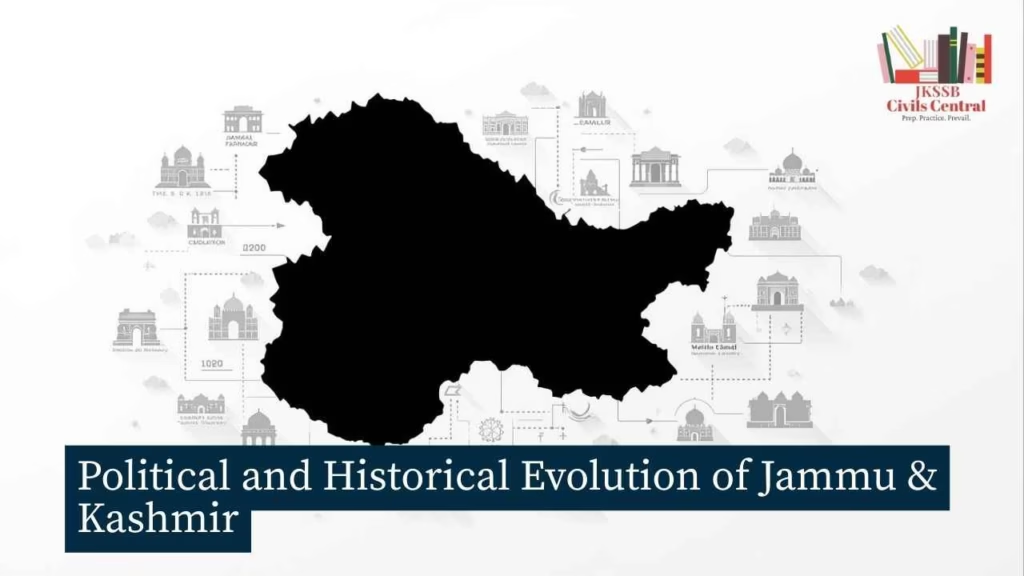

Political and Historical Evolution of Jammu & Kashmir
The political identity of Jammu and Kashmir (J&K) within the Indian Union is a unique narrative of historical resilience, constitutional shifts, and administrative transformation. For candidates preparing for the Jammu and Kashmir Services Selection Board (JKSSB) examinations, the study of this region’s history and polity is not merely a syllabus requirement but a fundamental necessity for understanding the governance framework in which they seek to serve.
Positioned as the northernmost apex of India, Jammu and Kashmir has served as a crossroads of civilizations, a crucible of dynastic changes, and a strategic bastion for national security. This report provides an exhaustive examination of the region’s journey from its mythological origins to its current status as a Union Territory governed under the framework of the Jammu and Kashmir Reorganisation Act, 2019.
Geographic Foundations and Strategic Imperatives
The physical landscape of Jammu and Kashmir has historically dictated its political boundaries and administrative challenges. The region is characterized by immense topographical diversity, ranging from the fertile plains of the Jammu division to the high-altitude alpine valleys of Kashmir and the rugged terrain of the Pir Panjal and Himalayan ranges. Geologically, the Union Territory is composed of rock formations spanning the oldest periods of the earth’s history to the youngest river and lake deposits.
The strategic significance of Jammu and Kashmir is derived from its location, bordering Pakistan to the west and China to the northeast. This geographical reality has influenced India’s defense and foreign policies since independence. The region is divided into 20 districts, with 10 located in the Kashmir Valley and 10 in the Jammu Division. The administrative structure recognizes two capitals to accommodate the seasonal variations of the climate: Srinagar serves as the summer capital, while Jammu functions as the winter capital.
Regional Classification and Physical Divisions
The Union Territory is structured into three distinct geographical zones that influence its climate, agriculture, and culture. The sub-mountain and semi-mountain plains, locally referred to as the Kandi or dry belt, provide the transition from the Punjab plains to the hills. Above this lies the Shivalik ranges, followed by the high mountain zone which constitutes the Kashmir Valley and the Pir Panjal range. The diversity of the terrain is further highlighted by major mountain ranges like the Nun Kun range, featuring peaks exceeding 7,000 meters, and the Zanskar range, which separates Zanskar from Ladakh.
| Feature | Details |
| Official Status | Union Territory since October 31, 2019 |
| Total Districts | 20 (10 in Jammu, 10 in Kashmir) |
| Legislative Model | Unicameral (Legislative Assembly) |
| Common High Court | High Court of Jammu & Kashmir and Ladakh |
The state symbols of the Union Territory reflect its ecological heritage. The Chinar (Platanus orientalis), known locally as “Booune,” is the official UT Tree, while the Lotus (Nelumbo nucifera) serves as the official UT Flower. The Kashmiri Stag, or Hangul, remains the state animal, representing the unique biodiversity of the region’s high-altitude forests.
Ancient and Medieval Historical Tapestry
The historical records of Kashmir are among the most meticulously documented in India, largely due to the existence of Sanskrit chronicles. The Nilamata-purana provides the mythological foundation, describing the valley as a vast prehistoric lake called Satisar. According to this tradition, the sage Kashyapa drained the lake, leading to the settlement of the land, which was subsequently named Kashyapmar. This history was later formalized by the poet-historian Kalhana in his seminal work, the Rajtarangini, written between 1148 and 1150 CE.
Ancient Jammu, too, finds mention in historical accounts, with its foundation attributed to Raja Jamboo Lochan during the Mahabharata period. Legend states that the city was founded after the Raja witnessed a lion and a goat drinking water from the same spot on the Tawi River, signifying a place of peace and coexistence.
Dynastic Successions and Religious Influence
Ancient Kashmir was ruled by a succession of influential dynasties, including the Mauryas, Kushans, and Karkotas. Emperor Ashoka is credited with introducing Buddhism to the valley and founding the original city of Srinagar. The Fourth Buddhist Council, a landmark event in religious history, was held at Kundalvan in Kashmir during the reign of the Kushan King Kanishka.
The 8th century witnessed the rise of the Karkota dynasty, with Lalitaditya Muktapida emerging as a formidable conqueror. His reign is best remembered for the construction of the Martand Sun Temple in Anantnag, an architectural marvel that stands as a symbol of the region’s ancient grandeur. The subsequent Lohara dynasty also played a significant role, with rulers like Queen Didda and her successor Sangramaraja maintaining the state’s sovereignty.
The Islamic and Mughal Eras
The transition to Muslim rule began in the 14th century, marked by the arrival of Sufi saints and the establishment of the Shah Mir dynasty. A pivotal figure of this era was Sultan Zain-ul-Abidin, popularly known as “Budshah” (the Great King), who is revered for his religious tolerance and promotion of arts and crafts like shawl weaving and papier-mâché. Significant monuments from this period include the Jamia Masjid of Srinagar, built by Sultan Sikandar, and the Khanqah of Shah Hamadan.
In 1586, the Mughal Emperor Akbar annexed Kashmir, integrating it into the vast Mughal Empire. Akbar constructed the Hari Parbat fort and planned a new capital called Nager Nagor. Subsequent Mughal rulers, particularly Jahangir and Shah Jahan, transformed the valley into a summer retreat, commissioning the world-famous Mughal gardens such as Shalimar Bagh and Nishat Bagh. The Mughals also created artificial islands on Dal Lake, namely Rupalank and Sonalank.
Following the decline of Mughal power, Kashmir came under the control of the Afghan Durrani Empire in the mid-18th century, a period often described as tumultuous. Afghan rule was eventually ended by the Sikh Empire under Maharaja Ranjit Singh, who conquered the valley in 1819.
The Dogra Era and the Birth of the Modern Princely State
The modern geopolitical entity of Jammu and Kashmir was consolidated in the 19th century under the Dogra dynasty. Gulab Singh, a distinguished general in the service of Maharaja Ranjit Singh, was installed as the Raja of Jammu in 1822. Through military campaigns led by his general, Zorawar Singh, Gulab Singh expanded his territory to include Ladakh, Baltistan, and Kishtwar.
The definitive moment for the modern state was the signing of the Treaty of Amritsar on March 16, 1846, between the British Government and Gulab Singh. Under this treaty, the British transferred the territory of Kashmir to Gulab Singh for a sum of 75 lakh Nanakshahi rupees, recognizing him as the Maharaja of the newly formed state of Jammu and Kashmir. This treaty established the Dogra dynasty as the rulers of a diverse region comprising the distinct cultural and linguistic zones of Jammu, Kashmir, and Ladakh.
| Dogra Ruler | Key Achievements / Events |
| Maharaja Gulab Singh | Founder of the state; signed Treaty of Amritsar (1846) |
| Maharaja Ranbir Singh | Modernized administration; Ranbir Penal Code (RPC) |
| Maharaja Pratap Singh | Infrastructure development; Banihal Cart Road construction |
| Maharaja Hari Singh | Last ruling monarch; signed Instrument of Accession (1947) |
The Dogra administration established a centralized governance structure. The royal residence shifted from the Mubarak Mandi Palace in Jammu to the Hari Niwas Palace in 1925 during the reign of Maharaja Hari Singh. It was also during this period that political consciousness began to rise, eventually leading to the formation of the Muslim Conference (later National Conference) and the ‘Quit Kashmir’ movement led by Sheikh Mohammad Abdullah.
1947: Independence, Invasion, and Accession
The end of British rule in August 1947 placed Jammu and Kashmir at a critical crossroads. As a princely state, it had the option to join either India or Pakistan or to remain independent. Maharaja Hari Singh initially opted for independence, hoping to maintain a neutral status. However, the situation deteriorated rapidly in October 1947 when tribal militias, supported by the Pakistani military, invaded the state.
The invaders advanced toward Srinagar, causing widespread destruction. Faced with the collapse of his forces and a threat to the sovereignty of the state, Maharaja Hari Singh sought military assistance from India. The Indian government, led by Prime Minister Jawaharlal Nehru, stipulated that aid could only be provided if the state formally acceded to the Indian Union.
The Instrument of Accession
On October 26, 1947, Maharaja Hari Singh signed the legal document known as the Instrument of Accession, thereby integrating Jammu and Kashmir with the Dominion of India. Lord Mountbatten, the Governor-General of India, accepted the accession on October 27, 1947. This legal act provided the basis for India’s military intervention to repel the invaders and remains the constitutional foundation of the region’s status within India.
Following the accession, an interim “Emergency Administration” was established on October 30, 1947, with Sheikh Mohammad Abdullah as the administrator. By March 5, 1948, a popular interim government was formed with Sheikh Abdullah as the Prime Minister. In 1949, Maharaja Hari Singh appointed his son, Yuvraj Karan Singh, as the Regent to act as the head of state.
The Framework of Special Status: Article 370 and Article 35A
The relationship between Jammu and Kashmir and the Indian Union was uniquely governed by Article 370 of the Indian Constitution, which came into force in 1950. This article was categorized under Part XXI of the Constitution as a “temporary, transitional, and special provision”. Its inclusion was intended to recognize the unique circumstances of the state’s accession and to provide a temporary framework for its internal governance until its own constitution could be drafted.
Key Features of Article 370
Article 370 granted significant autonomy to the state, restricting the legislative power of the Indian Parliament in Jammu and Kashmir. The Parliament could only make laws for the state on subjects related to defense, foreign affairs, communications, and finance without the concurrence of the state government. For all other matters, the concurrence of the state legislature was required for central laws to apply.
Other distinctive features included:
- The state had its own separate constitution.
- The concept of “dual citizenship” (state subject and Indian citizen) was maintained.
- Financial emergencies under Article 360 could not be imposed on the state.
- Directive Principles of State Policy and Fundamental Duties were not automatically applicable.
Article 35A and Permanent Residency
Introduced via a Presidential Order in 1954 (C.O. 48), Article 35A empowered the Jammu and Kashmir State Legislature to define “permanent residents” of the state. This article provided these residents with special rights and privileges in terms of government employment, acquisition of immovable property within the state, settlement, and eligibility for state-funded scholarships. The provision was designed to protect the demographic and cultural identity of the region, but it remained a point of legal and political contention for decades.
Administrative Evolution (1951–1965)
In 1951, a Constituent Assembly was elected to draft the state’s constitution. The assembly met for the first time in Srinagar on October 31, 1951. A major step in federal relations was the 1952 Delhi Agreement between Nehru and Sheikh Abdullah, which defined the state’s internal autonomy parameters.
The Constitution of Jammu and Kashmir was adopted on November 17, 1956, and came into full effect on January 26, 1957. Section 3 of this constitution famously declared that “Jammu and Kashmir is and shall be an integral part of the Union of India”.
Another significant transition occurred in 1965. Through the 6th amendment to the State Constitution, the titles were changed to align with the rest of India. The Sadr-i-Riyasat (Head of State) was redesignated as the Governor, and the Prime Minister of the state was redesignated as the Chief Minister. Karan Singh, who was the elected Sadr-i-Riyasat at the time, became the first Governor of Jammu and Kashmir on March 30, 1965.
The 2019 Watershed: Abrogation and Reorganisation
The political landscape of Jammu and Kashmir underwent a monumental shift on August 5, 2019. The President of India issued the Constitution (Application to Jammu and Kashmir) Order, 2019 (C.O. 272), which rendered Article 370 inoperative. This was followed by the passage of the Jammu and Kashmir Reorganisation Act, 2019, which transformed the state into two Union Territories (UTs): Jammu & Kashmir and Ladakh.
The Reorganisation Act received presidential assent on August 9, 2019, and the transition became effective on October 31, 2019. This date was chosen to coincide with the birth anniversary of Sardar Vallabhbhai Patel, the architect of India’s political integration.
Structural Changes under the 2019 Act
The reorganization introduced profound changes to the region’s administrative and legal framework. The most critical change was the bifurcation of the erstwhile state. The Union Territory of Jammu and Kashmir was established with a legislative assembly (modeled after Puducherry under Article 239A), while the Union Territory of Ladakh was established without a legislature, to be administered by a Lieutenant Governor alone.
Key provisions of the Act include:
- Abolition of the Legislative Council: The upper house of the state legislature was abolished.
- Executive Leadership: The Governor of the existing state became the common Lieutenant Governor for both UTs during the transition. Subsequently, separate Lieutenant Governors were appointed.
- Legal Integration: 106 central laws were extended to the UTs, including the Indian Penal Code (replacing the Ranbir Penal Code), the Right to Information Act, and the Right to Education Act.
- Repeal of State Laws: 153 state laws were repealed, while 166 others were retained or modified.
- Representation: The UT of Jammu and Kashmir was allocated five Lok Sabha seats, and Ladakh was allocated one.
| Aspect | Before August 5, 2019 | After October 31, 2019 |
| Status | Full State | Union Territory (J&K and Ladakh) |
| Constitution | Separate State Constitution | Only Constitution of India |
| Legislature | Bicameral (Assembly & Council) | Unicameral (Assembly) |
| Executive Head | Governor | Lieutenant Governor |
| Flag | Separate State Flag | Only National Tri-color |
| Penal Code | Ranbir Penal Code (RPC) | Indian Penal Code (IPC) |
Judicial Review and the Supreme Court Verdict (2023)
The abrogation of Article 370 was challenged by various petitioners, leading to a comprehensive hearing by a five-judge Constitution Bench of the Supreme Court of India. On December 11, 2023, the Court delivered a unanimous verdict upholding the validity of the abrogation and the reorganization process.
The Supreme Court’s rationale included several key findings:
- Article 370 was Temporary: The Court noted that the provision was designed as a temporary measure for the state’s integration and its placement in Part XXI of the Constitution confirmed its transitional nature.
- Sovereignty: The Bench ruled that Jammu and Kashmir did not retain any element of sovereignty after its accession to India. The Constitution of India became the supreme law of the land.
- Presidential Powers: The President had the authority to issue a notification for the cessation of Article 370 even in the absence of a recommendation from the state’s Constituent Assembly, which had dissolved in 1957.
- Restoration of Democracy: The Court directed the Election Commission of India to conduct elections for the Legislative Assembly by September 30, 2024, and emphasized the restoration of statehood as soon as possible.
The Delimitation Exercise (2020–2022)
To facilitate the first elections in the newly formed Union Territory, a Delimitation Commission was established in March 2020, headed by retired Supreme Court Judge Justice Ranjana Prakash Desai. The commission was tasked with redrawing the boundaries of assembly and parliamentary constituencies based on the 2011 Census.
The commission published its final report on May 5, 2022, which came into effect on May 20, 2022. The report introduced significant changes:
- Increase in Seats: The total number of elected seats in the Legislative Assembly was increased from 83 to 90.
- Regional Distribution: Of the 90 seats, 43 were allocated to the Jammu division (an increase of 6) and 47 were allocated to the Kashmir division (an increase of 1).
- Reservations: For the first time in the region’s history, 9 seats were reserved for Scheduled Tribes (ST) and 7 seats for Scheduled Castes (SC).
- PoJK Reservation: 24 seats continue to be designated for the areas under the occupation of Pakistan and remain officially vacant.
| Division | Seats before 2019 | Seats after 2022 Delimitation |
| Kashmir Division | 46 | 47 |
| Jammu Division | 37 | 43 |
| Total Elected Seats | 83 | 90 |
| Nominated Seats | – | 5 |
The 2024 Legislative Assembly Elections and New Governance
Following the delimitation, the first assembly elections in the Union Territory of Jammu and Kashmir were held in three phases from September 18 to October 1, 2024. The elections saw a record turnout, reflecting the public’s engagement in the restored democratic process.
The results, declared on October 8, 2024, led to the formation of a new government:
- The Jammu and Kashmir National Conference (JKNC) emerged as the single-largest party, winning 42 seats.
- The Bharatiya Janata Party (BJP) won 29 seats, primarily in the Jammu division.
- The Indian National Congress (INC) won 6 seats, while the Peoples Democratic Party (PDP) won 3 seats.
- Omar Abdullah was sworn in as the first Chief Minister of the Union Territory on October 16, 2024.
The Role of Nominated Members
The 2019 Act and its 2023 amendment provide for the nomination of five members to the Legislative Assembly by the Lieutenant Governor. These include:
- Two members from the Kashmiri Migrant community (at least one must be a woman).
- One member representing displaced persons from Pakistan-occupied Jammu and Kashmir (PoJK).
- Two women members if they are not adequately represented through elections.
These nominated members have the same rights as elected members, bringing the effective strength of the house to 95 for certain proceedings.
Current Affairs and Governance in 2025–2026
As of early 2026, the administration of Jammu and Kashmir continues to balance security priorities with developmental goals. The Lieutenant Governor, Manoj Sinha, serves as the representative of the President, while the elected government under Chief Minister Omar Abdullah manages the day-to-day affairs of the UT within its legislative competence.
The 2026 Budget Session
The fifth session of the first J&K Legislative Assembly is scheduled to commence on February 2, 2026. The session will begin with an address by Lieutenant Governor Manoj Sinha. A primary focus of this session is the presentation of the annual budget for the financial year 2026-27, as well as the supplementary statement of expenditure for 2025-26.
Ahead of the session, Speaker Abdul Rahim Rather chaired a Business Advisory Committee (BAC) meeting to finalize the agenda. Key political figures involved in the current assembly include Sunil Kumar Sharma as the Leader of Opposition (BJP) and Adv. Abdul Rahim Rather as the Speaker (JKNC).
Economic Indicators and Budget Highlights (2025-26)
The budget for the 2025-26 financial year, presented in March 2025, provided a roadmap for the region’s economic recovery and growth. The Gross State Domestic Product (GSDP) for 2025-26 is projected to be ₹2,88,422 crore, indicating a 10% growth over the previous year.
| Sector | Contribution to Economy (2024-25) |
| Services Sector | 62% |
| Agriculture & Allied | 20% |
| Manufacturing / Industry | 18% |
Key policy initiatives for the current period include:
- Mission YUVA: Aiming to create 1,37,000 enterprises and 4,25,000 jobs over five years.
- Free Transport for Women: Granting all women free ridership on government-owned e-buses and JKSRTC buses starting April 2025.
- Enhanced Food Security: Providing 10 kg of free rations to Antyodaya Anna Yojana (AAY) beneficiaries.
- Power Reforms: 200 units of free power for AAY families linked to the PM Surya Ghar scheme.
- Sakhi Niwas: Establishment of five new working women hostels in major districts including Srinagar and Jammu.
Security and Administrative Milestones
Security forces remain vigilant against infiltration attempts and terror activities, particularly along the Pir Panjal ranges. Initiatives like “Operation Sarvashakti” have been launched to target terror networks in the Rajouri-Poonch sector. On the administrative front, J&K has seen a significant push toward digitalization, with the e-Office system and the “Good Governance Index” being implemented across all districts.
Syllabus Guide for JKSSB Aspirants: High-Yield Topics
To excel in the General Knowledge section with special reference to J&K UT, aspirants should focus on the following core areas derived from verified sources:
Important Historical Sites and Founders
- Srinagar: Founded by Ashoka; known as the City of Rivers.
- Jammu: Founded by Raja Jamboo Lochan; named after the Tawi River area.
- Hari Parbat Fort: Initially built by Akbar; finalized by Atta Mohammad Khan.
- Martand Sun Temple: Built by Lalitaditya Muktapida in Anantnag.
- Shalimar Bagh: Built by Jahangir for his wife Noor Jahan in 1619.
- Nishat Garden: Built by Asif Khan, elder brother of Noor Jahan, in 1633.
Geographic Milestones
- Largest Lake: Wular Lake (Bandipora), one of the largest freshwater lakes in Asia.
- Highest Mountain Range: Nun Kun range.
- World’s Highest Railway Bridge: Chenab Rail Bridge, part of the USBRL project.
- Important Passes: Zoji La (connects Srinagar and Leh), Banihal Pass (Jammu-Srinagar route), Razdan Pass (Gurez Valley).
Key Constitutional Dates for MCQs
- Treaty of Amritsar: March 16, 1846.
- Instrument of Accession: October 26, 1947.
- Adoption of State Constitution: November 17, 1956.
- Effective Date of J&K Constitution: January 26, 1957.
- Abrogation of Article 370: August 5, 2019.
- Reorganisation Act effective date: October 31, 2019.
Conclusion: The Road Ahead for J&K
The historical journey of Jammu and Kashmir has reached a new chapter where integration with the Indian Union is complete, and a local democratic government is once again in place. The transition from a state with special status to a Union Territory has been validated by the highest court of the land, emphasizing the temporary nature of past constitutional arrangements.
For the aspirants, the “Historical Significance of J&K in Indian Polity” is more than a topic; it is an understanding of the evolving federal structure of India. As the region moves toward the restoration of statehood, as promised by the central government and directed by the Supreme Court, the administrative and political mechanisms will continue to refine.
Success in the upcoming JKSSB exams will require a firm grasp of these historical facts, paired with an analytical understanding of current affairs and the legislative frameworks that define modern Jammu and Kashmir. In this dynamic environment, the role of a civil servant is to be the bridge between this rich history and a prosperous, integrated future.
About The Author



Pingback: Complete History of Jammu & Kashmir in Chronological Order - JKSSB-CivilsCentral