
History of Jammu & Kashmir
From Prehistoric Times to Union Territory Status – A Comprehensive Guide for JKSSB Aspirants
Jammu & Kashmir holds a unique and layered place in Indian history. For JKSSB and other competitive exams, questions are often asked from its ancient past, medieval transitions, Dogra administration, accession to India, and modern constitutional changes.
This post presents the entire history of Jammu & Kashmir in chronological order, so aspirants can understand the flow of political, cultural, and administrative developments across time.
1. Prehistoric & Early History of Jammu & Kashmir
The history of Jammu & Kashmir begins long before written records.
🔹 Prehistoric Evidence
Archaeological findings from Burzahom (near Srinagar) show that Kashmir was inhabited during the Neolithic period (around 3000 BCE).
Key features:
- Pit dwellings (people lived in underground houses)
- Use of stone tools and bone implements
- Evidence of hunting and early agriculture
- Burials with animals suggest ritual practices
These findings indicate that Kashmir had an independent early cultural development.
2. Vedic and Early Historical Period
Kashmir finds mention in ancient Indian texts.
- The region is referred to as “Kashyapa-Meru” in Hindu traditions.
- According to mythology, Sage Kashyapa drained a vast lake to make the Kashmir Valley habitable.
- The Nilamata Purana (an early text related to Kashmir) describes the culture, religion, and traditions of early Kashmir.
By the later Vedic period, Kashmir was influenced by Hindu religious practices, temple culture, and Sanskrit learning.
3. Kalhana’s Rajatarangini– The First Historical Chronicle
The most important source of early Kashmir history is Kalhana’s Rajatarangini (12th century CE).
Why it is important:
- It is one of the earliest historical chronicles in Sanskrit
- It provides a continuous list of rulers of Kashmir
- Combines legend with historical facts
- Used as a major source for reconstructing Kashmir’s early political history
For exams, remember:
Rajatarangini = “River of Kings” = First historical chronicle of Kashmir
4. Mauryan Rule in Kashmir – Emperor Ashoka
In the 3rd century BCE, Kashmir came under the Mauryan Empire.
Role of Emperor Ashoka
- Ashoka is said to have founded the city of Srinagari (early Srinagar)
- He promoted Buddhism in the region
- Construction of stupas and monasteries
- Buddhism began to spread widely in the valley
This period marked Kashmir’s integration into pan-Indian political and religious developments.
5. Kushan Empire in Jammu & Kashmir: Governance and Mahayana Buddhism
After the Mauryas, Kashmir came under the Kushan Empire (1st–3rd century CE).
Cultural Impact of Kushans
- Kushan ruler Kanishka is closely associated with Kashmir
- The Fourth Buddhist Council is believed to have been held in Kashmir under Kanishka
- Kashmir became a major centre of Mahayana Buddhism
- Flourishing of art, trade, and religious scholarship
Kashmir now emerged as a bridge between India, Central Asia, and China.
6. Buddhism in Kashmir: History and Archaeological Evidence
From the Mauryan to Kushan periods, Buddhism deeply influenced Kashmir.
- Monasteries were established across the valley
- Kashmiri monks travelled to Central Asia and China
- Kashmir became known as a seat of Buddhist learning
However, later centuries saw the revival of Hinduism, especially Shaivism.
MEDIEVAL HISTORY OF JAMMU & KASHMIR
7. Karkota Dynasty in Kashmir: Lalitaditya Muktapida and His Rule
One of the greatest dynasties in Kashmir’s early medieval period was the Karkota Dynasty (7th–9th century CE).
Lalitaditya Muktapida (Greatest Ruler)
- Ruled in the 8th century CE
- Expanded Kashmir’s influence into Central Asia and North India
- Promoted art, architecture, and trade
Martand Sun Temple
- Built by Lalitaditya
- Located near Anantnag
- One of the finest examples of ancient Indian temple architecture
The Karkota period is considered a golden age of Kashmir’s political power.
8. Utpala Dynasty and Medieval Kashmir History: Guide for JKSSB Aspirants
After the Karkotas, the Utpala Dynasty (9th–10th century CE) ruled Kashmir.
Key Developments
- Political instability increased
- Rise of powerful ministers and nobles
- Decline of central authority
This period laid the ground for internal conflicts and weakening of Hindu dynasties.
9. Advent of Islam in Jammu and Kashmir – History Notes for JKSSB Exams
Islam arrived in Kashmir in the 14th century.
How Islam Spread
- Through Sufi saints, especially Shah-i-Hamdan (Mir Sayyid Ali Hamadani)
- Emphasis on spirituality, equality, and simple living
- Many locals gradually converted
Islam spread peacefully and culturally, not primarily through military conquest.
10. Sultanate Rule in Kashmir: Rulers and Reforms for JKSSB Preparation
The Shah Mir Dynasty (1339 CE onwards) established Muslim rule in Kashmir.
Important Rulers
Sultan Sikandar (Sikandar Butshikan)
- Known for religious intolerance in some accounts
Zain-ul-Abidin (Budshah)
- Most famous and tolerant ruler
- Promoted religious harmony
- Encouraged arts, crafts, shawl industry, and Sanskrit scholars
- Translated Sanskrit works into Persian
Zain-ul-Abidin’s rule is remembered as a period of peace and prosperity.
11. Cultural & Religious Developments in Medieval Kashmir
- Growth of Kashmiri language and literature
- Development of handicrafts like shawl weaving, wood carving
- Coexistence of Hinduism, Buddhism, and Islam
- Influence of Sufi and Rishi traditions (like Sheikh Noor-ud-din)
MUGHAL, AFGHAN & SIKH RULE
12. Mughal Rule in Kashmir – Administration and Architecture Notes for JKSSB
Kashmir was annexed by Emperor Akbar in 1586.
Key Features
- Kashmir became a summer retreat of Mughal emperors
- Construction of Mughal Gardens:
- Shalimar Bagh
- Nishat Bagh
- Better administrative organization
- Promotion of art and architecture
However, heavy taxation sometimes burdened local people.
13. Afghan Rule in Kashmir (1753–1819) – History Notes for JKSSB Exams
After the Mughals, Kashmir came under Afghan rule (1752–1819).
Impact on People
- Known as a harsh period
- Heavy taxation
- Oppression by Afghan governors
- Economic decline
This period is often described as one of the dark phases in Kashmir’s history.
14. Maharaja Ranjit Singh and Sikh Rule in Kashmir – JKSSB Preparation
In 1819, the Sikhs defeated the Afghans and took control of Kashmir.
Key Features
- End of Afghan oppression
- Kashmir became part of the Sikh Empire
- However, high taxation still continued
- Religious restrictions were placed on Muslims in some cases
Sikh rule lasted until the First Anglo-Sikh War.
14.1 Afghan & Sikh Rule in Kashmir – Socio-Economic Changes for JKSSB
DOGRA RULE & PRINCELY STATE ERA
15. Formation of Jammu and Kashmir Princely State (1846) – JKSSB Notes
After the Treaty of Lahore (1846) and Treaty of Amritsar (1846):
- The British sold Kashmir to Gulab Singh
- Gulab Singh became the Maharaja of Jammu & Kashmir
- Thus, the Princely State of J&K was formed
16. Treaty of Amritsar (1846)
Causes
- British victory in the First Anglo-Sikh War
- Weakening of Sikh power
Consequences
- Gulab Singh purchased Kashmir for 75 lakh Nanakshahi rupees
- Creation of a large princely state including Jammu, Kashmir, Ladakh, and Gilgit
17. Dogra Rule in Jammu and Kashmir: Administrative Developments
Gulab Singh founded the Dogra rule, which lasted until 1947.
Successors:
- Ranbir Singh
- Pratap Singh
- Hari Singh
18. Administrative Reforms Under Dogra Rulers
Ranbir Singh
- Introduced Ranbir Penal Code
- Encouraged Sanskrit and Persian learning
Pratap Singh
- Modern administration
- Roads, schools, and hospitals
Hari Singh
- Judicial reforms
- Education initiatives
- Faced political opposition from people demanding rights
19. Socio-Economic Conditions During Dogra Rule
- Heavy land revenue burden on peasants
- Rise of political awareness
- Growth of opposition movements in the 20th century
MODERN HISTORY & POLITICAL DEVELOPMENTS
20. Quit Kashmir Movement 1946: Causes, Politics & Impact – JKSSB Notes
- Led by Sheikh Abdullah
- Against autocratic rule of Maharaja Hari Singh
- Demanded responsible government
21. Sheikh Abdullah & Modern Jammu & Kashmir: Political Role & Legacy – JKSSB Notes
- Leader of National Conference
- Major figure in Kashmir politics
- Played a key role during accession to India
22. Accession of Jammu and Kashmir: History, Legal Process & Modern Integration
After tribal invasion from Pakistan:
- Maharaja Hari Singh signed the Instrument of Accession
- J&K acceded to India on 26 October 1947
- India sent troops to defend the region
23. Article 370 and 35A Explained: History and Administrative Framework of J&K
Article 370
- Granted special autonomous status to J&K
- Separate Constitution, flag, and laws
Article 35A
- Defined permanent residents
- Gave special rights in jobs and land ownership
24. Land Reforms in Jammu & Kashmir
Under Sheikh Abdullah:
- Big landowners lost excess land
- Land redistributed to peasants
- One of the most radical land reform programs in India
JAMMU & KASHMIR AS A UNION TERRITORY
🔄 25. Jammu and Kashmir Reorganisation Act: Historical Background and Administrative Changes
On 5 August 2019:
- Article 370 effectively revoked
- J&K Reorganisation Act passed
State divided into:
- Union Territory of Jammu & Kashmir
- Union Territory of Ladakh
26. J&K Reorganisation Act: Framework and Administrative Overview
- Separate Constitution removed
- Indian Constitution fully applicable
- Central laws extended
- Legislative Assembly for J&K UT (but not Ladakh)
27. Political and Historical Evolution of Jammu & Kashmir – Complete Guide for JKSSB Aspirants
- Lieutenant Governor as head
- Council of Ministers (when Assembly exists)
- High Court continues
28. Historical Evolution of Jammu & Kashmir – Administrative Timeline for Competitive Exams
- Border state with strategic importance
- Cultural meeting point of Hinduism, Buddhism, and Islam
- Key issue in India’s federal and constitutional history
29.Jammu & Kashmir History: Important Facts for JKSSB & Other Exams
30. Key One-Liners on Jammu & Kashmir History – JKSSB Preparation
31. Jammu & Kashmir History MCQs with Answers for JKSSB & Competitive Exams
EXAM-FOCUSED REVISION SECTION
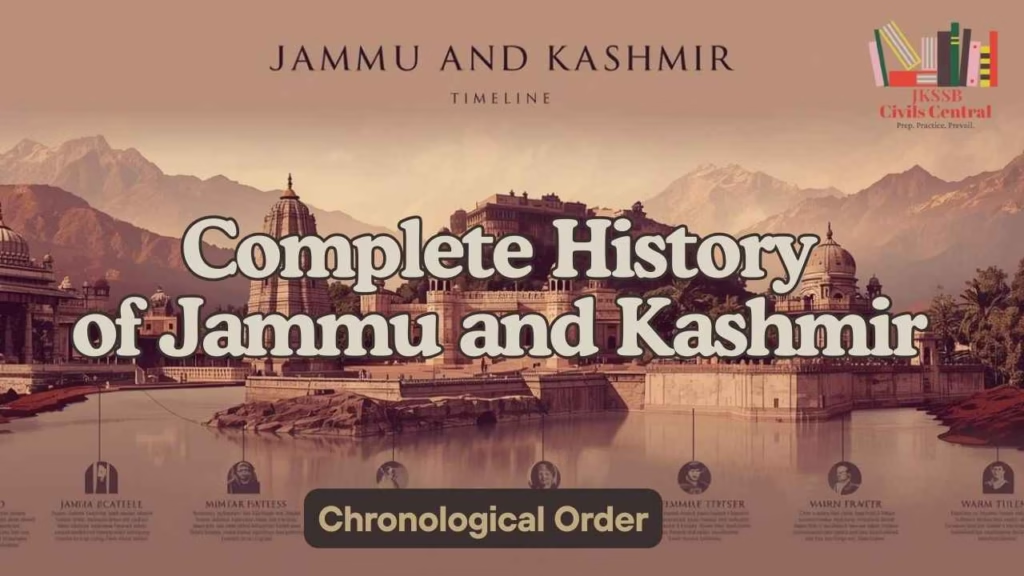
🕰️ Quick Timeline
| Period | Major Events |
| Prehistoric | Burzahom Neolithic culture |
| Mauryan | Ashoka spreads Buddhism |
| Kushan | Kanishka & Buddhist Council |
| Karkota | Lalitaditya, Martand Temple |
| Sultanate | Shah Mir dynasty, Zain-ul-Abidin |
| Mughal | Gardens, imperial control |
| Afghan | Harsh rule |
| Sikh | Ranjit Singh annexes Kashmir |
| Dogra | Treaty of Amritsar, princely state |
| 1947 | Accession to India |
| 1950 | Article 370 in effect |
| 2019 | Reorganization into UTs |
🧠 One-Liner Facts for JKSSB
- Rajatarangini was written by Kalhana
- Lalitaditya built the Martand Sun Temple
- Zain-ul-Abidin = Budshah (Great King)
- Treaty of Amritsar signed in 1846
- J&K acceded to India on 26 October 1947
- Article 370 revoked in 2019
✅ Conclusion
The history of Jammu & Kashmir is a story of ancient civilizations, powerful dynasties, cultural fusion, colonial treaties, political struggles, and constitutional transformation. For JKSSB aspirants, understanding this chronological flow is the key to solving both MCQs and descriptive questions.
Revise this timeline repeatedly, and you’ll be able to tackle any history question on Jammu & Kashmir with confidence.
About The Author