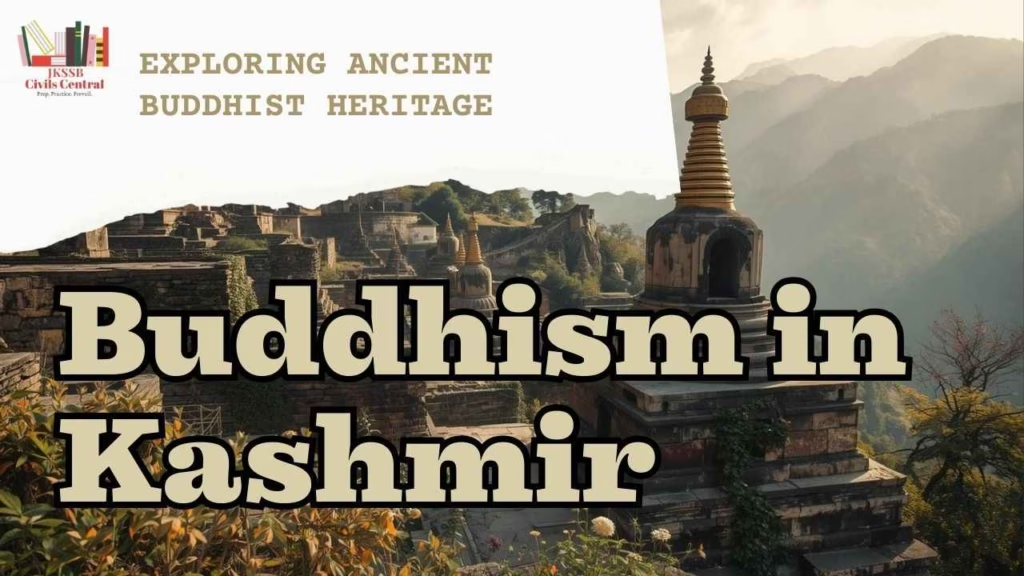

Buddhism in Kashmir
The historical trajectory of Buddhism in the Kashmir Valley is not merely a record of religious diffusion but a sophisticated chronicle of how a geographically isolated mountainous region transformed into a global intellectual hub. For candidates preparing for the Jammu and Kashmir Services Selection Board (JKSSB) examinations, the study of Buddhism in Kashmir is high-yield, frequently appearing in sections concerning the “General Knowledge with special reference to J&K”. This report provides an exhaustive analysis of the faith’s arrival, its peak during the Kushan era, its scholastic contributions to the world, and the recent archaeological breakthroughs of 2025-2026 that have redefined the regional historical narrative.
How Kashmir Began: Satisar and Indigenous Communities
The origin of settlement in the Kashmir Valley is steeped in the legend of the Satisar, a vast mountain lake that, according to the Nilamata Purana and Kalhana’s Rajatarangini, was drained by the sage Kashyapa. Geologically, this narrative aligns with evidence of volcanic actions or desiccation that transformed the lake into a habitable valley. Before the formal introduction of Buddhism, the region was inhabited by indigenous groups known as the Nagas, Pishachas, and Yakshas. These aborigines initially practiced Naga worship, a tradition that deeply influenced the later Buddhist and Hindu cultures of Kashmir.
While popular history often dates the arrival of Buddhism to the Mauryan period, literary sources like the Rajatarangini suggest that Buddhist influences were present in the valley long before the reign of Emperor Ashoka. Pre-Ashokan Kashmir was already home to several Viharas, and the local population had begun a gradual transition from Vedic faiths to Buddhist thought, attracted by its philosophical rigor and social inclusivity. This early, organic spread laid the foundation for the massive state-sponsored expansion that would follow under the Mauryas.
| Historical Source | Description of Early Kashmir | Key Significance for Aspirants |
| Nilamata Purana | Describes Kashmir as the lake ‘Satisar’ | Validates the ancient geological history of the valley |
| Rajatarangini | Written by Kalhana in 1148-50 CE | The primary historical chronicle for J&K history |
| Chinese Accounts | Referred to Kashmir as ‘Ki-pin’ or ‘Jipin’ | Highlights early international recognition of the region |
| Indigenous Tribes | Nagas, Pishachas, and Yakshas | The original cultural layers of the Kashmiri populace |
The Mauryan Epoch: Ashoka and the Mission of Majjhantika
The transformation of Buddhism into a dominant spiritual force in Kashmir is traditionally linked to the Mauryan Emperor Ashoka (r. 268–232 BCE). Ashoka’s engagement with the valley was multidimensional, involving urban planning, monastic construction, and missionary outreach. According to the Ceylonese Chronicles and Buddhist records, after the Third Buddhist Council at Pataliputra, the monk Majjhantika, a pupil of Ananda, was dispatched to Kashmir and Gandhara to spread the teachings of the Buddha.
Majjhantika’s mission is of particular interest to JKSSB aspirants because it intertwines religious history with Kashmiri cultural identity. Legend credits Majjhantika with the introduction of saffron cultivation to the valley, a crop that remains a cornerstone of the regional economy. Ashoka himself is credited with founding the city of ‘Srinagari’ at the site of modern-day Pandrethan (old Srinagar) and constructing 84,000 stupas across his empire, many of which were located in Kashmir. He also built the Dharamanaranyavihara near the source of the Jhelum (Vitasta), a monastery so lofty that it was said to defy the gaze of the observer.
| Mauryan Influence | Detailed Contribution to Kashmir | Exam Focus |
| Emperor Ashoka | Founded Srinagari and established Viharas | Introduced Buddhism in the 3rd Century BCE |
| Majjhantika | Missionary sent by Mogaliputra Tissa | Introduced saffron and established the Dhamma |
| Infrastructure | Construction of 84,000 stupas | Physical marks of Buddhist expansion |
| Jaluka | Ashoka’s son; initially a Shaivite | Defeated foreign tribes (Melechas) and restored peace |
The Kushan Empire: Kanishka and the Fourth Buddhist Council
The zenith of Buddhism in the Kashmir Valley was reached during the Kushan Empire, particularly under the reign of Emperor Kanishka (c. 1st–2nd century CE). Kanishka’s patronage was so profound that it shifted the center of the Buddhist world toward Kashmir and Gandhara. The most significant event of this era was the convening of the Fourth Buddhist Council in Kashmir.
The Fourth Buddhist Council was a pivotal moment that addressed internal divisions and formalized the Mahayana tradition. The council was presided over by the scholar Vasumitra, with the participation of Ashvaghosha, and was attended by 500 Arhats, 500 Bodhisattvas, and 500 Panditas. It was held at Kundalvana, a site often identified with Harwan or Kanzalwan. One of the most critical outcomes of the council was the encoding of the Mahā-Vibhāshā, a vast commentary on the Abhidharma, which was reportedly engraved on copper sheets and buried in a stone box within a stupa. This council also marked the official transition of Buddhist scholarly language from Prakrit to Sanskrit, reflecting the valley’s role as a seat of Sanskrit Buddhist learning.
| Aspect | Details of the Fourth Buddhist Council | Significance for JKSSB |
| Patron | King Kanishka (Kushan Dynasty) | High-yield topic for Ancient History |
| Venue | Kundalvana, Kashmir (often linked to Harwan) | Location is a frequent MCQ topic |
| Scholars | Vasumitra (President) and Ashvaghosha | Key personalities of the Kushan era |
| Outcome | Rise of Mahayana Buddhism; Sanskrit canon | Changed the trajectory of global Buddhism |
| Relic | Engraved copper sheets in stone boxes | The ‘Holy Grail’ of Kashmiri archaeology |
Architectural Marvels: Harwan, Parihaspore, and Ambaran
The physical footprint of Buddhism in Kashmir is evidenced by a series of archaeological sites that demonstrate advanced urban planning and artistic synthesis. Aspirants should be familiar with the architectural features of these sites, as they often appear in questions regarding J&K heritage.
Harwan (Shadarhadavana)
Harwan, located near the Shalimar Garden in Srinagar, is identified as the ancient Shadarhadavana or “Grove of Six Saints”. The site is world-renowned for its unique terracotta tiles, which date between the 1st and 5th centuries CE. These tiles depict a variety of motifs, including dancers, archers on horseback, rams fighting, and seated figures, reflecting a blend of Kashmiri, Central Asian, and Gandharan artistic traditions. The site features diaper pebble masonry and an apsidal shrine, which are characteristic of the early centuries of the Christian era.
Parihaspore (Kani Shahar)
Built in the 8th century by the Karkota ruler Lalitaditya Muktapida, Parihaspore served as the capital of Kashmir. While Lalitaditya was a staunch supporter of Vishnu, his patronage was syncretic; he commissioned a massive copper statue of the Buddha that reportedly “reached the sky” and established the Rajavihara monastery. Today, the site is known as “Kani Shahar” or the City of Stones due to the massive limestone blocks that remain. The ruins include a Chaitya, a stupa, and monastic cells, highlighting the scale of religious architecture in the 8th century.
Ambaran-Pamberwan (Akhnoor)
Ambaran, located near Akhnoor in the Jammu region, is the only identified Buddhist site in Jammu, making it a critical point for state-level exams. Excavations by the Archaeological Survey of India (ASI) have unearthed stupas and terracotta figurines dating back to the 2nd century BCE. These findings confirm that the influence of Buddhism was not restricted to the valley but was a pan-regional phenomenon during the early historic period.
| Archaeological Site | Primary Features | District |
| Harwan | Terracotta tiles; Diaper pebble masonry | Srinagar |
| Parihaspore | Massive stone blocks; Copper Buddha | Baramulla |
| Ambaran | Stupa remains; Buddhist terracotta | Jammu |
| Ushkur | Ancient stupa and Kushan settlement | Baramulla |
| Pandrethan | Site of the original city of Srinagari | Srinagar |
Kashmir as a Center of Global Scholasticism
The reputation of Kashmir as “Sharada Pitha”—a seat of learning—was sustained by its role as a repository and transmitter of Buddhist knowledge. Kashmiri monks were the primary agents of change who carried the Mahayana tradition across the Silk Route to Central Asia and China.
The Scholar-Monks
One of the most illustrious figures was Kumarajiva, a 5th-century scholar-monk who, after studying in the valley, traveled to China and translated numerous Sanskrit texts into Chinese, a legacy that is still venerated today. Another significant figure was Gunavarman, who is credited with spreading Buddhism to Indonesia. The valley also produced great philosophers like Asanga and Vasubandhu, who visited the region for study and edification.
The Chinese Pilgrims
The accounts of Chinese travelers like Hiuen Tsang (Xuanzang), who visited in the 7th century during the reign of Durlabhavardhana, provide invaluable historical context. Hiuen Tsang stayed in the valley for two years (631–633 CE), studying Sanskrit and Buddhist doctrine. His record, the Si-Yu-Ki, describes the existence of hundreds of monks and the deep respect for Buddhist learning in Kashmir.
The Gilgit Manuscripts
Discovery of the Gilgit Manuscripts represents one of the most significant finds in Buddhist archaeology. These are among the oldest surviving Buddhist texts in the world, written in Sanskrit and Prakrit, and they underscore Kashmir’s role as a custodian of original Buddhist philosophy at a time when ideas moved along monastic and mercantile networks.
Dynastic Transitions and the Decline of Institutional Buddhism
The history of Buddhism in the valley was a dynamic process of rise, peak, and eventual absorption into the regional syncretic culture.
The Huna Invasion and Mihirkula
In the 6th century, the expansion of Buddhism faced a severe setback under the Huna king Mihirkula. Known for his brutal persecution of Buddhists, Mihirkula destroyed numerous temples and monasteries, forcing many monks to flee the region. Despite this period of “terrorism,” Buddhism persisted in the valley, eventually enjoying a revival under later dynasties.
The Karkota and Utpala Dynasties
Under the Karkota dynasty (7th-8th century), Buddhism and Hinduism coexisted under imperial patronage. Rulers like Lalitaditya Muktapida and his grandson Jayatida were known for supporting scholars of both faiths. The Utpala dynasty, founded by Avantivarman in 855 AD, furthered this trend. Avantivarman focused on economic upliftment and the construction of temples in Avantipura dedicated to both Vishnu and Shiva, yet the artistic motifs of the era continued to reflect the Buddhist influence.
The Birth of “Kashmiriyat”
By the 9th century, the institutional dominance of Buddhism began to fade as Kashmiri Shaivism flourished under thinkers like Vasugupta. However, Buddhism did not vanish; rather, its philosophical emphasis on the “Middle Path” and non-extremism became embedded in the spiritual fabric of the valley. This shared cultural soil of Buddhist, Shaivite, and later Sufi thought formed the foundation of Kashmir’s syncretic composite culture, known as Kashmiriyat.
2025-2026 Current Affairs: The Zehanpora Breakthrough
For JKSSB aspirants, staying updated with the most recent archaeological and cultural events is essential. The year 2025 has been landmark for Buddhist studies in Jammu and Kashmir.
The Zehanpora Discovery
Archaeologists have recently unearthed a major 2,000-year-old Buddhist complex in Zehanpora village, Baramulla district. The site, spread over ten acres, revealed apsidal stupa foundations, monastic cells, pottery shards, and copper artifacts primarily from the Kushan period (1st–3rd centuries CE). This discovery was significantly aided by identifying century-old photographs in a French museum archive that depicted three stupas in the region. Prime Minister Narendra Modi, in a radio address, hailed this as a “proud moment” that opens a new window into Kashmir’s glorious past.
Cultural Diplomacy: The Russia Mission
In October 2025, Lieutenant Governor Manoj Sinha led a delegation to Russia for the exposition of sacred Buddhist relics. The Kapilvastu relics were taken to Elista, Kalmykia, highlighting the historical religious links between Kashmir, Ladakh, and the Eurasian world. This mission emphasized the role of Buddhist diplomacy in modern international relations.
UT-Level Heritage Conservation
The J&K Government is currently implementing Phase II and Phase III of the UT-level scheme for heritage conservation. Over 400 projects are being taken up, including the restoration of the Martand Sun Temple and various Buddhist shrines. Special focus is being placed on 3D mapping and digital archiving of rare manuscripts, including the Gilgit manuscripts, to ensure their long-term preservation.
| Current Affair Topic (2025-2026) | Key Details | Relevance for Exams |
| Zehanpora Site | Kushan-era Buddhist complex in Baramulla | Landmark archaeological find |
| LG’s Russia Visit | Exposition of Piprahwa (Kapilvastu) relics | Spiritual and religious diplomacy |
| Heritage Phase III | Restoration of over 400 religious/heritage sites | Massive government conservation drive |
| Gyan Bharatam Portal | Launched for manuscript digitization | Technology in heritage preservation |
Strategic Exam Preparation: PYQs and High-Yield Tips
To help aspirants master this topic, we analyze previous years’ questions (PYQs) and provide memory aids for the most complex historical data.
Analysis of Previous Years’ Questions
Common question patterns from JKSSB exams include:
- Foundational Events: Identifying Ashoka as the one who introduced Buddhism in the 3rd century BCE.
- Kushan Era: Identifying Kanishka as the patron of the 4th Council at Kundalvana.
- Archaeological Sites: Matching sites like Ambaran to Akhnoor or Harwan to its terracotta tiles.
- Travelers: Questions about Hiuen Tsang visiting during Durlabhavardhana’s reign.
Essential Mnemonics
Mnemonics are invaluable for recalling the chronology of kings and councils without confusion.
- BAPU KA HATH (Kings who followed Buddhism):
- B: Bimbisara
- A: Ashoka
- P: Prasanjeet
- U: Udaysen
- KA: Kanishka
- HATH: Harshavardhana
- RaVa Paka (Buddhist Council Venues):
- Ra: Rajgriha (1st)
- Va: Vaishali (2nd)
- Pa: Patliputra (3rd)
- Ka: Kashmir/Kundalvana (4th)
- Aj Kal Ashok Kaha Hai (Patrons of the Councils):
- Aj: Ajatashatru (1st)
- Kal: Kalashoka (2nd)
- Ashok: Ashoka (3rd)
- Kaha Hai: Kanishka (4th)
Exam Spotlight: The First Lady Ruler
Candidates should note a crucial detail from the Rajatarangini: Queen Yashovati of the Gonanda dynasty was the first lady ruler of Kashmir. While her reign followed the deaths of Gonanda and Damodar, her historical mention is a common niche question in J&K history papers.
Conclusion: Synthesizing the Buddhist Heritage
The expansion of Buddhism in the Kashmir Valley was a transformative process that turned the region into a “crucible where ideas were tested” before being carried across the Silk Route to distant civilizations. From the early missionary work of Majjhantika to the grand council of Kanishka, and from the terracotta artistry of Harwan to the massive stone monuments of Parihaspore, the valley’s Buddhist legacy is a testament to its ancient prominence in the intellectual and cultural world.
For the JKSSB aspirant, this history is not just about memorizing names and dates but about understanding the strategic and cultural significance of Kashmir in the broader Gandhara and South Asian network. The recent discoveries at Zehanpora and the ongoing massive restoration projects underscore that this history is still being written today, offering fresh material for both academic study and competitive examinations. Mastery of this topic requires a balanced understanding of literary chronicles like the Rajatarangini, physical remnants found at sites like Ambaran and Harwan, and the evolving current affairs of the 2025-2026 cycle.
About The Author