
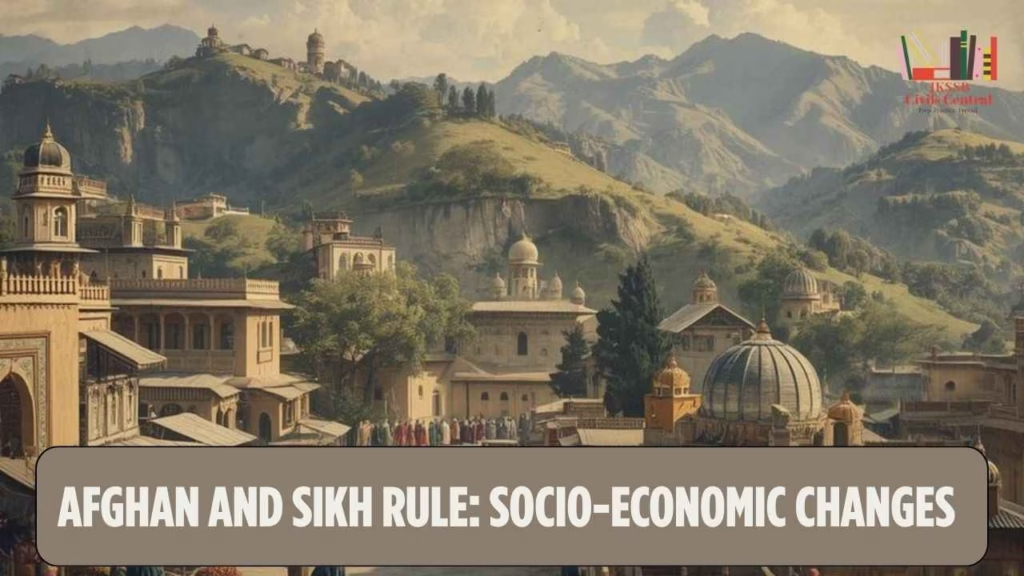

Afghan & Sikh Rule in Kashmir – Socio-Economic Changes
The historical narrative of Jammu and Kashmir serves as a foundational pillar for any candidate aspiring to clear the Jammu and Kashmir Services Selection Board (JKSSB) examinations, particularly those targeting the Finance Accounts Assistant, Sub-Inspector, and Naib Tehsildar cadres. Within the expansive syllabus of “General Knowledge with Special Reference to J&K UT,” the chapters detailing the transition from Mughal decline to the establishment of the Dogra dynasty represent a period of profound socio-political upheaval. This era, primarily encompassing the Afghan (Durrani) rule from 1753 to 1819 and the subsequent Sikh rule from 1819 to 1846, is often characterized in historiography as a time of intense administrative experimentation and significant popular hardship.
For the contemporary aspirant, understanding these periods requires more than a rote memorization of dates; it necessitates a nuanced grasp of the causal relationships between shifting central authorities in Kabul and Lahore and the lived reality of the Kashmiri peasantry and artisan classes.
The Geopolitical Vacuum and the Advent of the Durrani Empire
The inception of Afghan rule in the Kashmir Valley cannot be viewed in isolation from the broader disintegration of the Mughal Empire following the death of Aurangzeb in 1707. As central authority in Delhi waned, the administration of the outlying Subahs or provinces grew increasingly erratic. In Kashmir, the later Mughals governed through a series of fourteen governors whose tenures were marked by rising corruption, religious intolerance, and a general disregard for the protective infrastructure established by Akbar and Jahangir. The internal decay of the Mughal administrative machinery in the mid-18th century eventually led to a situation where local Kashmiri nobles felt compelled to seek external intervention to curb the excesses of the local Mughal deputies.
The specific mechanism of this transition involved two prominent Kashmiri figures, Miri Muquim Kanth and Khwaja Zahir Didmari, who observed the rising power of Ahmad Shah Abdali in neighboring Punjab. Abdali, the founder of the Durrani Empire in 1747, had recently seized the wealth of Nadir Shah, including the legendary Koh-i-noor diamond, and was looking to consolidate a vast frontier empire. In 1752, after being invited by these nobles, Abdali dispatched a formidable Afghan force under the command of Abdullah Khan Ishaq Aqasi. The resulting conflict culminated at the foot of the Pir Panjal pass near Shopian, where the Afghan forces defeated the Mughal deputy governor, Abul Qasim Khan. This victory formally ended nearly two centuries of Mughal hegemony and inaugurated the 67-year era of Afghan rule, a period that would later be immortalized in Kashmiri folk memory as one of the most challenging epochs for the common man.
| Event Timeline: Transition to Afghan Rule | Details | Source |
| Establishment of Durrani Empire | 1747 by Ahmad Shah Abdali | |
| Invitation to Abdali | Sent by Miri Muquim Kanth and Khwaja Zahir Didmari | |
| Battle of Shopian | 1752/1753: Defeat of Mughal governor Abul Qasim Khan | |
| Beginning of Rule | 1753: Abdullah Khan Ishaq Aqasi appointed first governor |
Administrative Mechanisms and the Burden of the Subhedars
The Afghan administrative structure in Kashmir was fundamentally a “dependency” model, where the valley was treated as a resource-rich frontier province rather than a core territory of the empire. Governance was conducted through twenty-eight successive governors (Subhedars) and deputy governors sent from Kabul or Kandahar. This high turnover rate—averaging one new governor every two and a half years—created a persistent atmosphere of political instability. Because these officials were often uncertain of their tenure due to shifting palace intrigues in the Afghan capital, their primary objective was the rapid extraction of wealth.
The evidence from archival records suggests that the first Afghan governor, Abdullah Khan Ishaq Aqasi, set a grim precedent by forcibly collecting approximately one crore rupees from the local merchants and peasantry in just six months before returning to Kabul. Such aggressive tax collection was justified by the governors as a means to pay the Peshkash or annual tribute to the Durrani King, but in practice, a significant portion was siphoned off for personal enrichment. This systemic corruption led to a breakdown of the civil services; the land was often leased out to revenue farmers who had no vested interest in the long-term fertility of the soil or the welfare of those who tilled it.
| Key Afghan Governors and Their Impact | Administrative Style/Contribution | Source |
| Abdullah Khan Ishaq Aqasi | Instituted a “reign of terror”; massive wealth extraction | |
| Raja Sukh Jivan Mal | Rare period of stability (1754–1762); Hindu governor | |
| Amir Khan Jawan Sher | Built Amira Kadal bridge and Sher Ghari fort; public works | |
| Haji Karim Dad Khan | Introduced the Dagshawl department to tax weavers | |
| Atta Mohammad Khan | Issued coins in the names of local saints to gain favor | |
| Jabbar Khan | Last Afghan governor; defeated in 1819 |
The Economic Plight: Taxation, Migration, and the Peasantry
The condition of the people during the Afghan era was inextricably linked to the state’s insatiable demand for revenue. Historians note that the Afghan state took as much as 75% of the gross agricultural produce as land revenue, leaving the peasants with a mere residue that was insufficient for survival through the harsh winter months. Beyond formal land revenue, the administration introduced “negative innovations” in the form of Rasum (various customary exactions) and additional levies on trade and crafts.
The impact on the agricultural sector was catastrophic. In many villages, peasants resorted to the desperate measure of cutting down their fruit-bearing trees to sell as firewood to meet the government’s tax demands. This level of exploitation triggered widespread peasant migration; by the end of the rule, it was estimated that only 1/16th of the cultivable land in the valley was actually under the plow. The valley, once a flourishing hub of Mughal horticulture, began to take on a “deserted look” as families fled to the plains of India, particularly to Punjab and the hill states, seeking escape from official vandalism.
The Shawl Industry: From Royal Patronage to Semi-Bondage
Kashmir’s world-famous shawl industry, which had reached its zenith under the Mughals and Sultan Zain-ul-Abidin, became a primary target for Afghan taxation. While the demand for Kashmiri shawls grew internationally—becoming a fashion staple in 18th-century Europe—the local artisans lived in a state of semi-bondage.
The establishment of the Dagshawl (Department of Shawls) by Governor Haji Karim Dad Khan was a pivotal administrative move. This department regulated the production and taxation of every piece of cloth, charging a heavy levy of Rs 3 per exported shawl and Rs 4 per trak (approximately 5kg) of imported raw wool. Under later governors like Azim Khan, the state further exploited the weavers by forcibly selling them grain at highly inflated prices and recovering the costs directly from the sale of their finished products. Consequently, the number of active looms plummeted from 40,000 in the Mughal era to just 16,000 during the Afghan period, as many craftsmen preferred to abandon their hereditary profession rather than endure the wretched conditions of the trade.
Socio-Cultural Fabric and Religious Tensions
The socio-cultural impact of Afghan rule was nuanced. Despite the political turmoil, the period was not devoid of literary achievement. Because Persian remained the language of the court and administration, the Kashmiri Pandit community, who were traditional masters of Persian scholarship, rose to positions of administrative eminence. This created a unique social dynamic where a small local elite managed the complex revenue machinery for their foreign masters.
However, the era was also marred by “wretched bigotry” and religious strife. Periodic Shia-Sunni riots occurred, often exacerbated by the governors’ inability or unwillingness to maintain communal harmony. Cultural life, nonetheless, found ways to adapt. As royal patronage for high courtly arts declined, more popular forms of entertainment like Hafiza Nagma and Bacha Nagma gained traction among the governing elite and the public respectively. Storytelling, or Dastaan goi, became an essential social outlet during the long winters, with poets translating Persian epics into the Kashmiri language to provide a form of psychological relief from the harsh political reality.
The Transition to Sikh Sovereignty: 1819
The end of Afghan rule followed a pattern similar to its beginning. Driven by the extreme cruelty of the final Afghan governors, particularly Azim Khan and Jabbar Khan, Kashmiri representatives again sought external intervention. Pandit Birbal Dhar and his son, Pandit Rajakak Dhar, escaped the valley and traveled to the court of Maharaja Ranjit Singh in Lahore. Ranjit Singh, the “Sher-e-Punjab,” had long eyed the conquest of Kashmir, having failed in earlier attempts in 1814 due to logistical difficulties and the betrayal of local hill chiefs.
In 1819, a massive Sikh expedition of 30,000 soldiers was organized. The force was led by renowned generals such as Hari Singh Nalwa, Misr Diwan Chand, and Prince Kharak Singh. The decisive engagement occurred at the Battle of Shopian on July 3, 1819, where the Sikh army defeated the forces of Jabbar Khan. This victory annexed Kashmir to the Sikh Empire, ending four centuries of Muslim rule and marking a major territorial expansion for the Lahore Durbar.
Sikh Rule in Kashmir (1819–1846): Governance and Economy
Kashmir became the most prized province of the Sikh Empire, often referred to as its “richest jewel” after Multan. The Sikhs ruled the region for 27 years through ten successive governors. While the initial entry of the Sikhs was celebrated by many who had suffered under the Afghans, the new administration brought its own set of challenges, combining administrative rigor with heavy taxation and the unfortunate coincidence of natural disasters.
| Sikh Governors of Kashmir | Tenure | Notable Accomplishments/Events | Source |
| Diwan Moti Ram | 1819–1820 | First governor; son of Diwan Mohkam Chand | |
| Sardar Hari Singh Nalwa | 1820–1821 | Greatest military general; strictly enforced discipline | |
| Diwan Kirpa Ram | 1826–1830 | Built fine structures; term saw significant earthquakes | |
| Prince Sher Singh | 1831–1834 | Son of Ranjit Singh; term marred by the 1833 famine | |
| Colonel Mian Singh | 1834–1841 | Best governor; revived agriculture after the famine | |
| Sheikh Imam-ud-Din | 1846 | Last governor; presided over the transition to Dogras |
The Famine of 1833 and its Devastating Toll
The year 1833 represents one of the most tragic moments in the history of the Sikh rule. A catastrophic famine, triggered by unseasonal heavy snowfall that destroyed the rice crops, decimated the population. Contemporary accounts suggest that the population of the valley dropped from nine lakhs to a mere two lakhs as thousands perished from starvation or fled to Punjab.
The response of the local administration during the peak of the crisis was criticized by European travelers like Mr. Wade, who observed that dead bodies lay unburied in the streets of Srinagar as the survivors lacked the strength to bury them. However, the subsequent governor, Colonel Mian Singh, is credited with an extraordinary effort to rebuild the province. He imported grain and livestock from Punjab, abolished numerous heavy duties, and provided interest-free loans to artisans, earning him the title of the most able Sikh governor in Kashmiri history.
Economic Potential and Trade Security
Under the Sikh Empire, the trade routes of Kashmir became significantly safer. Maharaja Ranjit Singh made special arrangements to protect traders from highway robbers using the Dogra brothers—Gulab Singh, Dhian Singh, and Suchet Singh—to secure the passages. This security allowed the export trade to flourish despite the lingering effects of the famine.
In 1836-37, archival records indicate that Kashmir’s exports were valued at Rs. 51,00,000, while imports stood at only Rs. 6,40,000, resulting in a healthy trade surplus of over Rs. 44 lakhs. The primary exports remained high-end handicrafts:
- Shawls: The second-largest source of revenue for the Lahore Durbar; taxed via stamp duty when taken off the loom.
- Paper: Famous for its gloss and durability, it was produced from cotton fibers and exported as far as St. Petersburg.
- Lac Products and Furniture: High-quality lacquered items and stone-carved vases were sent to markets in India and China.
The Begar System and State Oppression
While the Sikh rule brought a degree of military stability and trade security, it also institutionalized the Begar or forced labor system. This was particularly oppressive for the rural population, who were frequently pressed into service to transport military supplies over dangerous mountain passes to the frontier regions of Gilgit and Baltistan without any wages. This practice, coupled with high land revenue and religious restrictions—such as the 21-year closure of the Jamia Masjid for public prayers—ensured that the general population remained in a submissive and often impoverished condition.
The Treaty of Amritsar (1846) and the Dogra Transition
The conclusion of the Sikh era was not the result of an internal revolt but of the geopolitical outcome of the First Anglo-Sikh War (1845–1846). Following the defeat of the Sikh forces, the British East India Company sought to weaken the Lahore state by carving out its hilly territories. Through the Treaty of Amritsar signed on March 16, 1846, the British “sold” the Kashmir Valley and its adjoining areas to Raja Gulab Singh of Jammu for 75 lakh Nanakshahi rupees.
Gulab Singh, a former general of Maharaja Ranjit Singh, thus became the founder of the modern Princely State of Jammu and Kashmir. For aspirants, this event is a crucial “Sale of Kashmir” milestone that links the Sikh era to the 100-year Dogra rule (1846–1947), which eventually led to the state’s accession to the Indian Union in 1947.
Modern Perspectives and Current Affairs Relevance
For JKSSB aspirants, the study of the Afghan and Sikh periods is not merely an academic exercise but is deeply linked to contemporary administrative and archaeological developments.
- Archaeological Significance: Recent findings by the Department of Archives, Archaeology & Museums (DAAM) in 2024–2025, such as the discovery of ancient Hindu idols at Karkoot Nag in Anantnag, provide material evidence of how previous dynasties protected cultural heritage during the subsequent periods of conflict.
- Administrative Heritage: Many of the revenue divisions and districts established during the later periods have their roots in the Parganas and Wazarats of the Sikh and Dogra eras.
- Current Affairs: The transition of the state into a Union Territory in 2019 and the subsequent Reorganisation Act are the modern culminations of a journey that began with the territorial consolidations of Gulab Singh and the Sikh governors.
High-Yield Exam Facts for Aspirants
| Topic | High-Yield Point | Source |
| Srinagar Foundation | Founded by Ashoka (known then as Purandisthan) | |
| “Samudragupta of Kashmir” | Lalitaditya Muktapida (Karkota Dynasty) | |
| Darkest Rule | Afghan/Pathan Rule (1753–1819) | |
| First Sikh Governor | Diwan Moti Ram (1819) | |
| Best Sikh Governor | Colonel Mian Singh | |
| Treaty of Amritsar | Signed March 16, 1846 (Sale of Kashmir) | |
| First Dogra Maharaja | Gulab Singh (1846–1857) | |
| Lithium Resources | Inferred in J&K (GSI 2023) |
Conclusion and Recommendations for Aspirants
The century comprising the Afghan and Sikh rules was a crucible that shaped the modern identity of Jammu and Kashmir. For the people of the valley, it was an era of endurance against high taxation and environmental catastrophes. For the aspirant, these periods provide the necessary context to understand the state’s historical grievances, its economic potential in handicrafts, and the eventual formation of its unique administrative boundaries.
Candidates are encouraged to utilize resources like the Rajatarangini (Kalhana) for ancient context and the digitized archives of the Directorate of Archives, Archaeology & Museum for professional research. Maintaining a clear distinction between the governors of the Afghan era (28 in 67 years) and the Sikh era (10 in 27 years) is essential for multiple-choice accuracy. Furthermore, staying updated on current affairs, such as the 2025 budget or recent archaeological excavations at Harwan or Anantnag, will provide the “extra edge” needed in the competitive landscape of JKSSB examinations.
The study of this era ultimately teaches that the “Condition of the People” was not just a result of the rulers’ whims, but a complex interaction of global trade (shawls), local resilience (artisanry), and the unyielding geography of the Himalayas that connects Kashmir to both the plains of India and the highlands of Central Asia.
About The Author



Pingback: Complete History of Jammu & Kashmir in Chronological Order - JKSSB-CivilsCentral