
Introduction to Engineering Mechanics for JE & AE Exams (JKSSB, SSC JE, RRB JE, DSSSB AE/JE) – Complete Guide

The discipline of engineering mechanics serves as the fundamental scaffolding upon which the entire edifice of civil engineering is constructed. For aspirants targeting state and central-level technical examinations—specifically the Jammu and Kashmir Services Selection Board Junior Engineer (JKSSB JE), Jammu and Kashmir Public Service Commission Assistant Engineer (JKPSC AE), Staff Selection Commission Junior Engineer (SSC JE), Railway Recruitment Board Junior Engineer (RRB JE), and the Delhi Subordinate Services Selection Board (DSSSB) AE/JE—mastery of this subject is not merely an academic requirement but a professional necessity. Engineering mechanics provides the quantitative tools required to predict the behavior of rigid bodies under the influence of complex force systems, a prerequisite for advanced study in the strength of materials, structural analysis, and geotechnical design.
Examination Landscapes and Syllabus Synchronicity
The technical requirements for various engineering boards across India demonstrate a significant degree of overlap, yet they maintain distinct emphasize on specific sub-domains of mechanics. A strategic approach to these examinations requires a granular understanding of how each board values the components of mechanics. In the JKSSB JE syllabus, “Mechanics and Structural Analysis” is allocated a substantial 15 marks out of a 120-mark objective paper, signaling that approximately 12.5% of the technical assessment is rooted in mechanical principles. Similarly, the JKPSC AE exam incorporates rigid body mechanics as a core component of its technical module, often requiring a more sophisticated understanding of vector dynamics and spatial equilibrium than its junior counterpart.
The SSC JE examination integrates mechanics into its broader “Structural Engineering” section, where concepts such as bending moments, shear forces, and the theory of structures are analyzed through the lens of static equilibrium. Meanwhile, the RRB JE syllabus explicitly lists “Engineering Mechanics” as a stand-alone technical ability, focusing on force resolution, moments, friction, and centroids to ensure candidates can handle the structural demands of railway infrastructure. For the DSSSB, mechanics is categorized under “Applied Mechanics,” where the emphasis shifts slightly toward the physics of motion and material behavior, reflecting the diverse departmental needs of the Delhi government, from PWD to the Delhi Jal Board.
| Examination Board | Primary Subject Category | Weightage/Marks | Core Mechanical Focus Areas |
| JKSSB JE | Mechanics and Structural Analysis | 15 Marks | Force Laws, CG, Moments, Friction |
| JKPSC AE | Engineering Mechanics | Part of 120 Questions | Rigid Body Statics, Virtual Work, Dynamics |
| SSC JE | Structural Engineering | Variable (High) | SFD/BMD, Elastic Constants, Theory of Structures |
| RRB JE | Technical Abilities | Part of 100 Marks | Force Systems, Equilibrium, Centroids, Machines |
| DSSSB AE/JE | Applied Mechanics | Part of 100-200 Marks | Physics of Motion, Kinetics, Statics |
The convergence of these syllabi indicates that a unified study of force systems, equilibrium, and mathematical theorems is the most efficient path for aspirants preparing for multiple boards simultaneously. This report provides a deep technical dive into these core topics, synthesized from verified academic and governmental sources.
Theoretical Foundations: The Force System
A force system is defined as a collection of forces acting on a body in a specific configuration. In engineering mechanics, these systems are analyzed using the “rigid body” idealization, which assumes that the distance between any two points on a body remains constant regardless of the magnitude of the applied external force. This assumption allows engineers to neglect the internal deformations of a structure while determining the overall support reactions and stability conditions.
Comprehensive Classification of Force Systems
Forces are classified based on their orientation in space and their points of concurrency. For civil engineering applications, such as the analysis of trusses or beam supports, the following classifications are essential:
- Coplanar Force Systems: These systems consist of forces whose lines of action all lie within the same two-dimensional plane. Most introductory problems in the JKSSB and RRB JE exams focus on coplanar systems because they can be resolved into three scalar equations of equilibrium.
- Concurrent Force Systems: Forces are concurrent if their lines of action all intersect at a single common point. In such systems, the moment about the point of concurrency is zero, meaning equilibrium is purely a function of force summation.
- Parallel Force Systems: These systems feature forces with parallel lines of action. They are subdivided into “like parallel forces” (acting in the same direction) and “unlike parallel forces” (acting in opposite directions). This classification is crucial for analyzing loads on bridge girders and building floors.
- Non-Concurrent, Non-Parallel Force Systems: This is the most general system where forces act in various directions and at different points. Analyzing these requires the calculation of both resultant forces and resultant moments, typically using Varignon’s Theorem.
Understanding these systems is not merely an exercise in categorization; it is the first step in structural modeling. For instance, the joints of a pin-connected truss are modeled as concurrent force systems, whereas the truss as a whole is analyzed as a general coplanar system to determine external reactions.
The Principle of Transmissibility: Theoretical and Practical Constraints
The Law of Transmissibility of Forces is a cornerstone of rigid body mechanics. It states that the external effect of a force on a rigid body is independent of its point of application along its line of action. In simpler terms, a force acting at point A on a rigid body can be shifted to point B, provided point B lies on the same line of action and the force maintains the same magnitude and direction.
Mechanical Implications and Limitations
While this principle simplifies the analysis of external equilibrium, civil engineering aspirants must be aware of its strict limitations. The principle is valid only for analyzing external effects, such as the calculation of support reactions or the overall movement of a body. It does not hold true when considering internal effects, such as stress, strain, or deformation. For example, if a force is applied to pull a rod from one end (tension) and then shifted to push from the other end along the same line of action, the external equilibrium remains the same, but the internal state of the rod changes from tension to compression.
Furthermore, the law of transmissibility applies only to rigid bodies. In the study of deformable solids—a major component of the JKPSC AE and SSC JE Paper 2—the point of application is critical because it determines the local distribution of stress. In competitive examinations, questions often test this distinction by asking whether the internal stresses are altered when a force is transmitted along its line of action.
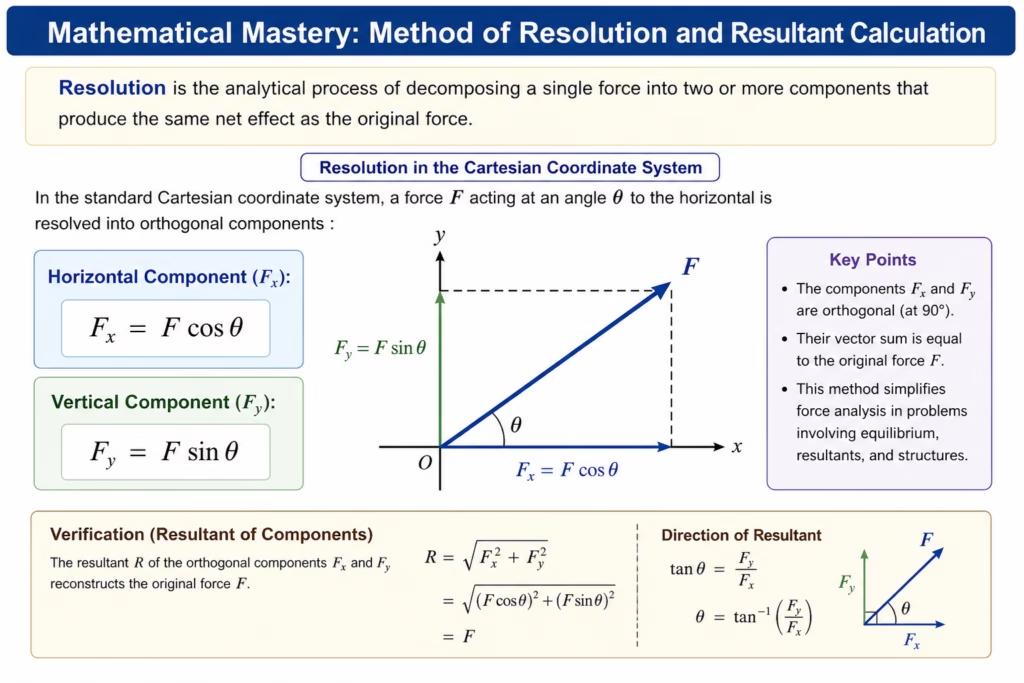
Mathematical Mastery: Method of Resolution and Resultant Calculation
Analytical Composition and the Parallelogram Law
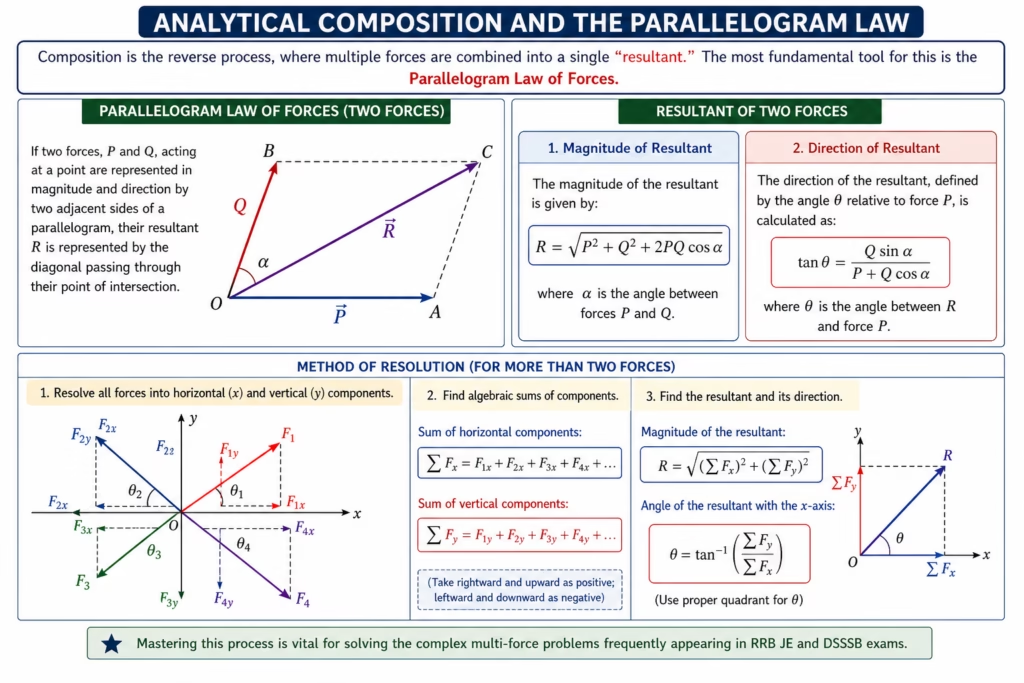
Composition is the reverse process, where multiple forces are combined into a single “resultant.” The most fundamental tool for this is the Parallelogram Law of Forces. It states that if two forces, P and Q, acting at a point are represented in magnitude and direction by two adjacent sides of a parallelogram, their resultant R is represented by the diagonal passing through their point of intersection.
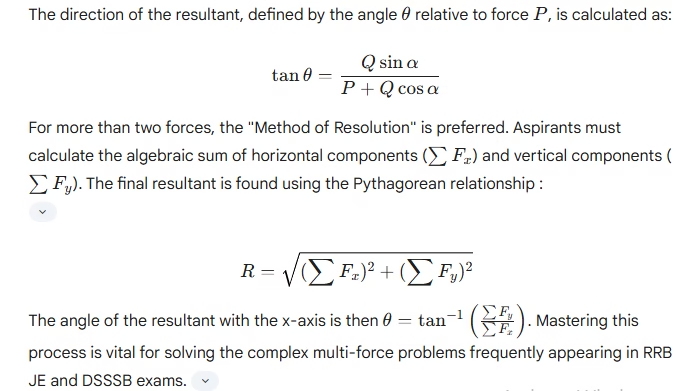
The magnitude of the resultant is given by the formula:


Varignon’s Theorem: The Principle of Moments
Varignon’s Theorem, named after the French mathematician Pierre Varignon, is also known as the Principle of Moments. It is an essential theorem in statics used to simplify the analysis of non-concurrent force systems. The theorem states that the moment of a force about any point is equal to the algebraic sum of the moments of its components about the same point.
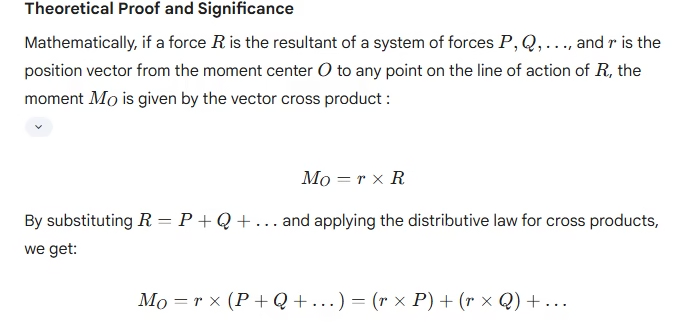
This theorem allows engineers to calculate the moment of a slanted or complex force by first resolving it into horizontal and vertical components. Since the perpendicular distances for horizontal and vertical components are often easier to identify from a building’s plan or a bridge’s elevation, this theorem dramatically reduces the chance of geometric calculation errors. In civil engineering practice, Varignon’s Theorem is used to find the center of gravity of composite sections and to determine the eccentricity of loads in foundation design.
Free Body Diagrams: The Foundation of Problem Solving
The Free Body Diagram (FBD) is arguably the most critical skill for any civil engineering aspirant. It is a graphical tool used to isolate a body or a part of a structure from its environment and replace all the supports and interactions with the forces they exert on the body.
Strategic Rules for FBD Construction
The construction of an FBD follows a rigorous logical sequence:
- Select the Free Body: Identify the specific component or system to be analyzed. This could be a single beam, a truss joint, or an entire bridge frame.
- Isolate the Body: Conceptually remove all surrounding members, walls, and supports.
- Draw Applied Forces: Represent all known external forces, including the weight of the body acting through its center of gravity.
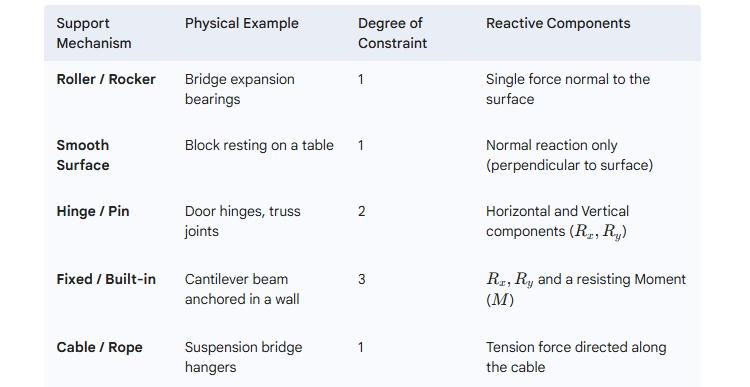
- Replace Supports with Reactions: This requires a deep understanding of support mechanics. For instance, a roller support is replaced with a single force perpendicular to the surface, while a fixed support is replaced with two force components and a resisting moment.
- Define a Coordinate System: Establish a sign convention (e.g., upward and rightward forces as positive) to maintain algebraic consistency.
Without an accurate FBD, the application of equilibrium equations is prone to failure. In examinations like the JKPSC AE and SSC JE, examiners often include “trap” reactions—such as missing the friction force at a rough surface or neglecting the moment at a fixed joint—to differentiate between surface-level learners and true subject experts.
Lami’s Theorem: Analyzing Three-Force Equilibrium
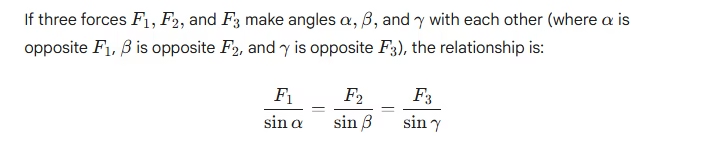
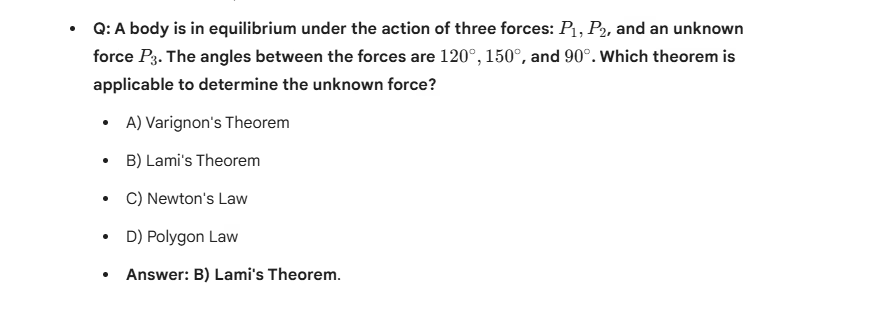
Lami’s Theorem is a specialized analytical tool derived from the Law of Sines in trigonometry. It is exceptionally efficient for solving equilibrium problems involving exactly three coplanar, concurrent, and non-parallel forces.
Statement and Mathematical Representation
The theorem states that if three forces acting at a point are in equilibrium, then each force is proportional to the sine of the angle between the other two forces.
Critical Application Constraints
For Lami’s Theorem to be valid, the following conditions must be strictly satisfied:
- The forces must be concurrent (meeting at a single point).
- The forces must be coplanar (existing in the same plane).
- The body must be in static equilibrium.
- None of the forces can be collinear (acting along the same line).
In exams such as the RRB JE, Lami’s Theorem is the preferred method for determining tensions in suspended cables, pulleys, and structural rings, as it avoids the need for resolving forces into components, thereby saving valuable time during the test.
Comparative Analysis of Support Reactions in Civil Structures
A significant portion of mechanics questions in state PSCs and the SSC focus on identifying unknown reactions for different support types. The ability to quickly translate a physical connection into a mathematical reaction is essential for time management in objective exams.
Advanced Problem Solving: Competitive Examination MCQs
The following multiple-choice questions represent the “advanced level” expected in JE and AE examinations. They integrate multiple theorems and require both conceptual and mathematical precision.
Final Synthesis: Mechanics as a Career Gateway
Engineering mechanics is not a subject to be cleared; it is a language to be mastered. From the resolution of forces to the sophisticated application of Varignon’s and Lami’s theorems, each concept serves as a critical piece of the structural puzzle. For aspirants of the JKSSB, JKPSC, SSC, RRB, and DSSSB, this mastery starts with the fundamental recognition that every force has a point of application, a magnitude, a direction, and a line of action. By isolating bodies through rigorous Free Body Diagrams and applying the laws of equilibrium, engineers ensure the safety and longevity of the infrastructure they design.
The road to becoming a Junior or Assistant Engineer in the Indian public sector is rigorous. However, by grounding preparation in the verified technical standards of government-approved curricula and focusing on the second-order implications of mechanical laws, candidates can navigate the technical complexities of these exams with confidence. The principles analyzed in this report—force systems, transmissibility, resolution, and equilibrium—form the bedrock of that preparation. As candidates move forward, the transition from rigid body mechanics to the mechanics of deformable bodies will feel like a natural evolution of these core principles, leading to success in both the examination hall and the professional engineering field.
Previous Year Questions (PYQs)
JKSSB JE (Civil)
- Q: “If a number of coplanar forces acting on a particle are in equilibrium, then the algebraic sum of their moments about any point is equal to the moment of their resultant force about the same point.” This statement describes:
- A) Lami’s Theorem
- B) Varignon’s Theorem
- C) Cauchy’s Theorem
- D) Euler’s Theorem
- Answer: B) Varignon’s Theorem (Asked in JKSSB JE Civil Official Paper, 19 Nov 2023).
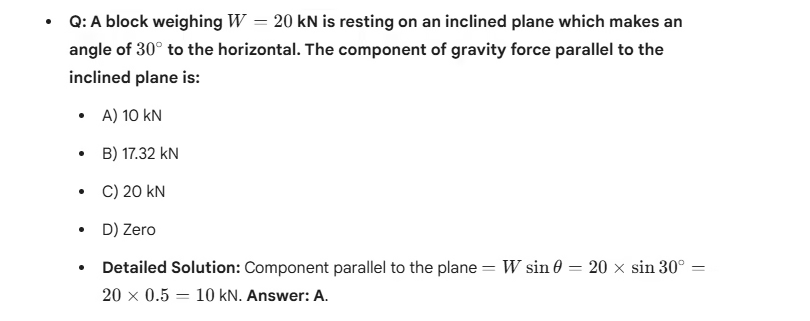
SSC JE (Civil)
Q: Which of the following is NOT an effect of a force applied to a body?
- A) Change in direction of motion
- B) Change in shape
- C) Change in mass
- D) Change in motion
- Insight: Mass is an inherent property that remains constant regardless of the force applied (unless a physical transformation like burning occurs).
- Answer: C.
JKPSC AE (Civil)
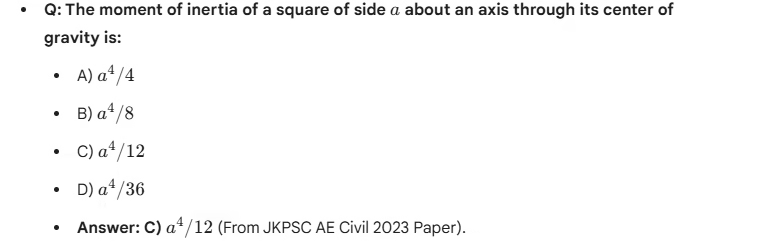
RRB JE (Civil)
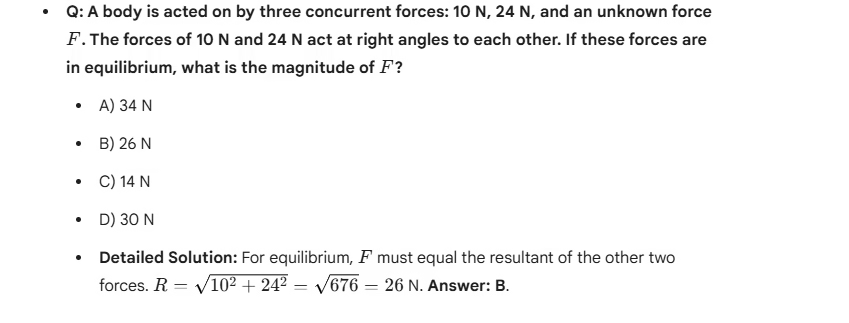
DSSSB AE/JE (Civil)
Q: A Free Body Diagram (FBD) is defined as:
- A) A diagram representing internal forces
- B) A figure representing external forces acting on an isolated body
- C) A free-hand sketch of a structure
- D) A diagram representing only moments
- Answer: B.
Q: A force system in which the lines of action of all forces lie in a single plane but do not meet at a common point is called:
- A) Coplanar concurrent
- B) Coplanar non-concurrent
- C) Non-coplanar concurrent
- D) Collinear
- Answer: B) Coplanar non-concurrent force system.
Frequently Asked Questions (FAQs)

Q2: How does the Principle of Transmissibility affect structural analysis?
Ans: It states that the external effect of a force on a rigid body remains unchanged if the force is moved to any other point along its line of action. However, this principle does NOT apply when calculating internal stresses or deformations, as shifting the point of application changes the internal state of the material.
Q3: What is the practical utility of Varignon’s Theorem?
Ans: Also known as the Principle of Moments, it is primarily used to find the location of a resultant force in a non-concurrent system. It simplifies calculations by allowing engineers to find the moment of a complex force by summing the moments of its simpler horizontal and vertical components.
Q4: What are the essential steps to draw a correct Free Body Diagram (FBD)?
Ans:
- Isolate the body from its surroundings.
- Represent the body’s weight acting through its center of gravity.
- Replace all supports with their corresponding reaction forces (e.g., a roller with one normal force, a hinge with two components).
- Show all applied external forces with correct directions and magnitudes.
Q5: What is the difference between a ‘Resultant’ and an ‘Equilibrant’?
Ans: A Resultant is a single force that replaces a system of forces to produce the same effect. An Equilibrant is a force that is equal in magnitude and collinear with the resultant but acts in the opposite direction to bring the system into a state of equilibrium.
Conclusion:-
Mastering Engineering Mechanics is not just about clearing a subject; it is about building the technical intuition required to design safe and sustainable infrastructure. For civil engineering aspirants eyeing prestigious roles through JKSSB JE, JKPSC AE, SSC JE, RRB JE, or DSSSB, these fundamental concepts form the bedrock of your technical score.
In examinations like JKSSB JE, where “Mechanics and Structural Analysis” carries a weightage of 15 marks , or the RRB JE, which tests these principles under “Technical Abilities” , conceptual clarity is your greatest asset. Whether it is using Lami’s Theorem to quickly solve three-force equilibrium problems or applying Varignon’s Theorem to find the location of a resultant force, these “shortcuts” are essential for managing time during a 120-minute paper.
Final Strategy for Success
- Visualize the Forces: Never skip drawing a Free Body Diagram (FBD). It is the single most effective tool to avoid “trap” reactions and sign convention errors.
- Understand the Limits: Remember that laws like the Principle of Transmissibility apply strictly to external effects on rigid bodies and change when you move to the study of internal stresses in SOM.
- Practice PYQs: As seen in the previous sections, boards like SSC JE and DSSSB often repeat core conceptual patterns. Solving previous year questions helps you recognize these patterns and improves your calculation speed.
By grounding your preparation in these verified technical standards and focusing on the second-order implications of mechanical laws, you can navigate the technical complexities of state and central-level exams with confidence. Engineering mechanics is the language of your future profession—speak it fluently, and the doors to your career as a Junior or Assistant Engineer will surely open.
About The Author