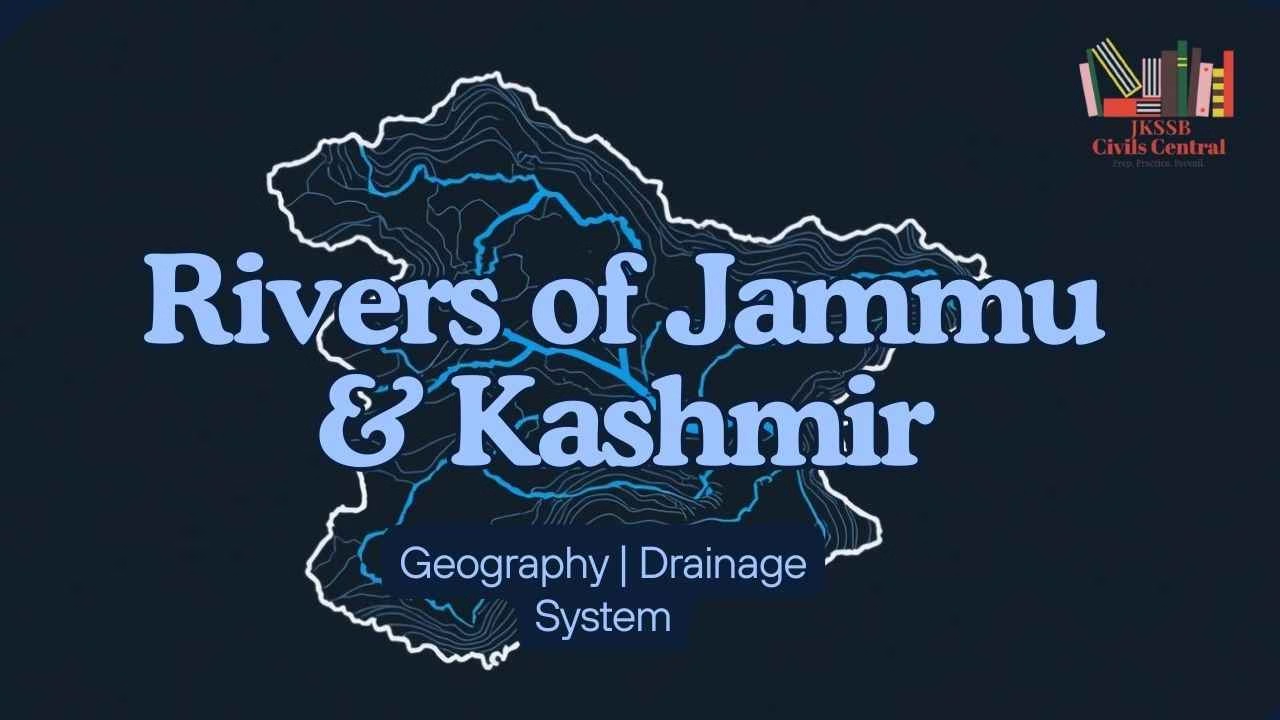
Rivers of Jammu & Kashmir: Geography, Drainage System, and Key Facts for JKSSB

Introduction
The drainage system of the Union Territory of Jammu and Kashmir serves as the fundamental circulatory system for the region’s economy, ecology, and geopolitical significance. Positioned within the northwestern Himalayan mountain arc, the territory acts as a critical catchment area for the Indus River Basin, sustaining life and energy for millions of people both within the Union Territory and in downstream riparian regions.
For aspirants of the Jammu and Kashmir Services Selection Board (JKSSB), mastering the intricacies of this river system is not merely a requirement for the geography syllabus; it is an essential component of understanding the administrative and economic machinery of the region. The following detailed notes provides an exhaustive analysis of the major river systems, their tributaries, hydroelectric potential, recent infrastructural developments, and the strategic recalibration of transboundary water treaties as of early 2026.
Geomorphic Evolution and Basin Morphology
The current hydrological landscape of Jammu and Kashmir is the result of millions of years of tectonic activity and glacial processes. The Union Territory lies between latitude 32O28’N to 37O06’N and longitude 72O53’E to 80O32’E, featuring an altitudinal gradient from 220 meters to over 8,611 meters. The geomorphology is dominated by three major mountain ranges—the Pir Panjal, the Zanskar, and the Great Himalayas—which delineate the major drainage basins.
The evolution of the Kashmir Valley’s drainage is particularly notable for the formation and subsequent drainage of the ancient Lake Karewa. Tectonic upliftment of the Pir Panjal range blocked the primeval drainage systems approximately four million years ago, creating a massive intermontane lake. Sediments of the Karewa group were deposited in this basin until about 85,000 years ago, when the lake was drained through the Baramulla gorge, giving rise to the modern Jhelum River. The remnants of this lacustrine phase are preserved today in the form of the Wular and Dal Lakes, which act as natural regulators for the valley’s hydrological discharge.
Primary Drainage Attributes
The region’s drainage can be categorized into three distinct geographical zones: the Jammu region, the Kashmir region, and the Ladakh region (contextually linked to the Indus catchment). The patterns of these rivers are often dendritic, though trellis and rectangular patterns are observed in areas with specific jointing or alternating hard and soft rock layers.
| Feature | Statistical Detail |
| Total Water Bodies | Approximately 1,230 in J&K. |
| Indus Catchment in India | 321,289 sq. km (193,762 sq. km in J&K). |
| Major River Lengths (in India) | Indus (1,114 km), Jhelum (725 km), Chenab (960 km), Ravi (725 km). |
| Hydrological Potential | Identified potential of 14,867 MW to 16,475 MW. |
The Jhelum River Basin: The Vitality of the Kashmir Valley
The Jhelum River, known historically as the Vitasta in Sanskrit and Hydaspes by the Greeks, and locally as the Vyeth, is the lifeline of the Kashmir Valley. It originates from the Verinag spring at the foot of the Pir Panjal mountains in the Anantnag district.
Course and Navigability
The Jhelum is unique among Himalayan rivers for its navigable stretch of approximately 177 kilometers from Khanabal to Baramulla. It flows through the heart of Srinagar city and passes through Wular Lake, the largest freshwater lake in India. The river’s path is characterized by a gentle gradient in the valley, which allows for the deposition of fertile alluvium, supporting the region’s intensive agriculture and horticulture sectors. After leaving the valley through a deep gorge at Baramulla, the river enters Pakistan-administered territories.
Tributary Analysis: Right and Left Bank Confluences
The Jhelum’s discharge is significantly augmented by a network of tributaries that originate from the surrounding glaciers and springs.
- Right-Bank Tributaries (Himalayan Source):
- Lidder River: Originating from the Tarsar Lake and the Kolahoi glacier, the Lidder is the largest tributary of the Jhelum. It flows through the famous tourist destination of Pahalgam and joins the Jhelum at Khanabal.
- Sindh River: Not to be confused with the Indus (Sindhu), the Sindh Nallah originates from the Gangabal Lake and the Machoi glacier near Zoji La. It joins the Jhelum at Shadipur, which is considered a sacred confluence.
- Bringi River: Drains the southeastern part of the valley and is formed by the confluence of several mountain streams.
- Pohru River: Joins the Jhelum near Baramulla and is significant for draining the Lolab and Rajwar regions.
- Left-Bank Tributaries (Pir Panjal Source):
- Vishav River: Known for the majestic Aharbal Falls, it originates from the Kaunsarnag Lake. It is the longest left-bank tributary and joins the Jhelum at a point called Sangam.
- Rambi Ara: Drains the Shopian district and is noted as the widest of the left-bank tributaries.
- Dudhganga: Formed by two mountain streams, the Sang-e-Safed and Yachera, it originates in the Yusmarg area. It is poetically called the “River of Milk” due to its frothy waters.
- Kishanganga (Neelum): While it originates in the Ganderbal/Dras region of India, it flows through the Gurez Valley and eventually joins the Jhelum at Muzaffarabad in Pakistan. The Kishanganga Hydroelectric Project is a critical infrastructure asset on this river.
The Chenab River Basin: Economic and Hydro-Power Pillar
The Chenab River, or the Asikni of the Vedic era and the Acesines of Alexander’s historians, is the most powerful river in the Union Territory in terms of volume and energy potential. It is formed by the union of the Chandra and Bhaga rivers at Tandi, in the Lahaul and Spiti region of Himachal Pradesh.
Geographical Course in J&K
The Chenab enters Jammu and Kashmir near Paddar in the Kishtwar district. It traverses a rugged course through the districts of Doda, Ramban, Reasi, and Jammu. The river spans approximately 504 kilometers within the territory of Jammu and Kashmir. It finally enters the plains of Pakistan at Akhnoor, where the Ranbir and Pratap canals originate to provide vital irrigation to the Jammu plains.
The Marusudar: The Giant Tributary
The Marusudar is the largest tributary of the Chenab within the Union Territory. Formed by the Batkot and Gumbar streams, it flows as the Warwan River in its upper reaches before becoming the Marusudar. This river is a central focus of the Chenab Valley Power Projects (CVPP), housing massive installations like the Pakal Dul and Bursar hydroelectric projects.
Hydroelectric Landscape on the Chenab
The Chenab basin holds an identified potential of 11,283 MW. Recent years have seen an unprecedented push to harness this power through joint ventures between the National Hydroelectric Power Corporation (NHPC) and the Jammu and Kashmir State Power Development Corporation (JKSPDC).
| Project Name | Installed Capacity | Status | Key Information |
| Baglihar (I & II) | 900 MW | Operational | Located in Ramban; major source of state revenue. Constructed on Chenab River. |
| Salal | 690 MW | Operational | Located in Reasi; built with a concrete rock-fill dam. Constructed on Chenab River. |
| Dulhasti | 390 MW | Operational | Located in Kishtwar; stage II (260 MW) revived in 2025. Constructed on Chenab River. |
| Pakal Dul | 1,000 MW | Under Construction | Expected commissioning by December 2026. Constructed on Marusudar River. |
| Ratle | 850 MW | Under Construction | Fast-tracked in 2025; concrete gravity dam. Constructed on Chenab River. |
| Kiru | 624 MW | Under Construction | Targeted completion by March 2028. Constructed on Chenab River. |
| Kwar | 540 MW | Under Construction | Part of the CVPP cluster in Kishtwar.Constructed on Chenab River. |
| Sawalkote | 1,856 MW | Awarded/Starting | Largest planned dam on the Chenab; budget ₹31,380 crore. |
The Indus River: Trans-Boundary Strategic Artery
The Indus, or Sindhu, is the primary drainage channel of the northern subcontinent. While it flows mainly through the Union Territory of Ladakh, its basin includes the entirety of Jammu and Kashmir. It originates from the Bokhar Chu glacier on the northern slopes of Mount Kailash in Tibet, where it is known as Singi Khamban.
Course and Tributaries
The Indus flows northwest through Ladakh, positioned between the Ladakh range to the north and the Zanskar range to the south. In India, it receives several critical tributaries:
- Zanskar River: Joins the Indus below Leh after originating from the confluence of the Doda (Stod) and Tsarap rivers.
- Shyok River: Originates from the Rimo glacier and is joined by the Nubra River before flowing into the Indus.
- Suru and Dras: These left-bank tributaries join the Indus near Kargil, carrying meltwater from the Zanskar range.
The management of the Indus is governed by the 1960 Indus Waters Treaty (IWT). However, following regional security developments in 2025, India has shifted its stance toward the “Western Rivers” (Indus, Jhelum, and Chenab), moving away from strict non-consumptive usage toward more aggressive capacity utilization.
The Tawi River: The Cultural and Urban Heart of Jammu
The Tawi River is central to the identity of Jammu city. Known as Surya-putri (Daughter of the Sun), it is a major left-bank tributary of the Chenab.
Hydrological Profile
The Tawi originates from the Kailash Kund glacier (Kali Kundi) in the Bhaderwah region of the Doda district, at an altitude of approximately 4,250 meters. It flows through the mountainous terrains of Doda and Udhampur before entering the plains of Jammu.
| Parameter | Value | Significance |
| Total Length | 141 km (88 miles) | Covers 141 km before entering Pakistan to join the Chenab. |
| Catchment Area | 2,168 sq. km | Extends across Jammu, Udhampur, and Doda districts. |
| Width at Jammu | Approx. 300 m | Site of the primary bridges and the upcoming artificial lake. |
| Primary Tributaries | Magri, Pharos, Gamhi | Nine predominant tributaries identified in the basin. |
In Jammu city, the river divides into two channels, known as Nikki Tawi (left) and Waddi Tawi (right). The construction of a Tawi Barrage at Bhagwati Nagar is a flagship project aimed at creating an artificial lake for tourism and city-wide water supply augmentation.
The Ravi River: Border Dynamics and Multipurpose Projects
The Ravi, or Iravati, is the smallest of the five rivers of the Punjab and serves as a natural boundary between Jammu and Kashmir and Punjab. It originates in the Bara Bhangal region of the Kangra district in Himachal Pradesh.
The Ranjit Sagar Dam (Thein Dam)
This project is the primary infrastructure asset on the Ravi, located at Thein village. It is a multipurpose project providing irrigation, hydroelectric power, and flood control to both J&K and Punjab. The river enters the plains near Madhopur, having left the Himalayas at Basohli.
The Ujh River: A Major Tributary
The Ujh originates in the Kailash Mountains near Bhaderwah and flows through Udhampur and Kathua. The Ujh Multipurpose Project, with an estimated capacity of 89.5 MW and a significant irrigation component, is currently a priority project to utilize India’s share of the eastern river waters.
Strategic Recalibration: The Indus Waters Treaty in Abeyance (2025-2026)
One of the most significant developments in the current affairs of the region is the shifting status of the Indus Waters Treaty. Historically, the treaty allocated the Eastern Rivers (Ravi, Beas, Sutlej) to India and the Western Rivers (Indus, Jhelum, Chenab) to Pakistan.
The April 2025 Turning Point
Following the April 22, 2025, terror attack in Pahalgam, the Indian government placed the Indus Waters Treaty in abeyance. This move marked a departure from 65 years of “water diplomacy,” allowing India to execute long-stalled projects on the Western Rivers without entertaining Pakistani objections.
Key Impacts of the IWT Suspension:
- Reservoir Desilting: For decades, desilting at projects like Salal (Reasi) and Baglihar (Ramban) was prohibited under IWT norms, leading to massive silt accumulation and reduced power output. In January 2026, the Union Power Ministry directed immediate desilting and capacity enhancement operations.
- Sawalkote Acceleration: The 1,856 MW Sawalkote project, stalled for nearly four decades due to treaty sensitivities, was fast-tracked in late 2025.
- Tulbul Navigation Lock: The Jhelum Navigation Barrage (Tulbul project) has been revived to raise the water level of Wular Lake, making the Jhelum navigable year-round and increasing downstream power generation.
- Inter-Basin Transfer Feasibility: A study was initiated in June 2025 for a 113-km canal to divert surplus water from the Chenab to the Ravi-Beas-Sutlej system to feed the Indira Gandhi Canal in Rajasthan.
Infrastructure Marvels: Bridging the Himalayan Gorges
The Udhampur-Srinagar-Baramulla Rail Link (USBRL) has produced engineering feats that are globally unprecedented, particularly the bridges over the Chenab and Anji rivers.
The Chenab Rail Bridge: The World’s Highest
Inaugurated on June 6, 2025, the Chenab Bridge is an architectural and engineering landmark.
| Feature | Technical Specification |
| Height | 359 m (1,178 ft) above the riverbed. |
| Length | 1,315 m (4,314 ft). |
| Wind Resistance | Can withstand speeds up to 260 km/h. |
| Lifespan | Designed to last for 120 years. |
| Seismic Resilience | Designed to withstand Magnitude 8 earthquakes. |
The bridge is 35 meters higher than the Eiffel Tower and uses specialized steel capable of withstanding temperatures from 10OC to 40OC.
The Anji Khad Bridge: India’s First Cable-Stayed Rail Bridge
Located between Katra and Reasi stations, the Anji Khad bridge spans a deep gorge to connect the Kashmir Valley with the rest of India.
- Design: Asymmetrical cable-stayed bridge with 96 steel cables.
- Pylon Height: 193 meters from its foundation (331 meters above the riverbed).
- Operational Readiness: Regular train services between Katra and Srinagar via this bridge began in June 2025.
- Monitoring: Incorporates a sensor-based structural health monitoring system to track wind, stress, and vibrations.
Environmental Conservation and River Management
The Jal Shakti Department of Jammu and Kashmir, alongside the Ministry of Environment, has prioritized the “Clean River Model” and the “Jal Shakti Abhiyan: Catch the Rain” initiative in 2025-26.
Restoration Milestones (2024–2025)
The Union Territory has reported significant progress in water conservation and rejuvenation of aquatic ecosystems.
- Project Completion: 16,002 water conservation and rainwater harvesting projects completed as of March 2025.
- Water Body Renovation: 6,622 water bodies restored, with Pulwama and Shopian as lead contributors.
- Groundwater Recharge: Development of 9,369 recharge structures, with a directive to establish at least five such structures in every village.
- Afforestation: 37,362 activities conducted, primarily in the catchment areas of the Jhelum, Chenab, and Ravi.
Lake Protection and Sewage Management
The conservation of Dal and Nigeen lakes is being executed in a “mission mode.” A project worth ₹518 crore is currently underway to connect all houseboats in the Dal Lake to an advanced sewage treatment plant (STP) network. The Lake Conservation and Management Authority (LCMA) has been tasked with maintaining the ecological balance of these water bodies, which are vital for the valley’s tourism economy.
JKSSB Examination Strategy: Syllabus Unit V (Water Resources)
For JKSSB aspirants, the “Water Resources” component of the geography syllabus is a high-yield area. Examination trends for 2025 and 2026 indicate a shift toward integrated questions that link static geography with recent current affairs.
Core Revision Points for Aspirants
- Vitasta vs. Asikni vs. Iravati: Be prepared for matching questions involving ancient, Greek, and modern river names.
- Origin Springs: Verinag (Jhelum), Kali Kund (Tawi), Bara Lachha La (Chenab) are recurring questions.
- Tributary Mapping: Distinguish between right and left bank tributaries of the Jhelum. The Lidder and Sindh are frequently confused.
- Dams and Districts: Memorize the district-wise location of projects. For example, Baglihar is in Ramban, while Salal is in Reasi.
- The 2025 Treaty Shift: Understand the term “abeyance” and the specific projects affected (Sawalkote, Ratle, Tulbul).
- Bridge Records: Know the heights and lengths of the Chenab and Anji bridges for static GK questions.
Statistical Data for MCQs
| Fact | Data Detail |
| Tawi Length | 141 km. |
| Wular Lake Type | Largest Freshwater (Tectonic origin). |
| Deepest Lake | Manasbal Lake. |
| Chenab Length in J&K | 504 km. |
| World’s Highest Rail Bridge Height | 359 meters. |
| IWT Abeyance Trigger | April 2025 Pahalgam Attack. |
Socio-Economic Implications of Hydrological Management
The management of river systems in Jammu and Kashmir is not merely a technical or political exercise; it has direct consequences for the livelihoods of the population.
Agriculture and Irrigation
The irrigation potential of the Jhelum and Chenab basins is the primary driver of the region’s ₹10,000 crore horticulture industry. Projects like the Ranbir Canal and the upcoming Ujh Multipurpose Project are designed to transform the dry Kandi belts of Jammu into fertile agricultural zones.
Energy Security
The Union Territory has historically faced a power deficit, particularly during the winter months when river discharge is low. The “doubling” of power capacity targeted for 2028 is expected to make the UT a power-surplus region, allowing for the export of electricity to the national grid and generating significant royalty revenue.
Tourism and Navigability
Rivers and lakes are the cornerstone of the J&K tourism model. The rejuvenation of the Jhelum for inland water transport and the creation of the Tawi artificial lake are strategic initiatives to diversify the tourism product and create sustainable local employment.
Final Takeaway
The river systems of Jammu and Kashmir represent a complex intersection of geography, geopolitics, and engineering. From the ancient tectonic events that drained Lake Karewa to the modern-day engineering marvels of the USBRL rail link, the hydrology of the region has always dictated its destiny. The 2025-2026 period stands as a historic pivot point, where the suspension of the Indus Waters Treaty has redefined the boundaries of regional water usage and accelerated the Union Territory’s transition into a hydroelectric powerhouse.
For the student of geography and the JKSSB aspirant, understanding these rivers requires a holistic view that integrates their physical characteristics with their strategic importance. Whether it is the frothy waters of the Dudhganga or the massive concrete spans over the Chenab, these waterways are the enduring symbols of the region’s resilience and its future potential. As Jammu and Kashmir moves toward 2030, the sustainable management of these resources—balancing the needs of energy production with the imperatives of ecological preservation—will remain the primary challenge and opportunity for the region’s administration. The detailed knowledge of these systems provided in these detailed notes serves as an authoritative guide for those seeking to understand or manage the vital water resources of the Northwestern Himalayas.
About The Author