
Introduction
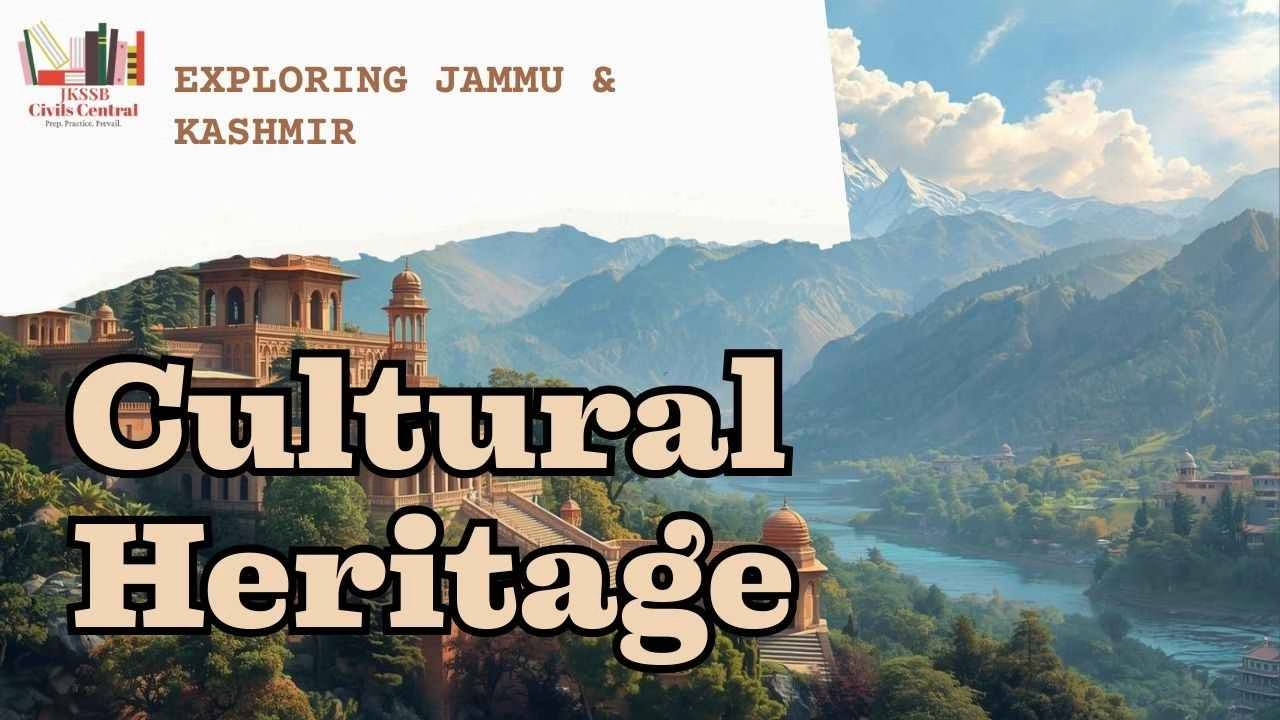
The Union Territory of Jammu and Kashmir represents a distinctive spectrum of diversity, characterized by a multifaceted, variegated, and unique cultural blend that distinguishes it within the Indian subcontinent. For candidates preparing for the Jammu and Kashmir Services Selection Board (JKSSB) examinations—specifically for high-stakes positions such as Junior Assistant, Naib Tehsildar, Finance Account Assistant (FAA), and Sub-Inspector—a profound mastery of the region’s heritage is not merely an academic requirement but a prerequisite for administrative competence.
The cultural fabric of the territory is woven from geographical, demographic, ethical, and social entities that have fostered an unparalleled cultural cohesion over ageless periods of history. This analysis examines the synthesis of Buddhist compassion, Hindu tolerance, and Muslim zest for life, which together define the attainments of the Kashmiri mind and the broader identity of the Union Territory.
The Philosophical and Ethical Foundations of J&K Culture
The cultural identity of Jammu and Kashmir is inextricably linked to its physical exuberance, where the shimmering snow of the mountainous periphery and the nectarine glow of the sun have groomed a mental attitude aimed at gleaning unity amidst diversity. Traditionally referred to as Peer Vaer (the land of spiritual gurus), the region has historically served as a sanctuary for spiritual seekers and scholars from across Central Asia and the Indian heartland. This cross-pollination of ideas facilitated the development of Kashmiriyat, a socio-cultural ethos based on mutual respect, tolerance, and shared religious space.
Historically, Kashmir was a premier learning center for Sanskrit and Persian scholarship. It served as the crucible where early Indo-Aryan civilization originated and flourished, later embracing the advent of Islam, which introduced the refined traditions of Persian civilization, tolerance, and brotherhood. This fusion is visible in the daily lives of the denizens, where Islamic identity and centuries-old friendly ties across religious divides remain fundamental. The region’s culture is in a constant state of flux and ferment, representing a non-stop mental journey that reflects the cumulative expression of the values enshrined in the hearts of its people.
Architectural Heritage and Monumental History
The built heritage of Jammu and Kashmir offers a tangible record of its dynastic transitions, from ancient Buddhist influences to the grandeur of the Mughal and Dogra eras. These structures are not merely tourist destinations but are pivotal to the historical narrative tested in JKSSB examinations.
The Karkota Dynasty and the Martand Sun Temple
The 8th century CE marks the zenith of the Karkota dynasty under the reign of King Lalitaditya Muktapida (724–760 CE). Lalitaditya is celebrated as an imperial visionary whose military conquests stretched the kingdom’s influence far beyond the valley’s traditional borders. The Martand Sun Temple, situated on a plateau near Anantnag, stands as a monumental testament to this era’s architectural prowess.
Architecturally, the temple represents a sophisticated synthesis of diverse influences, including Gandharan, Gupta, Chinese, and Roman-Greek styles. It employs a post-and-lintel system using massive limestone ashlars bonded with lime mortar and metal dowels. The central shrine, dedicated to Surya (the Sun God), was originally surrounded by a colonnaded peristyle consisting of 84 smaller shrines—the largest example of its kind in Kashmir. A distinctive feature is the trefoil arch, which provided structural relief and aesthetic grace to the structure. Despite its systematic destruction in the 15th century by Sultan Sikandar Shah Miri (Butshikan), the ruins remain a symbol of the creative brilliance of ancient Kashmir and are protected by the Archaeological Survey of India (ASI).
The Mughal Gardens: Persian Aesthetics in the Valley
The Mughal era introduced a refinement of the Persian “Paradise Garden” concept to the valley, characterized by terraced layouts, central water channels (Shah Nahar), and the strategic use of water fountains and Chinar trees. These gardens were envisioned by Emperors Jahangir and Shah Jahan as earthly reflections of paradise.
| Garden Name | Builder | Historical and Architectural Significance |
| Shalimar Bagh | Emperor Jahangir (1619) | Known as the “Abode of Love,” it was built for Empress Nur Jahan. It features four terraces and an exquisite black marble pavilion on the fourth terrace reserved for royalty. |
| Nishat Bagh | Asaf Khan (1633) | The “Garden of Bliss,” built by the brother of Nur Jahan. It consists of 12 terraces symbolizing the 12 zodiac signs and offers panoramic views of Dal Lake. |
| Chashma Shahi | Ali Mardan Khan (1632) | Commissioned by Shah Jahan for his son Dara Shikoh. It is famous for its natural spring, believed to have medicinal properties. |
| Pari Mahal | Dara Shikoh (1650) | The “Palace of Fairies,” built on the ruins of a Buddhist monastery. It served as a center for astronomy and astrology lessons given by teacher Mulla Shah. |
| Achabal Garden | Empress Nur Jahan (1620) | A personal retreat for the Empress, known for its gushing springs and Mughal-style cascades that blend with natural streams. |
| Verinag Garden | Jahangir/Shah Jahan | Situated at the source of the Jhelum River. It features an octagonal spring surrounded by stone pavements and ancient arches. |
The cultural continuity of these gardens is maintained through modern developments like the Indira Gandhi Memorial Tulip Garden. Recognized by the World Book of Records as Asia’s largest tulip garden, it spans 74 acres and features over 1.7 million tulips of 73+ varieties. In 2025, the garden recorded a record 8.55 lakh visitors, underscoring its role in the modern tourism economy.
The Fortification of Jammu: Dogra and Regional Legacy
In the Jammu region, the built heritage reflects a history of fortification and religious devotion, primarily influenced by the Dogra rulers.
- Bahu Fort: Believed to have been originally constructed by Raja Bahu Lochan 3,000 years ago, it was refurbished by the Dogras in the 19th century. It houses the temple of “Bawey Wali Mata” (Goddess Kali), the presiding deity of Jammu. The associated Bagh-e-Bahu garden and underground fish aquarium are major landmarks.
- Akhnoor Fort: Construction began in 1762 AD under Raja Tegh Singh as a humanitarian effort to provide work during a famine, a significant detail for aspirants regarding local governance history. It was completed in 1802 by Alam Singh. The fort features the Kishore Singh Burj, named after the father of Maharaja Gulab Singh.
- Amar Mahal Palace: Built like a French Chateau using red sandstone, it was the residence of Raja Amar Singh. It now serves as a museum housing a 120 kg pure gold throne and a library of 25,000 books.
- Ambaran: Near Akhnoor, this is the only early Buddhist site in Jammu. It is one of only eight places globally where Buddha relics have been found in a stupa, dating back to the Kushan and Gupta periods.
Other Important Terms:
- Samovar: The Samovar is a traditional metal tea urn (usually made of copper or brass) with a very clever design:
- The Fire Tube: There is a hollow vertical cylinder in the middle where burning charcoal is placed.
- The Water Chamber: The water and tea ingredients surround this fire tube, which heats the liquid quickly and keeps it piping hot for hours.
- The Chimney: The top has a vent to let the smoke out, often topped with a small “hat” to control the heat.
- Kanger (or Kangri): A Kanger is a portable, hand-held heater consisting of two main parts:
- The Kondul: An inner earthenware pot filled with glowing charcoal embers (tsini).
- The Wicker Case: An outer jacket made of intricately woven willow branches. This casing has a handle, allowing you to carry it under your Pheran (the long traditional cloak) without burning yourself.
- Daan: The Daan is more than just a mud pit; it is a carefully crafted piece of domestic architecture:
- Material: It is made from a specific type of local clay mixed with straw and water to prevent cracking under high heat.
- Design: A standard Daan usually has three holes (burners) on top. This allows the cook to have the rice boiling on one, the meat simmering on the second, and perhaps the Samovar or a vegetable dish on the third.
- Maintenance: It is a point of pride for the lady of the house to keep the Daan clean. Every morning or after a big meal, it is “coated” with a fresh layer of smooth, light-colored clay paste (a process called Daan-Luvun), making it look brand new and sacred.
- Paper-mâché (locally known as Kari-i-qalamdani): Kashmiri Paper-mâché is incredibly labor-intensive. It isn’t just “paper and glue”—it involves two distinct stages:
- Sakhtsazi (The Foundation): Waste paper is soaked in water for days, pounded into a pulp, mixed with rice paste (glue), and then molded into shapes (boxes, bowls, elephants). Once dry, it’s smoothed down with a stone or file.
- Naqashi (The Painting): This is where the magic happens. The surface is coated with a base layer (usually gold or silver leaf or bright paint) and then hand-painted with extremely fine brushes made from goat or cat hair.
- Sozni (or Sozni-kari): The most sophisticated forms of hand embroidery in the world. It is so incredibly fine that sometimes the embroidery is done so densely that the base fabric (the pashmina) is completely invisible.Sozni uses fine silk thread or very thin cotton.
- The Tool: A tiny, thin steel needle.
- The Precision: The stitches are so small that a single shawl can take anywhere from six months to two years to complete.
Linguistic Evolution and the Official Languages Act 2020
Linguistic diversity is a cornerstone of J&K’s identity. The Kashmiri (Koshur) language, a member of the Dardic subgroup of Indo-Aryan languages, was traditionally written in the Sharada script after the 8th century AD, though the Perso-Arabic script is now the official standard recognized by the government and the Academy of Art, Culture and Languages.
The Jammu and Kashmir Official Languages Act, 2020, is a critical legislative milestone for JKSSB aspirants. It expanded the list of official languages from the historical duo of Urdu and English to include five languages.
| Official Language | Status and Context |
| Kashmiri | Spoken by the majority in the Kashmir Valley; part of the 8th Schedule of the Constitution. |
| Dogri | Spoken predominantly in the Jammu region; also an 8th Schedule language. |
| Urdu | Historically the sole official language; retained for administrative purposes. |
| Hindi | Included to reflect demographic shifts and national integration. |
| English | Continued use for legislative, administrative, and legal documentation. |
According to the 2011 census, while Urdu was the sole official language, it was spoken by only 0.16% of the population as a primary tongue, whereas Kashmiri and Dogri were spoken by approximately 74%. The Act also encourages the development of other regional languages like Gojri, Pahari, and Punjabi, emphasizing the role of the J&K Academy of Art, Culture and Languages in this promotion.
Performing Arts: Music, Dance, and Theatre
The performing arts of J&K are a vibrant medium of expression that reflects the daily lives, spiritual yearnings, and social traditions of its people.
Traditional Dance and Theatre of the Kashmir Valley
- Bhand Pather: A traditional folk theatre that combines play and dance in a satirical style to depict social evils and traditions. Bhand Jashan is a variant performed by 10 to 15 artists to entertain during cultural functions.
- Rouf: A seasonal dance performed by women to welcome spring or celebrate Eid. It involves interlocking arms and rhythmic footwork with lyrical forward and backward movements.
- Dumhal: Performed exclusively by men of the Wattal region, involving vibrant robes, conical caps, and dancing around a banner planted in the ground.
- Hafiz Nagma: Part of the Sufiana music tradition, where a female dancer (Hafiza) moves her feet to musical notes while male accompanists play instruments like the Santoor and Sitar.
- Bacha Nagma: A variation where boys dress as women to perform, often at weddings.
Folk Traditions of the Jammu Region
- Kud: A thanksgiving ritual dance performed at night during the rainy season to honor local deities (Lok Devtas) for protecting crops and cattle. Musical instruments include the Chhaina, Narsingha, and flute.
- Jagarna: A women-only wedding dance performed at night when the groom leaves with the baraat.
- Heren: A “Deer Dance” performed by adults during the Lohri festival.
- Karak: A narrative folk music style performed by a group of three artists, where the lead singer plays a Sarangi to tell heroic tales or religious legends.
- Herath is the Kashmiri name for Maha Shivratri, but it is celebrated with a unique flavor that you won’t find anywhere else in India. The word “Herath” is derived from the Sanskrit Hararatri (the Night of Hara/Shiva). – Celebrated by Kashmiri Pandits.
Musical Instruments and Styles
Kashmiri folk music is dominated by Chakri, which uses instruments like the Garaha, Sarangi, and Rabab. Sufiana Musiqui, arriving from Iran in the 15th century, is the classical form that has incorporated Indian Ragas. The Santoor is the most iconic instrument associated with this genre. In Jammu, the use of the Bansiri (flute) and Dhauns (drum) is prevalent in community dances like Kud.
Economic Heritage: Geographical Indications (GI) and Crafts
The Union Territory is renowned for its traditional crafts, many of which have been granted Geographical Indication (GI) status to protect their authenticity and promote local economies. This sector is a vital component of the “History, Economy, and Culture” section of the JKSSB syllabus.
Notable GI Tagged Products as of 2025
| Product | Category | Unique Significance |
| Kashmir Saffron | Agricultural | Given GI status in July 2020; it is the only saffron in the world grown at high altitudes (1,600m to 1,800m) with unique long stigmas. |
| Kani Shawl | Handicraft | Hand-woven using wooden needles (Tujis) in intricate patterns; historically patronized by Mughal emperors. |
| Pashmina | Handicraft | Made from the fine wool of the Changthangi goat. Basholi Pashmina received a separate tag in 2023. |
| Khatamband | Handicraft | The art of making ceilings by fitting small pieces of walnut or deodar wood in geometrical patterns without using nails. |
| Mushqbudji Rice | Agricultural | Short-grain aromatic rice variety primarily cultivated in Anantnag and the Beerwah belt of Budgam. |
| Kashmir Willow Bat | Handicraft | Lightweight and durable bats made from local willow wood, granted GI status in April 2025. |
| Basohli Painting | Handicraft | A unique blend of Hindu mythology and folk art, characterized by vibrant colors and intricate details. |
| Ramban Sulai Honey | Food Stuff | Known as Acacia honey, harvested from the Banihal block of Ramban district. |
Other significant items include the Kashmir Paper Machie, Walnut Wood Carving, and Kashmiri Hand Knotted Carpet. New additions gaining attention for potential GI status include the Gucci Mushroom from the temperate forests of J&K.
Government Initiatives and Social Schemes (2025-2026)
Recent administrative measures reflect a concerted effort to preserve heritage while fostering economic growth through tourism and skill development. Chief Minister Omar Abdullah’s administration has prioritized these sectors in the latest fiscal cycles.
The J&K CM Heritage Scheme 2025
Launched under the Department of Skill Development, this scheme aims to revive traditional crafts across 25 units in Government ITIs and Polytechnics.
- Objectives: To restore rich cultural legacy and create employment for young graduates.
- Scale: 500 students are selected annually across 15 Government ITIs.
- Incentives: Students receive a monthly stipend of ₹1,000, and instructors are provided with remuneration (₹12,000–₹15,000).
- Revival: Focuses on seven traditional practices, including wood carving, papier-mâché, and shawl weaving.
Budget 2026-27: Tourism and Culture Allocations
The 2026-27 annual budget presented in the assembly reflects a “sustainable, inclusive, and year-round tourism economy”.
- Tourism Capital Expenditure: Allocated Rs 472 crore, which is Rs 61 crore higher than the revised 2025-26 allocation.
- Amarnath Yatra: Rs 180 crore proposed to modernise pilgrimage infrastructure in partnership with the Border Roads Organisation.
- Heritage Revival: Completion of Phase-I of the Heritage Revival, Restoration and Maintenance Scheme. Projects include the restoration of the Mughal-era Nishat Garden and modernization of the SPS Museum.
- Public Library Network: Proposed strengthening of the network and establishment of new cultural centers in districts like Kishtwar, Udhampur, and Budgam.
- Skill Mission: A dedicated mission will be launched to equip youth with industry-ready technical skills and on-the-job training in the tourism sector.
Digital Governance and Cultural Access
The launch of the newly developed official website for the Department of Culture by Chief Secretary Atal Dulloo in early 2026 marks a major step toward digital access to cultural services. This is complemented by the JK Tourism mobile app, providing real-time information, AI-based assistance, and booking services to visitors.
Current Affairs and Recent Appointments (2025-2026)
For JKSSB aspirants, staying updated on recent political and administrative shifts is essential. The following data points are critical for the 2025-2026 exam cycle.
| Appointment/Event | Details | Date |
| Chief Minister of J&K UT | Omar Abdullah (Elected following the March 2025 budget presentation). | March 2025 |
| Chief Justice of J&K and Ladakh HC | Justice Arun Palli. | April 2025 |
| J&K Budget Presentation | First budget presented in the J&K Assembly after 7 years. | March 2025 |
| Tourist Footfall 2025 | Record 1.77 crore visits, including 36,410 international tourists. | Dec 2025 |
| Kashmir Marathon 2025 | Over 3,000 registrations from 11 countries, promoting sports tourism. | 2025 |
| Wullar Bird Watch Conclave | Inaugurated in Bandipora to promote eco-tourism. | 2026 |
Tourism Growth and Infrastructure
The tourism sector remains a key pillar of the J&K economy, contributing significantly to hospitality, transportation, and retail. In 2025, the UT recorded over 1.77 crore tourist visits, reflecting sustained confidence despite occasional challenges like the Pahalgam terror incident and subsequent floods. The Homestay Programme has been expanded to address accommodation shortages, with over 1,600 registered homestays in Kashmir and 300 in Jammu.
Significant infrastructure projects include the 3.2 MLD sewage treatment plant at Gulmarg and the solid waste management plant at Sonamarg, aimed at protecting fragile high-altitude ecosystems while supporting massive tourist inflows. Additionally, the government has announced an international film festival for 2026-27 in collaboration with the National Film Development Corporation to promote cultural diversity and stimulate the local economy.
Important Points to note:-
- Sikandar Butshikan: Iconoclast who destroyed Martand Sun Temple.
- Lalitaditya Muktapida: Architect of Karkota glory.
- Asaf Khan: Architect of Nishat Bagh.
- Zabarwan Range: Mountain range overlooking Srinagar’s major gardens.
- Sharada Script: Ancient Kashmiri script.
- Kashmiriyat: Ethos of communal harmony.
- Viksit Bharat: Theme of the 2025 Union Budget relevant to J&K development.
- Global Shakti Museum: Part of the Vaishno Devi Shrine Board’s vision for Katra.
- Sheikh Noor-ud-din Wali (popularly known as Nund Rishi)
- Mir Sayyid Ali Hamadani (also known as Shah-e-Hamadan or Amir-i-Kabir)
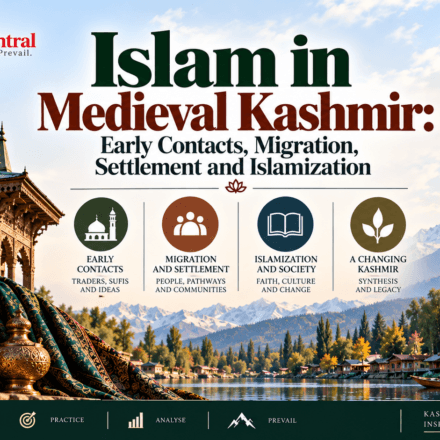
- Bulbul Shah (also known as Syed Sharaf-ud-din Abdur Rahman) was the first Sufi saint to successfully introduce Islam to the Kashmir Valley on a large scale, arriving in the early 14th century (around 1324).
- Lalleshwari (also known as Lalleshwari Devi, Lal Ded, or Lalla Arifa) is perhaps the most profound figure in Kashmiri history because she is claimed and loved by everyone—Hindus, Muslims, and Sikhs alike. – “Mother of the Valley”
Conclusion: Synthesizing Heritage and Governance
The cultural heritage of Jammu and Kashmir is an evolving narrative that provides a crucial context for understanding its modern administrative challenges and opportunities. For the JKSSB aspirant, the interplay between historical architecture, linguistic evolution, and contemporary government schemes like the CM Heritage Scheme represents the core of the regional knowledge base. The record tourist footfall of 2025 and the ambitious budget for 2026-27 indicate that the Union Territory is positioning itself as a global tourism brand while doubling down on the preservation of its ageless cultural service. By mastering the intricate details of dynastic history, the specifics of the Official Languages Act 2020, and the nuances of intangible folk arts, aspirants not only prepare for professional success but also for the role of future custodians of this unparalleled cultural cohesion.
The administrative focus on sustainable tourism, ecological preservation (as seen in Gulmarg and Sonamarg), and digital governance ensures that the heritage of J&K remains a source of economic strength and national pride.
About The Author