Mission Youth and Self-Employment Schemes in J&K – Complete Guide for JKSSB Aspirants

Mission Youth and Self-Employment Schemes in J&K
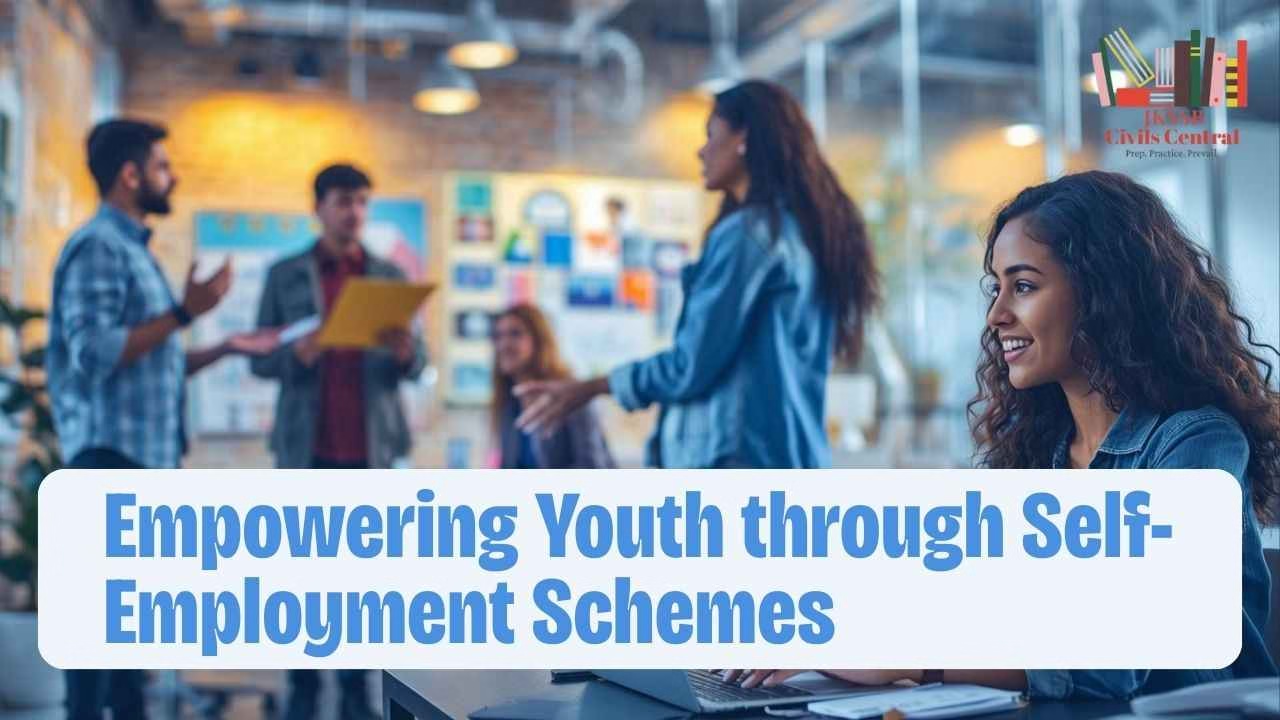
The demographic profile of Jammu and Kashmir has reached a critical juncture where the traditional reliance on the public sector for employment is being recalibrated through a sophisticated, multi-tiered institutional framework. For the thousands of aspirants currently navigating the competitive landscape of Jammu and Kashmir Services Selection Board (JKSSB) examinations, the socio-economic environment is no longer defined solely by the search for a government position. Instead, a robust ecosystem of entrepreneurship, anchored by the flagship Mission Youth initiative, has emerged to provide a parallel and increasingly viable path toward financial independence and regional prosperity.
Statistical evidence from the early part of 2025 indicated that approximately 3,708,111 unemployed youth were registered on the employment portal managed by the Employment Department. This cohort includes over 1.13 lakh graduates and post-graduates, reflecting a significant repository of skilled human capital currently seeking entry into the workforce. However, the competitive reality of recruitment cycles—exemplified by the 1,815 vacancies for the Executive Police cadre against hundreds of thousands of applicants—has necessitated a strategic expansion of livelihood options. The government’s response, manifested through Mission Youth and the more recent Mission YUVA (Yuva Udyami Vikas Abhiyan), represents a paradigm shift in governance from traditional service delivery to the facilitation of a self-reliant entrepreneurial class.
The Institutional Architecture of Mission Youth Jammu and Kashmir
Mission Youth operates as a specialized agency designed to address the multifaceted challenges faced by young individuals in the Union Territory. Its core mission is to transform the youth of Jammu and Kashmir into ambassadors of peace, prosperity, and socio-economic development by bridging existing gaps in education, employment, and skill enhancement. The initiative recognizes that youth empowerment is not merely a matter of financial assistance but requires a comprehensive support system encompassing livelihood generation, education, psycho-social counseling, and recreational engagement.
Core Pillars and Strategic Objectives
The mission’s overarching goal is achieved through several strategic pillars. These pillars are designed to create a sense of trust and engagement between the youth and the state, addressing historical grievances through tangible economic opportunities. The implementation strategy follows a top-down approach that integrates community-led development projects to encourage ownership among the youth population.
| Strategic Pillar | Focus Areas and Implementation Mechanism |
| Livelihood Generation | Direct financial assistance and credit-linked subsidies for self-employment. |
| Education and Skills | Free coaching for competitive exams (IAS/JKAS) and vocational training. |
| Financial Inclusion | Collaborations with J&K Bank and other institutions to provide collateral-free credit. |
| Psycho-Social Support | Addressing the drug menace through rehabilitation and counseling. |
| Social Engagement | Sports, cultural activities, and talent recognition programs. |
Analysis of the mission’s effectiveness suggests that outreach remains a critical component. Recommendations from recent critical analyses emphasize the expansion of publicity efforts through social media, local newspapers, and radio to ensure that segment of the youth population, particularly in remote areas, is informed about the available schemes. Furthermore, there is a recognized need to optimize the eligibility age criteria, potentially reducing it to 15-30 years in certain segments to address vulnerability to anti-national activities during formative years.
Technological Integration and User Experience
To facilitate easier access, Mission Youth has focused on improving its digital infrastructure. The implementation of online tutorials and resource libraries on the official portal is designed to assist youth in navigating the application process. One of the most significant innovations introduced in 2025 is the use of Artificial Intelligence (AI) to generate bank-ready Detailed Project Reports (DPRs). This technological intervention addresses a primary barrier for young entrepreneurs who often lack the skills or resources to prepare technical documents required for securing bank loans.
Mission YUVA: The Next Frontier in Entrepreneurial Development
Launched at the Sher-e-Kashmir International Convention Centre (SKICC) in mid-2025, Mission YUVA (Yuva Udyami Vikas Abhiyan) represents the most ambitious expansion of J&K’s employment strategy. Chief Minister Omar Abdullah emphasized that this mission belongs to the youth rather than any political entity, signaling a commitment to long-term sustainability over short-term political optics.
Ambitious Targets and Livelihood Impact
Mission YUVA aims to establish 137,000 new enterprises, which is projected to generate employment opportunities for approximately 425,000 unemployed youth over a five-year period. This initiative is rooted in extensive groundwork, including field surveys of over one crore people—an exercise comparable in scale to a census. The data generated from this survey is utilized across various departments, including social welfare, education, and health, to shape youth-centric policies.
The scheme is structured to provide strong institutional support and financial assistance under credit-linked mechanisms. It covers new ventures as well as the acceleration of existing enterprises, offering career counseling, guidance, and market linkages to ensure that businesses do not merely start but thrive in a competitive landscape.
The Nano-Enterprise Strategy
A cornerstone of Mission YUVA is the creation of nano-enterprises. The government aims to establish 125,000 such enterprises across the Union Territory, focusing on small-scale businesses in trade, services, manufacturing, and farm-based sectors. These units are designed for 1-2 person startups with a maximum project cost of ₹10 lakh.
| Feature of Nano-Enterprise Scheme | Provision Details |
| Maximum Project Cost | ₹ 10 Lakh |
| Bank Finance | 90% collateral-free loan |
| Government Subsidy (General) | 25% of the project cost |
| Government Subsidy (Women/PWD) | 30% of the project cost |
| Interest Subvention | 5% per annum |
| Beneficiary Contribution | Minimum (Typically around 5-10%) |
This strategy is particularly relevant for JKSSB aspirants who may wish to establish a sustainable income stream while continuing their professional development. The inclusion of interest subvention and substantial subsidies reduces the financial burden on new entrepreneurs, allowing them to achieve profitability sooner. Furthermore, only one person per family is eligible to ensure wider distribution of benefits, with priority given to female or disabled family members in cases of multiple applications.
Sector-Specific Livelihood Schemes: Mumkin and Tejaswini
While Mission YUVA provides a broad framework, Mission Youth has developed specialized schemes that target specific sectors and demographics, most notably the transport sector and female entrepreneurs.
The Mumkin Livelihood Generation Scheme
The Mumkin scheme is designed to help unemployed youth aged 18 to 35 enter the transport and small commercial vehicle sector. Since its inception, it has been one of the most popular initiatives due to its generous financial assistance model. The scheme facilitates the purchase of small commercial vehicles through a tripartite arrangement involving Mission Youth, vehicle manufacturers, and banking institutions.
Under Mumkin, Mission Youth provides a subsidy of up to ₹80,000 or 10% of the vehicle’s on-road price, whichever is lower. Crucially, the vehicle manufacturer provides a matching subsidy of the same amount. This combined support dramatically reduces the cost of the vehicle, leading to lower loan requirements and reduced monthly installments for the beneficiary. Applicants must be domiciles of Jammu and Kashmir, currently unemployed, and possess a valid commercial driving license.
Tejaswini: Empowering Women Entrepreneurs
The Tejaswini scheme focuses on young women aged 18 to 35, providing financial assistance for activities in manufacturing, services, trading, or small business units. The scheme encourages women to think beyond traditional roles and venture into profitable activities such as canteens, computerized desktop publishing, cyber cafes, beauty parlors, and yoga centers.
Tejaswini facilitates Mudra loans up to ₹5 lakh through J&K Bank. Mission Youth provides an incentive of ₹50,000 or 10% of the project cost as a subsidy, which is adjusted toward the loan installments for the first six months. This buffer is vital for new businesses, allowing female entrepreneurs to focus on establishing their market presence without the immediate pressure of loan repayment.
High-Growth and Innovation: Spurring Entrepreneurship Initiative (SEI)
The Spurring Entrepreneurship Initiative (SEI) targets youth aged 18 to 40 with a focus on high-growth entrepreneurship and innovation. Often branded under the theme “Youth Enterprise with Innovation (YouWiN),” this scheme identifies and nurtures potential ventures through a competitive business plan model.
Financial and Mentorship Support
SEI provides financial assistance ranging from a minimum of ₹2 lakh to a maximum of ₹20 lakh. A distinguishing feature of this scheme is the absence of a margin money requirement, making it accessible to those who may not have initial savings to invest. Mission Youth also bears the entire interest component of the loan up to a maximum of ₹2 lakh, effectively making a significant portion of the funding interest-free as long as the principal is repaid consistently.
For new startups, candidates must be unemployed and registered with the District Employment and Counseling Center. For existing businesses, the scheme can be used for expansion or modernization if the business has been operational for at least two years. A dedicated 25% of cases each financial year are reserved for women entrepreneurs to promote gender inclusivity in high-growth sectors.
Collective Prosperity: The Rise Together Scheme
The “Rise Together” scheme shifts the focus from individual entrepreneurship to community-oriented models. It visions promoting community-based entrepreneurship to generate jobs and promote a spirit of social service among youth. This scheme is particularly aimed at youth groups consisting of at least three members aged 18 to 35 with a minimum qualification of the 12th standard.
Funding Structure for Youth Groups
Financial assistance under Rise Together extends up to ₹20 lakh. This comprises an upfront subsidy from Mission Youth (minimum of ₹2.5 lakh or 10% of the project cost) and a bank loan of up to ₹17.5 lakh (70% of the project cost). The group is expected to self-finance at least 20% as margin money. Preference is given to youth registered as Self-Help Groups (SHGs), societies, or trusts. This model is designed to integrate livelihood generation with the socio-economic development of the broader community, fostering a concept of “collective prosperity”.
Traditional Self-Employment Foundations: PMEGP and JKREGP
While Mission Youth introduces modern, niche initiatives, the Prime Minister’s Employment Generation Programme (PMEGP) and the Jammu & Kashmir Rural Employment Generation Programme (JKREGP) remain vital pillars for mass employment generation. These schemes have a broader demographic reach and focus on establishing micro-enterprises in both rural and urban areas.
The PMEGP Framework in Jammu and Kashmir
PMEGP is a central sector scheme administered by the Ministry of MSME and implemented through KVIC, State KVIBs, and District Industries Centres (DICs). It merges the previous Prime Minister’s Rojgar Yojana (PMRY) and Rural Employment Generation Programme (REGP) to streamline the creation of micro-enterprises.
| Category | Beneficiary Contribution | Subsidy (Urban) | Subsidy (Rural) |
| General Category | 10% of project cost | 15% of project cost | 25% of project cost |
| Special Category | 05% of project cost | 25% of project cost | 35% of project cost |
Special categories include SC/ST, OBC, minorities, women, ex-servicemen, physically handicapped individuals, and residents of border areas. The manufacturing sector allows for projects up to ₹25 lakh, while the business and service sector caps projects at ₹10 lakh. For projects above certain thresholds (₹10 lakh in manufacturing, ₹5 lakh in business), beneficiaries must possess at least an VIII standard pass qualification.
JKREGP: Targeted Rural Development
The J&K Rural Employment Generation Programme (JKREGP) is a state-specific initiative implemented by the J&K Khadi and Village Industries Board (KVIB). Its primary aim is to generate sustainable employment for youth aged 18 to 40 residing in rural areas, defined as locations with a population of less than 20,000. Capital cities and district headquarters are excluded to ensure the focus remains on rural revitalization.
JKREGP uses an educational-qualification-based model to determine the maximum financial assistance, rewarding higher academic achievement with higher project cost ceilings.
| Qualification | Manufacturing Ceiling (₹ Lakh) | Service/Trading Ceiling (₹ Lakh) | Agri & Allied Ceiling (₹ Lakh) |
| Matric | 10.00 | 5.00 | 10.00 |
| 10+2 | 15.00 | 10.00 | 15.00 |
| Graduate | 20.00 | 15.00 | 20.00 |
| Post Graduate | 25.00 | 20.00 | 25.00 |
Under JKREGP, only one person per family (self and spouse) is eligible, and cost of land is excluded from the project cost. The scheme ensures that the focus remains on the creation of physical assets and productive enterprises in the rural hinterland.
Education and Competitive Exam Support: The Parvaaz Scheme
For JKSSB aspirants, the Parvaaz scheme is perhaps the most direct intervention in the competitive exam ecosystem. Recognizing the high cost of quality coaching for civil services and other recruitment exams, Mission Youth offers free coaching to meritorious students from socially and economically disadvantaged backgrounds.
Selection and Eligibility for Free Coaching
Selection for Parvaaz is based exclusively on merit in the Parvaaz Qualifying Test (PQT). The coaching covers examinations like the IAS and JKAS. To ensure that the benefits reach the intended group, eligibility is restricted to candidates with a family income not exceeding ₹8 lakh per annum.
| Eligibility Criteria | Requirement Details |
| Family Income | Not exceeding ₹ 8.00 Lakh per annum |
| Selection Basis | Merit in Parvaaz Qualifying Test (PQT) |
| Target Exams | IAS / JKAS (Civil Services) |
| Age Limit | As per the competitive exam guidelines (on 1st Jan of the year) |
| Qualification | Graduation (prescribed degree) from a recognized university |
Beyond Parvaaz, institutions such as the Centre for Career Planning and Counselling (CCPC) at the University of Kashmir play a pivotal role. The CCPC provides comprehensive career guidance, residential coaching programs (like CRISP-25), and campus recruitment drives. In late 2025 and early 2026, the CCPC conducted entrance tests and interviews for its civil services residential programs, reflecting a sustained effort to prepare J&K youth for both state and national administrative roles.
Fiscal Landscape: Budget Highlights 2025-26 and 2026-27
The sustainability of these youth empowerment schemes is underpinned by the fiscal health and budgetary priorities of the Union Territory and the Central Government. The budget sessions of 2025 and 2026 have consistently prioritized youth-centric development and infrastructure growth.
J&K Budget 2025-26: The Economic Foundation
Presented in March 2025 by Chief Minister Omar Abdullah, the first budget of the elected government in seven years focused on “Self-Reliant Jammu and Kashmir”. The total net budget estimates for the fiscal year 2025-26 were ₹1,12,310 crore. A key highlight was the allocation of ₹50 crore to assist entrepreneurs and venture capital funds, fostering a dynamic hub for innovation.
The J&K economy showed significant progress, expanding from ₹1.64 lakh crore in 2019-20 to ₹2.45 lakh crore in 2023-24. For the 2025-26 fiscal, the GSDP was projected at ₹2,88,422 crore, reflecting a growth rate of approximately 10%. This economic expansion is a critical driver for self-employment schemes, as it creates the market demand necessary for new businesses to survive.
Union Budget 2026-27: Enhanced Support for J&K
The Union Budget for 2026-27, presented in February 2026, proposed an allocation of ₹43,290.29 crore for Jammu and Kashmir, an increase of nearly ₹2,000 crore over the previous year. This budget emphasizes “Accelerating Economic Expansion” and provides rinnovated momentum to semiconductor development and MSME support.
One of the most innovative announcements in the 2026-27 Union Budget is a national programme for high-value nut crops (almonds, walnuts, and pine nuts). This initiative aims to rejuvenate old orchards and expand high-density cultivation, focusing on improving per-hectare yields through modern orchard management. Crucially, the programme aims to engage rural youth in value addition and post-harvest management, promoting employment in agriculture-linked activities in mountainous regions.
Revenue and Infrastructure Investments
| Fiscal Indicator | Value (FY 2025-26 / 2026-27) | Economic Context |
| Total Central Allocation | ₹ 43,290.29 Crore (FY 26-27) | Focus on bridge resource gaps. |
| Projected GSDP | ₹ 2,88,422 Crore (FY 25-26) | 10% projected growth. |
| Capital Outlay | ₹ 26,836 Crore (FY 25-26) | 37% increase in asset creation. |
| Tourism Sector Goal | 15% Contribution to GSDP | Increase from current 7%. |
| MSME/Liquidity Support | Enhanced via TReDS platform | Strengthening the business ecosystem. |
The massive push for infrastructure and connectivity, including an investment of ₹61,528 crore in the road sector, is viewed as a backbone for trade and tourism. The completion of the Jammu Semi Ring Road (98% complete by early 2025) and the connection of the Kashmir Valley to the national railway network are transformative milestones that integrate the region more closely with the national growth story.
Socio-Economic Context and Emerging Trends
The push for youth empowerment in Jammu and Kashmir is not merely an economic exercise but a strategic intervention to foster peace and stability. Mission Youth recognizes that addressing the “drug menace” is as critical as addressing unemployment. Part of the mission framework involves recognizing and openly addressing drug addiction through rehabilitation and counseling, ensuring that the youth are fit for the opportunities provided.
Women’s Empowerment and Social Inclusion
There is a concerted effort to promote women’s education and economic empowerment. Schemes like Tejaswini, combined with scholarships like “Beti Anmol” for BPL girl students (₹5,000 per student), are designed to cause cultural shifts and provide social inclusion. In 2026, the budget further supported “SHE Marts” to empower women entrepreneurs and integrated textiles programmes to revitalize the handicrafts sector—a traditional stronghold of female labor in J&K.
Digital Governance and “Classes of Joy”
The transition to digital governance has significantly strengthened institutional efficiency. The J&K Samadhan portal and regular public grievance redressal meetings have brought governance closer to the citizens. Beyond employment, the administration is focusing on early education through initiatives like “Classes of Joy,” which aims to improve the quality of primary education and foster an environment of creativity from a young age.
Strategic Insights for JKSSB Aspirants
The data suggests that for a JKSSB aspirant in 2026, a “dual-path” strategy is highly advisable. While the pursuit of government jobs remains a priority, the entrepreneurial ecosystem under Mission Youth offers a safety net and a viable alternative.
Leveraging Technology and Mentorship
The use of AI for DPR generation and the availability of virtual offices in J&K are game-changers for those who want to start a business with low overheads. A virtual office provides a professional address and GST-compliant registration, allowing home-based entrepreneurs or freelancers in technology and tourism to access government schemes without renting physical space.
Understanding the Financial Partner: J&K Bank
J&K Bank’s role as the principal financial partner for Mission YUVA is critical. The “YUVA Udaan” campaign ensure that the bank’s branch network acts with purpose and inclusivity to process applications in a time-bound manner. Aspirants should recognize the bank not just as a financial institution but as a “supporting pillar” to the UT government’s economic goals.
Group Entrepreneurship vs. Individual Ventures
The “Rise Together” scheme suggests that collective efforts may receive more significant strategic support. For youth from the same village or friend group, forming a group enterprise can leverage pooled skills and shared risks, potentially leading to higher sustainability in sectors like agri-processing or tourism.
Conclusion: A Future Defined by Self-Reliance
The holistic approach of the J&K administration—combining rigorous recruitment through JKSSB with mass self-employment initiatives—signals a robust future for the youth of the Union Territory. Mission Youth and Mission YUVA are not just schemes but “transformative movements” designed to build a self-reliant generation. As the region moves toward its goal of a $5 trillion national economy milestone, the J&K youth are positioned to be the primary drivers of this expansion.
For the aspirant, the horizon of 2026 and beyond is defined by opportunity. Whether through the corridors of the Civil Secretariat as an officer or through the establishment of a thriving nano-enterprise, the tools for empowerment are now readily accessible. The integration of high-density agriculture, world-class infrastructure, and AI-driven business support ensures that the path toward prosperity is paved with both innovation and inclusivity. Success in this environment requires a proactive engagement with the available resources, a disciplined approach to competitive preparation, and a willingness to embrace the spirit of “Aatmanirbhar Bharat” within the unique landscape of Jammu and Kashmir.
About The Author