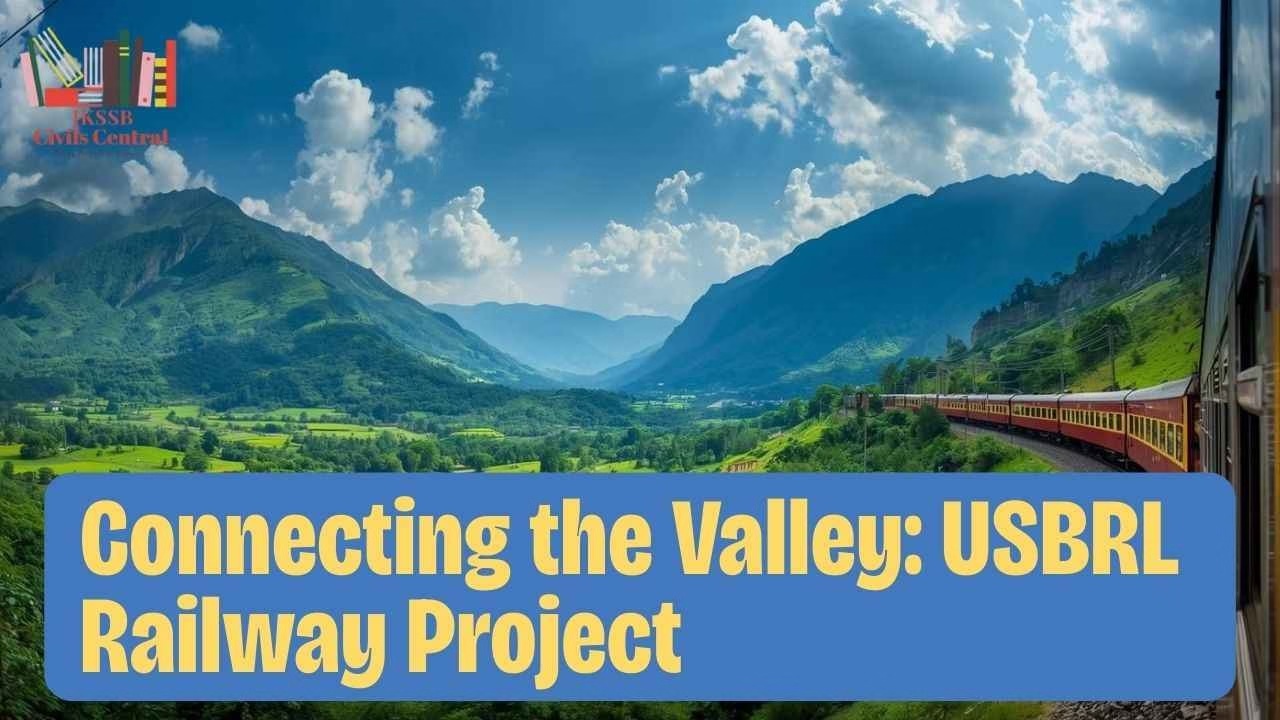
Connecting the Valley: The Economic Significance of the USBRL Railway Project for JKSSB Aspirants

The Economic Significance of the USBRL Railway Project
The integration of the Kashmir Valley with the rest of the Indian rail network through the Udhampur-Srinagar-Baramulla Rail Link (USBRL) represents one of the most significant engineering and socio-economic milestones in the history of Jammu and Kashmir. For aspirants preparing for the Jammu and Kashmir Services Selection Board (JKSSB) examinations, particularly those targeting posts like Patwari, Junior Assistant, and VLW, this project is a critical focal point of the “General Knowledge with special reference to J&K” and “Transport and Communication” components of the syllabus. The project is not merely a transportation corridor; it is a multifaceted development that touches upon geography, economics, engineering, and current affairs. Spanning a total length of approximately 272 kilometers, the USBRL project traverses the rugged and geologically unstable terrain of the young Himalayas to provide a reliable, all-weather alternative to the frequently disrupted Jammu-Srinagar National Highway (NH-44).
Historical Context and Project Evolution
The quest to connect Jammu and Srinagar via rail is an endeavor that spans more than a century. The first railway line in Jammu and Kashmir was laid in 1890 during the reign of Maharaja Pratap Singh, connecting Jammu with Sialkot. However, the modern iteration of the project, the USBRL, was sanctioned in 1994-95 to extend the Indian Railways network from Udhampur into the heart of the Kashmir Valley. Recognizing its immense strategic and developmental importance, the Government of India declared the USBRL a “National Project” in March 2002.
The project has been completed in several phases, each overcoming unique geographic and technical hurdles. The initial sections from Jammu to Udhampur (53 km) and from Baramulla to Qazigund (118 km) were operationalized first, followed by the Qazigund-Banihal stretch which features the iconic Pir Panjal Tunnel. The final and most challenging phase, the 111 km Katra-Banihal section, has been the primary focus of engineering efforts in recent years, as it requires traversing the heart of the Pir Panjal range.
| Project Phase | Section | Length (km) | Status/Commissioning |
| Phase 1 | Jammu to Udhampur | 53 | Operational |
| Phase 2A | Udhampur to Katra | 25 | Operational |
| Phase 2B | Qazigund to Baramulla | 118 | Operational |
| Phase 2C | Banihal to Qazigund | 18 | Operational (2013) |
| Phase 3 | Katra to Banihal | 111 | Operational (2025) |
Technical Profile and Engineering Marvels
The technical specifications of the USBRL are a testament to India’s growing engineering prowess. The line is a broad-gauge (1,676 mm) track designed to handle an operating speed of 110–130 km/h. The electrification of the entire route has been completed, ensuring that the rail link aligns with sustainable and green energy goals.
The Chenab Rail Bridge: A Global Benchmark
The center-piece of the USBRL is the Chenab Rail Bridge, located in the Reasi district. Standing at a staggering height of 359 meters (1,178 feet) above the riverbed, it is the world’s highest railway bridge. To put this into perspective for aspirants, the bridge is approximately 35 meters taller than the Eiffel Tower in Paris.
The structural integrity of the bridge is designed to withstand extreme conditions. It can endure wind speeds of up to 266 km/h and is built to remain functional in a region characterized by high seismicity (Zone V). The bridge uses approximately 28,660 metric tonnes of steel, specifically high-strength structural steel capable of withstanding temperatures as low as $-10^{\circ}C$. The design also incorporates blast-proof features to ensure safety against sabotage, designed to remain operational even if one of its eight concrete piers is compromised.
| Feature | Specification |
| Height | 359 meters above riverbed |
| Total Length | 1,315 meters |
| Arch Span | 467 meters |
| Design Life | 120 years |
| Steel Used | 28,660 metric tonnes |
| Max Wind Speed | 266 km/h |
Anji Khad Bridge: India’s First Cable-Stayed Rail Bridge
Another technical wonder of the project is the Anji Khad Bridge, which serves as India’s first cable-stayed railway bridge. This bridge connects Katra and Reasi and is anchored by a massive single pylon standing 193 meters above its foundation. The bridge is 725.5 meters long and stands at a height of 331 meters above the riverbed. The construction involved the use of 96 high-tensile cables, with a total cable strand length of 653 kilometers. The use of sophisticated ‘Tekla’ software for structural detailing allowed for high precision in its execution, which was completed in a record 11 months.
Tunnelling Excellence: T-50 and the NATM Method
The USBRL project features some of the longest and most complex tunnels in the country. Tunnel T-50, which connects Khari and Sumber, has officially become the longest transportation tunnel in India with a length of 12.775 kilometers. It surpassed the previously held record of Tunnel T-49 (12.75 km).
The construction of these tunnels utilized the New Austrian Tunnelling Method (NATM), which relies on the inherent strength of the surrounding rock mass to support the tunnel. This was particularly necessary given the complex geology of the Himalayas, which includes quartzite, gneiss, and phyllite formations. To ensure passenger safety, tunnels longer than 3 kilometers are equipped with a parallel escape tunnel connected by cross-passages every 375 meters.
| Tunnel Identifier | Length (km) | Key Connection |
| Tunnel T-50 | 12.775 | Sumber to Khari |
| Tunnel T-49 | 12.75 | Sumber to Arpinchala |
| Pir Panjal Tunnel | 11.215 | Banihal to Qazigund |
| Tunnel T-44 | 11.13 | Sawalkote to Sangaldan |
| Tunnel T-48 | 10.20 | Dharam to Sumber |
Economic Significance: Horticulture and Trade
The economic rationale for the USBRL project centers on providing a stable, year-round corridor for the movement of goods and services. For decades, the horticulture sector in Jammu and Kashmir, which contributes over 8% to the regional Gross State Domestic Product (GSDP) and supports 35 lakh livelihoods, has been vulnerable to the vagaries of road travel.
Impact on Horticulture and Agriculture
Signature Kashmiri products such as apples, cherries, saffron, and dry fruits stand to gain the most from the rail link. The transition from truck-based transport to rail cargo is expected to reduce transportation costs significantly, potentially saving producers $₹50$ per kilogram of fruit. Faster transit times also mean reduced spoilage for perishable items like cherries and strawberries. The successful trial of the first cherry cargo train from Katra to Mumbai on May 31, 2025, serves as a precursor to a future where Kashmiri produce can reach markets in South India within 48 to 72 hours.
The “Holistic Agriculture Development Plan” (HADP) of the J&K government, which aims to invest $₹5,013$ crore in 29 projects, will be bolstered by the railway’s capacity for bulk transport of organic fertilizers and high-yield seeds into the valley, while facilitating the export of high-value crops.
Industrial Growth and Employment
The construction phase of the USBRL has already acted as a significant employer, generating more than 5 crore man-days of employment. Beyond direct employment, the project has stimulated local economies through the construction of over 215 kilometers of approach roads. These roads have provided 73 previously inaccessible villages with their first consistent link to urban markets, benefiting a population of approximately 1.5 lakh people.
The J&K Economic Survey 2024-25 highlights a burgeoning industrial climate, with 1,984 units operationalized since 2019, involving an investment of $₹9,606$ crore. The railway link is expected to lower the cost of raw material imports for these units, particularly in the manufacturing and construction sectors, making J&K-based industries more competitive in the national market.
Tourism and Regional Mobility
Tourism is a cornerstone of the J&K economy, and the rail link is expected to usher in a new era of “year-round tourism.” In 2024, J&K recorded an all-time high of 2.36 crore tourist visits, including over 94 lakh pilgrims to Vaishno Devi and 5.12 lakh to the Amarnath shrine.
Promoting Spiritual and Leisure Tourism
The introduction of the Vande Bharat Express between Shri Mata Vaishno Devi Katra and Srinagar has been a transformative development. This semi-high-speed service has carried over 3.75 lakh passengers since its launch in June 2025, facilitating easy movement for pilgrims who wish to extend their trip into the Kashmir Valley.
The railway offers several advantages over traditional road or air travel:
- All-Weather Reliability: Unlike air travel, which is often suspended due to fog or snow, and road travel, which is prone to landslides, the rail link provides a dependable schedule even in harsh winters.
- Cost-Effectiveness: Rail travel offers a budget-friendly alternative to high airfares, making Kashmir more accessible to middle-income domestic tourists.
- Enhanced Comfort: Modern coaches, particularly on the Vande Bharat trains, provide climate-controlled environments and advanced safety features, improving the overall tourist experience.
Amrit Bharat Station Scheme
Under the “Amrit Bharat Station Scheme” (ABSS), the Ministry of Railways has identified four key stations in J&K for comprehensive redevelopment: Budgam, Jammu Tawi, Martyr Captain Tushar Mahajan (Udhampur), and Shri Mata Vaishno Devi Katra. These stations are being transformed into modern city centers with improved parking, air concourses, waiting lounges, and multi-modal integration to support the projected increase in passenger footfall.
| Station Name | Category | Notable Redevelopment Works |
| Jammu Tawi | NSG-2 | 72-meter air concourse, second entry building |
| Budgam | NSG-2 | Executive lounge, improved circulating area |
| Srinagar | NSG-2 | Modern amenities, multi-modal integration |
| Katra | NSG-4 | Enhanced facilities for pilgrim management |
Governance and Institutional Framework: The Jammu Division
On January 6, 2025, Prime Minister Narendra Modi inaugurated the Jammu Railway Division, the 70th railway division in India. Carved out of the Firozpur Division, the Jammu Division is headquartered in Jammu and has jurisdiction over approximately 742.1 kilometers of track. This administrative shift allows for more localized management of the unique challenges faced by the railway in J&K, including snow clearance and maintenance of high-altitude bridges.
The division’s jurisdiction covers not only Jammu and Kashmir but also parts of Ladakh, Punjab, and Himachal Pradesh. The establishment of this division is a strategic move to ensure that the massive investments in the USBRL project are supported by dedicated operational and maintenance staff on the ground.
Environmental Stewardship and Technical Safety
Constructing a massive infrastructure project in the sensitive Himalayan ecology requires a sophisticated approach to environmental conservation and structural safety.
Environmental Safeguards
The project roped in elite institutions like IISc Bangalore and IIT Delhi to design slope stabilization schemes that prevent erosion and damage to the natural terrain. Controlled blasting techniques were used during excavation to minimize ground vibrations, and sedimentation tanks were installed at tunnel outlets to protect local nallahs (streams) from muck and debris.
Comprehensive Environmental Impact Assessments (EIA) were conducted by the National Environmental Engineering Research Institute (NEERI) to mitigate the project’s footprint. This included the implementation of an Environmental Management Plan (EMP) that provided for alternative water sources for villages where natural springs were disrupted by tunnel boring.
Safety and Monitoring Systems
To ensure the safety of passengers in the seismically active Zone V, the project incorporates advanced monitoring technologies. Major bridges like Bridge 39 and Bridge 43 are equipped with a Structural Health Monitoring (SHM) system that uses more than 500 sensors to track strain, load, and vibrations. Within the tunnels, mechanical ventilation systems ensure air quality, while fire hydrants and extinguishers are placed at regular intervals.
The Vande Bharat trains operating on this route are specifically designed with anti-freezing features and anti-vibration seismic dampers to ensure safe operations throughout the year.
Strategic Significance and National Security
The USBRL project is a “dual-use” asset, meaning it serves both civilian and military needs. J&K’s strategic location near international borders necessitates a robust logistics framework for national security.
- Troop Deployment: The railway provides a faster and more reliable method for moving troops and heavy equipment to the frontier, independent of road conditions.
- Supply Chain Resilience: By ensuring an all-weather link, the project guarantees that essential supplies for both the military and civilian population remain uninterrupted during conflicts or natural disasters.
- Resource Security: The connectivity provided by the USBRL will also facilitate the exploration and extraction of critical minerals, such as the recently discovered lithium reserves in the Reasi district, which are vital for India’s energy transition.
JKSSB Exam Orientation: Key Data for Aspirants
For aspirants targeting JKSSB exams, the USBRL is a goldmine for multiple-choice questions (MCQs). Mastery of the following technical and current affairs data is essential for the “Transport and Communication” and “Geography” sections of the syllabus.
Geographical and Technical Highlights
Aspirants should be able to identify the specific rivers, districts, and ranges associated with the project.
| Topic | Relevant Detail for Exam |
| Highest Bridge | Chenab Rail Bridge (359m) |
| Cable-Stayed Bridge | Anji Khad Bridge (India’s 1st) |
| Longest Tunnel | Tunnel T-50 (12.775 km) |
| Longest Road Tunnel | Zojila Tunnel (14.2 km – under construction) |
| Longest Road Tunnel (Op) | Shyama Prasad Mukherjee Tunnel (9 km) |
| Railway Zone | Northern Railway |
| Railway Division | Jammu Division (70th in India) |
Current Affairs (2025-2026)
Staying updated with the latest project developments is crucial for scoring well in current events.
- Inauguration Milestones: The USBRL project was dedicated to the nation by Prime Minister Modi on June 6, 2025.
- Jammu Division Establishment: Officially inaugurated on January 6, 2025.
- Vande Bharat Stats: Over 3.75 lakh passengers carried in the first year of operation on the Katra-Srinagar route.
- Project Halts: In February 2026, the Railway Ministry put three proposed projects (Anantnag-Pahalgam, Anantnag-Shopian, and Baramulla-Kupwara) on hold due to concerns over fertile land and apple orchards.
- Budget 2026: A record capital expenditure of $₹2,93,030$ crore was allocated for Indian Railways for the 2026-27 fiscal year.
Syllabus Mapping for JKSSB
The USBRL project overlaps with several units in the JKSSB graduation-level and matric-level syllabi:
- Unit: Transport and Communication: Focus on the length of the rail link, historical evolution, and key tunnels/bridges.
- Unit: Geography of J&K: Understanding the path of the Chenab and Anji rivers and the crossing of the Pir Panjal range.
- Unit: J&K Economy: Analysis of how the rail link impacts GSDP, horticulture, and tourism arrivals.
- Unit: Current Events: Dates of inauguration, new train services, and policy decisions like the Amrit Bharat Scheme.
Economic Indicators and Growth Projections
The J&K Economic Survey 2024-25 provides a snapshot of the regional economy that the USBRL is set to boost. The real GSDP is expected to grow at 7.06%, while the per capita income is anticipated to increase by 10.6% to reach $₹1,54,703$.
| Economic Indicator | Value (FY 2024-25) | Growth Rate |
| Real GSDP | ₹1.45 Lakh Crore | 7.06% |
| Nominal GSDP | ₹2.65 Lakh Crore | 11.19% |
| Per Capita Income | ₹1,54,703 | 10.6% |
| Unemployment Rate | 6.1% (2023-24) | Decreasing from 6.7% |
The railway project is a key contributor to these figures. By facilitating industrial units—over 8,300 new applications for which were received as of late 2024—the rail link is the physical infrastructure that enables the “Viksit Bharat” vision for the region.
Broader Socio-Economic Ripple Effects
The significance of the USBRL extends beyond the movement of trains; it has profound implications for social equity and inclusion.
Bridging the Rural-Urban Divide
The construction of 215 kilometers of approach roads has brought healthcare and education within reach for remote communities in the Reasi and Ramban districts. Villages that were once isolated for weeks during heavy snowfall now have all-weather road access and a nearby railway station. This connectivity allows rural students to access better educational facilities in Jammu or Srinagar and enables critical patients to reach tertiary care hospitals faster.
Strengthening National Integration
The rail link is a powerful tool for cultural and social integration. It enables “people-to-people” exchanges, allowing residents of Jammu and Kashmir to travel to any part of India seamlessly and vice-versa. This movement helps in breaking down historical misconceptions and fostering a deeper sense of national unity. The railway is not just a carrier of goods; it is a carrier of ideas, cultures, and shared aspirations.
Impact on Handicrafts and Small Industries
Kashmir’s world-renowned handicrafts, including pashmina shawls, carpets, and wood carving, often face high logistical barriers when reaching global markets. The parcel facilities at stations like Srinagar and Budgam will allow artisans to send their products directly to export hubs in Delhi or Mumbai at a fraction of the current cost. This increased margin will benefit the actual makers, potentially revitalizing traditional crafts that were struggling with high overheads.
Future Outlook: Vande Sleeper and Expansion Plans
As of early 2026, the Ministry of Railways has firmed up plans to manufacture 260 rakes of Vande Bharat Sleeper trainsets. These trains, designed for overnight long-distance travel, are likely to be deployed on routes connecting Srinagar to major metros like Mumbai, Bengaluru, and Chennai.
Furthermore, the government is conducting Final Location Surveys (FLS) for several new lines to expand the network’s reach:
- Baramulla-Uri Line: A 50 km extension that will bring the railway closer to the Line of Control.
- Anantnag-Pahalgam and Awantipora-Shopian: Though currently on hold, these surveys demonstrate the long-term vision of connecting every major tourist and agricultural hub in the valley.
- Jammu-Poonch Line: A 223 km line via Akhnoor and Rajouri that will transform the economy of the Pir Panjal region.
Conclusions
The USBRL project is a transformative achievement that stands as a symbol of modern India’s resilience and vision. By overcoming the most daunting geographic challenges, the Indian Railways has provided Jammu and Kashmir with an all-weather lifeline that promises to redefine its economic and social landscape. For the horticulture sector, it is the key to unlocking the full potential of its produce. For tourism, it is the bridge that makes the valley a year-round destination. For the local population, it is the engine of employment and regional integration.
For the JKSSB aspirant, the USBRL is more than a set of statistics to be memorized for an exam; it is a living example of the developmental changes they will manage as future administrative and service professionals in the Union Territory. Understanding its technical specifications, its economic impact, and its strategic significance is essential for anyone who wishes to contribute to the future of Jammu and Kashmir. As the “second chapter” of the Jammu Division unfolds with new projects in 2026, the rail link remains the most critical foundation for the region’s ascent toward a self-reliant and prosperous future.
About The Author