Powering the Future: Major Hydroelectric Projects and Energy Potential in J&K for JKSSB Aspirants

Major Hydroelectric Projects
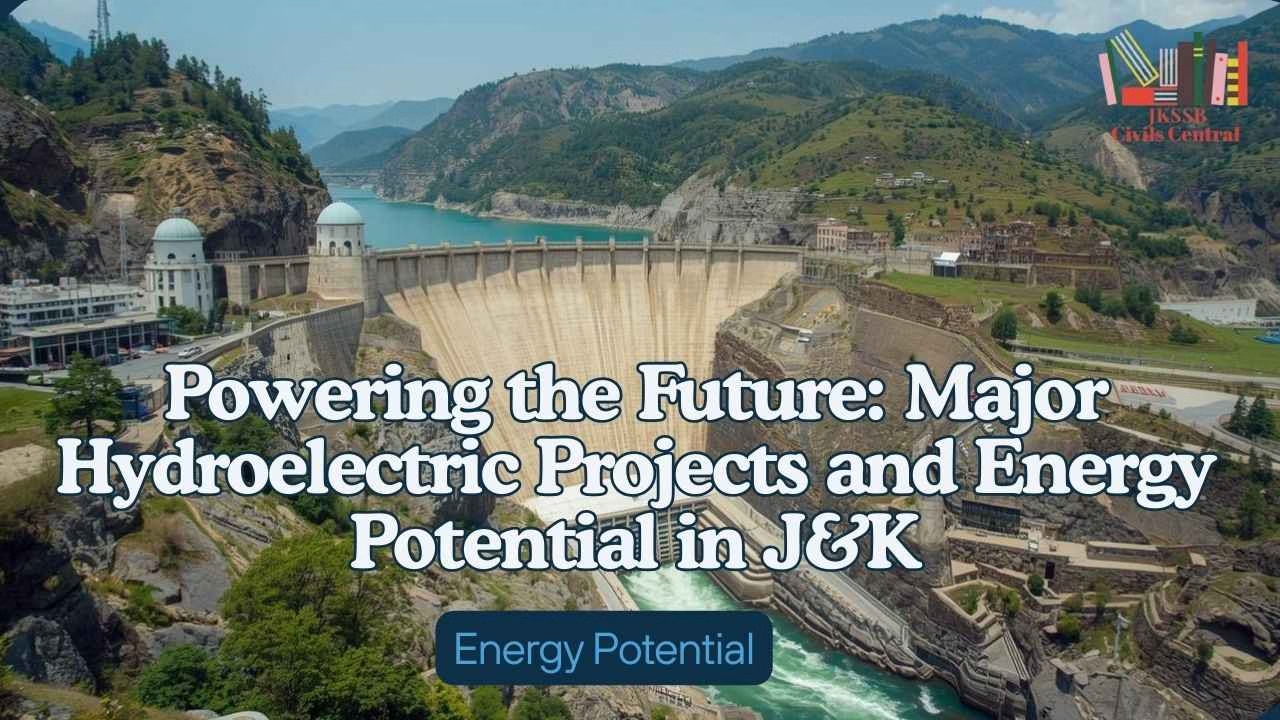
The Union Territory of Jammu and Kashmir stands at a pivotal crossroads in its developmental trajectory, with the hydroelectric sector serving as the primary engine of its economic transformation. For aspirants preparing for the Jammu and Kashmir Services Selection Board (JKSSB) examinations—ranging from the Finance Accounts Assistant and Patwari to the Junior Assistant and Police Constable roles—understanding the intricacies of the region’s energy potential is essential. The subject intersects with geography, economy, current affairs, and international law, specifically the Indus Waters Treaty. The region is often described as the “Power House of North India” due to its vast, perennial river systems and mountainous topography, which provide the ideal head and discharge required for hydroelectric generation.
The Geographical Landscape of Energy Potential
The hydroelectric potential of Jammu and Kashmir is fundamentally a gift of its unique geography. Situated in the lap of the Himalayas, the Union Territory is drained by three major rivers of the Indus System: the Chenab, the Jhelum, and the Indus. These rivers are primarily snow-fed, originating from glaciers in the higher Himalayas and the Karakoram range, ensuring a perennial flow that is critical for sustained power generation. The total hydroelectric potential of the region is estimated at 20,000Megawatts(MW), of which approximately 16,475MW have been scientifically identified.
The identification of this potential is a rigorous process involving the Central Electricity Authority (CEA) and the Jammu & Kashmir State Power Development Corporation (JKSPDC). The identified potential is distributed across the various river basins as follows:
Identified Hydroelectric Potential by River Basin
| River Basin | Identified Potential (MW) | Percentage of Total Potential |
| Chenab Basin | 11,283MW | 68.48% |
| Jhelum Basin | 3,084MW | 18.72% |
| Indus Basin | 1,608MW | 9.76% |
| Ravi Basin | 500MW | 3.04% |
| Total Identified Potential | 16,475MW | 100% |
The Chenab Basin, often referred to as the “Power Corridor” of Jammu and Kashmir, accounts for nearly 70% of the territory’s identified potential. This is due to the river’s steep gradient as it cuts through the districts of Kishtwar, Doda, and Ramban, allowing for the construction of high-head “Run-of-the-River” (RoR) projects. For aspirants, it is vital to note that while the estimated potential is 20,000MW, the actual utilized capacity as of late 2025 remains a fraction of this total, highlighting a massive opportunity for future growth.
The Indus Waters Treaty: A Legal and Strategic Constraint
For any JKSSB aspirant, a comprehensive grasp of the Indus Waters Treaty (IWT) of 1960 is mandatory. Brokered by the World Bank and signed on September 19, 1960, by Indian Prime Minister Jawaharlal Nehru and Pakistani President Ayub Khan, the treaty governs the sharing of the waters of the Indus system.
The treaty divides the six rivers into two groups:
- Eastern Rivers: The Ravi, Beas, and Sutlej are allocated to India for unrestricted use.
- Western Rivers: The Indus, Jhelum, and Chenab are allocated to Pakistan. However, India is granted limited rights over these rivers for domestic use, non-consumptive use (such as hydropower), and agricultural use.
Key Provisions for Hydropower under IWT
The treaty allows India to build “Run-of-the-River” hydroelectric plants on the Western Rivers. These plants do not require large storage reservoirs that would significantly alter the flow of the river to Pakistan. However, India is permitted a certain amount of “pondage” (daily storage) to manage peak power demands.
In recent years, particularly in 2025 and early 2026, the status of the IWT has become a central theme in regional current affairs. Following a series of security challenges and a terror attack in Pahalgam in April 2025, the Government of India announced that the Indus Waters Treaty would remain in “abeyance” or “suspension” until cross-border terrorism is irrevocably ended. This shift has profound implications for hydroelectric development, as India has moved to fast-track major projects like Ratle and Pakal Dul, rejecting the jurisdiction of the Court of Arbitration in The Hague, which India considers “illegally constituted”.
Administrative Structure of the Power Sector
The development of hydropower in Jammu and Kashmir is managed by three primary sectors: the UT (State) Sector, the Central Sector, and the Private Sector (Independent Power Producers).
1. The UT Sector (JKSPDC)
The Jammu & Kashmir State Power Development Corporation Limited (JKSPDC) was incorporated in 1995 to execute and maintain power projects within the territory. It currently manages 21 hydroelectric projects with a combined capacity of approximately 1,197.4MW. The flagship project of the UT sector is the Baglihar Hydroelectric Project.
2. The Central Sector (NHPC)
The National Hydroelectric Power Corporation (NHPC) Limited is the dominant player in the region, operating six major power stations with a total capacity of 2,250MW. These projects provide 12% free power to the UT of Jammu and Kashmir as part of the host-state agreement.
3. Joint Ventures and IPPs
To accelerate capacity addition, the government has formed Joint Venture (JV) companies.
- Chenab Valley Power Projects Limited (CVPPL): A JV between NHPC (49%), JKSPDC (49%), and PTC India (2%). CVPPL is executing the Pakal Dul, Kiru, and Kwar projects.
- Ratle Hydro Electric Power Corporation Limited (RHPCL): A JV between NHPC and JKSPDC for the execution of the 850MW Ratle project.
Shareholding and Operational Summary (Late 2025)
| Sector | Key Projects | Operational Capacity (MW) | Managing Agency |
| Central Sector | Salal, Uri-I, Dulhasti, Kishanganga | 2,250.00MW | NHPC |
| UT Sector | Baglihar I & II, Lower Jhelum | 1,197.40MW | JKSPDC |
| Private Sector | Small IPP projects | 92.75MW | IPP / JAKEDA |
| Total | 3,540.15MW |
Aspirants should note a recent change in the shareholding of RHPCL reported in late 2025. Due to an additional equity contribution from JKSPDC, NHPC’s stake temporarily dropped from 59.51% to 49.72%, though NHPC intends to restore its proportional stake through matching contributions.
Major Operational Projects: Engineering and Strategic Details
For the JKSSB exam, knowing the names of projects is not enough; one must know the river, district, and strategic significance.
1. The Baglihar Project (900 MW)
Located on the Chenab River in the Ramban district, Baglihar is the crown jewel of the JKSPDC. It was built in two stages of 450MW each. Stage I was commissioned in 2008, and Stage II in 2015−16. With a dam height of 143meters, it is one of the most prominent RoR projects in the country.
2. The Salal Project (690 MW)
Situated on the Chenab River in the Reasi district, Salal was the first project built by NHPC in J&K under the IWT regime. It consists of two stages of 345MW each. A critical point for current affairs is that the project is currently undergoing massive sediment removal operations to maintain its generation efficiency, following the pause in the IWT.
3. The Uri Projects (I & II)
Built on the Jhelum River in the Baramulla district, these projects are vital for the power stability of the Kashmir Valley. Uri-I (480MW) and Uri-II (240MW) are both NHPC-managed.
4. The Kishanganga Project (330 MW)
Located in Bandipora, this project involves a 37−meter tall dam and a complex diversion tunnel that carries water from the Kishanganga river to a powerhouse in the Jhelum basin. It has been a source of significant diplomatic friction with Pakistan, which refers to the river as the Neelum.
The Power Surge: Projects Under Construction (2026-2029)
The Union Territory is currently witnessing one of the largest hydropower expansions in Indian history, with projects totaling 3,063.5MW under construction.
1. Pakal Dul Hydroelectric Project (1000 MW)
This is the largest project currently under construction in the UT. It is located on the Marusudar river (a tributary of the Chenab) in the Kishtwar district. It will feature the highest dam in Jammu and Kashmir at 167meters. As of October 2025, it has achieved 75% physical progress and is targeted for commissioning by December 2026.
2. Ratle Hydroelectric Project (850 MW)
Located at Drabshala in the Kishtwar district on the Chenab river, Ratle is a flagship venture between NHPC and the UT government. After facing delays for nearly a decade, dam concreting work began in earnest in January 2026. The project is scheduled for completion in November 2028.
3. Kiru (624 MW) and Kwar (540 MW)
Both projects are located in the Kishtwar district on the Chenab. Kiru has achieved over 68% progress and is set for a December 2026 rollout. Kwar, which saw the diversion of the Chenab river in early 2024, has a commissioning deadline of March 2028.
Summary of Under-Construction Deadlines
| Project Name | Capacity (MW) | District | Revised Commissioning Deadline |
| Pakal Dul | 1,000MW | Kishtwar | December 2026 |
| Kiru | 624MW | Kishtwar | December 2026 |
| Kwar | 540MW | Kishtwar | March 2028 |
| Ratle | 850MW | Kishtwar | November 2028 |
Strategic Multipurpose Projects: Ujh and Shahpur Kandi
The Ujh Multipurpose Project in the Kathua district is a critical component of India’s strategy to utilize its full share of the Eastern Rivers. Granted “National Project” status, it is designed to provide irrigation to the parched “Kandi” belt and generate power. In early 2026, Union Minister Jitendra Singh announced the approval of a canal system alongside the project to check the uncontrolled flow of water to Pakistan and curb infiltration along the riverbed.
Similarly, the Shahpur Kandi Dam project on the Ravi River is nearing completion. These projects collectively ensure that water resources allocated to India under the 1960 treaty are not allowed to flow unutilized into Pakistan, especially following the 2019 policy shift that “blood and water cannot flow together”.
Economic Survey 2024-25: Financial and Structural Health
The 2024-25 Economic Survey Report for Jammu and Kashmir provides a sobering but optimistic view of the power sector. The region’s economy (Nominal GSDP) is estimated at ₹2.65lakhcrore, with the power sector serving as a major non-tax revenue contributor.
Key Economic Indicators (2025-26 Budget)
| Indicator | Value / Target |
| Power Sector Allocation | ₹2,021.37crore (Proposed 2025-26) |
| AT&C Losses | 41% (Current) -> 25% (Target 2025-26) |
| Average Power Cost | ₹7 per unit |
| Average Revenue Recovery | ₹2.5 per unit |
| Peak Power Demand Met | 242.49GW (National FY 2025-26) |
The massive gap between the cost of power (₹7) and the recovery (₹2.5) has led to a public debt that reached 52% of GSDP in 2023−24. To address this, the government is implementing the Revamped Distribution Sector Scheme (RDSS) with an investment of ₹12,922crore. This involves the installation of smart meters and the modernization of the distribution network in both Jammu and Srinagar.
The Future Pipeline: Proposed Mega Projects
The roadmap for the next decade includes some of the most ambitious engineering feats ever attempted in the Himalayas.
- Sawalkote Project (1,856 MW): Planned as a gravity dam on the Chenab between Ramban and Udhampur, Sawalkote will be the largest project in J&K’s history. It has secured environmental clearance and is awaiting funding approval from the Public Investment Board (PIB) as of March 2026.
- Kirthai-II (930 MW): Located in the Kishtwar district, this project is in the advanced planning stage.
- Bursar Project (800 MW): A storage project proposed on the Marusudar river, it is designed to regulate flow for downstream projects like Pakal Dul.
- New Ganderbal (93 MW): This project is at the award stage and will utilize the waters of the Sindh river to serve the electricity needs of central Kashmir.
Solar Energy and the Renewable Mix
Recognizing that hydropower is seasonal—with generation dropping during winter months when discharge is low—the UT is aggressively pursuing solar energy.
- Solarization of Govt Buildings: A plan to solarize 22,494 government buildings with a total capacity of 314MW is on track for completion by December 2025.
- PM Surya Ghar Yojana: Over 2.08 lakh rooftop solar systems have been installed across India by December 2025, with J&K witnessing a rapid uptake in urban centers.
- Mini Hydel Projects: JAKEDA has allocated 35 mini-hydel projects with a capacity of 103.05MW under the IPP mode to encourage local entrepreneurs.
Aspirant’s Quick Revision Guide: Project vs. River vs. District
| Project Name | River | District | Capacity (MW) | Status |
| Mohra | Jhelum | Baramulla | 10.5MW | Historic/Operational |
| Baglihar | Chenab | Ramban | 900MW | Operational |
| Salal | Chenab | Reasi | 690MW | Operational |
| Pakal Dul | Marusudar | Kishtwar | 1,000MW | Under Construction |
| Ratle | Chenab | Kishtwar | 850MW | Under Construction |
| Kiru | Chenab | Kishtwar | 624MW | Under Construction |
| Kwar | Chenab | Kishtwar | 540MW | Under Construction |
| Sawalkote | Chenab | Ramban/Udhampur | 1,856MW | Planned |
| Uri-I & II | Jhelum | Baramulla | 720MW | Operational |
| Dulhasti | Chenab | Kishtwar | 390MW | Operational |
| Kishanganga | Kishanganga | Bandipora | 330MW | Operational |
| Sewa-II | Sewa (Ravi) | Kathua | 120MW | Operational |
| New Ganderbal | Sindh (Jhelum) | Ganderbal | 93MW | Award Stage |
| Lower Kalnai | Chenab | Doda/Kishtwar | 48MW | Award Stage |
Strategic Takeaways for the JKSSB Syllabus
For the aspirants, the following second-order insights are crucial for solving complex multiple-choice questions (MCQs):
- Storage vs. Run-of-the-River: While most projects in J&K are RoR to comply with the IWT, Pakal Dul is a significant milestone as it represents India’s first storage project on a “Western River” (on a tributary), allowing for better regulation of water flow.
- Basin Dominance: The Chenab Basin is not just the largest by potential; it is also where the most intense diplomatic and legal battles are fought, as nearly three-fourths of Pakistan’s water originates from rivers flowing through India.
- Winter Power Deficit: Generation drops significantly in winter due to lower river discharge, while demand peaks for heating. This creates the 14−16% power gap that the UT fills by purchasing power from the Northern Grid at high costs.
- Administrative Autonomy: Following the reorganization of the state into a Union Territory in 2019, the mandatory consent of the Chief Minister for large projects is no longer required, allowing the Central government to fast-track strategic infrastructure without procedural delays.
- Employment and Local Welfare: Under the host-state agreements, NHPC and JVs provide 12% free power to J&K, which is a major source of revenue for the UT government. Furthermore, local residents and Project Affected Families (PAFs) are prioritized for employment through contractors engaged in these projects.
Conclusion: Powering the Future
The journey of Jammu and Kashmir from a power-deficit region to a potential energy hub of South Asia is well underway. The combination of historical projects like Mohra and Salal with future giants like Pakal Dul and Sawalkote creates a diverse and robust energy portfolio. For JKSSB aspirants, the mastery of this data is not merely an academic requirement but a gateway to understanding the future of the region they aim to serve. As the Union Territory strives to bring down AT&C losses to 25% and triple its generation capacity by 2030, the hydroelectric sector will remain the most significant chapter in its developmental story.
The strategic pause in the Indus Waters Treaty and the subsequent fast-tracking of “National Projects” like Ujh and Ratle signal a new era of water diplomacy and energy security. For the youth of Jammu and Kashmir, these projects represent more than just megawatts; they represent jobs, industrial growth, and the promise of a brighter, electrified future.
About The Author