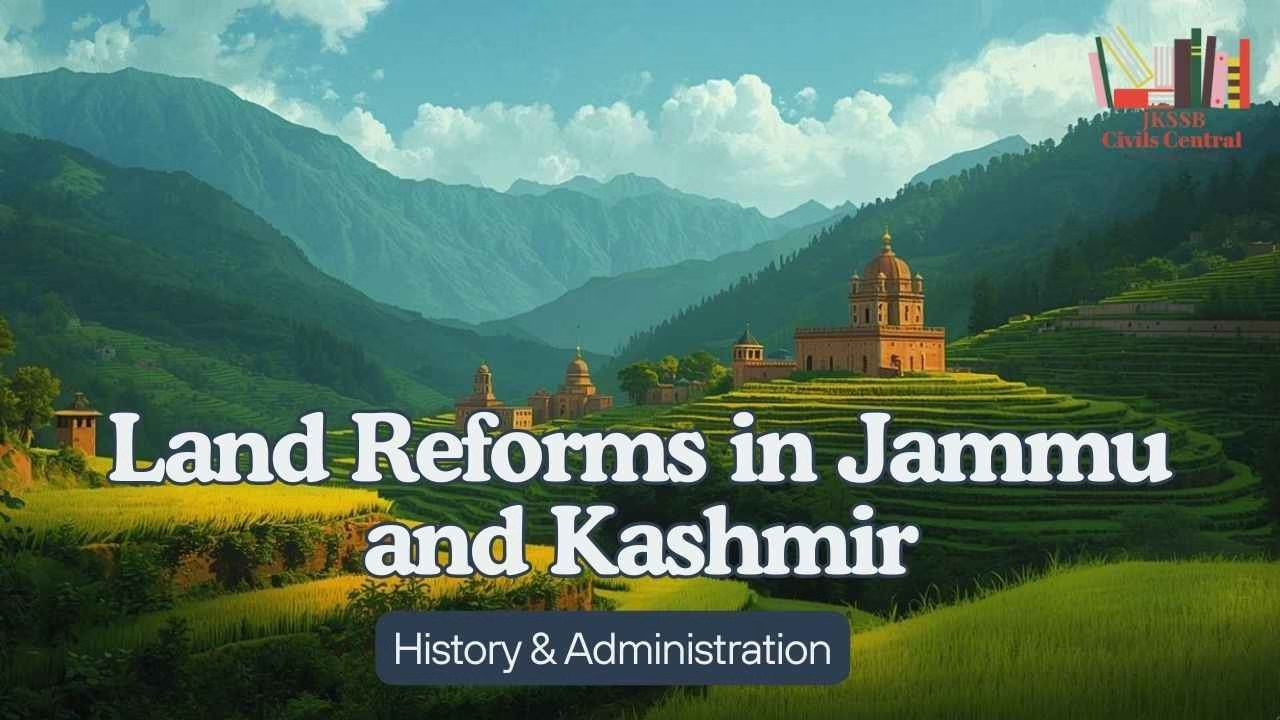

Land Reforms in Jammu and Kashmir
The agrarian history of Jammu and Kashmir serves as the bedrock of its socio-political identity, representing one of the most significant experiments in social engineering and wealth redistribution in the post-colonial world. For candidates preparing for the Jammu and Kashmir Services Selection Board (JKSSB) examinations—particularly for roles such as Patwaris, Naib Tehsildars, and Junior Assistants—a nuanced understanding of land reforms is not merely an academic requirement but a professional necessity.
The evolution of land tenure from the restrictive feudalism of the Dogra era to the radical “Land to the Tiller” policies of the mid-twentieth century, and further into the digital governance framework of the 2020s, offers a comprehensive map of the region’s development trajectory.
The Feudal Foundation and the Inception of Agrarian Crisis
The genesis of the land problem in Jammu and Kashmir is inextricably linked to the establishment of the Dogra dynasty in 1846 following the Treaty of Amritsar. This treaty, often described as a “sale deed,” saw the British government transfer the territory of Kashmir to Maharaja Gulab Singh for a sum of 75 lakh Nanakshahee rupees. This transaction had profound legal implications: the Maharaja perceived himself as the absolute proprietor of all land in the valley, effectively divesting the entire peasantry of their ancestral proprietary rights.
The Structure of the Feudal Hierarchy
The agrarian system that emerged was characterized by a parasitic hierarchy of intermediaries. The State did not interact directly with the tillers; instead, it managed land through a chain of grantees and officials whose primary objective was revenue extraction.
| Land Tenure Category | Legal Status and Role | Impact on the Tiller |
| Jagirdars | Granted whole villages or tracts of land in lieu of state service. They were almost autonomous within their estates. | Collected up to 75% of the produce, leaving only a fraction for the peasant’s survival. |
| Muafidars | Holders of revenue-free grants, typically for religious or charitable purposes (Muafi lands). | Exercised similar extractive powers as Jagirdars but were exempt from paying revenue to the State. |
| Chakdars | Land-revenue agents who held “Chaks” under state deeds; they lacked proprietary rights but acted as masters of the soil. | Stood immediately above the common peasant, ensuring the State’s share was extracted efficiently. |
| Khalsa Land | Land managed directly by the State where the Maharaja was the sole proprietor. | Peasants were treated as farm laborers, subjected to heavy taxation and the system of Begar (forced labor). |
By the late nineteenth century, the condition of the peasantry had deteriorated to a state described as “worse than beggars”. The methods of assessment were so retrograde that cultivators were forced to pay one-half of their produce as land revenue, alongside numerous illegal taxes and cesses. This exploitative environment led to a significant depopulation of the countryside as peasants fled to neighboring regions to escape the double burden of debt and starvation.
The Lawrence Settlement and Initial Administrative Reforms (1885–1933)
The catastrophic decline in agricultural productivity eventually forced the State to seek reform, driven largely by British intervention. In 1885, a British Residency was established in Srinagar, marking the beginning of a more structured administrative role for the British in J&K.
The Impact of Sir Walter Lawrence
The most significant step in this era was the appointment of Sir Walter Lawrence as the Settlement Commissioner in 1889. His task was to conduct a fair land revenue settlement that could stabilize the agrarian economy. Lawrence’s work, documented in his seminal book The Valley of Kashmir, laid the groundwork for modern revenue administration.
- Occupancy Rights: For the first time, peasants were granted occupancy rights, providing a degree of security against arbitrary eviction.
- Revenue in Cash: The system of collecting revenue in kind, which was prone to immense corruption and manipulation, was replaced by cash collection.
- Tax Curtailment: Many of the “innumerable” legal and illegal taxes that fleeced the peasantry were abolished or reduced.
Despite these improvements, the system remained backward compared to British India. True proprietary rights were still elusive, and it was only after the recommendations of the Glancy Commission (1931-1932) that the grant of proprietary rights over Khalsa land was initiated. This commission was a response to widespread political unrest and represented a pivotal shift from the Maharaja as the “sole proprietor” toward a system of individual ownership.
The Naya Kashmir Manifesto and the Vision of Sheikh Abdullah
The 1930s saw the rise of the National Conference and the emergence of a radical political consciousness centered on land rights. In 1944, the National Conference adopted the Naya Kashmir (New Kashmir) manifesto. This document, strongly influenced by socialist ideals and Soviet-style planning, articulated a comprehensive plan for the socio-economic reconstruction of the state.
The manifesto was built on two revolutionary pillars: the “Abolition of Landlordism” and “Land to the Tiller”. It linked regional underdevelopment directly to the exploitative nature of the agrarian economy and argued that political freedom was meaningless without economic emancipation. This ideological framework prepared the ground for the radical legislations that would follow the end of Dogra rule in 1947.
Phase I: Radical Post-1947 Reforms and the BLEAA 1950
Immediately after the National Conference assumed power in 1948, the government began implementing its progressive agenda. The first step was the abolition of Jagirs, Muafis, and Mukarraries grants (except those for religious institutions) in 1948, which affected 396 such grants and saved the state an annual revenue assignment of over 5.6 lakh rupees.
The Big Landed Estates Abolition Act (1950)
Passed in October 1950, the Big Landed Estates Abolition Act (BLEAA) is celebrated as the “Magna Carta” of the peasantry in Jammu and Kashmir. It remains one of the most radical land reform measures ever enacted in a non-communist state.
| Feature of BLEAA 1950 | Specific Provision / Data Point |
| Ceiling Limit | Fixed at 22.75 acres (equivalent to 182 kanals) per proprietor. |
| Land to the Tiller | Surplus land above the ceiling was transferred to actual cultivators in ownership right. |
| Compensation | No compensation was paid to the landlords, a unique feature in the Indian subcontinent. |
| Extent of Redistribution | Over 2.31 lakh acres were transferred directly to tillers free of all encumbrances. |
| Proprietors Affected | Approximately 9,000 proprietors were expropriated from their excess holdings. |
The rationale for refusing compensation was that the landlords had enjoyed the benefits of a parasitic and exploitative system for centuries and thus neither the State nor the tillers owed them anything. This act effectively ended landlordism and paved the way for rural prosperity and social transformation.
Regional Variations and Socio-Religious Context
The implementation of these reforms was not uniform across all districts. Research shows that Budgam saw the largest redistribution of land, while Poonch saw the smallest. Interestingly, the reforms also interacted with local social and religious dynamics:
- In Sehpora village (Budgam), redistribution was hampered by a fatwa that forbade taking property without compensation.
- In Nangali village (Poonch), the local Gurudwara, despite being the largest landowner, facilitated the process by providing food to land reform officials even as 299 of its 330 kanals were resumed by the State.
Phase II: The J&K Agrarian Reforms Act (1976)
While the 1950 Act broke the back of large-scale landlordism, certain loopholes remained. Proprietors could retain orchards and fodder reserves beyond the ceiling, which led some to convert cereal fields into apple orchards to escape the law. To address these and to further reduce land concentration, the government introduced the J&K Agrarian Reforms Act of 1976, which replaced a flawed 1972 version.
Key Provisions for JKSSB Aspirants
The 1976 Act aimed to ensure that “ownership follows personal cultivation”. It established a new, more stringent benchmark for land ownership.
- The 1971 Benchmark: The Act used the Kharif 1971 harvest record as the non-negotiable proof of “personal cultivation”. If a person was recorded as a tiller in the Girdawari of Kharif 1971, the land automatically transferred to them under Section 4.
- Reduced Ceiling: The ownership limit was further lowered to 12.5 standard acres.
- Standard Acre Concept: This was a measure of productivity. Depending on the soil quality and irrigation, 12.5 standard acres could translate to varying physical areas:
- Category II land: ~110 kanals.
- Category III land: ~140 kanals.
- Category IV land: ~171 kanals.
- Debt Reconciliation: Alongside land transfer, the State implemented debt reconciliation to prevent newly empowered farmers from being forced to sell their land to settle old debts.
The constitutional validity of this Act was upheld by the Supreme Court in Premnath Raina v. State of J&K, affirming that its dominant purpose was the “just and equitable redistribution of land”.
The Reorganisation of 2019 and the New Land Legal Framework
The most significant contemporary shift occurred on August 5, 2019, with the abrogation of the special status of Jammu and Kashmir and its reorganisation into two Union Territories. This move resulted in the repeal of the historic Big Landed Estates Abolition Act, 1950, and the amendment of several other land laws.
Major Legislative Changes
Under the UT of J&K Reorganisation (Adaptation of Central Laws) Third Order, 2020, at least 11 land laws were repealed or heavily modified.
| Legislation | Nature of Change | Implications |
| J&K Development Act, 1970 | “Permanent Resident” phrase removed. | Allows any Indian citizen to purchase non-agricultural land in J&K. |
| J&K Land Revenue Act, 1996 | Amended to protect agricultural land. | Only “agriculturists” can purchase agricultural land, though conversion is possible with permission. |
| Big Landed Estates Abolition Act | Repealed in its entirety. | Viewed by some as an end to the “special protections” for local landholders. |
| Alienation of Land Act, 1938 | Repealed. | Formerly prohibited the transfer of land to “non-state subjects”. |
The Center has argued that these changes were necessary to remove barriers to industrial development and investment, which were previously hampered by the inability of non-residents to own land.
Strategic Areas and Domicile Roles
A notable new provision under the 2020 order allows the government to declare any area as a “Strategic Area” on the request of an Army officer (Corps Commander rank or above) for operational and training requirements. Additionally, while land ownership has been liberalized, the administration introduced a Domicile requirement for jobs, requiring 15 years of residence or 7 years of study in the UT.
Modern Land Governance: Industrial Policies and Digitization
In the post-2019 landscape, the focus has shifted toward economic integration and the “Ease of Doing Business.” The J&K Industrial Land Allotment Policy 2021-2030 and the digitization of records under the “Aapki Zameen Aapki Nigrani” initiative are the cornerstones of this new era.
J&K Industrial Land Allotment Policy 2021-2030
This policy was designed to provide a transparent, time-bound mechanism for land allotment for industries, health, and education sectors.
- Duration: 10 years (2021–2030).
- Allotment Tenure: Initially for 40 years, extendable up to 99 years.
- Zonation: Each district is divided into Zone A (urbanized/central) and Zone B (focus for spatial growth).
- 2024 Amendments: In July 2024, the administration liberalized the policy further to attract “Mega Projects.” Units with a minimum capital investment of Rs. 4,000 crore can now receive land on a preferential basis.
- Local Employment: To avail of maximum state incentives, units must maintain a minimum level of local employment (starting at 55% and reaching 90% for higher concessions).
“Aapki Zameen Aapki Nigrani” (AZAN) Initiative
Launched in October 2021, the AZAN portal (landrecords.jk.gov.in) represents a monumental shift in how citizens interact with the Revenue Department. It removes the need to physically visit tehsil offices for basic land information.
| Digitization Metric | Achievement / Status |
| Total Scanned Pages | Over 7.70 crore pages of revenue records. |
| Digitized Maps (Mussavis) | 55,216 maps scanned and available online. |
| Land Passbooks | Over 28 lakh passbooks distributed by early 2023. |
| Citizen Engagement | Over 7.5 lakh citizens have used the portal to view their records. |
This digital transformation addresses a long-standing grievance: for decades, land records were kept in complex Urdu and Persian terminology that was inaccessible to most owners. The current system provides these records in Hindi and English alongside Urdu, returning the “power of information” to the public.
Revenue Terminology: A Glossary for JKSSB Aspirants
For candidates appearing for the Patwari or Naib Tehsildar exams, a deep understanding of these revenue terms is essential. Most digital portals still use these traditional categories.
- Khasra Number: A unique survey or plot number given to a specific piece of land in a village map.
- Khewat Number: Also known as ‘Khata Number’, it refers to the account assigned to a set of co-owners who own land in the same proportion.
- Khatoni Number: An account number for a set of cultivators within a Khewat.
- Jamabandi: The amended edition of the Record of Rights (RoR), prepared every four years; it is the final authority on land ownership.
- Girdawari: Harvest inspection conducted twice a year (Kharif and Rabi). It records the actual condition of the crop and the identity of the person tilling the soil.
- Mutation (Intikal): The process of updating land records after a change in ownership (sale, inheritance, etc.).
- Mussavi: The original hand-drawn mapping sheets of a village used during settlement.
- Latha: A cloth map of the village showing Khasra numbers.
- Gair-Mumkin: Land that has become uncultivable for any reason, such as land under roads or canals.
Units of Measurement in J&K
Candidates must memorize these conversions as they frequently appear in objective-type questions.
| Traditional Unit | Equivalent in Other Units | Square Feet (Approx) |
| 1 Marla | 0.05 Kanal | 272.25 sq ft. |
| 1 Mannut | 10 Marlas | 2,722.5 sq ft. |
| 1 Kanal | 20 Marlas / 2 Mannuts | 5,445 sq ft. |
| 1 Trakh | 2 Kanals | 10,890 sq ft. |
| 1 Acre | 8 Kanals | 43,560 sq ft. |
Current Affairs (2025–2026): Recent Legislative Debates and Disputes
The agrarian story of J&K is not yet closed. In the 2025 and 2026 legislative sessions, land ownership and eviction drives have been at the forefront of public debate.
The “Anti-Bulldozer” Bill of 2025
Introduced by PDP legislator Waheed Para, the J&K (Regularisation and Recognition of Property Rights of Residents in Public Land) Bill, 2025 sought to protect long-term occupants of state land.
- Objective: To grant proprietary rights to residents who have built houses on state-owned, Kahcharai, or Shamilat land for over 20 years.
- Rationale: Proponents argued that forced evictions violate the “Right to Shelter” under Article 21 of the Constitution.
- Rejection: In February 2026, the J&K Assembly rejected this bill through a voice vote. Chief Minister Omar Abdullah stated that the government could not reward illegal occupation, as it would encourage people to occupy state land and claim ownership the next day.
Land Grant Rules and Heritage Hotels
The J&K Land Grants Rules 2022 introduced by the Lieutenant Governor’s administration have sparked controversy in tourist hubs like Gulmarg.
- The Issue: These rules ended the automatic renewal of old leases, requiring fresh auctions where “outsiders” could also bid. This has put heritage hotels with expired leases at risk of government takeover.
- Legislative Push: National Conference legislator Tanvir Sadiq introduced a bill in late 2025 to restore the 1960 Land Grants Act, which protected occupants from such dispossession.
Environmental and Tribal Land Conflicts
The extension of the Forest Rights Act (FRA) 2006 to J&K has introduced a new layer of rights for nomadic communities like Gujjars and Bakarwals.
- Raika Forest Dispute: A major legal battle exists over a forest patch in Jammu proposed for a new judicial complex. While the government views it as necessary infrastructure, tribal advocates argue it violates forest conservation rules and indigenous rights.
- Claim Rejections: In 2026, it was reported that the J&K government had rejected over 39,000 land claims submitted under the FRA, leading to ongoing tension between the tribal affairs department and forest dwellers.
Insightful Synthesis: The Evolution of Agrarian Logic in J&K
When we analyze the arc of land reforms in Jammu and Kashmir, we see three distinct philosophical eras. The first was the Feudal Era (1846–1947), where land was a tool of monarchical control and peasant exploitation. The second was the Redistributive Era (1948–2019), where land was a instrument of social justice and poverty alleviation. This era successfully built a “middle peasantry” and ensured that J&K became a developmental success story with low levels of indebtedness and homelessness.
The third era, starting with the 2019 Reorganisation, is the Developmental/Market Era. Here, the logic has shifted from “Land to the Tiller” to “Land as an Asset for Investment”. The repeal of old laws and the introduction of digital passbooks and industrial land banks are designed to integrate J&K into the national economy.
For JKSSB aspirants, these shifts explain why current exam questions often focus on two areas:
- Technical Revenue Management: Knowing the exact definitions and measurements to manage the new digital systems like AZAN.
- Legal Awareness: Understanding the transition from the 1976 Act (based on the 1971 benchmark) to the current 2020 orders.
Conclusion: Strategic Advice for Aspirants
JKSSB candidates should adopt a multi-layered approach. First, master the Historical Timeline, specifically the years 1846, 1889, 1944, 1950, 1976, and 2019. Second, familiarize yourself with the Revenue Vocabulary; the digital portal AZAN is a goldmine for understanding how these terms are applied today. Third, stay updated on Assembly Debates (2025-2026); the rejection of the Para bill and the ongoing forest rights disputes are prime topics for current affairs.
Land in Jammu and Kashmir is more than just property; it is the history of a people who moved from being “beggars on their own soil” to masters of their destiny. As future administrative officials, your role will be to uphold this legacy of transparency and efficiency, ensuring that the records you maintain reflect both the law of the land and the welfare of its people.
About The Author