
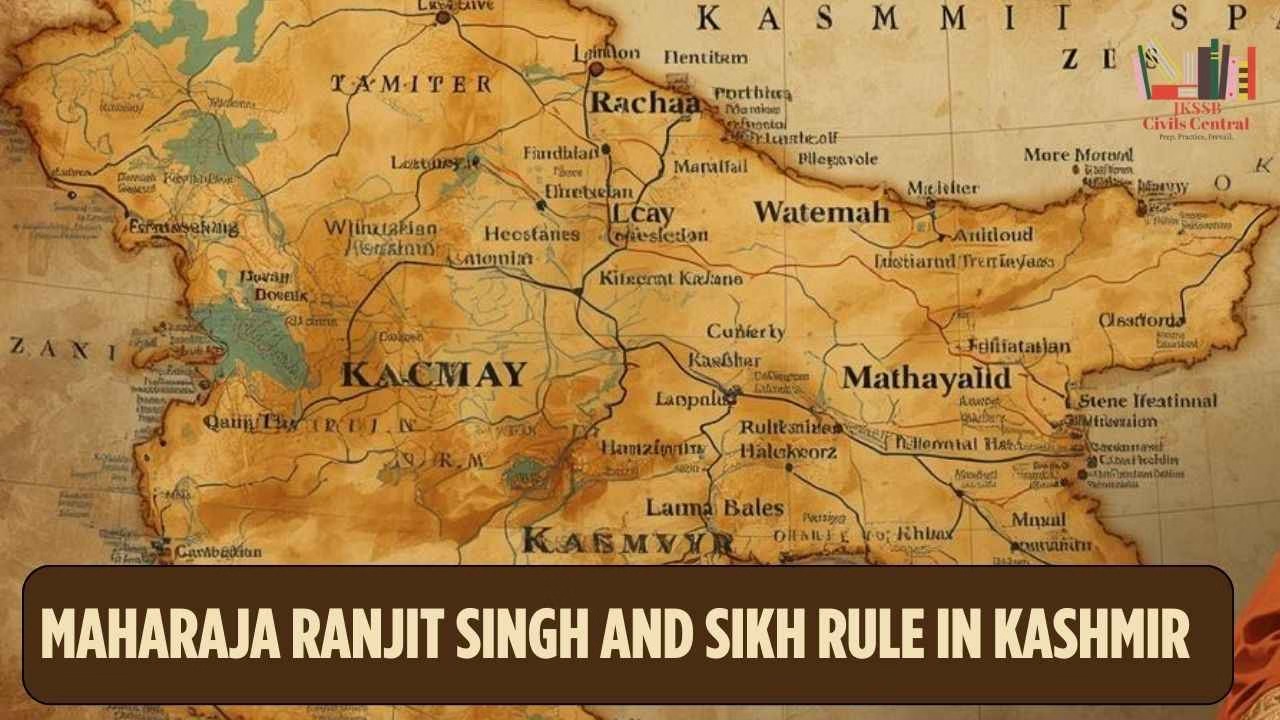

Maharaja Ranjit Singh and Sikh Rule in Kashmir
The historical landscape of Jammu and Kashmir underwent a foundational metamorphosis during the early nineteenth century, a period that effectively bridged the gap between the medieval Islamic sultanates and the modern princely state structure. For aspirants preparing for the Jammu and Kashmir Services Selection Board (JKSSB) examinations, the study of Sikh rule from 1819 to 1846 is not merely a chronological exercise but a vital exploration of administrative evolution, economic restructuring, and cultural synthesis. This era represents the first time in nearly five hundred years that the Kashmir Valley was governed by a non-Islamic sovereignty, marking the transition of the “bridle of reigns” from Kabul to Lahore. This shift significantly affected the destinies of the local populace, moving from the predatory and often brutal administration of the Afghan Durrani Empire to the more structured, military-focused, and reform-oriented governance of the Sikh Empire under Maharaja Ranjit Singh.
The Geopolitical Context of the Sikh Ascendancy
To understand the annexation of Kashmir, one must first recognize the formidable power of Maharaja Ranjit Singh, known as the “Lion of Punjab” or “Sher-e-Punjab”. Born in 1780 to Mahan Singh of the Sukerchakia Misl, Ranjit Singh unified the fragmented Sikh confederacies into a centralized empire centered in Lahore by 1799. His strategic vision was curtailed to the east by the British East India Company via the Treaty of Amritsar in 1809, which established the Sutlej River as a boundary he could not cross. Consequently, his imperial expansion was directed toward the west and north, specifically targeting the rich territories of Multan, Peshawar, and the crown jewel of the Himalayas—the Kashmir Valley.
Kashmir held immense allure for the Lahore Durbar due to its legendary scenic beauty and its economic potential as a trade hub between the Indian plains, Central Asia, and Tibet. It was considered the second richest province in the Sikh Kingdom after Multan, making it a critical target for revenue generation and military buffering against the Afghans. The internal collapse of the Durrani Empire following the death of Ahmad Shah Abdali provided the necessary political vacuum for the Sikh Empire to strike.
The Military Conquest: Expeditions and Strategies
The Sikh annexation of Kashmir was characterized by a series of military campaigns that tested the resilience and strategic depth of the Khalsa Army. The path to Srinagar was not immediate and required navigating some of the most difficult mountainous terrain in Asia.
The Failed Expedition of 1814
The first major attempt by Maharaja Ranjit Singh to conquer the valley took place in 1814 A.D.. Under the command of Diwan Ram Dayal, the Sikh forces attempted to enter the valley through the Mandi and Tosh-Maidan passes. However, the expedition faced insurmountable challenges from nature. Heavy rain and early snow hampered the movement of troops and supplies, leading to a failure of the campaign. The Afghan soldiers, led by Azam Khan, utilized the highlands to their advantage, driving the Maharaja’s men back into the plains. This failure served as a critical lesson for the Sikh leadership, highlighting the need for better intelligence and local support before attempting another northern invasion.
The Turning Point: Birbal Dhar and the 1819 Campaign
The dynamics of the conflict changed when Birbal Dhar, a high-ranking revenue minister under the Afghan administration in Kashmir, fled to the Lahore Durbar to escape persecution. Dhar provided Maharaja Ranjit Singh with invaluable intelligence regarding the internal vulnerabilities of the Afghan forces, the exact number of troops stationed in the valley, and the most viable invasion routes that could bypass traditional defenses.
With this new intelligence, a massive expeditionary force of 30,000 men was organized in early 1819. The army was divided into three sophisticated columns to ensure both offensive capability and supply line security:
- The Advance Column: Commanded by Misr Diwan Chand (who would later earn the title Zafar-e-Jang), this unit carried heavy artillery and was tasked with breaking initial resistances.
- The Support Column: Led by Prince Kharak Singh and the legendary General Hari Singh Nalwa, these troops provided the primary combat strength.
- The Rear Guard: Commanded by Maharaja Ranjit Singh himself, stationed at Bhimber to oversee the entire operation and manage reinforcements and logistics.
The Decisive Battle of Shopian
On July 3, 1819, the Sikh army reached the plains of Shopian, where they were confronted by the Afghan governor, Jabbar Khan, and an army of 5,000. The Afghans, though outnumbered, had heavily entrenched themselves and managed to capture two Sikh guns early in the fight, throwing the Sikh left flank into temporary disarray. However, the tide was turned by the martial brilliance of Akali Phoola Singh, the commander of the Sikh right flank. Leading a fierce charge across the battlefield, his Nihang soldiers engaged the Afghans in close-quarters combat using swords and daggers. The superior martial skills of the Sikh soldiers overwhelmed the Afghan forces. Jabbar Khan was wounded and fled to Peshawar, effectively ending Afghan rule in Kashmir.
| Key Feature | Details of the Battle of Shopian |
| Date of Battle | July 3, 1819 (sometimes cited as July 5) |
| Sikh Commanders | Misr Diwan Chand, Hari Singh Nalwa, Akali Phoola Singh |
| Afghan Commander | Jabbar Khan |
| Historical Result | Decisive Sikh Victory; Annexation of Kashmir into the Sikh Empire |
| Geographic Significance | End of 500 years of non-stop Muslim rule in the Valley |
Administrative Reforms and the Governance Model
Sikh rule in Kashmir lasted for approximately twenty-seven years, during which the valley was administered by a series of ten governors appointed by the Lahore Durbar. This frequent rotation of governors was a strategic choice to ensure that no single administrator could build a local power base sufficient to challenge the central authority of Maharaja Ranjit Singh.
The Sequence of Sikh Governors
JKSSB aspirants should be well-versed in the chronological order of these governors, as questions frequently target the “first,” “last,” or the “most able” among them.
| Order | Governor | Tenure | Distinctive Features and Achievements |
| 1 | Diwan Moti Ram | 1819–1820 | First Governor; son of Diwan Mohkam Chand; prohibited cow slaughter; closed Jamia Masjid |
| 2 | Hari Singh Nalwa | 1820–1821 | Greatest military general; abolished Begar (forced labor); standardized weights; issued “Hari Singhi” rupee |
| 3 | Diwan Moti Ram (2nd) | 1821–1826 | Reduced the state tribute from 52 to 26 lakh rupees; focused on agricultural recovery; faced cholera |
| 4 | Diwan Chuni Lal | 1826–1827 | Protege of the Dogra brothers; tenure marked by the increasing influence of the Jammu Raja |
| 5 | Diwan Kirpa Ram | 1827–1831 | Built the Rambagh garden; honest administrator; faced a massive earthquake and cholera |
| 6 | Bhama Singh Ardali | 1831 | Considered a poor administrator; tenure saw significant Sunni-Shia sectarian riots |
| 7 | Prince Sher Singh | 1832–1834 | Son of Ranjit Singh; his rule coincided with the catastrophic famine of 1833 |
| 8 | Colonel Mihan Singh | 1834–1841 | Often cited as the “Most Able Governor”; suppressed the Galwan bandits; reformed the postal system |
| 9 | Sheikh Ghulam Mohi-ud-Din | 1841–1846 | First Muslim governor; reopened Jamia Masjid for Friday prayers; repaired Shankaracharya temple |
| 10 | Sheikh Imam-ud-din | 1845–1846 | Last Sikh Governor; surrendered to the British and Gulab Singh after the First Anglo-Sikh War |
The Local Administrative Hierarchy
The Sikh administration utilized several key officials to maintain order and ensure revenue flow. The structure was decentralized but held together by the overarching fear of the Khalsa Army’s efficiency.
- Kotwal: The administrative head of Srinagar, tasked with maintaining law and order and municipal functions.
- Thanedar: Local military-police officers stationed in various rural districts to suppress rebellions and theft.
- Kardar: The primary district officer responsible for revenue collection, audits, and managing military garrisons.
- Parganas: The valley was divided into these smaller units for revenue administration, a system adapted from the preceding Mughal and Afghan eras.
- Wazir: High-ranking civil advisors; Udho was a notable figure who served as Wazir under Maharaja Ranjit Singh.
- Kulpurohit: The chief religious advisor to the Maharaja, reflecting the traditional and religious dimensions of the court.
Economic Systems: Agriculture, Industry, and Trade
The economic history of Sikh-ruled Kashmir is a complex narrative of attempted stabilization set against high taxation and natural disasters. While the government introduced reforms to protect trade and standardize commerce, the demands of the Sikh military often put the local peasantry under significant strain.
Revenue and Land Management
Land in Kashmir during this period was categorized into several types, primarily to manage revenue and reward service.
- Khalsa: Land owned directly by the state, with all proceeds going to the Lahore Durbar.
- Jagir: Estates granted to members of the royal family, loyal generals, or religious institutions.
- Dharmarth: Lands dedicated to religious and charitable endowments, particularly gurdwaras and temples.
- Khud-kasht: Land cultivated by the owners themselves, which was relatively rare in the valley compared to Jammu.
Revenue collection was initially very high, with a tribute of 52 lakh rupees demanded by the Lahore treasury. Recognizing the hardship this caused, Diwan Moti Ram successfully petitioned the Maharaja to reduce this to 26 lakhs. To support the struggling farmers, Governor Mihan Singh introduced Taqavi loans (low-interest agricultural credit) and imported grain and eggs from Punjab to restart poultry and crop production after the 1833 famine.
The Shawl Industry and The Dag-Shawl Department
The Kashmiri shawl industry was the primary engine of the region’s economy and its most significant export. At the time of the Sikh annexation, Srinagar boasted 84 varieties of crafts and trades, most of them linked to textile production.
- Regulation: The Sikh government established the Dag-Shawl department to mark and tax every shawl produced in the valley.
- Safety: Maharaja Ranjit Singh provided special military protection for trade routes. Before his rule, costly shawl consignments were frequently looted by robbers; the Sikhs made these routes so safe that highway robbery reportedly became a thing of the past.
- Decline: The industry faced a major setback in the 1830s when Raja Gulab Singh of Jammu began diverting raw wool from Ladakh (which he had recently annexed) through Kishtwar to Jammu, depriving Kashmiri weavers of their raw material and causing widespread poverty in Srinagar.
Natural Calamities and Their Impact
The period was marred by three significant natural disasters that often overshadowed administrative successes:
- The Earthquake of 1828: A massive seismic event that destroyed homes and infrastructure across the valley.
- Cholera Outbreaks: Several waves of cholera decimated the population in the late 1820s and early 1830s, worsened by the lack of medical infrastructure.
- The Great Famine of 1833: This was perhaps the most devastating event of the era. Triggered by early snowfall that destroyed the rice crop, it led to massive starvation, the abandonment of villages, and a permanent decline in the number of skilled shawl weavers.
Cultural and Religious Synthesis: A Secular Monarch’s Legacy
Maharaja Ranjit Singh is frequently described by historians as a secular king whose court was composed of a diverse mix of Sikhs, Hindus, and Muslims. In Kashmir, this pluralistic approach was implemented with varying degrees of success.
Religious Policies and Tolerance
While the Sikh government was generally tolerant, it did impose several regulations that aligned with Sikh and Hindu religious sentiments.
- Ban on Cow Slaughter: Following the general law of the Sikh Empire, cow slaughter was strictly prohibited in Kashmir, with severe penalties for violators.
- Mosque Closures and Reopenings: Early in the rule, Governor Moti Ram closed the Jamia Masjid in Srinagar for public prayers and banned the Azan (call to prayer), reportedly to prevent local leaders from organizing political opposition. However, under the later governorship of Sheikh Ghulam Mohi-ud-Din, these restrictions were lifted, and the Jamia Masjid was reopened for Friday congregational prayers.
- Relief for Kashmiri Pandits: General Hari Singh Nalwa lifted many of the restrictive Afghan-era laws that had banned Kashmiri Pandits from wearing their traditional dress or practicing their religious rituals in public.
- Restoration of Temples: The administration took steps to repair ancient Hindu structures. Sheikh Imam-ud-din is credited with installing a Shiv Lingam at the Shankaracharya temple, which had fallen into disrepair.
Sikh Heritage and Gurdwaras
The Sikh rule saw the establishment and renovation of several sites of great spiritual importance to the Sikh community.
- Gurudwara Chatti Padshahi: Located in Rainawari, Srinagar, near the southern gate of the Hari Parbat fort, this is the most important gurdwara in the valley. It commemorates the visits of both Guru Nanak Dev Ji and the sixth Guru, Guru Hargobind Ji.
- Healing Waters: A well located at the site is said to have been dug on the orders of Guru Hargobind Ji and is believed by devotees to possess healing properties.
- Mai Bhag Bhari: The legend of this devout blind lady, who waited years to present a cloak she had woven for the Guru, remains a central part of Kashmiri Sikh folklore.
The Rise of the Dogras and the Strategic Alliance
A defining feature of the Sikh rule in Jammu and Kashmir was the elevation of the Dogra brothers from Jammu within the Lahore Durbar. Gulab Singh, the son of Mian Kishore Singh, joined Maharaja Ranjit Singh’s army as a teenager and distinguished himself through his military bravery and diplomatic acumen.
The Raja of Jammu
In 1822, Maharaja Ranjit Singh personally performed the coronation of Gulab Singh at Akhnoor, marking the bank of the Chenab River with a symbolic tilak to confirm him as the Raja of Jammu. Gulab Singh’s brothers, Dhian Singh and Suchet Singh, also held prominent positions; Dhian Singh served as the Prime Minister of the Sikh Empire for many years.
Territorial Expansion into Ladakh and Baltistan
While the Sikh Governors administered the valley, Gulab Singh acted as a powerful vassal who expanded the empire’s frontiers far beyond the traditional boundaries of Kashmir.
- Ladakh (1834): Under the command of General Zorawar Singh, the Dogra forces annexed Ladakh, bringing it under Sikh suzerainty.
- Baltistan (1840): The Dogra forces continued their northern expansion, annexing Skardu and other regions of Baltistan, which strengthened the northern frontiers of the Sikh Empire against Central Asian threats.
The Sunset of Sikh Rule and the Treaty of Amritsar (1846)
The death of Maharaja Ranjit Singh in 1839 triggered a period of political instability in Punjab. Internal factions within the Lahore Durbar and the subsequent First Anglo-Sikh War (1845–1846) led to the eventual dissolution of Sikh sovereignty over Kashmir.
- The First Anglo-Sikh War: The defeat of the Sikh forces by the British East India Company resulted in the Treaty of Lahore on March 9, 1846.
- War Indemnity: The British imposed a war indemnity of 1.5 crore rupees on the Lahore Durbar. Unable to pay the full amount, the Sikhs ceded the hill territories between the Beas and Indus rivers, including Kashmir, to the British.
- The Sale of Kashmir: Seeking a buffer state against Russia and the Afghans, and wanting to reward Gulab Singh for his neutrality and mediation during the war, the British sold Kashmir to him for 75 lakh rupees under the Treaty of Amritsar on March 16, 1846.
- The Last Stand: Sheikh Imam-ud-din, the last Sikh governor, was encouraged by the Lahore Wazir, Lal Singh, to resist the transfer. However, after the British sent troops and Gulab Singh’s army defeated him at Dalgate, Imam-ud-din surrendered, marking the formal beginning of the Dogra rule.
High-Density Information for JKSSB Aspirants
To facilitate rapid revision, the following consolidated tables and facts integrate history with the current affairs topics often found in modern examination papers.
Important Historical Sites and Founders
| Site / Monument | Founder / Key Figure | Era |
| Hari Parbat Fort | Current Fort by Shuja Shah Durrani (1808) | Late Afghan |
| Pandrethan | Emperor Ashoka | Ancient |
| Martand Sun Temple | Lalitaditya Muktapida | 8th Century Karkota |
| Shalimar / Nishat | Emperor Jahangir | Mughal |
| Gurudwara Chatti Padshahi | Commemorating 6th Guru | Sikh Rule Period |
| Rambagh Garden | Diwan Kirpa Ram | Sikh Rule |
Current Affairs and Archaeological Milestones (2024–2025)
The JKSSB has increasingly focused on the preservation of heritage and current cultural news. Candidates should note these recent developments:
- Zehanpora Excavation (December 2025): A landmark discovery of a major Buddhist complex from the Kushan era was unearthed in Baramulla. This project, a joint effort by the University of Kashmir and the Department of Archives, is the first major collaborative archaeological mission under ASI regulations in the Union Territory in decades.
- Anantnag Archaeological Discovery (August 2025): Ancient Hindu idols and Shivlings were recovered from a spring at Karkoot Nag in Aishmuqam. These are believed to date back to the Karkoota dynasty (625–855 CE), reinforcing the historical significance of the region.
- Mubarak Mandi Restoration (October 2025): The J&K Government has set a deadline for the completion of major restoration projects at the Mubarak Mandi Heritage Complex in Jammu, which includes the Dogra Art Museum and the Raja Ram Singh Palace.
- Heritage Preservation (November 2025): World Heritage Week was celebrated with an exhibition of rare archival records at the Shergarhi Complex in Srinagar, emphasizing the confluence of Shaivism, Sufism, and Buddhism in the region’s identity.
Key Terminology and Concepts
- Begar: Forced labor without pay. It was a rampant practice during Afghan rule but was officially abolished by General Hari Singh Nalwa during the Sikh period.
- Taqavi: Government-sponsored agricultural loans introduced to help farmers recover from natural disasters.
- Zafar-e-Jang: The title meaning “Victor of War,” bestowed upon Misr Diwan Chand following the conquest of Kashmir.
- Dag-Shawl: The state department responsible for marking shawls and collecting production taxes.
- Sarkar-i-Khalsa: The official name of the government of the Sikh Empire under Maharaja Ranjit Singh.
Conclusion: The Strategic Legacy of Sikh Rule
The 27 years of Sikh rule in Jammu and Kashmir represent a period of profound structural realignment. By transitioning the administrative focus from the predatory taxation of the Afghans to a model that, while demanding, sought to protect trade and standardize civil functions, the Sikh governors laid the groundwork for the modern state. The integration of the Dogra brothers into the highest echelons of the Lahore Durbar directly led to the formation of the princely state of Jammu and Kashmir as we know it today. For the JKSSB aspirant, mastering this period provides a clear understanding of the “bridge” between medieval turmoil and modern administrative systems, ensuring success in history, geography, and current affairs sections of the competitive examinations.
About The Author



[…] 14. Maharaja Ranjit Singh and Sikh Rule in Kashmir – JKSSB Preparation […]