
Afghan Rule in Kashmir (1753–1819)
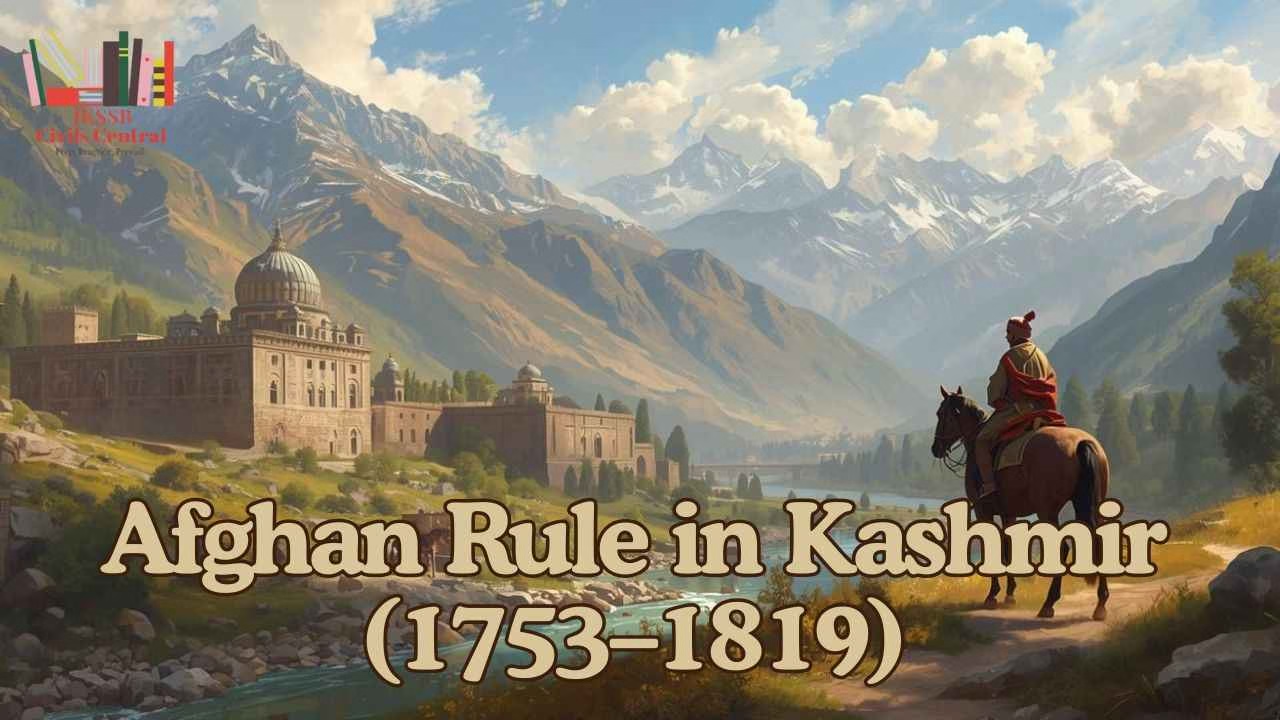
The historical landscape of Jammu and Kashmir underwent a profound and tumultuous transformation during the mid-eighteenth century, a period that marked the transition from the decaying grandeur of the Mughal Empire to the assertive and often extractive hegemony of the Afghan Durrani Empire. For candidates preparing for the Jammu and Kashmir Services Selection Board (JKSSB) examinations, the study of the Afghan rule, which spanned sixty-seven years from 1753 to 1819, is not merely a chronological requirement but an essential exercise in understanding the socio-political and economic shifts that paved the way for modern regional dynamics. This era is characterized in historiography by a shift from the centralized, culturally oriented administration of the Mughals to a decentralized, military-centric, and economically exploitative governance under the Kabul-based Durrani monarchs.
The Geopolitical Context and the Rise of the Durrani State
The genesis of Afghan rule in Kashmir cannot be understood without examining the broader geopolitical tremors emanating from Persia and Afghanistan. Following the decline of the Safavid dynasty in Persia, a military leader named Nadir Quli (later Nadir Shah) rose to power, eventually dealing a devastating blow to the Mughal Empire during his invasion of India in 1739. Within Nadir Shah’s ranks was a young and capable soldier from the Sadozai family of the Abdali clan, Ahmad Khan. Following the assassination of Nadir Shah in 1747, Ahmad Khan secured the Persian treasury and the legendary Koh-i-Noor diamond, subsequently being elected as the leader of the Afghan tribes in Kandahar. Assuming the title Ahmad Shah Durrani (meaning “Pearl of the Age”), he laid the foundation for the modern state of Afghanistan and turned his sights toward the rich provinces of the crumbling Mughal Empire, including the Punjab and Kashmir.
Kashmir, at this juncture, was suffering under the mismanagement of the later Mughal governors. The administration had become a hotbed of corruption and religious intolerance, prompting local Kashmiri nobles, such as Miri Muquim Kant and Khwaja Zahir Didmari, to seek outside intervention. These nobles traveled to Lahore to invite Ahmad Shah Abdali to annex the valley, hoping that Afghan rule would provide a stable and more equitable alternative to the corrupt Mughal satrapy. This invitation, while intended to relieve the people of their miseries, ironically ushered in a period that many historical records and local oral traditions describe as the “darkest chapter” in the history of the state.
The Conquest and Formal Establishment
In 1752, Ahmad Shah Durrani dispatched a formidable Afghan force under the command of Abdullah Khan Ishik Aqasi to occupy the Kashmir Valley. Despite resistance from the last Mughal representatives, the Afghan forces triumphed, and the flag of the Durrani Empire was raised over the ramparts of Akbar’s town at Nagar Nagar in Srinagar. This transition officially ended Mughal suzerainty over Kashmir, which had lasted since the late sixteenth century.
| Key Historical Milestone | Year | Significance for Aspirants |
| Foundation of Durrani Empire | 1747 | Ahmad Shah Abdali assumes power in Kandahar. |
| Invitation to Abdali | 1752 | Miri Muquim Kant and Khwaja Zahir Didmari invite Afghan intervention. |
| Afghan Occupation of Kashmir | 1753 | Formal commencement of Durrani rule under Abdullah Khan Ishik Aqasi. |
| Third Battle of Panipat | 1761 | Afghan victory over the Marathas, securing the northern frontiers. |
| Death of Ahmad Shah Abdali | 1772 | Succession of Timur Shah; beginning of frequent governor turnovers. |
| Sikh Conquest of Kashmir | 1819 | Maharaja Ranjit Singh ends Afghan rule after the Battle of Shopian. |
Administrative Machinery and the Governor System
The Afghan administration in Kashmir was primarily a military occupation intended to serve the financial needs of the Kabul court. Unlike the Mughals, who often visited the valley and invested in its aesthetic and cultural preservation, the Afghan monarchs rarely visited Kashmir, viewing it primarily as a revenue-generating province. The valley was governed by a series of twenty-eight governors (Subedars) and deputy governors appointed by the Afghan kings. The rapid turnover of these officials was a direct reflection of the political instability within the Durrani Empire itself; as various claimants struggled for the throne in Kabul, the governorship of Kashmir changed hands frequently, leading to a lack of long-term administrative vision and a focus on immediate, ruthless extraction.
Profiles of Significant Afghan Governors
Understanding the specific tenures of various governors is a frequent requirement in JKSSB history papers. While most governors are remembered for their severity, a few left unique footprints on the region’s history.
Abdullah Khan Ishik Aqasi: The Architect of Extortion
As the first Afghan governor, Abdullah Khan Ishik Aqasi established a precedent of brutality that would characterize much of the sixty-seven-year rule. During his brief six-month tenure, he is reported to have forcibly extracted nearly one crore of rupees from the local population, primarily targeting wealthy merchants and the peasantry. His reign initiated a period of widespread looting and arbitrary killings, devastating the economic stability that had existed toward the end of the Mughal period.
Raja Sukh Jivan Mal: The Hindu Exception
In a departure from the general trend of Afghan governors, Raja Sukh Jivan Mal (1754–1762) is remembered as a relatively humane administrator who attempted to restore peace and order. Appointed by Ahmad Shah Abdali, Sukh Jivan Mal eventually sought to assert independence from Kabul. He patronized local scholars and was well-regarded by all communities until he was eventually defeated and executed by a subsequent Afghan force dispatched by Abdali.
Amir Khan Jawan Sher: Builder and Sectarian Divider
Appointed during the reign of Timur Shah, Amir Khan Jawan Sher is notable for building the Sher Ghari fort and the Amira Kadal bridge in Srinagar. However, his administration was also marked by the destruction of hundreds of Mughal gardens and the incitement of sectarian tensions within the Muslim community, leading to a period of internal strife and social unrest.
The Extremism of Karim Dad Khan and Azad Khan
The tenures of Karim Dad Khan and his son Azad Khan are often cited as the pinnacle of Afghan tyranny. Karim Dad Khan was infamous for his rapacious taxation, including the Zar-i-Ashkhas property tax, which bankrupted much of the middle class. His son, Azad Khan, was so feared for his cruelty that he reportedly executed citizens for the slightest perceived infractions, causing a state of constant terror. During this time, the ecological landscape suffered as desperate peasants cut down fruit-bearing trees to sell as firewood to meet the government’s tax demands.
Atta Mohammad Khan: The Independence Seeker
Atta Mohammad Khan is significant for his attempt to create an independent kingdom in Kashmir. To garner local support, he struck coins in the name of the patron saint of Kashmir, Sheikh Noor-ud-Din Wali (Nund Rishi), rather than the Afghan monarch. He is also credited with the construction of the present-day fortification of the Hari Parbat Fort, which remains one of the most prominent historical landmarks in Srinagar.
Economic Transformation and the Mechanism of Extraction
The primary objective of the Durrani presence in Kashmir was the systematic drainage of its rich resources to finance the empire’s military campaigns in Punjab and Persia. The Afghan economic policy was fundamentally extractive, relying on a system of revenue farming known as Ijaradari, where land was leased to the highest bidder. These revenue farmers, faced with high demands from the central treasury and uncertain tenures, practiced ruthless exploitation of the peasantry and artisans.
The Burden of Taxation
The Afghans introduced a series of innovative and burdensome taxes that affected every segment of Kashmiri society. For aspirants, understanding these terms is crucial for questions regarding the socio-economic impact of the era.
| Tax Designation | Targeted Demographic | Description and Impact |
| Zar-i-Niaz | Mansabdars and Jagirdars | A “presentation tax” often collected at rates four to six times the income of the nobility. |
| Zar-i-Ashkhas | Middle-class and Gentry | A property tax targeting traders and shopkeepers, leading to widespread bankruptcy. |
| Zar-i-hubub | Cultivators | A grain tax that deprived the peasantry of their basic sustenance. |
| Zar-i-Dudak | Hindus | A religious tax imposed on the Hindu community, contributing to mass migration. |
| Zara-i-Bafta | Weavers | A levy on the production of shawls, which significantly increased the cost for artisans. |
The Shawl Industry: Flourishing Trade vs. Artisan Misery
A notable paradox of the Afghan period was the continued international growth of the Kashmiri shawl industry. Despite the oppressive political environment, the demand for Kashmiri shawls in Europe and the Indian plains reached new heights. The Afghan administration sought to capitalize on this by establishing the Dagh-shawl department, a regulatory body designed to tax every stage of shawl production. While the state generated nearly 13 lakh rupees annually from this trade, the actual weavers were reduced to penury, earning mere pittance (2 to 4 paisa daily) while working under coercive conditions. This extreme exploitation eventually led to a decline in the number of skilled laborers as many artisans preferred other professions or migrated to escape the tax burden.
Agricultural Devastation and Environmental Impact
The agricultural sector, once the backbone of the valley’s prosperity, withered under Afghan rule. The combination of high revenue demands and the neglect of vital irrigation systems led to frequent man-made famines. The environmental impact was particularly severe during the reign of Haji Karimdad Khan, when the state’s demands were so high that peasants were forced to cut down fruit-bearing orchards to sell as timber and firewood. This not only denuded the valley of its horticultural wealth but also destroyed the long-term economic security of the rural population.
Social and Cultural Implications
The sixty-seven years of Afghan rule left a deep and often painful imprint on the collective memory and social structure of Kashmir. The era is remembered for its suppression of civil liberties and the introduction of a pervasive culture of fear. Residents were forbidden from carrying weapons, and a vast network of spies was employed to monitor the local population.
Religious and Sectarian Dynamics
The Afghan governors, often guided by tribal codes and imperial lust for power, practiced policies that significantly altered the religious landscape of the valley. While both Muslims and Hindus suffered under the economic policies, certain communities were specifically targeted for persecution.
The Kashmiri Pandit community experienced a particularly challenging period, as religious taxes and humiliating practices led to large-scale migrations to the plains of Northern India. Similarly, sectarian tensions were frequently exploited by the governors; for instance, Amir Khan Jawan Sher’s reign was marked by severe oppression of the Shia community, leading to internal riots and social fragmentation. These policies of religious discord were a departure from the relatively more integrated and tolerant traditions of the earlier Sultanate and Mughal periods.
Cultural Influences and the “Rishi” Synthesis
Despite the political turmoil, the cultural identity of Kashmir continued to evolve. The social composition of the valley changed as several Afghan tribes and families settled in the region, introducing Pashto and Persian influences into the Kashmiri language and lifestyle.
In the realm of performing arts, the “Pather” (folk drama) traditions—such as Raza Pather and Derze Pather—continued to flourish, often incorporating satirical elements that critiqued the harshness of the administration. The issuance of coins by Atta Mohammad Khan in the name of the patron saint Sheikh Noor-ud-Din Wali (Nund Rishi) serves as a poignant reminder of the enduring power of local Sufi and Rishi traditions, which remained the primary source of spiritual and psychological solace for the common people during this turbulent era.
Architectural and Urban Legacies
While the Afghans were not as prolific in their architectural endeavors as the Mughals, their contributions were strategic and functional, often focusing on defense and administrative stability.
Hari Parbat Fort (Koh-e-Maran)
The most iconic monument from the Afghan period is the Hari Parbat Fort in Srinagar. While the outer wall (Nagar Nagar) was originally built by the Mughal Emperor Akbar in the late sixteenth century to house his new capital, the present-day fort structure atop the hill was constructed by Atta Mohammad Khan during his tenure from 1795 to 1806. Built during a period when the governor sought independence from Kabul, the fort was designed as a military stronghold. Modern architectural assessments suggest that the Afghan construction, while imposing, lacked the durability and refined stonemasonry characteristic of the earlier Mughal buildings.
The Development of Sher Ghari and Amira Kadal
Srinagar’s urban landscape was significantly modified by the Afghan administration. Amir Khan Jawan Sher is credited with the construction of the Sher Ghari Fort, which served as the administrative headquarters and royal residence throughout the Afghan, Sikh, and Dogra periods. He also built the first bridge across the Jhelum at Amira Kadal, a vital piece of infrastructure that remains a central landmark of the city today. These structures illustrate that despite the overall extractive nature of the rule, certain governors invested in projects that were essential for the city’s defense and connectivity.
The Resistance and the End of Afghan Hegemony
The collapse of Afghan rule was precipitated by the internal decay of the Durrani Empire in Kabul and the rising military power of the Sikh Empire in the Punjab under Maharaja Ranjit Singh. The immediate catalyst for the transition was the rebellion of the local Kashmiri nobility, who had grown weary of the incessant taxes and brutal governance.
The Role of Birbal Dhar and the Sikh Intervention
In the early nineteenth century, Pandit Birbal Dhar, a high-ranking revenue official, fled the valley to escape the wrath of the governor Azam Khan. Dhar reached the court of Maharaja Ranjit Singh in Lahore and persuaded the Sikh leader that the Afghan administration in Kashmir was internally weakened and the people were ready to support a new ruler.
In 1819, Maharaja Ranjit Singh dispatched a large force of 30,000 Sikh soldiers to conquer the valley. In the decisive Battle of Shopian, the Sikh forces defeated the Afghan army led by the last governor, Jabbar Khan. This victory marked the end of sixty-seven years of Afghan rule and the commencement of the Sikh period in Kashmir, which would last until the formation of the Princely State under the Dogras in 1846.
Modern Context and Current Affairs for Aspirants
For JKSSB and JKPSC aspirants, it is essential to connect historical events with current developments in heritage preservation and administrative changes in the Union Territory. Historical knowledge is frequently tested alongside current affairs.
Heritage Preservation and Digital Initiatives
The J&K Government, under the current administration, has launched several schemes for the “revival, restoration, preservation, and maintenance” of the region’s historical architecture. As of 2025, work is ongoing on 45 heritage projects, including significant forts and religious sites.
- Digitization of Archives: The Department of Archives, Archaeology, and Museums has successfully digitized over 3.8 million pages of historical records, including thousands of Persian and vernacular files from the Afghan and Sikh periods. This project is crucial for preserving the primary sources that document the socio-economic policies of the Durrani governors.
- Hari Parbat Fort: The fort continues to be a central focus of heritage tourism and conservation. In recent years, the Indian national flag has been hoisted atop the fort as a symbol of regional integration and historical celebration.
- Cultural Festivals: Modern cultural initiatives, such as the winter carnivals and heritage walks in Srinagar, often focus on the layered history of the city, highlighting the contributions of the Mughal and Afghan eras to the valley’s unique architectural and culinary identity.
Current Milestones in J&K (2024–2025)
| Current Event/Project | Category | Relevance to J&K History/Culture |
| J&K Budget 2025-26 | Economy | Rs. 41,000 crore allocated for infrastructure and heritage. |
| Heritage Restoration Scheme | Culture | 118 projects identified for restoration including ancient forts. |
| Z-Morh Tunnel Inauguration | Infrastructure | Enhancing connectivity to historic borderlands like Ganderbal. |
| Digitization of Manuscripts | Education | Preserving ancient Kashmiri and Persian literary works. |
Third-Order Insights: The Enduring Impact of Afghan Rule
A deeper analysis of the Afghan period reveals long-term structural changes that outlasted the Durrani Empire itself. While the period is often viewed purely through the lens of tyranny, it had profound implications for the subsequent two centuries of Kashmiri history.
The Legacy of Economic Drainage
The Afghan focus on immediate revenue extraction without investment in infrastructure created a legacy of economic fragility. The “drain of wealth” meant that when the Sikhs took over in 1819, they inherited a province where the peasantry was deeply impoverished and the irrigation systems were in ruins. This set the stage for the economic hardships that continued into the early Sikh and Dogra periods, often requiring subsequent rulers to implement drastic reforms just to stabilize the food supply.
Social Displacement and the Diaspora
The migration of the Kashmiri Pandit community during the Afghan period was not a temporary move but led to the establishment of significant Kashmiri communities in Punjab, Delhi, and Uttar Pradesh. This diaspora became highly influential in the administration of the British Raj and eventually in the Indian independence movement. Thus, the persecution during the Afghan era indirectly contributed to the emergence of a politically potent Kashmiri leadership outside the valley.
Strategic Fortification and Urban Identity
The military fortifications of the Afghan era, particularly the Sher Ghari and Hari Parbat Forts, defined the strategic landscape of Srinagar for over a century. By shifting the center of administration from the open Mughal gardens and palaces to fortified riverside complexes like Sher Ghari, the Afghans altered the psychological relationship between the rulers and the ruled, institutionalizing a more defensive and detached form of governance that was continued by both the Sikhs and the Dogras.
Conclusion
The Afghan rule in Kashmir from 1753 to 1819 remains one of the most significant and debated epochs in the history of the Jammu and Kashmir region. For the JKSSB aspirant, this period serves as a crucial link between the medieval and modern eras, illustrating the volatile nature of 18th-century geopolitics and its impact on a sensitive borderland like Kashmir. While the narrative is dominated by tales of economic exploitation and religious hardship, the period also witnessed the creation of vital urban infrastructure and the preservation of the unique Kashmiri spiritual identity in the face of immense pressure.
Understanding the mechanisms of Afghan governance—from the rapid succession of governors to the oppressive taxation systems like Zar-i-Ashkhas—provides aspirants with the necessary analytical tools to handle both historical and socio-economic questions in competitive exams. Furthermore, connecting this history with modern heritage conservation and digitization efforts demonstrates a holistic understanding of the subject that is highly valued in the civil services. As the valley moves forward in the twenty-first century, the silent ramparts of the Hari Parbat Fort stand as a testament to an era of struggle that forever shaped the social and political destiny of the “Paradise on Earth”.
About The Author