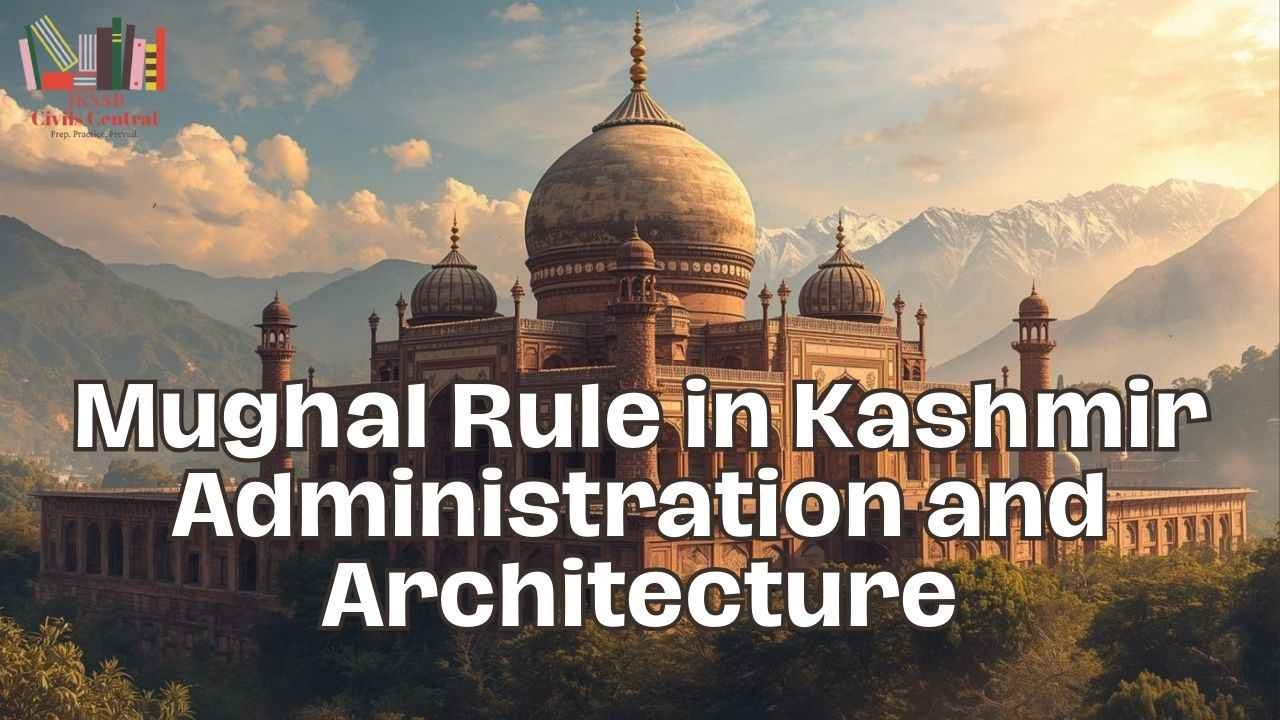
Mughal Rule in Kashmir – Administration and Architecture Notes for JKSSB

Mughal Rule in Kashmir
The historical narrative of the Kashmir Valley underwent a definitive shift in the late sixteenth century, transitioning from the localized governance of the Shahmiri and Chak dynasties to becoming an integral northern province of the Mughal Empire. This period, spanning from 1586 to 1752 CE, represents more than a mere change in political leadership; it was an era of systematic integration into a centralized, military-bureaucratic state that introduced sophisticated Persianized administrative theories, standardized fiscal reforms, and a monumental architectural vocabulary that redefined the valley’s cultural landscape. For candidates preparing for the Jammu and Kashmir Services Selection Board (JKSSB) examinations, understanding this era is critical, as it laid the foundations for much of the region’s modern administrative nomenclature and heritage identity.
The Geopolitical Prelude and the Process of Annexation
The Mughal ambition to annex Kashmir was a strategic objective that predated the successful invasion by Emperor Akbar. The founder of the Mughal dynasty, Babur, had expressed interest in the valley, and his son Humayun witnessed early attempts at conquest by his relatives. In 1531, Kamran Mirza, the son of Babur, briefly occupied the land for two months, but it was Mirza Haider Dughlat, a cousin of Humayun, who established a more prolonged Mughal presence between 1540 and 1551 CE. Dughlat acted as a regent and titular ruler, introducing early Mughal administrative concepts before the restoration of the local Sultanate.
The definitive annexation occurred during the reign of Akbar, who utilized the internal instability and communal tensions of the Chak period to justify imperial intervention. The Chak rulers, specifically the later kings like Yusuf Shah Chak and Yaqub Shah Chak, faced internal revolts from the nobility, who frequently sought help from the Mughal court. In 1586, following the Battle of Hastivanj, Mughal forces led by Qasim Khan and Raja Man Singh defeated the last sovereign Chak ruler, Yaqub Shah. Initially, Kashmir was not designated as a separate province but was treated as a Sarkar (district) under the Subah (province) of Kabul, reflecting its status as a newly conquered frontier territory.
| Key Event | Year | Historical Significance |
| Early Conquest by Kamran Mirza | 1531 CE | First brief Mughal footprint in the valley. |
| Rule of Mirza Haider Dughlat | 1540–1551 CE | Introduction of early Mughal-style regency. |
| Formal Annexation by Akbar | 1586 CE | Integration into the Mughal Empire; end of Chak rule. |
| First Visit of Emperor Akbar | 1589 CE | Imperial stabilization and foundations of Nagar Nagar. |
| Separation as a Distinct Subah | 1648 CE | Elevation to full provincial status under Shah Jahan. |
| Annexation by Durrani Empire | 1752 CE | Conclusion of the Mughal era in Kashmir. |
The Administrative Framework of Mughal Kashmir
The nature of the Mughal state in Kashmir was essentially that of a military-centric, centralized bureaucracy. The emperors assumed titles like ‘Vakil’ (agent of God) and ‘Badshah Salamat’, serving as the fountainhead of all honors and the supreme source of justice. This centralized authority was operationalized through the Mansabdari system, which organized all civil and military officials into a single hierarchical order based on rank or status, known as Mansab.
The Mansabdari System and Provincial Tiers
Every official in the Mughal administration held a specific rank defined by two numerical values: Zat and Sawar. Zat indicated the personal status and salary of the official, while Sawar designated the number of cavalrymen they were required to maintain for imperial service. This system ensured that the bureaucracy remained loyal to the emperor, as appointments and salaries were controlled directly by the center.
In Kashmir, the administrative structure mirrored the central government’s model, designed with a system of checks and balances to prevent regional governors from establishing independent power bases. The province was headed by the Subahdar (Governor), who was responsible for defense and executive functions, while the Diwan (Finance Minister) managed revenue and reported directly to the central treasury, independent of the Subahdar.
| Administrative Office | Primary Functions | Reporting Authority |
| Subahdar (Nazim) | Provincial head; maintenance of law and order; military leadership. | The Emperor |
| Diwan | Revenue administration; management of Khalisa (crown) and Jagir lands. | Central Diwan-i-Ala |
| Bakshi | Military paymaster; supervision of Mansabdars and horse branding (Dagh). | Central Mir Bakshi |
| Sadr-us-Sudur | Judicial head for religious matters; administrator of Inam (charity) grants. | Central Sadr |
| Kotwal | Chief of city police; municipal administration and market control. | Subahdar |
| Qazi | Judicial officer responsible for civil and criminal justice according to Islamic law. | Central Qazi |
Sub-Provincial Administration: Sarkars and Parganas
To maintain effective control over the diverse topography of the valley, the Mughals divided the Subah into smaller administrative units. A Sarkar was a district-level unit, which was further divided into Parganas (sub-districts) and finally into villages. The Pargana served as the primary unit for revenue collection and local governance, where officers like the Shiqqdar acted as executive heads and the Amil functioned as the revenue collector.
This hierarchical structure allowed the Mughals to reach the grassroots level of Kashmiri society, although local village machinery was often permitted to prevail in non-essential matters. The integration was not just administrative but also linguistic; Persian was adopted as the official language of the court and administration, significantly influencing local culture and record-keeping.
Fiscal Policies and the Land Revenue System
The economic backbone of the Mughal Empire was land revenue, which was viewed as the “remuneration of sovereignty” in exchange for the protection and justice provided by the state. Under the guidance of Raja Todar Mal, Akbar’s finance minister, the empire moved toward a scientific and standardized method of assessment known as the Dahsala or Zabti system.
Revenue Assessment Methods in the Valley
While the Zabti system—based on ten-year average produce and prices—was the standard in the core provinces of India (like Agra and Delhi), the Mughals adapted their methods to the specific needs of Kashmir. The difficult terrain and the prevalence of rice as the primary crop led to the continued use of older, more flexible systems alongside imperial reforms.
- Ghalla Bakhshi (Crop Sharing): This was the most common method in Kashmir, where the harvest was physically divided between the state and the cultivator. The state typically took one-third of the produce. This system was preferred in regions where land measurement was difficult or where agricultural yields were unpredictable.
- Kankut (Estimation): Also known as Danabandi, this method involved estimating the grain yield of a standing crop through expert appraisal. The land was measured, and productivity was estimated based on its classification as “good, middling, or bad”.
- Zabti (Measurement): This was a more rigid system involving the actual measurement of cultivated land and the application of fixed cash rates (Dasturs) per crop. Although ideal for administrative predictability, its implementation in the mountainous Kashmir was less pervasive than in the plains.
Land Classification and Taxation Officers
To ensure fairness in taxation, land was categorized based on its fertility and cultivation frequency :
- Polaj: Land that was cultivated every year and never left fallow.
- Parauti: Land left uncultivated for a short period to recover its nutrients.
- Chachar: Land left fallow for three to four years.
- Banjar: Marginal land that had not been cultivated for five years or more.
The revenue machinery at the local level was intensive. The Amal Guzar (revenue collector) was assisted by the Bitikshi (recorder), who maintained the Patta (title deed) and Qabuliyat (agreement) records. The Khazandar (treasurer) was responsible for receiving payments, preferably in cash, though the Mughals frequently allowed payments in kind in Kashmir to accommodate the local economy.
| Revenue Term | Definition | Context in Kashmir |
| Jama | The assessed amount of revenue to be collected. | Often fluctuated based on crop success. |
| Hasil | The actual amount collected by the state treasury. | Used to gauge the efficiency of governors. |
| Khalisa | Land whose revenue went directly to the royal treasury. | Reserved for the most fertile regions. |
| Jagir | Revenue assignments granted to Mansabdars in lieu of cash salary. | Often transferred frequently to prevent local power bases. |
| Karori | Officers appointed to collect a crore of dams and audit local accounts. | Represented Akbar’s attempt at direct fiscal control. |
The Architectural Legacy: A Synthesis of Cultures
Mughal architecture in Kashmir is characterized as a “Indian Summer” of Muslim art, representing a sophisticated blend of Persian grandeur and local craftsmanship. The emperors, particularly Jahangir and Shah Jahan, viewed architecture as a direct visual reflection of their authority and as a means of projecting the “monstrosity” and elegance of the empire. Unlike the brick and stone structures of the plains, Kashmiri Mughal architecture made extensive use of local deodar wood and gray limestone, adapting to the valley’s environment.
The Evolution of the Mughal Garden
The most iconic contribution of the Mughals to the valley’s landscape is the development of terraced gardens. While the concept of pleasure gardens (Vatikas) existed in pre-Islamic Hindu Kashmir, the Mughals introduced the Persian Chahar Bagh (four-fold garden) pattern, characterized by symmetrical layouts and central water channels. In the mountainous terrain of Kashmir, this pattern was adapted into a “mountain-side” style, using multiple terraces to create a vertical hierarchy and take advantage of natural springs.
Engineering and Hydraulic Features
The beauty of these gardens relied on the sophisticated engineering of water. The Mughals directed mountain streams into central nahrs (channels), which were interrupted by various decorative and functional elements :
- Chadars: These were sloping stone slabs over which water flowed, often carved with patterns to create musical sounds and a cooling mist.
- Hauz and Fountains: Large water tanks located at the center of terraces, often featuring hundreds of fountains powered by gravity and natural hydraulic pressure.
- Baradaris: Pavilions with twelve doors (or open arches) placed directly over water channels to provide a shaded area for leisure and royal courts.
The Six Primary Gardens of the UNESCO Tentative List
Kashmir’s Mughal gardens have been on the UNESCO World Heritage Tentative List since 2010, representing a serial nomination of six sites that exemplify the peak of horticultural and architectural brilliance.
| Garden | Founder / Patron | Significant Features |
| Shalimar Bagh | Emperor Jahangir (1619) | The largest garden; built for Nur Jahan; known as Farah Baksh; served as the imperial summer residence. |
| Nishat Bagh | Asaf Khan (1634) | The “Garden of Bliss”; twelve terraces symbolizing zodiac signs; offers panoramic views of Dal Lake. |
| Chashma Shahi | Ali Mardan Khan (1632) | Built around a natural spring on the Zabarwan Mountains; famous for its cool, medicinal water. |
| Achabal Bagh | Empress Nur Jahan (1620) | Located in Anantnag; reimagined from a traditional orchard; features a royal hammam and majestic Chinars. |
| Pari Mahal | Dara Shikoh (c. 1650) | A seven-terraced structure; originally a Sufi school and observatory; lacks the typical central water channel. |
| Verinag | Emperor Jahangir (1620) | Built at the source of the River Jhelum; features an octagonal tank and a surrounding stone arcade. |
Urban Planning and Fortifications
Mughal architecture extended beyond pleasure gardens to include strategic urban settlements and the reconstruction of religious sites. Emperor Akbar, recognizing the need to secure the imperial administration from local rebellions, initiated the construction of a new capital city.
Nagar Nagar and the Hari Parbat Fort
In 1590 CE, Akbar laid the foundation for the walled city of Nagar Nagar at the base of the Hari Parbat hill. The project was intended to house the Mughal troops and officials away from the local population to prevent skirmishes. The most significant feature was the Kalai, an impregnable stone wall approximately 4.8 kilometers long and 9 meters high, built using gray limestone.
Historians note that Akbar employed over 200 stonemasons from outside the valley for this project, as the indigenous tradition was almost exclusively focused on wood. The construction also served as a royal employment scheme for locals during a period of drought and economic hardship. While the current fort sitting atop the hill was largely constructed later by the Afghan Governor Atta Mohammed Khan in the 18th century, the foundational ramparts and the gateways, like Sangeen Darwaza and Kathi Darwaza, are quintessential Mughal structures.
The Reconstruction of Jamia Masjid, Srinagar
The Jamia Masjid of Srinagar, the valley’s primary Friday mosque, represents a unique fusion of Mughal patronage and local architectural spirit. While originally built in 1400 CE by Sultan Sikandar, the mosque was destroyed by fire multiple times. The current structure was largely erected by Emperor Aurangzeb in 1672 CE after a devastating fire.
Aurangzeb’s reconstruction adhered to the original “Indo-Saracenic” design, which features 378 massive deodar pillars and a quadrangular courtyard. Unlike the domes of Agra or Delhi, the Jamia Masjid in Srinagar features pyramidal roofs and spires, influenced by the local Kashmiri pagoda style. An enduring legend states that when Aurangzeb was informed of the fire, his primary concern was the safety of the Chinar trees in the mosque’s courtyard, emphasizing the Mughal reverence for the valley’s natural beauty.
Socio-Cultural Integration and the Rise of Kashmiriyat
The Mughal era was not merely one of administrative control but of profound cultural exchange. The empire’s wealth and the rulers’ intellectual caliber provided a framework for a “cross-fertilization” of native and foreign values.
The Promotion of Arts and Crafts
The Mughals were extraordinary patrons of art, and their presence in Kashmir boosted several industries that are now synonymous with the region’s identity :
- Shawl Weaving: While shawl making existed earlier, the Mughals provided the royal patronage and global trade routes that turned Kashmiri Pashmina into a luxury item sought after in the courts of Delhi, Isfahan, and Istanbul.
- Papier-Mâché and Wood Carving: These crafts flourished under the demand for ornate furniture, ceilings, and decorative boxes in Mughal palaces and gardens.
- Horticulture: The introduction of new varieties of fruits, flowers, and the systematic planting of the Chinar (Oriental Plane) tree transformed the valley’s landscape.
Religious Synthesis and Tolerance
The Mughal policy of relative tolerance, particularly under Akbar and Jahangir, allowed for a peaceful coexistence of various religious traditions. This period saw the construction of mosques and shrines alongside the protection of Hindu and Buddhist sites. For instance, Pari Mahal was built on the ruins of a Buddhist monastery, and the local “Rishi” order of Sufis was highly respected by the imperial court. This environment contributed to the ethos of Kashmiriyat—the composite culture of J&K that blends Indo-Aryan, Central Asian, and Islamic influences.
Modern Context and Current Affairs (2024–2026)
The legacy of the Mughal era remains a vibrant part of Kashmir’s contemporary identity and a cornerstone of its tourism economy. For JKSSB aspirants, staying updated on recent conservation efforts and administrative news is essential for current affairs portions of the exam.
UNESCO World Heritage Status Efforts
As of late 2024 and early 2025, the government of Jammu and Kashmir, with the assistance of INTACH and conservation architects, has intensified its efforts to secure permanent UNESCO World Heritage status for the six Mughal gardens.
- Dossier Submission: A comprehensive nomination dossier was finalized in 2021 and is currently being processed by the Archaeological Survey of India (ASI) and the Ministry of Culture.
- Funding and Infrastructure: Achieving the World Heritage label is expected to ensure increased funding for the conservation of these sites and the development of tourism infrastructure.
Recent Legislative and Executive Announcements
In a landmark session of the J&K Legislative Assembly on March 20, 2025, Chief Minister Omar Abdullah outlined the government’s commitment to heritage revival :
- Heritage Conservation Scheme: A UT-level scheme launched in 2022 aims at the value-based restoration of 118 projects, including forts, monuments, and religious buildings.
- Budgetary Allocation: Approximately ₹310.71 crore has been sanctioned for heritage projects under the Capital Expenditure (CAPEX) budget and the first two phases of the restoration scheme.
- Digital Preservation: The government is implementing 3D mapping and the creation of digital archives for all major Mughal-era sites to protect them from natural disasters and urban encroachment.
- Srinagar Smart City Project: Under this initiative, the historic Amira Kadal bridge was redeveloped and opened for the public in January 2026, aimed at restoring the historic character of the city’s commercial heart.
| Current Heritage Initiative | Focus Area | Status (as of 2025/2026) |
| Phase I Restoration | 33 projects (springs, gardens, shrines) | Work in progress; ₹86.4 crore utilized. |
| Phase II Restoration | 73 projects (detailed project reports ready) | Identified for value-based revival. |
| Mubarak Mandi Complex | Renovation of seven sub-projects | ₹59.69 crore sanctioned; work ongoing. |
| Digital Archives | Digitization of ancient manuscripts and 3D site maps | Ongoing for long-term preservation. |
Synthesis for Exam Preparation
For aspirants aiming for the JKSSB or other regional competitive exams, the Mughal period provides a rich source of objective and descriptive questions. The transition from the localized “Sultanate” model to the “Imperial” Mughal model is a recurring theme.
Critical Takeaways for Aspirants
- Dates and Chronology: Remember 1586 (Annexation), 1590 (Nagar Nagar founding), 1619 (Shalimar), 1648 (Separation of Subah), and 1752 (Afghan Takeover).
- Administrative Tiers: Distinguish between the Subahdar (executive), Diwan (revenue), and Kotwal (municipal).
- Revenue Nomenclature: Focus on the three systems—Zabti, Kankut, and Ghalla Bakhshi—and the classification of land into Polaj, Parauti, Chachar, and Banjar.
- Architectural Attribution: Be clear on which emperor or governor built which garden (e.g., Nishat was built by Asaf Khan, not an emperor).
- UNESCO Serial Sites: Memorize the six gardens: Shalimar, Nishat, Achabal, Chashma Shahi, Pari Mahal, and Verinag.
- Current Affairs: Note the ₹310 crore budget and the 2025 assembly announcements regarding heritage conservation.
The Mughal rule in Kashmir was an era where the “Paradise on Earth” was not just a natural description but a meticulously constructed administrative and architectural reality. By weaving together Persian systems with Kashmiri ingenuity, the Mughals created a legacy that remains the primary lens through which the history and beauty of the valley are viewed today.
About The Author