
Karkota Dynasty in Kashmir
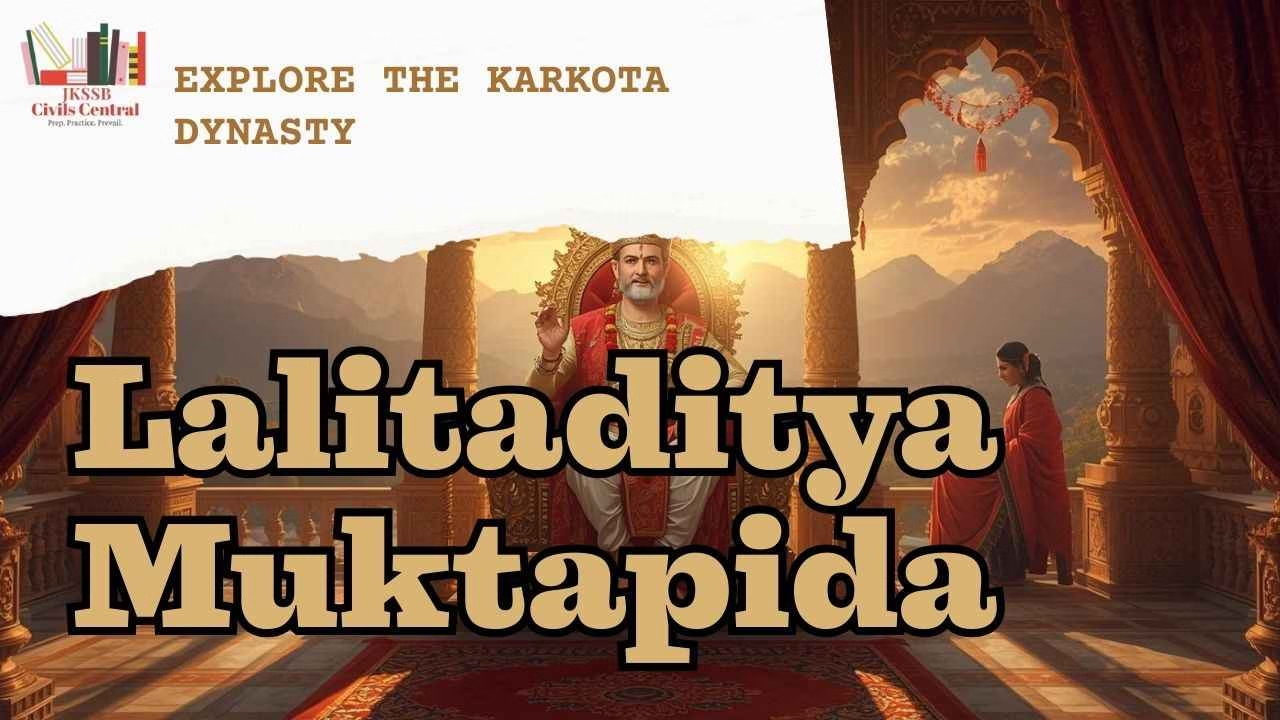
The historical landscape of the Jammu and Kashmir Union Territory is defined by several epoch-making eras, yet none resonates with the same level of imperial grandeur and cultural synthesis as the Karkota Dynasty. For aspirants preparing for the Jammu and Kashmir Services Selection Board (JKSSB) exams—ranging from the Finance Sub-Inspector to the Junior Assistant and Patwari levels—the study of this period is not merely a cursory requirement of the “History of Jammu and Kashmir” syllabus; it is the study of the foundation of Kashmir’s identity as a continental power. Spanning approximately from 625 CE to 855 CE, the Karkota rule transformed a secluded mountain valley into the epicenter of a pan-Asian empire that successfully navigated the complex geopolitics of the 7th and 8th centuries. At the heart of this narrative stands Lalitaditya Muktapida, the fifth ruler of the dynasty, whose military campaigns, administrative innovations, and architectural masterpieces like the Martand Sun Temple earned him the enduring title of the “Alexander of Kashmir”.
Historical Origins and the Foundation of the Karkota Power
To understand the rise of Lalitaditya, one must first analyze the foundations laid by his predecessors. The Karkota Dynasty emerged following the decline of the Huna power in Northern India. The primary source for this period remains Kalhana’s Rajatarangini (The River of Kings), a 12th-century Sanskrit epic that stands as the most verified and comprehensive historical record of the region. Kalhana’s work is essential for JKSSB preparation as it provides the chronological framework that examiners frequently test.
Durlabhavardhana: The Architect of the Dynasty
The dynasty was founded in 625 CE by Durlabhavardhana. He was initially an official in the court of Baladitya, the last ruler of the preceding Gonanda dynasty. Historical narratives, often blending myth with political reality, suggest that Durlabhavardhana was of humble origins but rose to prominence through his administrative acumen and his marriage to Baladitya’s daughter, Anangalekha. To legitimize his rule, he claimed descent from the mythical Naga king Karkotaka, thereby establishing the “Karkota” or “Naga” lineage.
During Durlabhavardhana’s thirty-six-year reign (625–661 CE), Kashmir enjoyed a period of stability that allowed it to assert influence over neighboring territories like Taxila, Sinhapura, and parts of the Punjab. A critical verified event for aspirants to note is the visit of the celebrated Chinese pilgrim Xuanzang (Hiuen Tsang) between 631 and 633 CE. Xuanzang’s accounts provide an invaluable external perspective, noting that the King of Kashmir controlled vast swaths of the northwestern subcontinent and provided facilities for the study of Hindu and Buddhist scriptures.
The Pre-Lalitaditya Succession
The period between the founder and Lalitaditya saw rulers who consolidated the kingdom’s resources. Durlabhaka, also known as Pratapaditya II, succeeded the founder and ruled for five decades (662–712 CE). He was followed by his sons, whose contrasting reigns provide a nuanced look at Karkota governance. Chandrapida (Vajraditya I) is remembered as a just and courageous king who prioritized the welfare of his subjects. In contrast, Tarapida (Udayaditya), who ruled briefly from 720 to 724 CE, is depicted as a cruel and unpopular monarch. The transition from Tarapida to Lalitaditya in 724 CE marked the beginning of Kashmir’s most aggressive phase of expansion.
| Ruler | Regnal Name/Alias | Reign (CE) | Significant Contributions/Events |
| Durlabhavardhana | Prajnaditya | 625 – 661 | Founder; hosted Chinese traveler Xuanzang. |
| Durlabhaka | Pratapaditya II | 662 – 712 | Longest stable reign; established foundational wealth. |
| Chandrapida | Vajraditya I | 712 – 720 | Known for justice and defense against early Arab incursions. |
| Tarapida | Udayaditya | 720 – 724 | Period of internal unrest and misgovernance. |
| Lalitaditya | Muktapida | 724 – 761 | Zenith of empire; built Martand Sun Temple. |
Lalitaditya Muktapida: The Philosophy of Universal Conquest
Lalitaditya’s reign (724–761 CE) was defined by the concept of Digvijaya, or the conquest of all directions. Aspirants should understand that his campaigns were not merely for plunder but were strategic moves to secure Kashmir’s borders and control the vital trade routes of the Silk Road.
The Defeat of Yashovarman and the Mastery of Kannauj
The most significant military achievement of Lalitaditya was the subjugation of Yashovarman, the ruler of Kannauj, around 733 CE. Kannauj was the political and cultural capital of North India, and its control signaled hegemony over the entire Gangetic plain. The conflict reportedly began over a diplomatic dispute regarding a treaty title, where Lalitaditya insisted his name appear before Yashovarman’s. The subsequent victory was so complete that the court poets of Kannauj, including the famous Vakpatiraja and Bhavabhuti, were brought to Kashmir, further enriching the valley’s intellectual life. This victory granted Lalitaditya the theoretical right of suzerainty over most of Northern India.
Continental Expeditions: East, West, and South
Following the fall of Kannauj, Lalitaditya’s armies moved with unprecedented mobility. To the East, he reached Gauda (Bengal) and Kalinga (Orissa), where the local rulers submitted to his authority and provided war elephants to his burgeoning military machine. To the West, he successfully checked the expansion of the Umayyad Caliphate. The Arab general Muhammad bin Qasim, who had captured Sindh in 712 CE, was eyeing Kashmir as a gateway to Central Asia. Lalitaditya’s military genius kept these forces at bay, ensuring that the valley remained an unbreached fortress of Hindu-Buddhist culture.
His Southern expedition is perhaps the most debated by modern historians but is vividly recorded in the Rajatarangini. Lalitaditya is said to have reached the Kaveri River in the Deccan. He allied with the Chalukyas and overran the Rashtrakuta territories, bringing the wealth of the south back to the north. According to Kalhana, his soldiers sipped coconut wine on the southern shores, a narrative meant to illustrate the vastness of the Karkota reach.
Securing the Northern Frontiers: Tibet and the Silk Road
Lalitaditya’s most enduring strategic legacy was his management of the northern frontiers. He faced constant threats from the Tibetan Empire and the Turkic tribes of Central Asia. To counter these, he formed a sophisticated alliance with the Tang Dynasty of China. In 747 CE, a joint Kashmiri-Chinese effort led to a crushing defeat of the Tibetans, an event that was celebrated in Kashmir for centuries as a day of national victory. By securing the Karakoram passes, Lalitaditya ensured that Kashmir controlled the overland caravan routes between India and China, a factor that brought immense prosperity to the region.
| Region | Key Opponent/Power | Significance for J&K History |
| Central India | Yashovarman of Kannauj | Established Kashmir as the successor to Gupta power. |
| Eastern Plains | Gauda and Kalinga | Provided access to eastern trade and elephant corps. |
| Western Frontier | Umayyad Caliphate | Protected the region from early medieval invasions. |
| Northern Plateau | Tibetans and Turks | Secured the Silk Route and the Karakoram range. |
| Southern Deccan | Ratta Queen / Chalukyas | Demonstrated the trans-continental reach of Kashmiri armies. |
Administrative Innovations and Economic Prosperity
Lalitaditya was as much a statesman as he was a warrior. His administrative reforms were designed to support a state that was perpetually on a war footing while ensuring the welfare of the agrarian population.
The Panchmahasabda and Centralized Governance
To manage the complexities of a vast empire, Lalitaditya expanded the existing administrative structure. Before his rule, the state was managed through 18 departments, or Karmasthanas. Lalitaditya introduced five new high offices, known as the Panchmahasabda, which centralized power and streamlined military and fiscal operations :
- Maha Sandhivigrahika: The Chief Minister of Foreign Affairs and Peace, essential for managing the numerous vassal states.
- Mahapratihara: The High Chamberlain, responsible for palace security and the emperor’s public appearances.
- Mahabandhagarika: The High Keeper of the Treasury, tasked with managing the massive wealth flowing from tributes and trade.
- Mahasvasala: The Lord of the Horses, reflecting the vital importance of the cavalry in his continental campaigns.
- Mahasadhanabhoga: The Chief Executive Officer, responsible for the general administration of the empire’s various provinces.
Irrigation, Agricultural Welfare, and Flood Control
For JKSSB aspirants, Lalitaditya’s contribution to irrigation is a recurring topic. He was the first ruler to identify the systemic causes of flooding in the Kashmir Valley, specifically the poor drainage of the Jhelum and the overflow of the Wular Lake. He commissioned the construction of massive waterwheels (Gharais) to facilitate irrigation in elevated plateaus like Vijbror and Chakradhar, which were previously unproductive. These reforms brought agricultural stability, reduced the price of grain, and increased the overall productivity of the valley. He also implemented strict diplomatic controls on the Damaras (feudal landlords) to ensure they did not accumulate enough power to destabilize his successors.
The Artistic and Architectural Zenith: The Martand Sun Temple
Lalitaditya’s most visible legacy is the Martand Sun Temple, a monument that embodies the “Golden Age” of Kashmir. Built in the 8th century, the temple was dedicated to Surya (Martand), the solar deity, and was designed to be a symbol of the emperor’s divine right to rule.
Architectural Features and Cultural Synthesis
The Martand temple is an architectural masterpiece that blends various styles, demonstrating Kashmir’s role as a crossroads of civilizations :
- Structure: The complex consists of a central sanctuary surrounded by a massive colonnaded courtyard (peristyle) containing 84 smaller shrines.
- Dimensions: The internal dimensions of the courtyard are 220 feet by 142 feet, making it the largest temple complex in ancient Kashmir.
- Influences: The fluted pillars and trefoil arches show a distinct Greco-Roman and Syrian-Byzantine influence, while the carvings of Vishnu and the river goddesses Ganga and Yamuna reflect the Gupta artistic tradition.
- Engineering: The temple was constructed from massive blocks of black stone, carved with precision and fitted without mortar, allowing it to withstand earthquakes for centuries.
The City of Parihaspura
Lalitaditya founded a new capital city, Parihaspura (the City of Happiness), on a plateau near modern-day Srinagar. The city was envisioned as an urban marvel, housing grand palaces, Hindu temples, and Buddhist Viharas. Notable structures included the Parihasa-Keshava and Mukta-Keshava temples, as well as a colossal copper Buddha statue that was reportedly comparable to the Bamyan Buddhas of Afghanistan. His architect, Cankunya, a Turkic or Chinese expert, played a pivotal role in the construction of these sites, further highlighting the multicultural nature of the Karkota court.
| Monument/City | Location (Current) | Purpose/Significance |
| Martand Sun Temple | Anantnag (Mattan) | Dedicated to Surya; zenith of Kashmiri architecture. |
| Parihaspura | Pattan (Baramulla) | Imperial capital; housed massive copper Buddha and Vishnu shrines. |
| Hushkapura Vihara | Ushkur (Baramulla) | A major center for Buddhist learning and pilgrimage. |
| Lalitapura | Lethpora (Pulwama) | Named after the King; known for its grand temples. |
| Parnotsa | Poonch | Established as an administrative outpost in the western hills. |
Cultural and Economic Syncretism
Under Lalitaditya, Kashmir became a melting pot of Hindu and Buddhist traditions. While the King was a devout follower of Vaishnavism, he patronized Buddhism with equal fervor, building stupas and monasteries across his realm. This religious tolerance fostered an environment of intellectual growth, attracting scholars from Central Asia, China, and the Indian heartland. Economically, the empire’s strategic location on the Silk Route made it a thriving trade center, connecting the markets of the Tang Dynasty with those of the Indian subcontinent and West Asia. The prosperity brought by this trade fueled the construction of the magnificent cities and temples that define the Karkota legacy.
The Twilight of the Dynasty and the Death of a Legend
The circumstances of Lalitaditya’s death remain one of the great mysteries of Kashmiri history. Kalhana records two primary versions: one where he perished in the heavy snows of “Aranyaka” (modern-day Afghanistan) during a northern expedition, and another where he chose to end his life when separated from his army to avoid being captured.
Following his death in 761 CE, the Karkota Dynasty entered a period of gradual decline. His immediate successors, Kuvalayapida and Vajraditya II, were unable to maintain the vast continental empire, and many vassal states in the south and east asserted their independence. Internal civil wars and the rising power of the feudal Damaras further weakened the state. By 855 CE, the Karkota Dynasty was superseded by the Utpala Dynasty, but the cultural and architectural foundations laid by Lalitaditya continued to influence the region for centuries.
Current Affairs: Heritage Restoration and Modern Relevance (2024–2026)
For JKSSB aspirants, it is crucial to link historical facts with contemporary developments. In recent years, there has been a significant governmental push to restore and celebrate the legacy of Lalitaditya Muktapida and the Karkota Dynasty.
The 2024 Restoration Initiative
In March 2024, the Jammu and Kashmir government announced a high-level initiative for the “protection, conservation, and restoration” of ancient temples, with the Martand Sun Temple as a primary focus.
- Lalitaditya Statue: A major highlight of this plan is the installation of a grand statue of Emperor Lalitaditya Muktapida within the premises of the Martand Sun Temple.
- Heritage Revitalization: The government initiated a meeting in April 2024 to deliberate on the installation of the statue and the physical restoration of the ruins, which have suffered from neglect and natural weathering.
- Cultural Symbolism: Recent events, such as the installation of a ‘Kalash’ from Ayodhya at the site in early 2024, underscore the temple’s position as a symbol of national spiritual unity.
Budget 2025–26: Funding the Future of History
The Jammu and Kashmir Budget for the fiscal year 2025–2026 includes substantial provisions for heritage conservation.
- Culture Department Allocation: A proposed outlay of Rs 132 crore has been set for the Culture Department to modernization of museums and promote regional art.
- Project Targets: Out of 106 heritage projects, 16 have been completed, and 46 are targeted for completion by March 2026.
- Mubarak Mandi and Beyond: While Rs 30.02 crore is specifically allocated for the Mubarak Mandi complex, the “Heritage Revival Scheme” (Phase III) includes 123 new projects across all districts, including many Karkota-era sites.
- Digital Heritage: The administration is utilizing 3D mapping and AI-assisted digitization to create digital archives of ancient manuscripts and monuments for long-term preservation.
| Policy/Project | Timeline | Strategic Objective for J&K |
| Martand Restoration Plan | Launched March 2024 | Conservation of the 8th-century structure and honoring Lalitaditya. |
| Heritage Revival Scheme (Phase III) | 2025–2026 | Restoration of 123 new sites including ancient forts and temples. |
| World Heritage Week | Annually (Nov) | Public awareness and heritage walks at sites like Parihaspura. |
| Chief Minister’s Heritage Scheme | Nov 2025 | Introduction of heritage courses in ITIs to revive traditional crafts. |
Examination Insight: Preparing for the JKSSB Syllabus
For candidates, the Karkota period is a “high-yield” topic. Questions often focus on the founder, the primary sources, the major monuments, and the nicknames of Lalitaditya. To aid in memorization and quick recall, the following structured data summarizes the essential “need-to-know” points for any JKSSB aspirant.
Essential MCQ Data Points
- The Founder: Durlabhavardhana (625 CE).
- Primary Source: Rajatarangini by Kalhana, which is divided into 8 books and contains 7,826 verses.
- The “Samudragupta” or “Alexander” of Kashmir: Lalitaditya Muktapida.
- The “Lalitaditya of Medieval Kashmir”: Sultan Shihab-ud-din.
- Martand Sun Temple Location: Mattan, Anantnag district.
- Capital City: Parihaspura (Pattan area).
- Chinese Visitor: Xuanzang (visited during Durlabhavardhana’s reign).
- Administrative Offices: Panchmahasabda (5 new offices added to the existing 18).
- Successor of Lalitaditya: Kuvalayapida.
- The “Naga” Dynasty: Another name for the Karkota dynasty based on their claimed descent.
Synthesis of Historical Significance
Lalitaditya Muktapida’s achievements are a blend of military brilliance and administrative foresight. His ability to navigate the complex tribal politics of the north, the imperial aspirations of the Tang Dynasty, and the religious diversity of the Indian plains speaks to a level of statesmanship rarely seen in the early medieval period. For the modern student, he represents a time when Kashmir was not just a destination but a decider of regional fates. The current efforts by the government to restore the Martand Sun Temple and install his statue are attempts to reintegrate this “Golden Age” into the contemporary consciousness of Jammu and Kashmir, making it a living part of the UT’s cultural and political identity.
Conclusion: The Enduring Legacy of the Karkotas
The Karkota Dynasty, led by the towering figure of Lalitaditya Muktapida, remains the high-water mark of ancient Kashmiri history. From the intricate stone carvings of the Martand Sun Temple to the sophisticated administrative reforms of the Panchmahasabda, the Karkota era was one of unparalleled achievement. For JKSSB aspirants, mastering this period is essential, as it frequently forms the backbone of the “History of J&K” component of the examinations. The shift in 2024 and 2025 toward heritage conservation and the celebration of Lalitaditya as a regional icon further emphasizes the importance of this topic. By understanding the Karkotas, one understands the potential of Kashmir to reach great heights of power, prestige, and cultural synthesis. As restoration efforts continue through 2026, these ancient ruins will once again stand as proud testaments to a ruler who once commanded the destiny of the subcontinent from the heart of the Himalayas.
About The Author