
Mauryan Rule in Kashmir
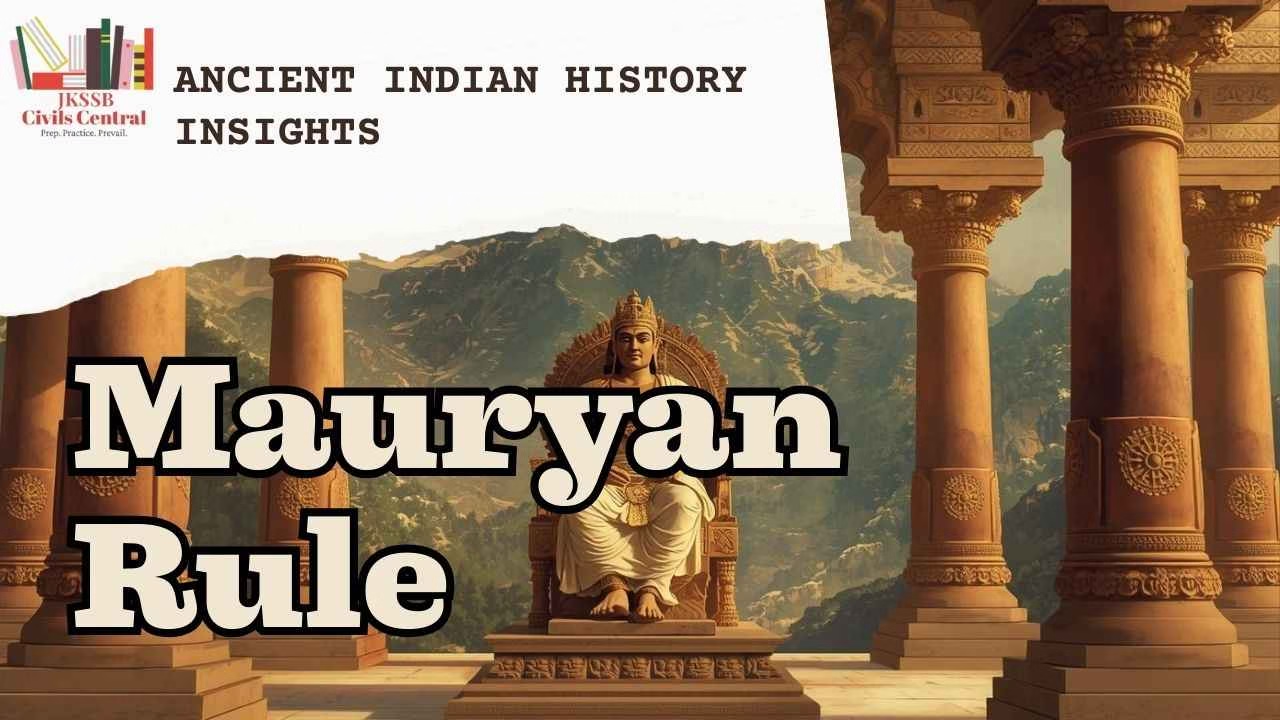
The historical narrative of the Kashmir Valley, a region defined by its distinct geography and strategic position at the crossroads of Central and South Asia, underwent a profound transformation during the third century BCE. This period, synonymous with the zenith of the Mauryan Empire under Emperor Ashoka, marks the transition of Kashmir from a collection of fragmented tribal principalities into a sophisticated hub of imperial administration and global religious thought. For candidates preparing for the Jammu and Kashmir Services Selection Board (JKSSB) examinations, particularly those focusing on the “General Awareness with Special Reference to J&K UT” component, the Mauryan influence is a foundational topic. It encapsulates the origins of urban planning in the valley, the introduction of institutionalized religion, and the establishment of a centralized bureaucratic model that would influence Kashmiri governance for over a millennium.
Historiographical Foundations and Sources of Mauryan Kashmir
The reconstruction of Mauryan history in Kashmir relies on a synthesis of literary traditions, epigraphic evidence, and archaeological findings. Unlike many other regions of ancient India, Kashmir possesses a continuous written tradition, primarily anchored by the Rajatarangini (The River of Kings), authored by the 12th-century historian Kalhana.
Literary Records: Kalhana and the Nilmat Purana
The Rajatarangini remains the most authoritative indigenous source, providing the first textual evidence of Srinagar’s foundation by Ashoka in 250 BCE. Kalhana depicts Ashoka not merely as a distant conqueror but as a transformative ruler who integrated the valley into the Mauryan political framework while respecting its existing spiritual traditions. Complementing this is the Nilmat Purana, which details the mythological and early historical transition of the valley from the “Satisar” lake into a habitable land governed by the Naga tribes. The conversion of these Naga inhabitants to Buddhism under the influence of Mauryan missionaries is a critical turning point that redefined the social fabric of the region.
| Source Type | Primary Texts/Evidence | Core Contributions to Mauryan History |
| Literary (Indigenous) | Rajatarangini, Nilmat Purana | Records the founding of Srinagari, the list of early kings, and the Naga-Buddhist transition. |
| Literary (Foreign) | Mahavamsa, Accounts of Hiuen Tsang | Details the mission of Majjhantika and the spread of Sarvastivada Buddhism. |
| Epigraphic | Major/Minor Rock Edicts, Pillar Edicts | Provides the ethical framework of Dhamma and administrative hierarchies. |
| Archaeological | Pandrethan ruins, Harwan tiles, Zehanpora (2025) | Physical evidence of urban centers, monastic architecture, and trade links. |
Archaeological Methodology and Modern Decipherment
The modern understanding of this era was significantly advanced by colonial and post-independence archaeological efforts. James Prinsep’s decipherment of the Brahmi and Kharoshthi scripts in 1838 allowed for the reading of Ashokan edicts, many of which are scattered along the trade routes leading into the valley. In the early 20th century, archaeologists like Alexander Cunningham and D.R. Sahni identified the site of Puranadhisthana (Pandrethan) as the original Ashokan capital, bridging the gap between Kalhana’s literary descriptions and material reality. Recent technological advancements, including drone-based mapping and aerial surveys used in the 2025 Zehanpora excavations, continue to unearth deeper layers of this Mauryan-Kushan heritage.
The Strategic Ascension of the Mauryas in the North-West
The integration of Kashmir into the Mauryan Empire was a calculated strategic move initiated by the predecessors of Ashoka and brought to fruition during his reign. Chandragupta Maurya, with the guidance of Chanakya, had already secured the north-western frontiers by defeating the Hellenistic governors of Alexander the Great.
Geopolitical Importance of the Valley
Kashmir served as the eastern terminus of the Gandhara region, a vital nursery for cultural and commercial exchange. The Jhelum River (Vitasta) provided a natural corridor for trade and military movement, linking the heartland of Magadha with the Silk Road corridors. For the Mauryas, control over Kashmir meant control over the lucrative trade in textiles, timber, and Himalayan minerals, as well as the ability to monitor the movements of Indo-Greek and Central Asian tribes.
The Kalinga War and the Transition to Dhamma-vijaya
While Ashoka inherited a vast empire capable of maintaining a standing army for protection, his conquest of Kalinga in 261 BCE fundamentally altered his approach to governance. The transition from Bherighosha (conquest by war) to Dhamma-vijaya (conquest by righteousness) had profound implications for frontier regions like Kashmir. Instead of maintaining the valley through purely military force, Ashoka utilized the policy of Dhamma—a moral and ethical code emphasizing religious tolerance, non-violence, and social welfare—to assimilate the local Naga and Brahmanical populations.
The Founding of Srinagari: A Study in Ancient Urbanism
One of the most frequent topics in JKSSB history questions is the origin of Srinagar. According to Kalhana, Ashoka founded the city of Srinagari (the City of Sri or Goddess Lakshmi) in approximately 250 BCE.
Puranadhisthana: The Site of Pandrethan
The original city of Srinagari was located at the site of present-day Pandrethan, approximately 3 to 5 kilometers southeast of the modern city center. The name Pandrethan is a phonetic corruption of the Sanskrit Puranadhisthana, which literally means “The Old Capital”.
- Urban Infrastructure: Ashoka’s Srinagari was designed as a “City of Prosperity” and potentially a “City of the Sun” (Surya-Nagar). It featured numerous stupas, Shiva temples, and viharas, reflecting the king’s personal religious transition and his state policy of pluralism.
- Archaeological Discoveries: Excavations at Pandrethan in 1913 and 1915 revealed remains of two Buddhist stupas and a quadrangular monastery enclosure. Furthermore, massive stone pillars and embankments along the Jhelum indicate a highly developed understanding of hydraulic engineering and stone masonry.
- Architectural Legacy: While the current Shiva temple at Pandrethan dates to the 8th-9th century CE, it stands on foundations that reflect the enduring sanctity of the site established during the Mauryan era.
Comparative Table: The Evolution of Srinagar’s Capitals
| Capital Name | Founder | Era | Modern Identification | Significance |
| Srinagari | Ashoka | 250 BCE | Pandrethan | Introduction of Buddhism and Mauryan urban planning. |
| Pravarapura | Pravarasena II | 6th Century CE | Hari Parbat / Old City | Shift of the city center to the right bank of Jhelum. |
| Parihaspur | Lalitaditya | 8th Century CE | Near Shadipur | Constructed as the “City of Pleasure”. |
| Avantipur | Avantivarman | 9th Century CE | Pulwama District | Known for its grand temple complexes. |
The Spiritual Revolution: Introduction of Buddhism to the Valley
The Mauryan influence in Kashmir is inseparable from the propagation of Buddhism. Ashoka’s conversion to the faith led to one of the most successful religious missions in history, transforming Kashmir into a “Holy Land” of Buddhist learning that would later export the faith to Tibet and China.
The Mission of Majjhantika and the Naga Conversion
Following the Third Buddhist Council at Pataliputra, the Arhant Majjhantika (Madhyantika) was dispatched to the “Kashmir and Gandhara” region.
- Confrontation with the Nagas: Historical accounts in the Mahavamsa describe Majjhantika’s struggle against the Naga King Aravala, who controlled the valley’s water resources and destroyed crops with hail storms.
- The Triumph of Ahimsa: Through the display of equanimity and spiritual power, Majjhantika remained unharmed by the Naga king’s elemental attacks. Impressed by the monk’s adherence to non-violence (Ahimsa), King Aravala and his subjects embraced Buddhism.
- Settlement of Monks: Records state that approximately 500 monks arrived in Kashmir under Ashokan patronage, settling in newly constructed viharas. This established a permanent monastic community that would eventually develop the Sarvastivada school of Buddhist philosophy.
Institutionalization of Faith
Ashoka did not merely introduce a new belief system; he created a permanent ecclesiastical infrastructure. He is credited with building 84,000 stupas across his empire, several hundred of which were located in Kashmir. These stupas served as reliquaries and community centers, fostering a sense of imperial unity through shared religious practice. In the valley, this period saw the emergence of a syncretic culture where Buddhism coexisted with pre-existing Shaivite and Naga traditions, as evidenced by Ashoka’s personal construction of Shiva temples like the shrine of Ashokeshvara.
Mauryan Administration: The Kautilyan Model in Kashmir
For aspirants of administrative exams, understanding the Mauryan bureaucracy is essential, as it provided the blueprint for later Indian political systems. The governance of Kashmir was an extension of this highly centralized and efficient autocracy.
Provincial and Local Hierarchy
Kashmir was likely integrated into the Uttarpatha (Northern Province), with its regional headquarters at Taxila. The administration was characterized by a meticulous hierarchy designed for revenue collection, justice, and surveillance.
| Administrative Tier | Lead Official | Responsibilities |
| Empire | Samrat (Ashoka) | Head of State, Army, and Judiciary; supreme architect of Dhamma. |
| Province (Chakra) | Kumara / Aryaputra | Royal princes acting as viceroys; maintaining peace and collecting regional taxes. |
| District (Janapada) | Rajuka | Responsible for civil justice and the welfare of the peasantry. |
| Sub-District (Vishaya) | Vishayapati | Local law and order, monitoring trade guilds and irrigation. |
| Village (Grama) | Gramika | Grassroots administration, maintenance of local records. |
Innovations under Ashoka: The Dhamma-Mahamatras
Ashoka introduced a unique class of officials known as Dhamma-Mahamatras. Their role in Kashmir was multifaceted:
- Social Harmony: They were tasked with promoting mutual respect among different sects—Brahmins, Buddhists, and Nagas—ensuring that the king’s policy of religious tolerance was implemented on the ground.
- Public Welfare: They oversaw the state-funded construction of hospitals for humans and animals, the planting of medicinal herbs, and the digging of wells along trade routes.
- Judicial Oversight: They were empowered to review prison sentences and ensure that local administrators were prompt and impartial in dispensing justice, emphasizing the king’s view of himself as a “father to his people”.
Economic Integration and Trade Dynamics
The Mauryan era brought Kashmir into a unified economic zone, characterized by a single currency and nationally administered taxation.
The Economy of the Valley
The centralized government abolished the burdens of regional kings’ taxes, replacing them with a standardized revenue system based on agricultural produce, trade, and industries.
- Trade Routes: The development of a major international trade network expanded India’s exports to Bactria and Persia. Kashmir, situated on these routes, became a hub for the export of textiles, silk, and Himalayan spices.
- Currency and Standardisation: The use of a uniform currency across the empire simplified trade for Kashmiri merchants, allowing them to engage with markets as far as Pataliputra and the Hellenistic world.
- Infrastructure for Commerce: The Mauryan state-funded thousands of roads and rest houses (Serais), which were essential for the movement of goods and ideas through the difficult Himalayan terrain.
Archaeological Deep-Dive: Harwan and the “Diaper” Masonry
While Pandrethan is the site of the Ashokan capital, the Harwan Monastery site, located 12 kilometers northeast of Srinagar, provides some of the most intricate archaeological evidence of the Buddhist era in Kashmir.
Architectural Evolution and Styles
Excavations at Harwan by Pandit Ram Chandra Kak in 1925 revealed a unique style of construction that highlights the cosmopolitan nature of ancient Kashmiri art.
- Diaper Rubble and Pebble Masonry: The structures at Harwan are built using “diaper rubble” and “diaper pebble” styles. This involves a core of rubble stones faced with small pebbles transported from neighboring torrent beds, a style that reflects Central Asian and Gandharan influences.
- Terracotta Tiles: The site is famous for its exquisite terracotta tiles, many of which bear numerals in the Kharoshthi script (prevalent between 2nd BCE and 2nd CE). These tiles depict a variety of motifs, including musicians, dancers, flora, and fauna, showcasing a blend of religious and everyday imagery.
- The 4th Buddhist Council: Although the 4th Council took place under the Kushan king Kanishka, historians like Aurel Stein identify Harwan (Sadarhadvana) as the home of the philosopher Nagarjuna and a site that flourished due to the foundational infrastructure established by the Mauryas.
Key Archaeological Sites of the Buddhist Era in Kashmir
| Site Name | Region | Primary Features | Period/Influence |
| Pandrethan | Srinagar (South) | Stupa ruins, stone sculptures, site of old capital. | Mauryan (Ashoka) |
| Harwan | Srinagar (North) | Terracotta tiles, diaper masonry, apsidal temple. | Kushan / Mauryan roots |
| Ushkur | Baramulla | Monastic ruins, link to Gandhara. | Kushan (Huvishkapura) |
| Zehanpora | Baramulla | Stupa mounds, copper artifacts, trade route node. | Mauryan/Kushan (Recent) |
Current Affairs: The 2025-2026 Zehanpora Discovery
A critical requirement for JKSSB aspirants is the integration of current affairs with historical knowledge. In late 2025 and early 2026, the discovery of a 2,000-year-old Buddhist complex in Zehanpora, Baramulla, captured national attention.
The Rediscovery of a Lost Journey
The excavation was sparked by the discovery of grainy, archival photographs from a French museum depicting three stupas in the Baramulla region. Prime Minister Narendra Modi, in his Mann Ki Baat address, emphasized that these rare images helped researchers connect the dots and confirm the historical importance of Zehanpora as a major Buddhist hub.
- Archaeological Findings: Drone surveys and systematic digging by the University of Kashmir and the J&K Archaeology Department revealed structural foundations of stupas, monastic cells, and urban-style settlements.
- Strategic Context: Zehanpora sits along a major trade and pilgrimage route that once connected the Kashmir Valley with Gandhara. Its discovery fills a significant gap in the early Buddhist map of north-western India.
- Links to Huvishkapura: Experts suggest the site may be linked to the lost Kushan capital of Huvishkapura, further cementing Baramulla’s role as a gateway of civilizations.
Implications for Modern Heritage
The 2025-2026 findings at Zehanpora are not just academic; they have been hailed as a “proud moment” that reinforces Kashmir’s identity as a confluence of civilizations. For aspirants, this emphasizes the importance of staying updated on current excavations, as they frequently appear in “General Knowledge” questions regarding the UT’s cultural heritage.
The Post-Ashokan Period: Jaluka and the Shaivite Transition
The Mauryan rule in Kashmir began to dissolve following the death of Ashoka in 232 BCE. However, the legacy of his administration survived through his son and successor in the valley, Jaluka.
Jaluka: The Shaivite Ruler
According to Kalhana, Jaluka was a powerful ruler who pursued a different spiritual path than his father.
- Restoration of Peace: Jaluka is credited with defeating the Mlecchas (foreign tribes, likely Indo-Greeks) who had begun to encroach upon the valley during the central Mauryan decline.
- Expansion of Administration: He is said to have further developed the bureaucratic machinery of the valley, establishing several new administrative offices that mirrored the Kautilyan model.
- Religious Synthesis: While Jaluka was a staunch devotee of Lord Shiva, he did not dismantle the Buddhist infrastructure established by Ashoka. This period represents the continuing synthesis of Hindu and Buddhist cultures that would define Kashmir for centuries.
Transition to the Kushans
Following the reigns of Jaluka and his successor Damodar II, the valley experienced a brief interlude of Indo-Greek influence before being consolidated by the Kushan Empire in the 1st century CE. The Kushans, particularly Kanishka, would build upon the Buddhist foundation laid by Ashoka, convening the 4th Buddhist Council in the valley and further developing the Gandharan style of art and architecture seen at Harwan and Ushkur.
Examination Strategy: High-Yield Topics and Syllabus Mapping
For JKSSB aspirants, the Mauryan period is a high-reward topic. Below is an analytical mapping of this history to the official syllabus requirements.
Syllabus Mapping: JKSSB General Awareness
| Syllabus Topic | Mauryan Relevance | High-Yield Keywords for MCQs |
| History of J&K UT | Formation of Srinagari and introduction of Buddhism. | Ashoka, Srinagari, Pandrethan, Majjhantika. |
| Culture & Heritage | Monastic architecture and the policy of Dhamma. | Harwan tiles, diaper masonry, Rajatarangini. |
| Famous Personalities | Role of Ashoka, Majjhantika, and Kalhana. | Puranadhisthana, Sarvastivada, Nilmat Purana. |
| Current Affairs (J&K) | Recent excavations and heritage conservation. | Zehanpora Stupa, Baramulla excavation (2025-26). |
Practice Questions and Analytical Reasoning
- Question: Which city was established by Emperor Ashoka in Kashmir around 250 BCE?
- Reasoning: Kalhana’s Rajatarangini identifies Srinagari (Pandrethan) as the capital founded by Ashoka to promote prosperity and religious learning.
- Question: The “diaper-pebble” style of masonry found in Harwan is characteristic of which cultural influence?
- Reasoning: This style reflects Gandharan and Central Asian influences, indicating Kashmir’s position as a trade hub between the Mauryan heartland and the Silk Road.
- Question: Who was the Buddhist missionary sent by Ashoka to the valley?
- Reasoning: Majjhantika was the Arhant who converted the Naga tribes, as recorded in both Sri Lankan (Mahavamsa) and Kashmiri (Nilmat Purana) traditions.
- Question: Which recent archaeological site in Baramulla was hailed as a “proud moment” by PM Modi in 2025?
- Reasoning: The Zehanpora site, where a 2,000-year-old Buddhist complex was rediscovered using French archival photos.
The Civilizational Legacy: Why Ashoka Matters to Modern Kashmir
The Mauryan influence in Kashmir was not a transient political occupation but a civilizational “reboot.” Ashoka provided the valley with its first urban center, a standardized administrative language (Sanskrit/Brahmi), and an ethical framework (Dhamma) that transcended tribal affiliations.
The “City of Sri” (Srinagari) served as the template for every subsequent capital in the valley. The administrative division of the land into districts (Janapadas) and the king’s role as the provider of Yogakshema (welfare) remained the bedrock of Kashmiri governance through the Hindu, Muslim, and Dogra periods. Furthermore, the introduction of Buddhism turned Kashmir into a global intellectual capital, attracting travelers and scholars for a millennium.
For a JKSSB aspirant, this history is more than dates and names; it is the story of how Kashmir became a confluence of cultures. The recent excavations at Zehanpora and the ongoing preservation of Harwan and Pandrethan remind us that the Ashokan legacy is not just in books, but in the very soil of the valley. Understanding this period is essential for appreciating the deep-rooted historical continuity that defines the Union Territory of Jammu and Kashmir in the 21st century.
Administrative Insight: The Concept of Welfare Statehood
One of the most profound insights for those aspiring to enter the civil services is Ashoka’s invention of the “Welfare State.” In his edicts, he declares, “All men are my children,” and he established a system where the state was responsible for the physical and moral well-being of its citizens. In Kashmir, this translated into the construction of public infrastructure that survived for centuries. The Mauryan emphasis on medicinal gardens and hospitals for animals was revolutionary and set a standard for compassion in governance that remains a goal for modern administrations. This “ethical humanism” combined with “pragmatic bureaucracy” is why the Mauryan model remains a high-yield topic in modern Indian administrative history exams.
By weaving together these threads of political history, administrative structure, archaeological evidence, and current discoveries, aspirants can build a holistic understanding of the Mauryan epoch. This era represents the first time Kashmir was unified with the Indian mainland, creating a shared heritage of prosperity, learning, and pluralism that continues to resonate today.
About The Author