
Kalhana’s Rajatarangini
The intellectual heritage of the Indian subcontinent finds one of its most rigorous and aesthetically profound expressions in the Kalhana’s Rajatarangini,, or “The River of Kings.” Composed between 1148 and 1149 CE by the Kashmiri Brahman scholar Kalhana, this metrical chronicle represents the first systematic attempt at historical writing in Sanskrit literature. For aspirants of the Jammu and Kashmir Services Selection Board (JKSSB), the Rajatarangini is not merely a literary text but a primary source that delineates the sovereign identity, geographical specificity, and socio-political evolution of the Kashmir Valley. Kalhana’s work is distinguished by its departure from the standard panegyric style of early Indian court biographies, known as charitas, which often prioritized the glorification of a patron over the verification of historical events. Instead, Kalhana introduced a methodology characterized by transparency, skepticism, and a commitment to objectivity that anticipates the critical historical research methods developed centuries later in the 19th-century Western academy.
Kalhana’s Method and Sources
Kalhana’s credentials as a historian are rooted in his unique personal and family background. He was born into a family of high-ranking officials; his father, Chanpaka, served as a minister to the ill-fated King Harsha of the Lohara dynasty. This proximity to the seat of power granted Kalhana an intimate understanding of administrative mechanisms, court intrigues, and the consequences of systemic governance failures. Despite his connections, he remained personally uninvolved in the contemporary political maelstrom, allowing him to observe the rise and fall of dynasties with a measure of detachment. In the opening verses of his chronicle, Kalhana articulates a rigorous ideal for historical narrative: a historian, like a virtuous poet, must be free from “love and hatred” (raga and dvesha) and restrict his language to the exposition of facts.
To construct a comprehensive history spanning nearly 3,600 years, Kalhana utilized an exhaustive array of sources, demonstrating a fastidiousness that was unprecedented in his era. He explicitly mentions consulting eleven previous chronicles of Kashmir, including the lost works of Padmamihira, Helaraja’s Parthivavali, and Kshemendra’s Nripavali. Recognizing the limitations of relying solely on written texts, he delved into unconventional and primary sources such as royal charters, edicts, land grants (shasana), and temple inscriptions. He further validated his narrative through numismatic evidence, studying coins to date regnal spans and assess economic health. The Nilamata Purana, an ancient text detailing the religious and topographical legends of the valley, served as a foundational source for his early books, helping him reconstruct the names of 17 of the 52 “lost kings” whose records had been obscured by time.
| Category of Source | Specific Examples and Context | Significance for Accuracy |
| Literary Works | Nilamata Purana, Harsacarita, Brihat-samhita, Nripavali | Provided traditional lineages and regional legends. |
| Epigraphic Evidence | Royal charters, temple foundation inscriptions, land grants | Verified specific acts of patronage and regnal years. |
| Numismatics | Copper and gold coins of various dynasties (e.g., Karkota) | Confirmed the existence of rulers like Toramana and Lalitaditya. |
| Topography | Records of Tirthas (sacred sites), irrigation systems, and town founding | Linked history to physical landmarks and engineering feats. |
| Oral Traditions | Family records, pilgrimage narratives, local folklore | Preserved the “cultural memory” of the Kashmiri people. |
Kalhana’s approach was essentially analytical; he did not accept information at face value but subjected it to critical scrutiny, presenting multiple versions of events when they conflicted in his sources. He attempted to explain historical transitions through causality—specifically the relationship between a ruler’s adherence to dharma (moral law) and the stability of the state—rather than attributing all events to divine intervention. This rational framework allowed him to criticize kings for their cruelty, even if they were patrons of his peers, as seen in his condemnation of King Harsha’s iconoclasm and the administrative corruption of the Kayasthas.
The Eight Sections of Rajatarangini
The Rajatarangini consists of 7,826 Sanskrit verses divided into eight books, referred to as Tarangas (Waves). This division is metaphorical, representing the flow of time and the continuity of the kingdom despite the rise and fall of individual “waves” or kings. For competitive examinations like the JKSSB, the chronology and thematic focus of these eight books are high-yield topics, particularly as they transition from legendary to verifiable historic periods.
Books I–III: Mythical Foundations and the Dawn of Sovereignty
The initial three books cover the early antiquity of Kashmir, blending legendary accounts with the earliest historical figures. Kalhana begins with the creation myth of the valley, describing it as a vast mountain lake named Satisar. According to the Nilamata Purana and Kalhana’s account, the sage Kashyapa Rishi drained the lake through a breach at Baramulla (Varahamulla), allowing the land to become habitable for the Nagas and subsequent human settlers.
Book I identifies Gonanda I as the first king of Kashmir, a contemporary of the Pandavas and a relative of the Magadhan king Jarasandha. While much of this period is considered semi-historic, Kalhana introduces several figures whose historicity is corroborated by external sources:
- Ashoka: Identified as the first king to introduce Buddhism to the valley, Ashoka is credited with founding the city of Srinagari (Pandrethan) and constructing numerous Shiva temples and Buddhist stupas.
- The Kushans (Turushkas): Kalhana mentions Hushka (Huviska), Jushka (Vajheska), and Kanishka as rulers of Turkish origin who were great patrons of Buddhism. During their reign, the 4th Great Buddhist Council was held in Kashmir, marking a peak of Buddhist learning in the region.
- Mihirakula: A Huna ruler described as a “cruel king” who persecuted Buddhists and favored Shaivism, ordering the mass killing of subjects.
Book III records the “Restored Gonandiya” dynasty, featuring rulers like Meghavahana, who famously banned animal slaughter and promoted Ahinsa (non-violence). It also records the reign of Pravarasena II, the founder of Pravarapura (modern-day Srinagar), whose rule is supported by the discovery of numerous copper coins bearing his name.
Book IV: The Karkota Dynasty and the Imperial Renaissance
The Karkota dynasty (c. 625–855 CE) marks the beginning of what historians consider the truly historical period of the Rajatarangini, where Kalhana’s descriptions align closely with archaeological and epigraphic evidence. The dynasty was founded by Durlabhavardhana, who rise to power is noted as the first genuine historical account in the chronicle.
The zenith of Karkota power was achieved under Lalitaditya Muktapida (724–761 CE), often hailed as the “Samudra Gupta of Kashmir”. Lalitaditya was a prolific conqueror whose campaigns extended across Northern India and into Central Asia. His architectural legacy includes the construction of the capital city Parihaspur and the magnificent Martand Sun Temple, an iconic structure that symbolized the fusion of Gandharan, Gupta, and local Kashmiri architectural styles.
Books V–VI: The Utpala Dynasty and Administrative Innovation
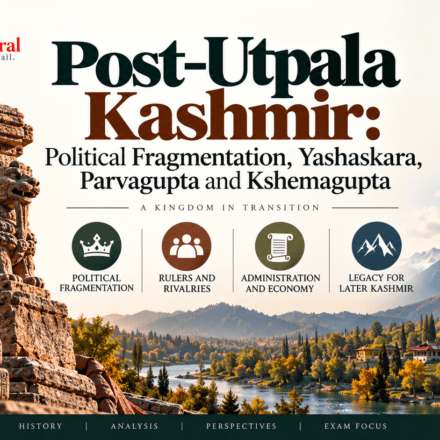
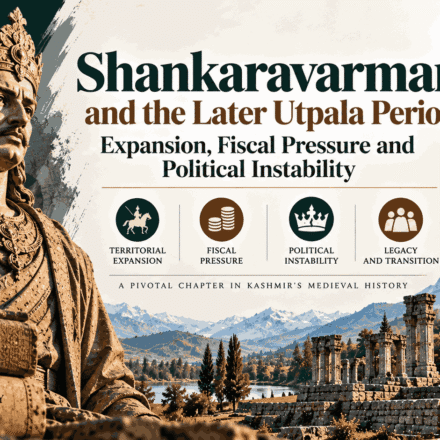
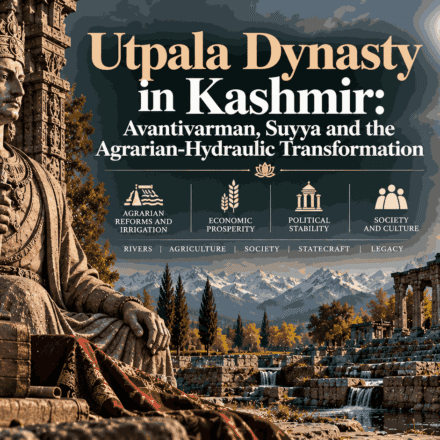
The Utpala dynasty (c. 855–939 CE) represents a shift toward domestic consolidation and monumental public works. Avantivarman (855–883 CE), the founder of the dynasty, is remembered as a benevolent ruler who prioritized agricultural prosperity. His reign is most notable for the work of Suyya, a brilliant engineer who devised a comprehensive irrigation and drainage system for the valley. By dredging the Vitasta (Jhelum) river and regulating its flow near Baramulla, Suyya successfully mitigated the threat of catastrophic floods, significantly increasing land availability for rice cultivation.
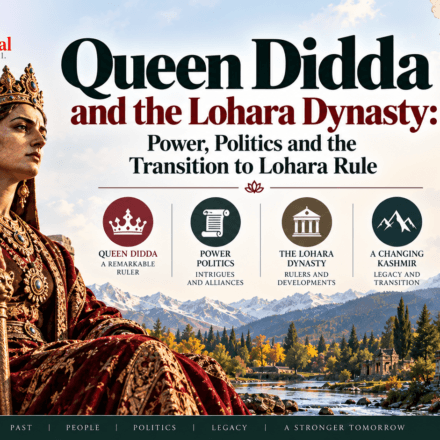
Book VI focuses on the regency and rule of Queen Didda (980–1003 CE). Originally a princess from the Lohara house, she effectively controlled the state as a regent for her son and grandsons before ascending the throne as a sovereign ruler. Kalhana portrays her as a formidable and often ruthless leader who successfully suppressed the rebellions of the feudal Damara lords, maintaining central authority during a period of intense factionalism.
Books VII–VIII: The Lohara Dynasties and Contemporary Reality
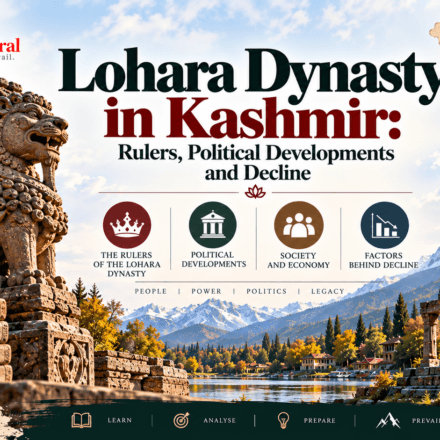
The final two books deal with the Lohara dynasties (1003–1171 CE) and provide the most granular detail, as Kalhana lived through many of the events described. Book VII documents the reign of King Harsha (1089–1101 CE), a multifaceted figure who was a patron of the arts but eventually resorted to looting temple wealth and imposing heavy taxes to maintain his large military, leading to his tragic downfall and regicide.
Book VIII, the longest section of the work, focuses on the stabilization of authority under King Jayasimha (1128–1149 CE). Kalhana details the intricate civil wars between the Lohara princes and the rising power of the Damara lords, providing an eyewitness-style account of the political fragmentation that characterized medieval Kashmir.
Geography and Urban Centres in Rajatarangini
A unique strength of the Rajatarangini is its “vividly real” topography. Unlike other ancient Indian texts that often mythologize geography, Kalhana provides specific names of temples, rivers, towns, and pilgrimage sites (Tirthas), many of which survive as ruins or active centers of worship today. This topographical precision is invaluable for historians and archaeologists attempting to reconstruct the cultural landscape of early medieval India.
| Ancient Name (Rajatarangini) | Modern Name/Location | Significance and Association |
| Vitasta | Jhelum River | The “holy river” of Kashmir; associated with its creation myth. |
| Srinagari | Pandrethan, Srinagar | The old city founded by Ashoka; location of the Shiva temple. |
| Parihaspur | Near Pattan/Baramulla | Capital of Lalitaditya; site of massive Buddhist and Hindu ruins. |
| Sayapur | Sopore | Town founded by the engineer Suyya during Avantivarman’s reign. |
| Sharada | Sharada Peeth (Neelum Valley) | Ancient temple of learning and pilgrimage in the northwest. |
| Martanda | Mattan, Anantnag | Site of the Sun Temple and sacred springs. |
| Chakradhara | Semthan Mound, Anantnag | Ancient settlement and center for Vishnu worship. |
Kalhana’s detailed notes on sacred springs like Papasudana and Tri-Samdhya help researchers trace the history of pilgrimage routes that have remained consistent for over a millennium. His familiarity with the Kishenganga Valley and the shrine of Sharada suggests he may have personally visited these remote regions, further enhancing the reliability of his geographical descriptions.
Social and Cultural Insights: Governance, Classes, and Gender
Beyond the chronology of kings, the Rajatarangini serves as a “veritable encyclopedia” of medieval Kashmiri society. Kalhana offers nuanced observations on the social classes, economic conditions, and the role of women in the public sphere, which are critical for understanding the “ebb and flow of national life”.
The Social Hierarchy and Economic Life
Kashmiri society in the 12th century was highly stratified, influenced by both traditional Brahmanical norms and regional socio-economic realities.
- The Brahman Community: Kalhana, being a Brahman himself, provides deep insights into this community, which held significant influence as priests, ministers, and intellectual leaders. He notes their political activism, including the use of solemn “hunger strikes” (Prayopavesha) to influence royal policy.
- The Damaras: These were the powerful landed feudal lords who often functioned as king-makers. Their control over local resources and private forts made them a constant threat to the central authority of the king, a theme that recurs frequently in the later books.
- The Kayasthas: As the administrative and clerical class, they were often the targets of Kalhana’s criticism. He frequently described them as greedy and corrupt, acting as oppressive intermediaries between the crown and the peasantry.
- Economic Disparity: Kalhana records that while the elite drank perfumed wines and ate diverse meats, the common poor often survived on wild vegetables and coarse grains, reflecting a significant economic divide.
The Tradition of Powerful Women
Kashmir’s history, as documented by Kalhana, is notable for the prominent role of women in governance. The Rajatarangini records three major women who served as sovereign rulers or regents:
- Yashovanti: The queen of Damodara I, who was placed on the throne by Krishna himself, establishing a precedent for female sovereignty.
- Sugandha: A ruler of the Utpala dynasty who ascended the throne after the death of her son, supported by the army and the populace.
- Didda: Perhaps the most famous female figure in Kashmiri history, she ruled for nearly 44 years. Despite Kalhana’s personal biases regarding her character, he meticulously documents her administrative prowess and her ability to stabilize a fractured kingdom.
Kalhana also notes the influence of “low-born” women and courtesans in the royal harem, who sometimes wielded significant indirect political power. His descriptions of Queen Suryamati (Lohara dynasty) highlight her role in subduing rebellions and organizing the military, showcasing that royal women were often active participants in statecraft and warfare.
Later Works and Translations of Rajatarangini
Kalhana’s Rajatarangini was not a static text but the beginning of a living tradition of historiography in Kashmir. Its structural appeal and methodological rigor served as a model for subsequent chroniclers who continued the narrative through the medieval period.
The Later Rajataranginis
The chronicle was expanded by several authors to cover the transition from Hindu to Muslim rule and eventually to the Mughal period.
- Jonaraja (d. 1459 CE): Continued Kalhana’s work into the 15th century, documenting the rise of the Shah Miri dynasty and the reign of Sultan Zain-ul-Abidin.
- Shrivara (c. 1486 CE): A pupil of Jonaraja, he authored the Jaina-Rajatarangini, providing an intimate account of the reign of Zain-ul-Abidin, whom he portrayed as a champion of religious tolerance.
- Prajyabhatta and Shuka: Continued the record through the Rajavalipataka, bringing the history down to the annexation of Kashmir by Akbar in 1586 CE.
Modern Scholarship and Translation
The work’s international significance was solidified through various translations. Sultan Zain-ul-Abidin commissioned the first Persian translation by Mulla Ahmad in the 15th century, recognizing the text’s importance for regional legitimacy. In the 19th and 20th centuries, European scholars like H.H. Wilson and Aurel Stein brought the work to global attention. Stein’s two-volume translation (1900) remains the authoritative edition, featuring extensive annotations and a memoir on ancient Kashmiri geography that validates Kalhana’s topographical notes.
Current Affairs and Recent Archaeological Insights (2024–2026)
For modern students and aspirants, Kalhana’s Rajatarangini is increasingly relevant as contemporary archaeological excavations in Jammu and Kashmir continue to validate the text’s historical and geographical claims.
The Zehanpora Breakthrough (2025)
In late 2024 and throughout 2025, a landmark archaeological discovery occurred at Zehanpora in the Baramulla district of North Kashmir. A joint excavation by the J&K Department of Archives, Archaeology and Museums and the University of Kashmir unearthed a massive Buddhist complex from the Kushan era (c. 1st–3rd century CE).
- Findings: The site revealed large stupas, structural walls, and architectural remnants that confirm Kalhana’s mention of the “Turushka” kings (Hushka, Jushka, Kanishka) and their patronage of Buddhism in this region.
- Context: This discovery redefined Kashmir’s role as a major hub of Mahayana Buddhist thought and its position on ancient trans-regional trade routes linking Taxila and Central Asia.
- Numismatic Correlation: The findings are supported by copper objects and pottery, mirroring Kalhana’s account of the thriving urban centers of North Kashmir during the early historic period.
Discoveries at Karkoot Nag (2025)
In August 2025, renovations to the Karkoot Nag spring in Aishmuquam led to the discovery of 21 ancient stone idols and reliefs.
- Dynastic Link: Archaeologists, including Dr. Ajmal Shah, have dated these artifacts to the Karkota Dynasty (c. 625–855 CE).
- Religious Syncretism: The idols include 11 Shivlings alongside artwork showing both Hindu and Buddhist influences, validating Kalhana’s description of the Karkota rulers as religiously tolerant and significant patrons of temple architecture.
Cultural Revitalization: The Vitasta Festival
The Government of India, through the Ministry of Culture, has institutionalized the Vitasta Festival to celebrate Kashmir’s rich heritage.
- Vitasta Festival 2024-2025: These festivals, organized by the North Zone Cultural Centre (NZCC), showcase Kashmiri arts, music, and the influence of the Vitasta (Jhelum) river on the valley’s identity.
- Sewa Parv 2025: In October 2025, a mega art workshop was held at the SKICC in Srinagar under the theme “Viksit Bharat ke Rang, Kala ke Sang,” involving thousands of students and artists in efforts to preserve the traditional crafts documented by Kalhana.
High-Yield Repository for JKSSB Aspirants
For aspirants preparing for J&K General Knowledge components, the following tables synthesize key historical facts, administrative terms, and dates mentioned in the Rajatarangini and verified by official sources.
| Topic | Key Fact / Detail | Reference Context |
| Oldest Name of Kashmir | Sitasar (The vast lake) | Mentioned in Nilamata Purana. |
| Sage who drained Satisar | Rishi Kashyapa | Drained through Baramulla breach. |
| Founder of Srinagar | Emperor Ashoka | Founded as Srinagari (Pandrethan). |
| Founder of Pravarapura | Pravarasena II | Modern Srinagar city. |
| The “Samudra Gupta” of Kashmir | Lalitaditya Muktapida | Known for wide conquests and Martand Sun Temple. |
| Great Engineer of Avantivarman | Suyya | Drained Jhelum; founded Sopore (Sayapur). |
| First Lady Ruler | Didda (Some sources list Yashovanti earlier) | Known for strong regency and sovereign rule. |
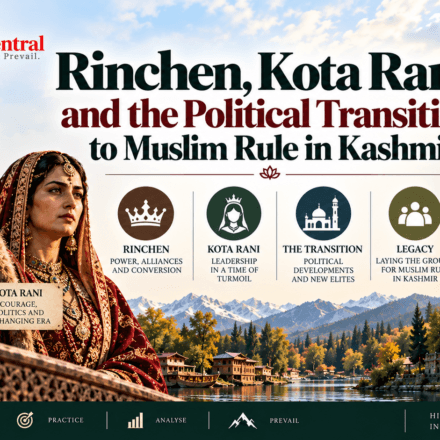
| First Muslim Ruler | Sultan Sadr-ud-din (Rinchana) | 1320-1323 CE (Transition documented in sequels). |
| Translation to Persian | Mulla Ahmad (commissioned by Zain-ul-Abidin) | Recognised historical continuity. |
| Translation to English | M.A. Stein (1900) | Based on the Codex Archetypus in Sharda script. |
Important Treaties and Dates in J&K History
While Kalhana’s chronicle ends in the 12th century, JKSSB exams frequently combine Rajatarangini knowledge with later historical markers.
| Event | Date | Significance |
| Composition of Rajatarangini | 1148-1149 CE | Written during King Jayasimha’s reign. |
| Shah Mir Dynasty Founded | 1339 CE | Beginning of Sultanate period. |
| Mughal Rule Begins | 1586-1587 CE | Annexation by Akbar. |
| Afghan Rule Begins | 1752 CE | Established by Ahmad Shah Abdali. |
| Sikh Rule Begins | 1819 CE | Established by Maharaja Ranjit Singh. |
| Treaty of Lahore | 9 March 1846 | Followed first Anglo-Sikh war. |
| Treaty of Amritsar | 16 March 1846 | “Sale Deed” of Kashmir; Gulab Singh paid 75 Lakh Nanakshahi Rupees. |
| Instrument of Accession | 26 October 1947 | Signed by Maharaja Hari Singh. |
Conclusion: The Enduring Relevance of the River of Kings
Kalhana’s Rajatarangini remains an unparalleled achievement in Indian historiography. By moving beyond the mythical and the panegyric, Kalhana provided a blueprint for regional history that emphasized verification, causality, and the moral responsibilities of power. His work captures the unique identity of Kashmir as a center of intellectual synthesis, where Buddhism, Shaivism, and eventually Islam intersected within a vividly described geographical landscape.
For JKSSB aspirants, the chronicle is not just a list of kings but a record of resilience—documenting how the valley overcame floods, famines, and factionalism through engineering, administrative reform, and the occasional strength of individual rulers. The ongoing archaeological breakthroughs at Zehanpora and Aishmuquam serve as a reminder that the “River of Kings” continues to offer fresh insights, as the physical remnants of the past emerge to confirm the written legacy of the 12th century. Understanding Kalhana’s work is essential for anyone seeking to comprehend the deep historical roots and cultural pride of Jammu and Kashmir.
About The Author